

Packaging and branding fail late. Artwork is approved, print is booked, cartons are made, and then somebody in the channel asks a question the box was never designed to answer — which importer is named on it, which model number appears beside the logo, what the label says about a certification that has no per-model row, or what happens to the print when a model leaves the range. None of those questions is difficult. All of them are expensive to answer after the freeze.
This article treats packaging and branding as the workstream it is: three surfaces, three owners, one freeze point, and a set of questions that are much cheaper to ask before the artwork is signed than after. It also covers what our own published records do and do not say about customisation, because the most common misunderstanding in this category is treating an internal record as a published capability list.
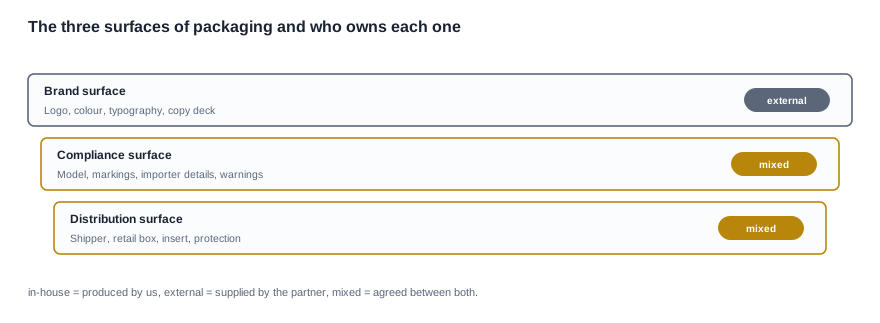
Smart glasses packaging and branding: three surfaces and three owners
The brand surface
The brand surface is the part a customer sees first: the logo, the colour, the typography, the layout, the imagery, and the product description on the back of the box. It is the surface a distributor controls most completely, because it is the one they bring. What they bring is an artwork file, a colour reference, a copy deck, and a set of approvals from people who rarely share a vocabulary with a factory.
The hard part of the brand surface is not the design. It is that a brand surface sits directly on top of a compliance surface, and a change to one frequently disturbs the other. A logo that grows a millimetre to sit correctly on a curved surface moves the product name; a product name that moves pushes the label; the label moves the barcode, and the barcode is not a design element — it is an inventory control.
The retail box is a product of its own
It is worth treating the retail box as a separate product with its own specification, its own artwork, its own approval and its own version. A box has a job on the shelf that the unit inside it does not: it has to identify the brand, the model and the range, it has to carry the compliance surface without competing with the brand surface for attention, and it has to survive being handled, opened and re-closed by somebody who is not thinking about it.
That job produces a set of questions that belongs to packaging rather than to product management. How much of the front surface is brand and how much is regulatory wording. Whether the model name is the thing a customer recognises or a code that only the channel uses. Whether the box opens without a tool and re-seals without damage, which decides whether a customer can return a unit without destroying the packaging. And whether the insert, the manual and the label are one item or three, because three items means three approvals and three opportunities to disagree.
A distributor who treats the box as a product discovers these questions while there is still time to change the design. A distributor who treats it as a container for the unit discovers them at the first packaging change, when the cost is a reprint rather than a redraw.
The compliance surface
The compliance surface carries the model number, the electrical and transport markings, the importer or responsible party details, the batch or lot reference, the safety and disposal statements, and whatever warning text the destination market requires. It is the least design-sensitive surface and the most consequential one, because it is the surface a regulator reads and a customs authority reads and a retailer's own compliance function reads.
Our own published position is worth stating precisely, because it determines what can go on the box. The catalogue contains no reference to CE, FCC or RoHS anywhere and carries no per-model certification row; the company-level export certification page is an image page showing ten patent certificates, of which eight are appearance design patents and two are utility models, which tells a reader nothing about a specific model's conformity. The internal working record adds the two category differences that matter for a box: it publishes no model list and no certificate number for the camera, audio and sport rows, records the IP54 marking as a catalogue annotation with no test report attached, and records the children's certification information as missing altogether.
What that means for a box is concrete: a marking may only appear if a document behind it names the model. The certification checklist is the right instrument for collecting those documents, and the market selection page is where the destination rules are set out.
The distribution surface
The distribution surface is the box as a logistics object: the shipper carton, the retail box, the insert, the foam or moulded protection, the labels a warehouse applies, and the way a unit is opened, checked and put on a shelf. It is where the published catalogue has the most to say and the least to offer, and the two facts that matter most are the case state and the weight.
A model that ships with a 1400 mAh case is a different box from a model whose catalogue page prints no charging-case row at all, and a model that ships with a foldable case is a different box again. Only one model in the catalogue publishes a weight — 158 g for the MT6 glasses, excluding its foldable case — so packing specification has to come from a document rather than from the catalogue. This is the part of the workstream where a distributor and a supplier argue about numbers that neither of them has, and the argument is avoidable by asking for the packing specification early.

Smart glasses packaging and branding: what the catalogue constrains
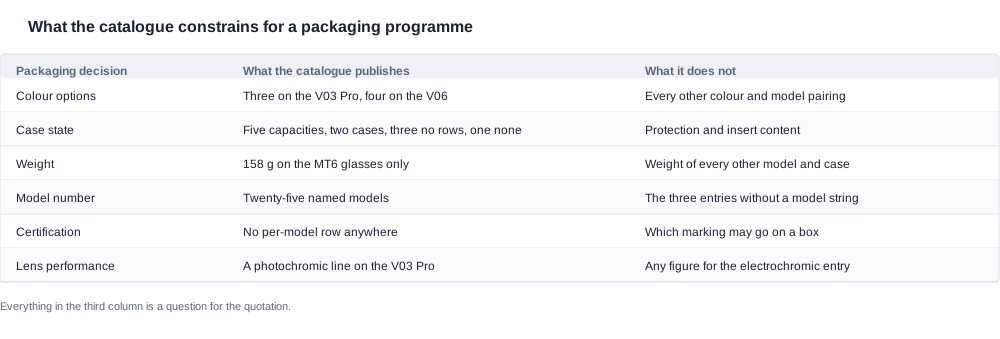
Colour is a published row on two models only
A branded packaging programme almost always needs a colour choice, and the catalogue publishes colour options for exactly two models: the V03 Pro with three — orange, beige-white and black — and the V06 with four — orange, ice blue, black and black ice blue. Every other model, and every colour outside those two sets, is a colour that has to be created, which means a new material or finish, a new proof, a new tolerance agreement and a new print run.
That has a consequence for the range plan that is easy to miss: a brand with a specific palette can run the published colours on two models and has to treat every other colour as a development item with a cost and a schedule. The question to ask a supplier is not "can you do our colour" but "which of our colours exist as published options on which models, and what does each remaining colour cost to create, in which process, against which tolerance".
The case states change the box, not just the contents
The three case states across the eleven camera models — capacity published on five, a case listed with no capacity on two, and no case row at all on four — decide what the retail box has to contain, and for the four with no row at all the box contents are a question the distributor has to put to the supplier and what it has to protect. They also decide the insert, because an insert that illustrates a case is wrong for a model that has none, and it decides the outer carton, because the volume and weight bands a carrier applies are a function of what is in the unit.
A distributor who builds one box design for a range spanning two case states will end up with two box designs. Building them as two from the start costs less and produces a catalogue that matches the shelf.
The three entries without a model string
The AR, electrochromic and bone conduction rows carry specifications but no model number, which means none of them can be quoted against a SKU and none of them belongs in a labelled retail programme yet. Our internal record notes that all three require a formal model number before they can be quoted individually, and it also notes that the AR entry's published specification matches a standard Bluetooth audio pair with no AR capability disclosed, and that our electrochromic row gives no figure for the lens performance at all.
Two rules follow for packaging. A box cannot carry a model number that does not exist, so these entries are excluded from a branded range until the numbering exists. And a lens claim cannot be printed for the electrochromic entry, because there is no published figure behind it — which is also true of the photochromic lenses the V03 Pro publishes as a feature line, where the claim can name the feature but not a performance.
A third rule comes from the bone conduction entry. Its published 35 dB amplification gain is the most aggressive figure in the catalogue and, on our own record, the highest compliance risk in it, because a hearing-assistance claim may bring the product within medical device regulation. No box, insert, listing or leaflet in a channel programme should carry that claim.

Smart glasses packaging and branding: the artwork freeze and what follows it
The freeze is a scheduling event rather than a design event, and treating it as anything else is the most common expensive mistake in a branded programme.

The freeze
The freeze is the moment after which the artwork file, the copy deck, the label content and the packaging specification stop being editable without a cost. Before it, a change is free. After it, a change is a reprint, a new label run, a new carton or a new set-up on the production line, and each of those has a lead time that the programme did not plan for.
The freeze has to sit at a specific point in the sequence, and that point is set by the slowest document, not by the fastest design. In this category the slowest document is usually the conformity set, because it has to name the model list, and the model list has to match the configuration that is actually produced. A freeze placed before that document exists is a freeze placed in the wrong place.
The documentation that has to travel with the artwork
A packaging programme produces a document set, and the set has to be reviewed against the artwork rather than against the product. Four documents normally travel with it.
The artwork proof is the version of the design that was approved, and its value depends entirely on version control: a proof without a version number cannot be compared with a box in a photograph, and a programme that has had two artwork revisions is usually carrying two proofs in the same email thread.
The packaging specification is the document that turns the design into a manufactured object: the material, the print process, the tolerance, the panel layout and what the carton contains. It is also the document that carries the packing data, and it is where the case state and the weight have to appear.
The label content sheet carries the compliance surface, and it is the one that changes most often, because it changes by market and by model. In a multi-market programme it is usually the same document at different lengths, and the same document at different lengths is how a market ends up with wording meant for another one.
The conformity set is the document that names the models the packaging may be used with. A box that carries a claim, a marking or an importer line is only correct for the models in that set, and a model added to the range later needs a new proof that the packaging applies to it.
The review of these four against each other is the packaging freeze. It is short, it is done once, and it is the only moment when the artwork, the label, the packing data and the model list are all on the same table.
What changes after the freeze
Four things change the artwork after a freeze, and each of them has a different commercial shape. A model that leaves the range retires the artwork and the print rather than reusing it, because print carrying a model that has left the range is stock that cannot be sold. A market that is added later needs its own label content, which is a label run rather than a carton run. A configuration change within a model — a different colour, a different packaging, a different insert — is a new configuration rather than a variant, and it inherits the whole artwork freeze for itself. And a specification change from the supplier is a diff against the previous version rather than a redesign, provided the change does not touch the printed surface.
The practical question to settle before the freeze is which of these four are acceptable after it, and which of them trigger a new configuration. A programme that answers that in advance has a predictable second year; a programme that answers it during the first reorder has an unpredictable one.

Smart glasses packaging and branding: the questions to ask
Packaging questions are cheap to ask and expensive to answer late. The list below is the one to put into the enquiry.
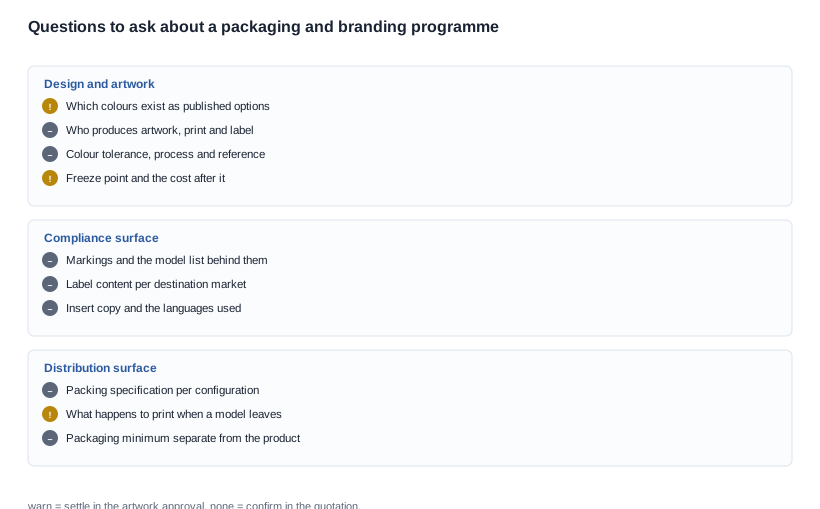
- Which of our colours exist as published options on which models, and which have to be created? The catalogue publishes colour options on two models only, and everything else is a development item with a cost and a schedule.
- Who produces the artwork, the print and the label, and who signs the proof? A buyer's file printed to the buyer's specification and a supplier's file printed to the supplier's own artwork are different documents with different risks.
- What tolerance applies to the colour, in what process, and against what reference? "Brand blue" is not a reference; a named standard reference against a named material is.
- What is the artwork freeze point, and what does a change after it cost? The cost matters less than the schedule, because the schedule is what a launch date is built on.
- Which markings appear on the box, and which document behind each one names the model? A marking without a model list behind it is a marking nobody can defend.
- What does the label carry per destination market, and who supplies the importer details? The label is the part of the box that changes most often and is reviewed least.
- What is in the insert, who writes it, and in which languages? Insert copy is the most frequently missed document in a channel programme, and it is the one a customer reads.
- What is the packing specification per configuration, including the case and the protection? The case state decides the box, and the published weight covers one model only.
- What happens to the artwork and the print when a model leaves the range? The answer determines whether the programme holds stock or loses it.
- What is the minimum for the packaging itself, separately from the product minimum? Packaging frequently carries its own minimum, and a print run bought in full is a cash exposure that does not appear on the product line.
Two of these deserve a note. The third is the one that saves the most rework, because a colour agreed on a screen and rejected on the part is a reprint. And the tenth is the one most often discovered after the budget is committed, because the packaging minimum frequently exceeds the product minimum in a first programme.
Smart glasses packaging and branding: our position and the next step
The commitment a packaging programme carries
Our internal product record carries a set of customisation axes per category, and the counts differ: the camera records show seven, the audio records five, the sport records five, the children's records two alongside one entry marked as awaiting verification, the electrochromic record three, the bone conduction record nothing disclosed, and the AR entry unknown. The axis names across the three named families cover different ground, and none of the three is contained in another — which tells a buyer that the customisation conversation for an audio product is not the camera conversation restated for audio.
We do not publish that as a capability list, and a buyer should not treat it as one. A recorded axis is one line in an internal record, and whether it can be carried out for a given article, at what depth, at what cost and on what schedule are matters for the quotation. That is how our own record frames it: a requirement that is new to us is a development item with a cost and a schedule, not a configuration switch. The standard OEM programme page sets out the commercial framework the questions sit inside.
What we will not do is print a claim that no document supports, state a certification on a box that no per-model document covers, or present a product photography programme as a supplier deliverable — our record shows that no real photographs, no video material and no test reports accompany any of the twenty-eight entries, and a generated picture describes a product that does not exist. We will not quote a packaging minimum, a print price or a lead time that has not been confirmed per enquiry.
Designing a packaging programme around five answers
Send the artwork or the artwork intent, the palette as named references, the destination markets, the models and the case states, and ask for: which of those colours exist as published options, the packing specification per configuration, the label content per market, the artwork freeze point, and the packaging minimum. Those five answers are the difference between a packaging programme that is designed and one that is discovered. The wholesale programme and the distributor programme set out the commercial framework around them.


