

An eyewear brand that buys connected products for the first time is not starting without quality discipline. It is starting with a discipline built for a different object. Frames get judged on optical centration, hinge behaviour, temple tension and surface finish, and the acceptance thresholds already exist somewhere in the buyer's own inspection system. What changes is that the incoming unit now also carries a cell, a charging interface, a radio, and on some lines an imaging module, and the old inspection sheet does not reach any of them.
That makes quality assurance for smart glasses an eyewear brand operation before it is an electronics operation. The rows we publish tell a buyer what a unit is. They do not tell a buyer how a batch of frames behaves after two thousand hinge cycles, nor what a supplier's own inspection actually covers, and a brand that treats the catalogue as a quality certificate will find the gap late, at the returns counter rather than at the goods-in bay.
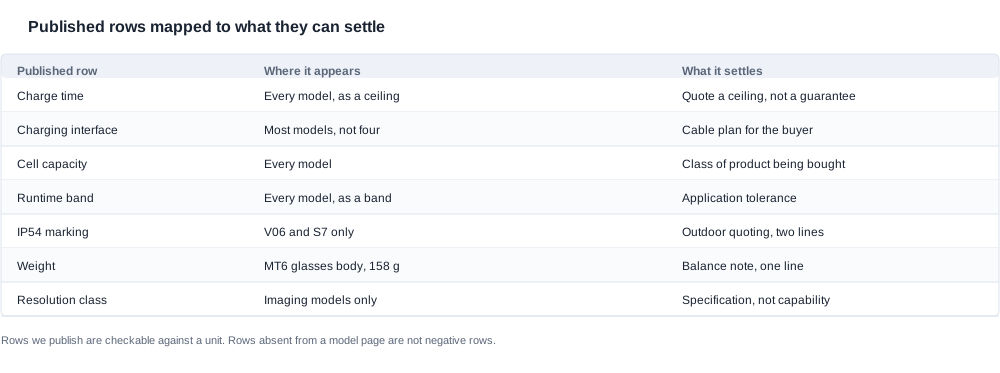
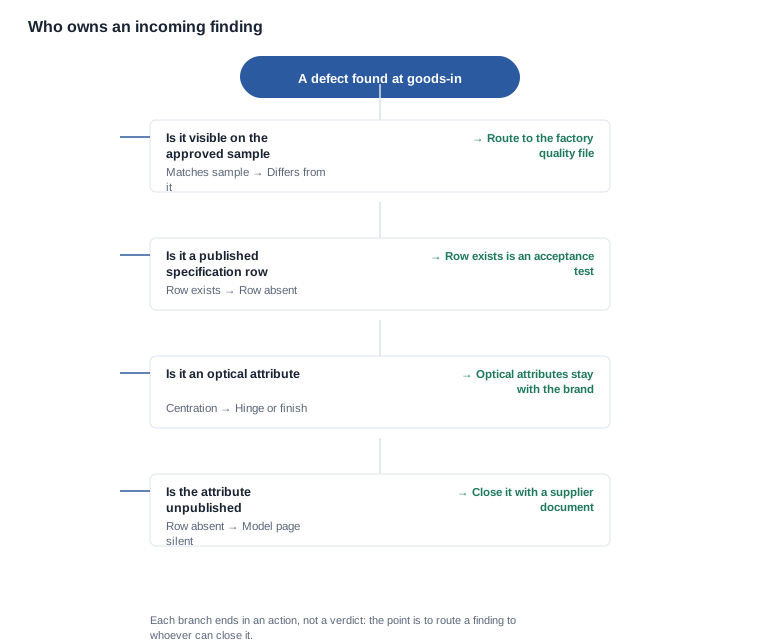
The working conclusion is this. Keep the optical discipline you already own and run it unchanged on the electronic product, because a unit that fails an existing frame check would have failed anyway and would have been caught in the field. Then convert every published catalogue row into a named line on the incoming inspection sheet, and close the attributes our catalogue does not publish with written supplier documentation before the first purchase order is released.
Smart glasses quality assurance starts with the checks an optical buyer already runs
The four attributes an optical inspector checks without instruction
Every eyewear brand that already sells frames has, whether it is written down or not, four standing checks. The first is centration: whether the lens sits where the fitting expects it relative to the pupil distance, because a frame that is optically off is not repairable by a customer and returns to the store as an invisible fault. The second is hinge and temple behaviour, including the tension that decides whether the frame holds its shape across a working day. The third is surface finish, where a cosmetic defect that a customer can see under retail lighting becomes a return in a way that an internal defect never does. The fourth is the completeness of the unit against the brand's own packing list.
Those four checks have something in common that matters for this decision: they are all observable at goods-in by a person with a checklist, without laboratory equipment and without a supplier's cooperation. A brand applying them to a smart glasses unit gets a real signal on the first delivery, and the signal is worth more than any document that arrives later.
Where a connected product breaks the inspection habit
The habit that breaks is subtler than "we do not know how to test electronics". It is the assumption that a frame is a passive object whose failure modes are known and enumerable. A smart glasses unit adds failure modes that are invisible, intermittent, or dependent on how the unit was charged the night before.
A battery that has been left flat can arrive looking perfect and behave poorly. A charging interface that is published for most models in the range is not published for four of them, so the buyer cannot assume the magnet or the Type-C port exists on every line. A unit whose runtime is published as a band rather than a point behaves differently depending on what the camera is doing. And an imaging module introduces an attribute that a frame inspector has no vocabulary for at all.
Our catalogue publishes the charge time for every model in the range, and publishes it as a ceiling: two hours or less for twenty-six of them, and about one hour for the D17 and the ZH12. That is a useful specification and it is not a warranty, because no start state and no termination criterion are published alongside it. An inspector who treats a ceiling as a measured value will sign a batch that later fails a customer expectation.
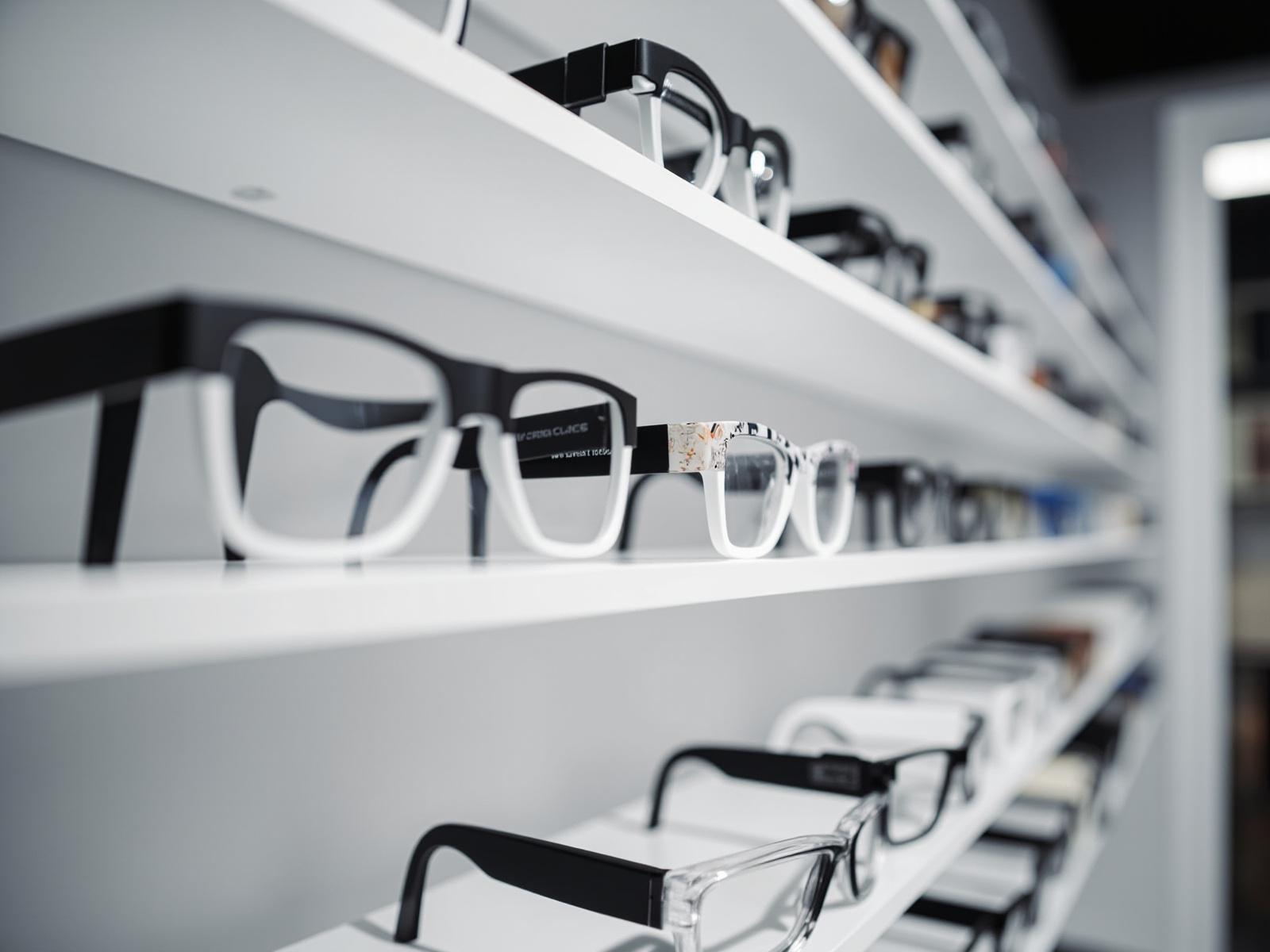
The four checks, restated as a buyer would write them on a sheet, look like this:
- Centration and lens alignment against the approved sample.
- Hinge and temple behaviour against the approved sample.
- Surface finish and colour against the signed unit.
- Carton contents against the brand's own packing list.
Everything else on the sheet is either a published row being checked, or a document being requested.
Turning published smart glasses rows into incoming inspection lines
Rows you can test on arrival
Some published rows convert into goods-in checks without any supplier input at all. The cell capacity printed on the model page can be checked against the label on the carton and against the value on the device. The charging interface can be identified by eye and by cable. The runtime band can be sanity-checked by observing whether a unit behaves as an audio product, an imaging product, or something else.
The IP rating is the clearest example of a published row that behaves differently across the range. IP54 appears against the V06 and the S7 only. An inspection sheet written for the range as a whole therefore cannot carry an IP line, because the line would be true for two models and unsupported for the rest. The sheet can carry a model-specific line, and it can carry a question for the supplier about the models that are meant to be used outdoors.
The same discipline applies to weight. The catalogue publishes one weight in the whole range, and it is the MT6 glasses body at 158 g, which excludes the folding charging case. A brand that wants a weight to quote in a product page for any other model cannot take it from us and must ask for it.
Rows you can only quote
Some rows are not inspection items at all. They are quoting items. The cell capacity and the runtime tell a buyer what class of product they are buying, and they belong in the specification sheet attached to the purchase order rather than on the inspection sheet. The charging interface sits between the two: it is an inspection item when the buyer owns the cables and a quoting item when the buyer is deciding on packaging, because a magnetic interface in a retail box obliges the brand to ship a cable or to explain the absence of one.
This distinction is worth making explicitly because it prevents a common category error. Buyers frequently ask for a specification sheet and then discover that the sheet they received is a marketing extract rather than a set of acceptance criteria. What an eyewear brand should be able to do with our published rows is derive acceptance criteria: for each model in the proposed order, the interface that must be present, the runtime band the application must tolerate, the IP line that may be quoted and the lines that may not.

The sequence that gets a brand from a catalogue to a signed sheet is short and has a fixed order:
- Pick the models the brand intends to carry and pull the published row set for each.
- Split every row into a quotation line and an incoming inspection line.
- Attach the brand's existing optical checks unchanged to the inspection sheet.
- Approve one physical sample per model and per published colour.
- Send the residual attribute list to the supplier for written answers.
- Write the answers and the tolerances into the purchase agreement.
The distinction between an absent row and a negative row
One trap deserves its own note, because it has caught buyers in adjacent categories. An absent row is not the same as a row that says no. In the camera models, the catalogue publishes a charging case row for some models with a capacity, publishes the existence of a case without a capacity for two others, does not publish a case row at all for four, and publishes no model as shipping without a case.
Those three states are different, and none of them can be settled from the catalogue alone. For the four models with no case row published, the correct buyer question is not "there is no case" but "does this model ship with a case, and what is its capacity". For the two models with a case but no published capacity, the question is the capacity. For the five with a published capacity, the specification is settled, and the question becomes what the customer receives instead.
A buyer who collapses these four states into a single assumption will build a packaging plan on the wrong basis, and the correction usually arrives after the first pallet is packed.
Optical checks that transfer unchanged onto a smart glasses unit
Hinge, temple and lens alignment
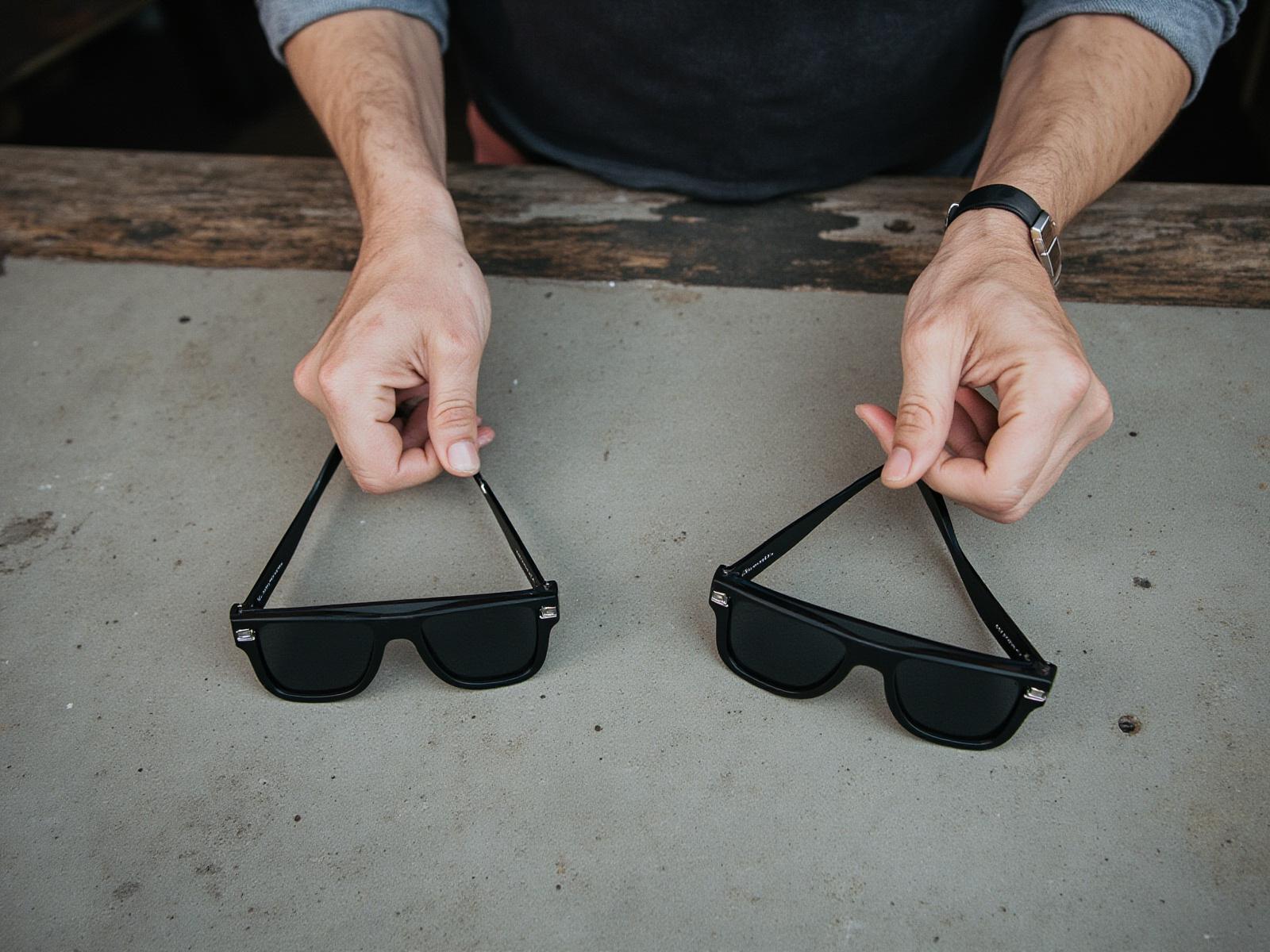
The optical inspection points are the ones an eyewear brand is best at, and there is no reason to weaken them. Temple tension and hinge behaviour determine whether the unit survives a year of daily handling, which is a commercial question as much as an engineering one: a hinge failure in the field is a return, and returns in an eyewear channel are expensive because the customer has already bought into the frame's optical credibility.
Run the brand's existing hinge cycle test unchanged. If the electronic product passes, the buyer has learned something real about the mechanical build. If it fails, the brand has found a defect that would have taken a season of customer complaints to surface otherwise. Either outcome is useful, and neither requires the supplier to send anything.
Lens alignment and centration matter more here than in a conventional frame, because the sensor and the camera module are positioned relative to the lenses rather than to the front of the frame. For the imaging models the catalogue publishes a resolution class and stops there: nothing on the sensor behind the lens, the width of the frame, the frame rate, the container the footage lands in, how much it holds, or how it behaves in poor light. A brand with an optical alignment rig can therefore check geometry. A brand that wants to know where the module points and what it captures has to ask.
What the supplier's own quality file has to contain
A buyer who stops at the catalogue has only described the product. To describe the supply, the buyer needs the supplier's inspection record, and it is worth being specific about which parts of that record are useful before the first order rather than after a dispute.
Four items carry most of the value. The first is a first-article approval record, meaning a report that names a specific serial unit, states the date it was measured, and was signed against the same specification the buyer will hold. A supplier file that contains photographs of a good unit and no serial number cannot be used to reject anything.
The second is the defect classification the supplier uses internally. Buyers rarely need the supplier's defect taxonomy itself, but they do need to know which categories the supplier counts as a defect and which are counted as cosmetic variance, because the returns threshold written into the agreement has to reference the same categories. A buyer that writes "no visible scratches" and a supplier that classifies light surface marks as non-defects will find that every scratch is a warranty claim.
The third is the incoming inspection the supplier performs on the buyer's behalf, if one exists. In this category that inspection is often narrower than the buyer assumes, because the optical attributes are outside the supplier's own frame expertise. The agreement should say which checks are performed at the factory and which are performed at the buyer's goods-in bay, so that no assumption is left about who catches a centration fault.
The fourth is the corrective action record from the previous order, if there is one. Its value is not the defect rate but the evidence of what happened after a defect was found: whether the cause was identified, whether the affected batch was contained, and whether the corrective measure reached the next production run.
A factory audit is the mechanism that produces these records, and it is more efficient to run one before the first order than to reconstruct the same information from a failure afterwards. The quality consistency page sets out what that mechanism is meant to establish.
Finish, colour and the sample you approve
Where the range publishes colours, it publishes them as finished options rather than as a colour palette. The V03 Pro is published with three colours, and the V06 with four. For an eyewear brand that already runs a colour approval process against physical samples, this is a familiar exercise with an unfamiliar subject: the approval unit is an electronic product, and the sample has to be signed as a unit rather than as a frame.
The practical approach is to approve one sample per colour, per model, and to keep the approved sample physically for the life of the agreement. When a production batch arrives, the comparison is against an object the brand already owns and has already judged. This is the cheapest quality control available to a buyer in this category, and it is entirely within the brand's control.

Documentation to request before the first smart glasses order
Certification scope and the per-model question
Certification is the area where buyers most often rely on an inference that the record does not support, so it deserves precision.
Our catalogue carries a company-level export certification page whose content is images rather than extractable text, and the catalogue text contains no reference to CE, FCC or RoHS. Nowhere in the range is there a per-model certification row. That is not a company-level claim and it is not a pending item either; it is an absence of a row.
Separately, our internal product record carries a certification axis for each product category. That record states that no CE, FCC or RoHS text and no per-model certification row is published anywhere, and that no certificate number exists for us to quote. For the sport category the same record adds that the IP54 marking is a catalogue marking with no third-party test report number behind it. For the children's category, the certification status is not provided at all.
Three states, and they are deliberately different. A buyer should therefore ask for certification scope in writing per model, with certificate numbers that can be verified with the issuing body, and should not treat a catalogue IP marking as a test report. This is the same rigour the certification checklist applies to other categories, and the same point that the export documentation for OEM-ready platforms makes at the platform level. The buyer's leverage here is straightforward and should be stated early in the negotiation: a certificate number is verifiable, and a claim is not.
The attributes our catalogue deliberately does not publish
Alongside certification, a set of attributes is not published for any model in the range. Frame weight is published only for the MT6 glasses body at 158 g, and no bare frame weight is published anywhere. The number of connected devices, the microphone specification, and whether a temple carries a touch surface are not published for any model. For the imaging models, the catalogue publishes the resolution class only: eight megapixel across eight of the eleven imaging models, and thirteen megapixel across the L2 Utral and the L1 Pro, and the S7.
For a brand, that list is the actual work plan. Each unpublished attribute becomes a question to the supplier, and the answers belong in the agreement rather than in a conversation. A brand that plans a launch around a weight figure, a runtime promise or a certification scope that it has not seen in writing is planning around an assumption.
The attributes a buyer must request rather than read are consistent enough to name as a standing list:
- Per-model certification scope, with certificate numbers that can be verified.
- A test report behind any IP rating the brand intends to advertise.
- Frame weight for every model except the one published figure.
- Sensor model, field of view, frame rate and storage format for imaging models.
- Whether a temple carries a touch surface, and how it is configured.
The materials and ergonomics note covers the frame-side attributes that are usually discussed for this category, and it is the right companion to this checklist when a brand is deciding which lines to carry at all.
Where the smart glasses catalogue stops and the supplier file begins
Our published position
We do not publish a certification claim that our catalogue does not carry, and we do not publish a weight, a runtime promise or a battery figure that is not in the model pages. What we publish is a set of specification rows per model, and the useful thing about a row is that it is checkable against a unit. Where a row is absent, we say so rather than letting a buyer infer.
On quality assurance for smart glasses in the eyewear channel, our position is that the buyer's own optical discipline is the strongest control available, that the published rows should be converted into named acceptance criteria before the order, and that the residual attributes are closed with supplier documentation in the agreement. We will supply the published rows as the specification baseline, and we will answer the residual questions in writing.
We will not convert a charge-time ceiling into a measured guarantee, because no start state and no termination criterion are published, and we will not present a catalogue IP marking as a laboratory test report, because that is what it is not.
Turning a model list into a draft acceptance sheet
Send us the model list you intend to carry, the channels you sell through, and the tolerances your own inspection system already enforces. We will return the published row set for those models, a draft acceptance-criteria sheet built from those rows, and a written list of the attributes that still require supplier documentation. That is the shortest path from a catalogue to an inspection sheet, and it does not require anyone to publish anything that is not already published.
For the wider category, the eyewear brands solution page sets out how this category is positioned against the rest of the range, and it is worth reading before a first technical conversation so that the discussion starts from the same baseline.
Send the model list, the channels and your existing tolerances, and we will return the published row set plus a draft acceptance-criteria sheet.


