

OEM ready platforms are sold as a starting point, and the export document set is where that promise is either kept or quietly broken. Every file that travels with an order has to name the model it covers, and a document that names a platform instead of a product is not a document that covers your product. That one rule decides most of what follows, and it is the rule that gets missed, because a platform genuinely does share a cell configuration, a radio version and a case family across several models. Sharing is real; shared paperwork is not implied by it.

The practical consequence for a procurement team is that the document set is not a bundle you request once at the end of a project. It is a set you assemble per configuration, check per model designation, and store per shipment. Most delays at a first consignment are caused by a document that existed but named something else.
OEM ready platforms and the document that has to name the model
Start from the identifier, because everything downstream keys off it. The model designation, the colourway and the configuration variant have to be confirmed in writing and then used identically on four surfaces: the retail carton, the listing, the certification application and the customs paperwork. When those four surfaces drift, the drift surfaces as a customs query, a marketplace takedown, or a claim you cannot answer because nobody wrote down what was actually shipped.
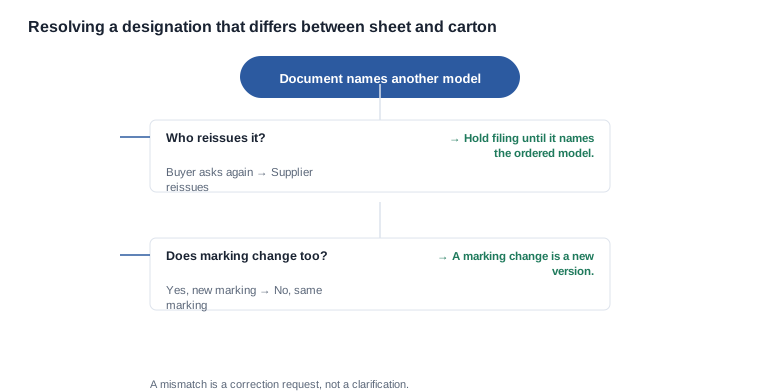
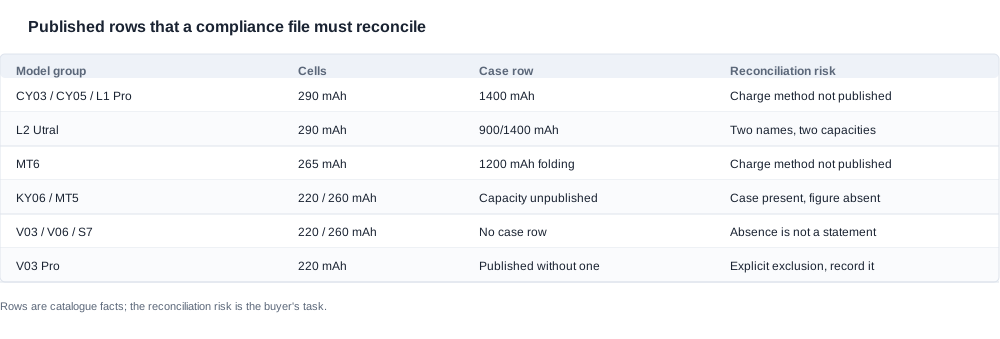
The catalogue makes the risk concrete without needing anyone to speculate. Take the L2 Utral. Its page carries two names printed side by side, Utral and Pro Max, and a charging-case row that reads 900/1400mAh — two values in one row — plus a feature row naming the Type-C charging interface. The catalogue does not state which case capacity belongs to which of the two names, and it does not designate either name as the base variant. So if your purchase order says L2 Utral and your carton says Pro Max, nobody at the supplier can resolve it from the published information, and the customs broker will not resolve it either.
That is a naming problem before it is a paperwork problem. The L2 Utral pre-order checklist places designation control first for the same reason.
Write the designation into the purchase order
A purchase order that carries the model designation, the colourway and the case configuration as separate line items is the cheapest compliance instrument available to you, because it fixes the reference every later document has to match. A purchase order that says only "one camera model, black, as per quotation" gives you nothing to check against when a test report arrives under a different name.
Two rules follow. First, quote the designation exactly as the catalogue prints it, including spacing and punctuation, because a transposition is a different identifier to a broker. Second, require the supplier to echo the same string on the documents they issue, and treat a mismatch as a correction request rather than a clarification. A supplier who changes the string between the quotation and the declaration of conformity has introduced a variable you will be tracking for the life of the programme.
Colourways are part of the identifier where the catalogue publishes them
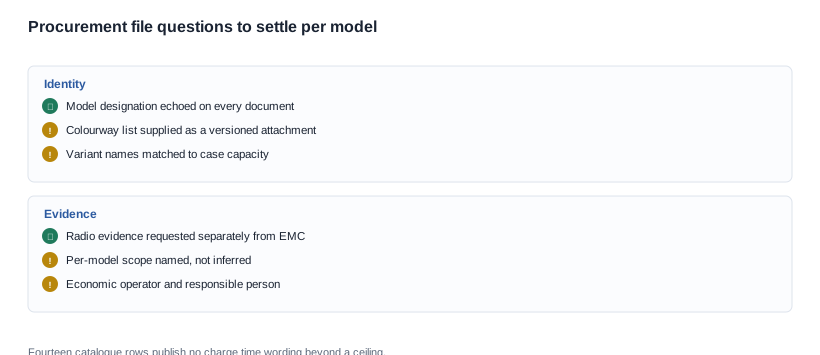
Only two camera models publish colour rows: the V03 Pro in orange, off-white and black, and the V06 in orange, ice-blue, black and black-blue. For those two models the colourway is a published, checkable variable, and a certification application or a market marking document that references one colourway should be read as covering that colourway unless the supplier states otherwise in writing.
For the other twenty-six models, no colour row is published. That does not mean the product is available in one colour; it means the number of colourways, and their names, are information you have to obtain from the supplier before you can put them on a carton or in a listing. Ask for the colour list as a versioned attachment, and ask what happens to an existing document if a colourway is added or withdrawn later.

A model designation is a controlled identifier, not a label
Treat the designation the way a document control system treats a part number. It has a format, an owner, a change history and a set of artefacts that reference it. Marketing wording is not the designation; a listing headline is not the designation; a colour name is not the designation.
This matters most in the camera tier, where eleven models publish a resolution class but not much else. Eight of them publish the eight-megapixel class — the KY06 and the MT6, the MT5 and the CY03, and the V03 Pro and the V06, and the CY05 and the V03 — and three publish the thirteen-megapixel class: the L1 Pro and the S7, and the L2 Utral. The camera tier publishes no Bluetooth version for any of the eleven, no sensor model, no field of view, no frame rate and no video format. A document set that quietly blends those models into "the camera platform" inherits every one of those gaps.
The rule that catches most supplier assumptions
If two models share a specification row, a supplier may reasonably believe one document covers both, and it may not. Test reports, declarations of conformity and market approvals are written against a specific product with a specific internal configuration. Where the catalogue shows shared rows — the K01 and the K02 publish identical standard specification rows, and the G07 and the YK12 publish identical five-row specifications — the sharing is real and visible, and it is still not a certification statement. The certification coverage notes set out why a certificate that does not name your model is close to worthless as evidence.
Write the test into your purchase agreement instead of leaving it to goodwill: each document is issued against the named model designation and colourway; a document that names a different identifier is reissued rather than accepted by reference; and the supplier confirms in writing which of its documents cover which of its models.
What the catalogue does and does not give you to start with
Be precise about this, because the distinction is the whole point of the exercise. The catalogue carries a company-level export certification page whose content is images rather than text — ten patent certificates, eight appearance-design patents and two utility-model patents. The catalogue text contains no reference to CE, FCC or RoHS, and there is no per-model certification row anywhere in it. That means a buyer cannot derive a per-model conformity claim from the catalogue, in either direction. It does not mean the products lack certification; it means the certification scope is material you must request in writing before you commit, and that material is a legitimate term of the agreement rather than an afterthought.
Conformity file contents worth specifying
Where a market regime requires a declaration of conformity, the file behind it should be enumerable and you should be able to ask for the index rather than the assembled PDF. In a European lane the relevant framework for a radio product is the Radio Equipment Directive (EU) 2014/53/EU, with the Electromagnetic Compatibility Directive (EU) 2014/32/EU and its harmonised standards applying to the EMC aspects; the two should not be conflated in a request, because a supplier who treats them as one document may send you the wrong one. Ask separately for the radio conformity evidence and the EMC evidence, each referencing the named model.
Alongside those, ask for the economic operator details, the responsible-person designation for the destination market, the technical documentation index and the traceability arrangements. The last group sits with whoever places the product on the market rather than with the factory, which is why it belongs in your file from the first shipment rather than from the first complaint.

Battery paperwork follows the configuration, not the category
Battery documentation is the item that most often delays a first consignment, and its length depends entirely on the configuration that ships. This is where the catalogue's structure pays off, because the number of cells travelling with a unit is a published or unpublished fact per model — and you can determine it before you ask anyone.
A camera model with a published case capacity ships two energy-containing components per unit: the cell in the glasses and the cell in the case. The L1 Pro, the CY03 and the CY05 each publish a 1400 mAh case. The MT6 publishes a 1200 mAh folding case alongside its 265 mAh cell. The L2 Utral publishes a 900/1400 mAh case row. Each of those units therefore carries a cell in the glasses plus a cell or cells in the case, and each fitted cell needs a test summary that covers the specific cell fitted, with packing instructions that follow from the declared watt-hour rating.
Some camera models have a case but no published capacity: the KY06 and the MT5 both show a case in their charging row, and neither publishes the capacity. Four models publish no charging-case row at all — the V03, the S7 and the V06, and the V03 Pro — which is an absence of information, not a published statement about what the box contains. Keeping that group apart from the two that publish a case without a capacity is a small discipline that prevents a very common error, in which the V06 and the S7, and the V03 Pro and the V03 get recorded as case-less because the catalogue was read too quickly.
One cell, or several
An audio model with a single cell and Type-C charging is a much shorter chain. The D11 and the D12 each publish a 100 mAh cell, Type-C charging and about seven hours; each is one cell, one summary, one packing instruction. The audio models that publish two cells — the K01 and the K02 at 90mAh*2, the LC-105 pair at 55mAh*2, the G07 and the YK12 at 55mAh*2, and the YKC02 at 70mAh*2 — are a longer chain again, with magnetic charging rather than Type-C.
Write the capacity as the catalogue publishes it rather than as a derived total. 55mAh*2 is what the catalogue says; 110 mAh is your arithmetic, and putting your arithmetic into a compliance file risks it being read as a published figure. If you need a total for freight or storage assessment, label it as a derived value in your own records.
The battery transport compliance buyer checklist sets out the document chain in full, and the certification status for a camera model shows a two-cell case worked through end to end.
Charge time is a ceiling and the paperwork does not make it precise
A caution that matters here because buyers copy figures into their own specification sheets: twenty-six of the twenty-eight catalogue entries publish a charge time of two hours or less, and only the D17 and the ZH12 publish roughly one hour. "Two hours or less" is a ceiling. It does not state a start state, it does not state a termination criterion, and it does not state the charger. So it cannot be used as a measured interruption window for a shift change, and it cannot be used as a case turnaround figure. Carry it into the document set as a ceiling, with the wording preserved.
Marking, warnings and the destination market
Language, warnings, economic operator details, responsible person and traceability are set per market, and the document set is therefore lane-specific rather than range-specific. The children's category adds layers that a buyer should treat as open items rather than assumptions: the age band and the small-parts assessment are not published, and the supplier has to state them in writing if the product is to be sold into that segment. The safety requirements piece covers what has to be established and what remains unstated.
For the children's models themselves, note that the A05 and the A06 publish a 40 mAh cell and about twenty hours, and the A07 publishes a 70 mAh cell with about twenty hours and a Bluetooth version — three different configurations, three different document sets. Any statement about those pages must stay a description of the rows the catalogue lists and must not become a claim about eyesight, posture correction or clinical effect.

Where platform sharing stops being an argument
There is a moment in every project where a supplier's engineer starts explaining that four models are built on the same board, so the paperwork can be shared. Sometimes that is true and useful. It is not, on its own, a basis for a document set.
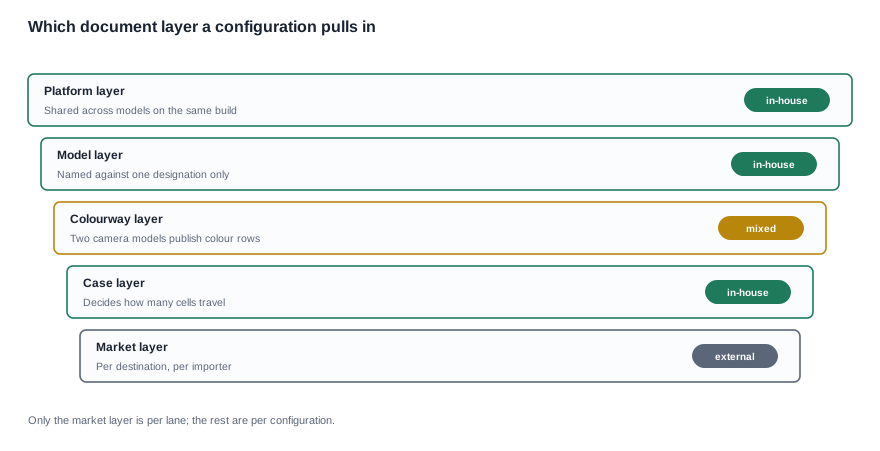
Ask for the boundary explicitly. Which documents are issued per platform, and which are issued per model. Which documents are issued per model but shared across colourways, and which are issued per configuration including the case. Which documents are the supplier's responsibility and which are the importer's. When those three questions are answered in writing, the argument ends and the file becomes buildable; when they are not, the file is rebuilt from scratch at each shipment, and the cost of that is paid by you.
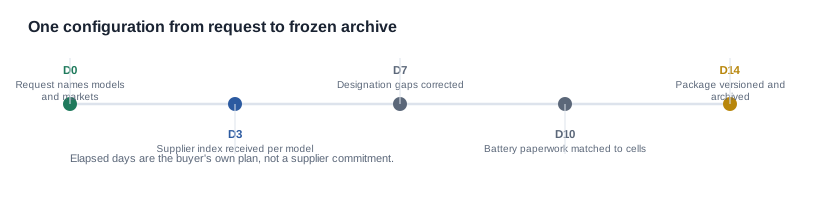
The archive is part of the deliverable
Store the document set, the locked artwork, the proofed sample and the production file together as one package, because they are only meaningful as a set. A certificate issued against artwork that has since changed is a weaker document than it was on the day it was issued, and the only way to demonstrate that is to keep the versioned artwork next to the dated document.
Version everything by configuration. When a colourway changes, the marking changes, and a change to the marking is a change to a compliance document. Keep a change log with an owner and a date, and require the supplier to notify you before implementing a change rather than after. This is an ordinary commercial term, it belongs in the agreement, and it costs nothing to write down.
The market layer sits on top of the platform layer
The export documentation discussion gets compressed into "which certificates do we have", and that compression is where buyers get trapped. The platform layer is shared. The market layer is not. A lane, a labelling requirement and a responsible-person obligation attach to the importer and change by destination, so a range that is compliant in one market may need a different marking file for the next.
The export considerations for the kids category covers the market-specific layer in detail, and the OEM ready logistics planning covers the route and the consolidation decisions that sit beside the paperwork.
A shortlist check before you accept a document set
A document set should be evaluated against three criteria before it is accepted, and against one warning sign before it is relied on.
The criteria: does every document name the model designation it covers; does every document that exists for one model also exist for the models the programme actually includes; and is there a stated process for what happens when a configuration changes. A set that meets the first but not the second leaves a programme with a documentation gap it did not know it had, and that gap appears at the border or in a listing claim rather than in a file review.
The warning sign is a set delivered as a bundle rather than as an index. A bundle tells you what the supplier chose to send; an index tells you what the supplier holds, including the gaps. For due diligence purposes the second is worth several times the first, because the whole purpose of the request is to find out what is missing.
The practical criteria to apply, then, before you commit: check the designation on each document, check the index against the models you plan to sell, and check that a change procedure exists. Where all three hold, the set is buildable. Where one does not, the gap is a question to ask rather than a risk to accept.
Building the set once and versioning it per configuration
The cheapest way to build a document set is to request it once per platform, naming every model the platform covers, and then to check each returned document for the model designation it actually names. That sequence sounds obvious and is rarely followed, because the request is usually written as a list of document types rather than a list of models.
A workable request names the models, the colourways and the destination markets, then asks for an index of what the supplier holds per model and per market. When the index comes back, the gaps become visible immediately: which models have no conformity evidence named against them, which colourways are not covered by an existing document, which markets have no marking artwork at all. An index is a much better negotiating object than a request for "the certificates", because it is short, it is comparable between suppliers, and it exposes the gaps without requiring either side to make an admission.
Six items to settle before the first shipment
- The model designation and colourway, confirmed in writing and used identically on the carton, the listing and the customs paperwork.
- The test reports and conformity evidence, each checked for the model designation it actually names.
- The conformity file index, with economic operator and responsible-person details for the destination market.
- The battery paperwork, covering every cell that travels with the unit, in every configuration you have ordered.
- The per-market marking, including warnings, and any age band or small-parts position the destination requires.
- The archive, versioned by configuration, stored beside the locked artwork and the production file.
What we will and will not say about this set
We treat the export document set as a deliverable rather than a formality, and we will not publish a certificate number we have not seen. We will not state a certification status for a model that our own documentation does not support, and where the documentation is incomplete — the per-model certification scope, the minimum order quantity, the lead time, the case capacities that are not published — we say it is incomplete rather than offer an estimate that later becomes a commitment. The absence of any CE, FCC or RoHS reference in the catalogue text, and the absence of a per-model certification row, is precisely why these belong in the written agreement: a buyer who needs them has to ask for them, and a supplier who holds them has to say so per model.
Send us the models, the destination markets and the shipping mode, and we will tell you which documents sit on the critical path for that lane and which can be built once for the whole platform.
Related reading
- Designation control before anything else — what to check before ordering L2 Utral smart glasses
- Why a shared certificate rarely covers your model — certification coverage notes
- The battery chain, cell by cell — battery transport compliance buyer checklist
- A two-cell case worked through — certification status for a camera model
- The market layer — export considerations for the kids category
- Route and consolidation — OEM ready logistics planning
- Compliance surface on the carton — logo and packaging in real detail


