

Battery and charging is where the retail and education channels separate most sharply, and the separation is not about the product. It is about who owns the charging routine, and about what happens to the programme when the routine fails.
In retail, the charging case is part of the product proposition. The customer bought a case, the case is a visible object in the box, and the case is why a runtime figure of roughly seven hours feels generous. In education, the charging case is infrastructure. The decision is how a room with twenty units gets charged overnight, who owns the cables, and what the school does when a dock fails at six in the morning.
That makes smart glasses for retail and education battery and charging a question about which of two quite different operations the charging has to serve, and the published rows answer only the hardware half of it. The rows are published, and they are useful, but they do not tell a buyer who carries the risk of a failed charge overnight.
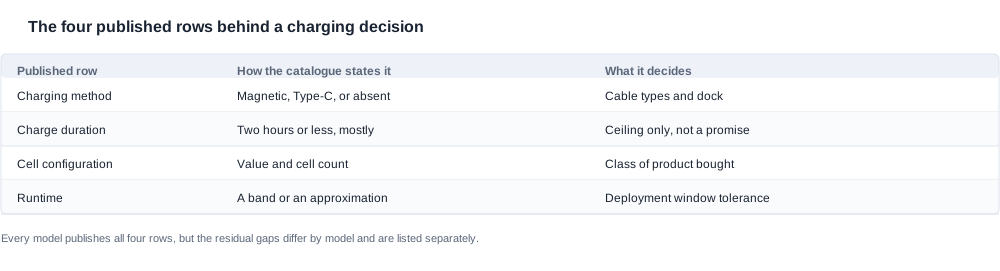
The conclusion to carry into a supplier conversation is narrow. Decide the owner of the charging routine before selecting a model, then read the interface row, the charge-time ceiling and the runtime band in that order, and treat every published row as a specification of the device rather than a guarantee of the deployment. The published data makes the hardware choice tractable. It cannot make the operational choice, because the operational choice belongs to the channel.
Smart glasses battery and charging: what the interface row decides
The charging interface is the row with the largest channel consequence
Across the range, the charging method divides into magnetic charging, Type-C charging, and a small group of models where the catalogue publishes no charging method row at all. The Type-C appears on seven entries, and they are the D11 and the L2 Utral, the D12 and the D17, and the V03 Pro and the ZH12, together with the bone-conduction model. Everything else in the audio, camera and sport lines charges magnetically, as do the AR and photochromic entries.
The CY05 and the CY03, and the MT6 and the L1 Pro publish nothing on the interface. That is an absent row rather than a published refusal, and the practical difference between the two is significant. A buyer planning a dock needs to know the interface before the dock is specified, and for those four models the answer has to be requested.
The reason this row matters more than the others is that it is the one row a buyer cannot design around later. Cell capacity can be argued about, a runtime band can be tolerated, and a charge time can be improved with better charging habits. A cable type cannot. Once a school has fitted a cabinet with twenty Type-C leads, choosing a magnetic model later means a second cabinet.
Interface uniformity is a procurement decision, not a product preference
A single interface across a deployment is worth more than any individual specification, and it is achievable within the published range because the interface groups are large enough to fill an order from one group.
Two practical rules follow. The first is to select models by interface group rather than by feature, because a mixed order multiplies the cable types the customer owns. The second is to treat any model with an unpublished charging method as an open question that must close before the order, not after.
The questions that close it are specific and short:
- Which charging method applies to each model in the proposed order?
- Is the charging cable supplied with the unit, and in which markets?
- What connector does the charging case use, where a case is published?
- What is the spare-parts position for the interface itself?
None of these are answered by the catalogue, and all of them affect the quotation.
Where the case sits in the charging decision
The charging case occupies an ambiguous position that buyers regularly misread, because in some models it is the only charging method and in others it is a second battery that sits in the box.
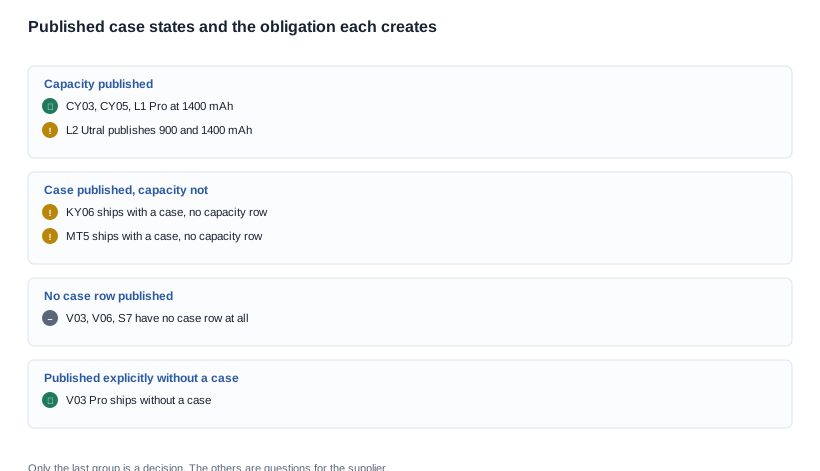
The published case states across the camera line take four distinct forms, and a buyer who treats them as one will mis-plan the packaging. Some camera models publish a case capacity of 1400 mAh, the L2 Utral publishes two capacities in one row as 900 and 1400 mAh, and the MT6 publishes a 1200 mAh folding case. The KY06 and the MT5 publish the existence of a case without a capacity. The V03, the V06 and the S7 publish no case row at all, and the V03 Pro has no charging-case row.
For a retail buyer, a published case is a feature to be communicated; for an education buyer it is a logistics decision, because twenty cases are twenty objects to store, twenty to charge and twenty to lose. The absence of a published capacity on the KY06 and the MT5 is the question to ask, and the absence of any case row on the V03, the V06 and the S7 is a different question again.

Charge time as a ceiling, not a measurement
What every published charge-time figure means
Every model in the range publishes a charging duration, and the way to read that figure is the single most useful piece of interpretation in this category.
Twenty-six of the models publish a duration of two hours or less. Two of them, the D17 and the ZH12, publish approximately one hour. The phrase "two hours or less" is a ceiling. It says the unit reaches a full charge in no more than that period, and it says nothing about how quickly it charges in the first ten minutes, how much of the charge time is bulk charging, or what state the cell was in when the clock started.
The practical consequence for a buyer is that the published figure cannot be used to compare two interrupted charging windows. If a customer's charging window is ninety minutes, the published ceiling for a two-hour model says nothing about whether that customer is full at the end of it: the catalogue names neither the state the cell starts from nor the point at which a charge is judged complete. A buyer who converts a ceiling into a promise is publishing a claim the catalogue does not make.
Why the catalogue's own labels make this easy to get wrong
There is a further trap in this category, and it is a labelling inconsistency rather than a technical one. On the camera model pages, the same word is used for runtime on some pages and for charge time on others, and the two appear on adjacent pages.
The three camera models whose runtime row is labelled as a charging duration are the V03 at five to eight hours, the KY06 at six to eight hours and the MT5 at six to eight hours, and each of those pages carries a separate charge-time row alongside it. Other camera pages label the runtime row as usage duration, and the rest label it as battery life. The audio and sport pages label the runtime row consistently.
This matters because it is the kind of inconsistency that gets copied between documents. A buyer who builds a comparison table by pulling the first number on a model page will, for three camera models, put a runtime figure into a charge-time column. The check that catches it is simple: every camera model in this range publishes both a charge time and a runtime, so a comparison table that has only one of the two for a given model has mislabelled one of them.
What to ask about charging conditions
The rows we publish do not state the conditions under which the charge-time figure was measured. These are the questions that close the gap, and they belong in the specification rather than in a sales conversation:
- What is the state of charge at the start of the published charge time?
- What cell temperature range applies to the published figure?
- Is the published figure measured with the unit idle, or with functions active?
- For models with a charging case, does the published figure refer to the unit or to the case?

Case capacity, case absence and the four camera states
The published cell configurations, as they are written
The catalogue publishes cell capacity as a cell value and a cell count rather than as a single total, and the distinction should be preserved when a buyer builds a specification.
In the audio and sport lines the published configurations run at 55 mAh with two cells, 70 mAh with two cells, 90 mAh with two cells, 100 mAh with one cell and 115 mAh with one cell. In the camera line they run from 220 mAh through 260 mAh, 265 mAh and 290 mAh. The children's models publish 40 mAh for the A05 and the A06, and 70 mAh for the A07.
Two pairs are easy to confuse and should be checked against the model page rather than remembered. The A07 publishes 70 mAh with a single cell while the YKC02 publishes 70 mAh with two cells, and those two figures are not interchangeable. The MT6 publishes 265 mAh while the L1 Pro and the CY05, and the CY03 and the L2 Utral publish 290 mAh, and the MT6 is also the only model in the range with a published weight.
A comparison table that writes the combined capacity into a column headed with the catalogue's own value will read as a published figure when it is a derived one. The two can be compared in analysis, provided the derivation is labelled as such.
Runtime bands and what a buyer can do with them
Runtime in this range is published as a band or as an approximation, and the values differ by line. The audio models publish roughly eight hours for the K01, the K02 and the LC-105 pair, and roughly six hours for the G07 and the YK12. The sport models publish roughly eight hours for the YKC02 and the ZH12, and roughly seven hours for the D17. The camera models publish five to eight hours for the V03 and the V06, and the S7 and the V03 Pro, six to eight hours for the KY06 and the MT5, and approximately seven hours for the CY03 and the CY05, the MT6 and the L2 Utral, and the L1 Pro.
The bands are wide, and the width is itself information. A band from five to eight hours is a statement about variable load rather than about tolerance, and a buyer who needs a guaranteed shift-length runtime has to ask for the test condition behind the lower end of the band.
For an education deployment this is the point where the specification and the timetable meet. A classroom block is usually shorter than a working shift, and the question is whether the units are recharged or whether the programme carries spare units. The published band informs the second question; it cannot answer the first.
The four case states and the obligation each creates
The four published case states across the camera line create four different obligations, and a specification should record which state applies to each model rather than assuming one rule for the range. The first state, a published capacity of 1400 mAh across the CY03, the CY05 and the L1 Pro, obliges the buyer to decide whether the case is retail furniture or institutional infrastructure, because a published capacity tells the buyer what the second object in the box weighs and costs to ship. The second state, the L2 Utral publishing 900 and 1400 mAh in one row, obliges the buyer to ask which capacity applies to which variant, because the catalogue publishes both values and does not publish the correspondence between them. The third state, the KY06 and the MT5 publishing a case without a capacity, obliges the buyer to request the capacity. The fourth state, the V03, the V06 and the S7 publishing no case row and the V03 Pro published explicitly without one, obliges the buyer to establish what the customer receives instead.
The distinction in the fourth state is the one buyers get wrong most often. Publishing that a model has no case row means the catalogue is silent, and silence is a question. Publishing that a model ships without a case is a decision the buyer can build a packaging plan around. Treating the two as equivalent is how a school ends up with a storage expectation that was never published and never agreed.

Asking the supplier what the catalogue does not publish
The residual list, kept in one place
Charging is a good example of a topic where the published record is strong and the residual list is short. The published record covers the charging method for all but four models, the charge duration for every model, the cell configuration for every model, the runtime for every model, and the case status for every camera model.
The residual list is what a buyer must request in writing:
- The charging method for the CY03 and the L1 Pro, and the MT6 and the CY05.
- The charging conditions behind each published charge-time figure.
- The case capacity for the KY06 and the MT5.
- The correspondence between the two published L2 Utral case capacities and the two published variant names.
- Whether a case is included in the packaging, and for which markets.
- The spare-parts and replacement position for cases, cables and docks.
Each of these is a line in the specification. None of them is a number we can supply from the catalogue, and inventing one would put a false figure into a procurement file.
Why the questions are commercial, not technical
Charging is the part of this category where a buyer's question list usually gets answered verbally and then lost, because the answers feel like details once a unit has been chosen. They are not details, and the reason is specific to the way this category is priced and shipped.
The charging interface determines how many cable types the channel carries, which determines the accessory order, which is a separate line on the same purchase order. Whether a case ships with the unit determines the packaging volume, which determines the freight and the carton count, and a packaging change after production is a charge to the buyer. The case capacity determines how many dock slots an institution needs, which determines how many units can be recharged per night, which determines the size of the spare pool. Minimum order quantity, unit price and production lead time are not published on this site and are confirmed per enquiry, because each of them turns on the configuration, the order quantity, the production mix and where the factory's schedule currently stands.
So the questions are not pedantic. They are the questions that determine the total cost of the deployment, and the ones worth settling before the order rather than after it.

The reading order for a charging decision
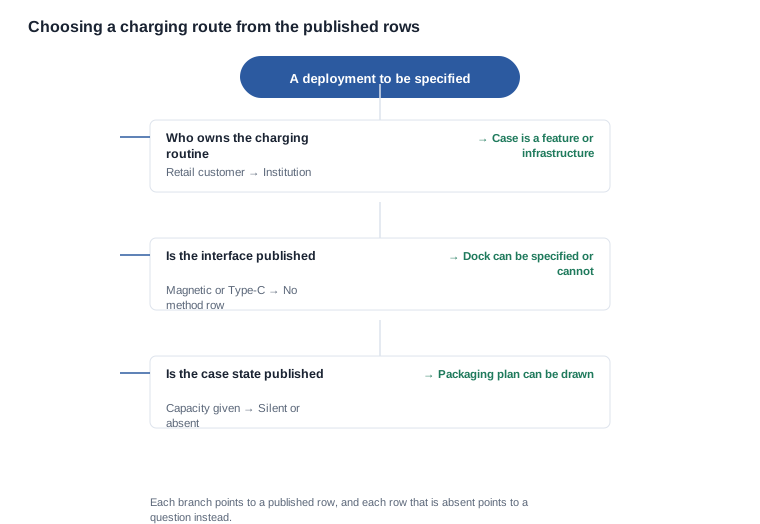
A buyer who reads the rows in the right order avoids most of the confusion in this topic. The order is short:
- Fix the charging routine owner, because it decides whether a case is furniture or infrastructure.
- Fix the interface group, because it decides the cable types and the dock.
- Read the charge-time ceiling for the models in that group, and keep it as a ceiling.
- Read the runtime band for the models in that group, and test it against the deployment window.
- Resolve the case state for each model, distinguishing an unpublished case from a published absence.
- Put the residual list into the specification, and price the accessories against it.
Where the charging record stops
What we publish and what we hold back
We publish the charging method, the charge duration, the cell configuration, the runtime and the case status per model, and we publish them in the form the model pages use, including the cell-and-count notation and the band notation for runtime. We do not publish a charge time as an exact figure when the catalogue states a ceiling, and we do not publish a case state where the catalogue is silent.
On smart glasses for retail and education battery and charging, our position is that the charging architecture is a channel decision before it is a hardware decision, that the interface row is where a buyer should start, and that the published runtime should be treated as a band under an unstated load rather than as a shift-length guarantee. The charging solutions page covers the interface and dock side of the same subject, and it is the natural companion to this one.
How to evaluate a charging specification before you commit
Once the four rows have been read, a buyer still has to judge whether the resulting specification is coherent, and that judgement has criteria rather than instincts. The first criterion is interface closure: can every model in the order be charged with the cable types the channel will carry, with no model left open because its charging method row is absent? The second is window adequacy: does the published runtime band sit inside the deployment window the channel actually has, given that the band describes variable load rather than a guaranteed duration? The third is case closure: for every model, is the case state known well enough to write the packaging line?
Those three criteria are also where the red flags appear. The clearest red flag is a specification in which the charge duration has been converted into a fixed expectation, because the ceiling has quietly become a promise and the buyer has taken on a risk the catalogue never carried. A second red flag is a model set spanning more than one interface group without a stated reason, which usually means the order was assembled by feature rather than by charging architecture. A third is a case plan built on the assumption that silence means absence.
The trade-offs are worth naming rather than avoiding. A shorter published charge time, which only the D17 and the ZH12 carry, is worth less than it appears if the model sits in the wrong interface group for the channel. A larger published case capacity is worth less than it appears if the case is an object the school has to store, charge and lose. And a runtime band with a high upper end is worth less than it appears if the lower end is what the shift actually depends on.
The practical method is to total the cost of the deployment rather than the unit: the units themselves, the interface accessories, the cases wherever they are published, the dock slots, the spare pool sized against the runtime band, and the replacement provision. Which model to carry is a shortlist question, and that shortlist should be built on the published rows before anyone discusses price.
Sending the channel, the unit count and the charging environment
Tell us the channel, the number of units and the charging environment, and we will return the published rows for the models that fit, the interface groups those models fall into, and the residual questions to put in your specification. We will also say which of those questions we can close from our own records and which have to be answered by the factory.
For the wider category, the retail and education solution page sets out how the two channels differ beyond charging, and the wholesale packaging options discussion covers how the case question turns into a packaging decision.
Tell us the channel, the unit count and the charging environment, and we will return the published rows plus the residual question list.


