

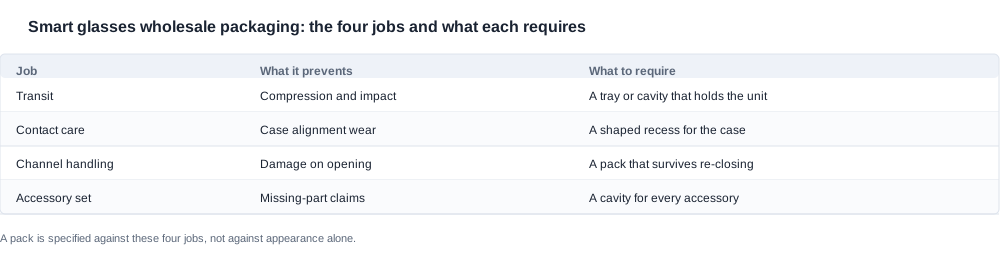
Packaging is the cheapest damage control in this category and the most frequently under-specified in a wholesale quotation. A pack has four separate jobs to do, and most quotations specify one of them and assume the other three: protecting the product in transit, protecting the charging case and its contacts, presenting a unit that a channel partner has to handle and resell, and keeping the accessory set together so that the box that reaches a shelf is complete. Comparing smart glasses wholesale packaging options properly means separating those four jobs, because two packs can do the same job badly in different ways, and the comparison only becomes useful once the jobs are separated. The criteria for choosing between them are therefore neither aesthetic nor a unit figure; they are the four physical jobs, and a buyer who cannot state which job a given option performs badly has no basis for a decision.
No unit rate, minimum order quantity, tooling charge or packaging fee is published for this catalogue, and none is quoted here. A packaging comparison built on unpublished costs is a marketing document rather than a procurement tool, so what follows is the structure of the choice: what each option physically prevents, what it requires from the buyer before artwork is approved, and what has to appear on the quotation so that two suppliers' answers can be read against each other.
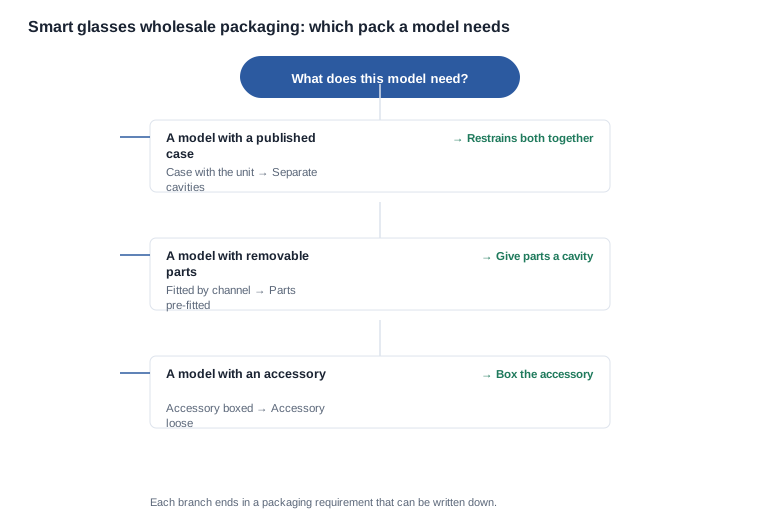
The catalogue's published detail is what makes this comparison concrete rather than generic. It carries 28 models, and the physical requirements differ sharply across them: seven camera models come with a charging case, with published capacities ranging from a foldable 1200 mAh case to a paired 900 and 1400 mAh case, and three camera models publish no case row at all. Two models publish a removable inner frame, one audio model publishes a detachable temple, and two sport models publish a remote shutter that has to arrive in the same pack as the unit.
Smart glasses wholesale packaging: the four jobs a pack has to do
The first job is transit protection, and it is the job everyone assumes a pack does. In practice the risk is not a drop but a compression event: a master carton stacked under heavier cartons in a warehouse, or a pallet that has shifted during handling. What prevents compression is not decoration but the geometry of the pack, specifically whether the unit is held in a rigid inner tray or allowed to move inside an over-sized carton.
The second job is contact protection for the charging case. A case with magnetic charging contacts has a specific failure mode: the contacts degrade, the alignment drifts, and the unit begins to fail on a charging fault that appears months after the sale. The pack does not prevent that degradation, but it does determine whether the case is stored in a position that accelerates it, whether the contacts are exposed to abrasion inside the carton, and whether a replacement case can be shipped separately in the same protective format. A pack that stores the unit and its case in separate cavities with no restraint at all is a pack that has not considered this job.
The third job is channel handling. The unit arrives at a warehouse, is counted, is opened, is checked, and is put away. Every one of those steps is an opportunity for damage, and the pack determines how many of them are needed. A pack that requires a knife, a separate inner bag and a foam insert will be opened destructively, which is acceptable in a retail channel and expensive in a wholesale channel where the box is opened, checked and re-closed before it goes to the end customer.
The fourth job is completeness of the accessory set. A remote shutter appears in the published rows of two sport models, and those models ship with a control accessory that is part of the product's value and separate from the unit itself. Two camera models publish a removable inner frame and one audio model publishes a detachable temple, which means components that are assembled and disassembled by the channel rather than by the customer. In each of those cases the pack has to hold the accessory set together and make the completeness of that set checkable in one glance, otherwise the completeness check becomes an inspection task rather than a visual one.
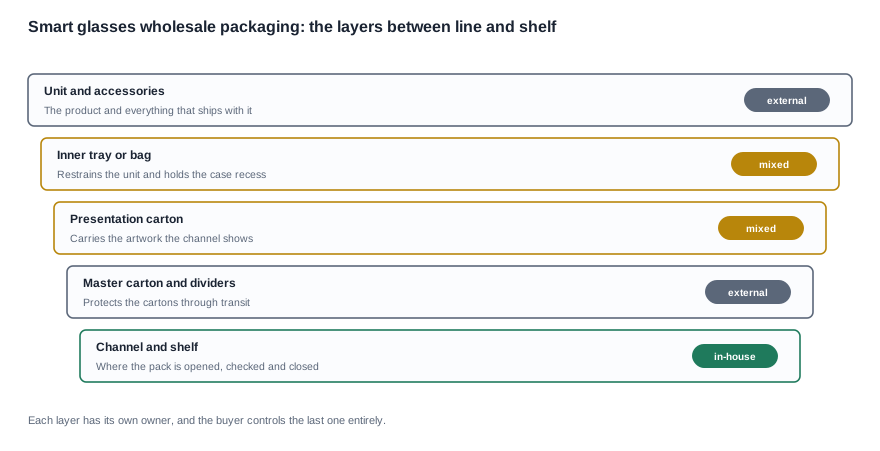
There is a distinction worth making at the start, because it is where most quotations go wrong. A pack can be a logistics artefact, a presentation artefact, or both, and the two are frequently specified by different people and costed separately even when the box looks like one object. The logistics artefact is the part that has to survive a pallet, a forklift and a warehouse. The presentation artefact is the part a customer sees. Where both exist, the buyer needs to know whether the presentation layer sits inside the logistics layer or replaces it, because that single fact decides whether a carton is opened destructively in a distribution centre or survives a second trip.
This distinction also decides where artwork sits. Artwork on the presentation layer is constrained by the marketing brief, and artwork on the logistics layer is constrained by the master carton and by what the channel prints on its own labels. A buyer who has not separated the two ends up with artwork on a box that gets covered by a shipping label, or with a presentation surface that gets damaged because nothing protected it.

Smart glasses wholesale packaging: what each option prevents and what it costs
Four options cover most of the volume in this category, and they differ in the jobs they perform rather than in how good they are.
The bagged option puts the unit in a sealed protective bag with minimal structure around it. It performs the transit job weakly and performs the other three jobs not at all. In a wholesale channel where the box is opened and re-closed it offers nothing, and in a channel where the unit is sold online it offers almost nothing against a return. What it does offer is the simplest possible handling path and the lowest material content, which is why it still appears in this category.
The tray-and-carton option holds the unit in a rigid inner tray inside a printed or plain carton. It performs the transit job properly because the tray resists compression, and it performs the channel-handling job well because the tray can be lifted out without destroying anything. It performs the accessory job well if the tray has dedicated cavities for every accessory. It performs the contact-protection job only as well as the cavity design allows, and that is the part to examine: whether the case sits in a shaped recess or loose against the unit.
The full presentation box adds a sleeve, an insert and often a window or a printed surface. It performs the presentation job that a retail channel needs and that a wholesale channel may not. Its risk is that presentation packaging is frequently a single-use artefact for the customer while the logistics packaging around it does the real work, and the two are sometimes confused with each other in a quotation. A buyer should be able to see which pack protects the unit in transit and which pack presents it to a shelf, and should check whether both exist or only one.
The rugged option, with foam or moulded inserts sized to the unit and its case, performs the transit and contact-protection jobs best and is normally specified where the channel is a logistics operation rather than a retail one. It carries the highest material content and the most dimensional weight, and dimensional weight is a cost driver rather than a detail, which is why it belongs in a landed-cost discussion and not only in a packaging discussion.
The pack also determines the freight arithmetic, which is why a packaging decision is a landed-cost decision. A rigid tray and a foam insert add material but they also fix the external dimensions of the carton, and it is those external dimensions rather than the weight of the goods that determine how much space a consignment occupies in a vehicle. Two packs for the same unit can differ by a meaningful fraction in the space they occupy per carton, and that fraction is multiplied by every carton in the order and by every shipment that follows it. The question to put to a supplier is the carton dimension and the units per master carton, and the question to put to a forwarder is what the resulting shipment volume does to the total cost of the shipment. Both are easier to ask before you commit to an artwork version.
A related point applies to the foldable case, which is the only case in the catalogue published as foldable. A foldable case and a rigid case do not occupy the same space in a carton, so a basket that mixes the two needs a carton that accommodates the larger of them, and the buyer should establish whether the supplier intends to pack them together or separately. Separately is more space-efficient; together is simpler to handle. Neither is wrong, and the difference belongs in the landed-cost comparison rather than in the packaging brief.
The comparison that matters is therefore job by job rather than option by option, and the criteria for a shortlist should be written before any option is proposed rather than after one has been chosen. Two options that appear equivalent on a quotation page can protect a case completely differently, and the buyer who has not separated the jobs cannot see it. The trade-offs between options only become visible once each job is assessed on its own.
Smart glasses wholesale packaging: the case geometry that drives the choice
Because the camera range carries cases and the audio and sport ranges generally do not, the model list decides the packaging difficulty more than any other variable, and the published case detail makes that unusually visible.
A model with a published 1400 mAh case, a model with a foldable 1200 mAh case, and a model published with two case capacities of 900 and 1400 mAh each present a different packaging problem. The foldable case is a different physical object from a rigid one and needs a different recess. A model published with two case capacities has two possible carton configurations, which doubles the packaging variants and doubles the artwork and stock-keeping work. A model with a case row but no published capacity is a packaging design that cannot be finalised until the capacity is confirmed, because the recess depends on a dimension nobody has published.
Three camera models publish no case row at all while another is published with no case either, and those four are the easiest in the range to pack correctly because there is one less assembly to restrain. That is worth noticing for a first order: the packaging programme is usually hardest on the models with the most published detail, not the least.
The removable components create a second geometry. Two camera models publish a removable inner frame and one audio model publishes a detachable temple. Any pack that permits assembly in the channel has to leave the component accessible and has to restrain it during transit, because a loose component in a carton is the most common source of a missing-part claim. The accessory cavity has to exist in the tray, not in the printed insert, because an insert is discarded on opening and a tray is not.

Smart glasses wholesale packaging: what belongs on the quotation
A packaging quotation that a procurement team can compare against another one states six things, and the checklist below is built so that every one of them is a question rather than an assumption.
Three red flags in a packaging quotation deserve attention before the line-by-line detail: artwork carrying a claim the compliance file cannot support, a carton dimension quoted without the units per master carton, and a pack specified in words rather than in a drawing.
- Which pack protects the unit in transit, and which presents it to the channel, with both named separately if both exist.
- The carton dimensions and the material content, since these drive both the outer carton and the freight.
- How the unit is restrained: tray, cavity, foam, or a bag inside a carton.
- How the charging case is held, if the model has one, and whether the contacts are covered or exposed.
- Where each accessory is held and how completeness is checked on opening.
- Whether the packaging is reusable for returns, which determines the cost of a channel-side swap.
Two commercial behaviours belong on that quotation as well, because both are recurring rather than one-off and both are invisible in a unit figure. The first is whether artwork changes are handled as new versions with their own setup, and how many of them are expected in a year, because a buyer who expects two artwork revisions a year is buying into a per-version cost without knowing it. The second is whether packaging is specified by the buyer or by the supplier, because a pack specified by the buyer carries a risk that the supplier cannot assemble it efficiently, and that risk returns as a schedule rather than as a cost.
There is a third item that most buyers request and few suppliers volunteer: the packaging specification itself, as a drawing or a written construction note. A buyer who receives only a photograph of the finished pack has no way to check that the cavity geometry, the accessory positions and the master carton are the same in the next production run.
The last item is frequently skipped and it is often the most expensive omission. A channel that opens and re-closes boxes for inspection needs a pack that survives that, and a pack chosen purely for the customer-facing experience may not. The buyer should ask what the channel actually does with the box, because the channel's answer determines whether the box needs to survive a second trip.
Two more points belong on the quotation rather than in the negotiation. The first is whether the packaging is a one-off per order or a per-version item that recurs with each artwork change, because those are different cost behaviours and the difference appears on the second order. The second is what happens to packaging when a model is withdrawn, which matters for a channel holding stock of that model, for the spare-parts position discussed in the service commitments material, and for how the next order is negotiated.

Smart glasses wholesale packaging: the questions to ask before artwork is approved
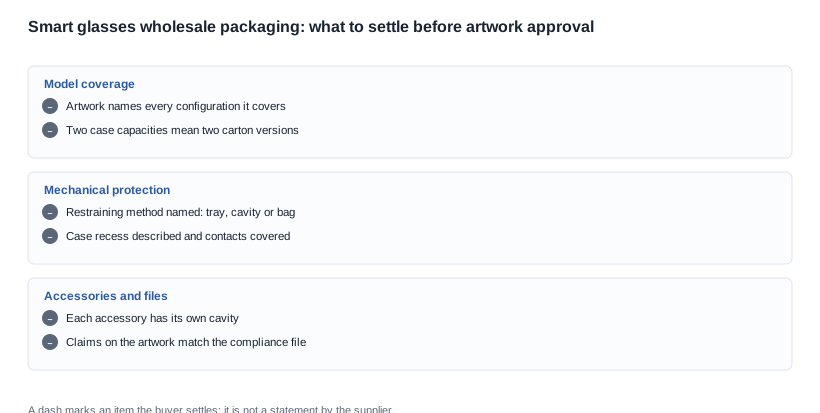
Artwork approval is the point at which a packaging programme becomes expensive to change, so it is the point at which the questions have to be answered. The list below is the one a buyer sends with the artwork request.
- Which model does this artwork cover, and does it cover every configuration of that model?
- If a model has two published case capacities, is this artwork for both or for one?
- Where is each accessory held, and can the completeness of the set be checked without opening the pack?
- What is the transit protection method, and has it been described as a tray, a cavity or a bag?
- Does the pack survive being opened and re-closed by the channel?
- What is the carton dimension and the material content?
- Does the artwork carry anything that has to be consistent with the compliance file, and is that file available yet?
The seventh question is the one that catches people. Artwork frequently carries a claim, a marking or a market identifier, and the compliance file for a specific model may not exist yet. Approving artwork that asserts something the model cannot support creates a document that has to be withdrawn.
The order of these questions matters as well. The mechanical questions should be answered before the artwork is drawn, because a change in cavity geometry after artwork approval changes the artwork too. The compliance question should be answered before the artwork is approved for the same reason, since a marking that cannot be supported has to be removed rather than re-drafted. And the accessory question should be answered first of all, because an accessory that was not counted when the tray was designed cannot be added to it without re-cutting the tray.
A first programme should also expect to run one small approval cycle before the main order. The purpose of that cycle is not to approve artwork but to establish how to verify the physical pack against the actual unit, which is the only way to find out whether the case recess and the accessory cavities are right. It is a small cost set against the cost of discovering the same problem in a full consignment, and the packaging pitfalls it is meant to catch are the ones no drawing will reveal.
Smart glasses wholesale packaging: where the catalogue stops and the supplier starts
The catalogue's contribution to any packaging conversation is the physical fact set: which models carry a case, what capacity that case publishes, which models publish a removable component, which models ship a remote accessory, and which two models publish a colour split that has to be reflected in the artwork. Everything else about the pack — the carton dimensions, the material, the artwork treatment, the tooling situation, the recurrence of the packaging cost — is not published and has to be quoted.
On this, our position is that we will map the packaging requirement against the published rows and state which parts of it are settled by those rows and which parts require the supplier's own answer, and we will not publish a packaging fee, a tooling charge or a minimum order quantity for any of it, because those are not published values. Send the model list, the colour split where it is published, the channel type and the markets, and the packaging requirement will come back as a specification rather than as a range of possibilities.
Two supporting readings sit on either side of this one: the after-sales support commitments page covers the service and spare-parts position that depends on the pack, and the wholesale programme entry point is where a packaging question is raised together with the model list it depends on.
The practical sequence for a buyer is therefore short: settle the model list, read the case and accessory rows, decide which pack performs which job, and only then ask for artwork. Every one of those steps costs less than the step after it, and the step that is most often skipped is the second, which is the one the catalogue can answer for free.
Smart glasses wholesale packaging is decided by four jobs, not by one. Separate the transit job from the presentation job, the contact-protection job from the accessory job, and the choice stops being a preference between appearance and becomes a set of testable requirements.


