

Equipment management in this category is usually discussed as a software problem, which is how the category ends up with buyers who have a device management platform and still cannot answer the question that matters: which unit is where, and what state is it in. That question is answered by a register, and the register is determined by what the catalogue publishes.
The published rows in our range are unusually well suited to building a register, because they cover the fields a register needs for every model: cell configuration, charge duration, runtime, charging interface, plus the case state for the camera models. What they do not cover is the identification of an individual unit, the software it runs, and whether it has been updated. Those three gaps decide how much of the management burden lands on the buyer's own systems.
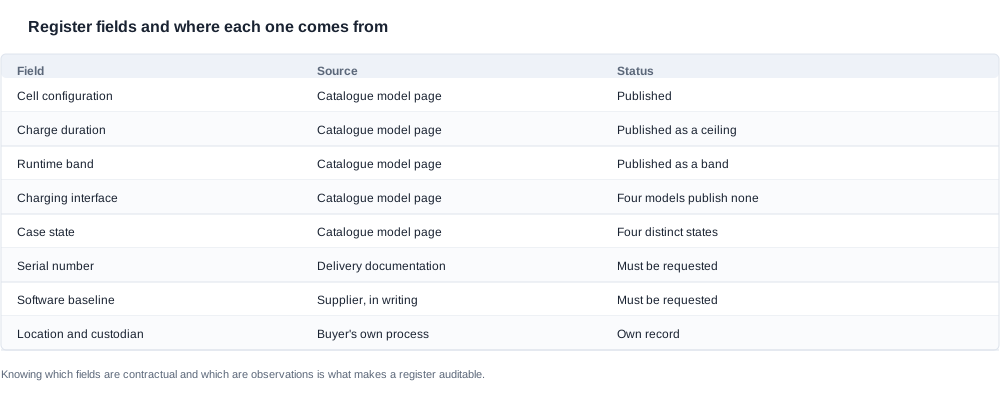
The conclusion is that an equipment management programme for this category should be built as a register-first operation, in which the published specification fields are captured at delivery and the operational fields are added by the buyer's own process. Trying to manage the fleet from the supplier's catalogue alone fails, because the catalogue describes models rather than units.
Smart glasses equipment management starts with the register
What a register is for in this category
A register in this category earns its keep in three specific places, and nowhere else. It answers who has which unit, it answers what the unit should be doing, and it answers what happens when it stops. Everything else a management system might offer is optional.
The first job is custody. An institution that issues twenty units across three rooms needs to know which serial number is in which room, which is a bookkeeping task with a physical audit attached to it. The second job is interpretation, which means the register should carry the published specification fields so that a fault can be diagnosed from the record rather than from a re-inspection. The third job is evidence, meaning the register is what allows a warranty claim to be raised, what allows a replacement to be justified, and what allows an auditor to show the chain of custody.
A register that carries only serial numbers and room locations does the first job and fails the other two, which is why the specification fields belong in it from the first delivery.
The fields the published rows give you immediately
The rows we publish populate a surprising amount of the register without any help from the supplier, and this is worth spelling out because it is unusual in a category where most published data stops at the marketing summary.
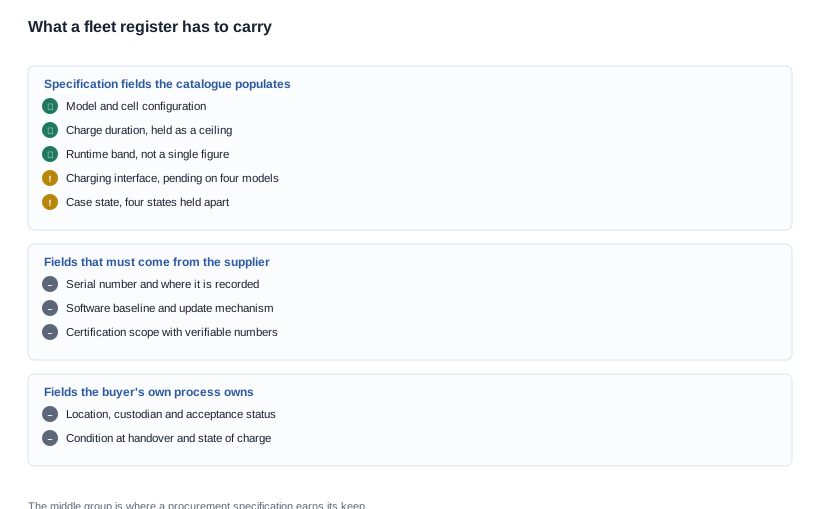
Every model in the range publishes a cell configuration, so the register can carry the energy specification of the unit in the buyer's own vocabulary. Every model publishes a charge duration, and because that figure is a ceiling rather than an exact measurement, the register should record it as a ceiling. Every model publishes a runtime, published as a band or an approximation, and the register should hold the band rather than a single figure that implies a precision the catalogue does not claim. Every model publishes a charging interface, with the exception of the four camera models that publish no charging method at all, and the register should mark those as pending rather than leaving the field blank.
For the camera models the register can also carry the case state, and it needs the four states kept apart: a published capacity, a case with no published capacity, no case row at all, and a published absence of a case. The MT6 is the one model with a published weight for the glasses body, and the register can carry that figure as a unit attribute rather than as a fleet attribute.
The three fields the catalogue cannot populate
Three fields have to come from the buyer's own delivery and asset process, and it is worth naming them so that a procurement specification can ask for them directly.
The first is unit identity. The catalogue describes models, and the specification pages carry no serial numbers. Whether a serial number appears on the carton, on the device, in the packaging paperwork or nowhere at all is a delivery question, and it is the question that determines whether the register can identify a unit at all.
The second is the software baseline. For no model in the range does the catalogue publish a firmware version, an operating system, an application or an update mechanism, and no platform description of ours would imply one. A buyer with a fleet therefore has to decide whether to run unmanaged devices and accept the consequence, or to require the baseline to be stated in writing per model as a delivery condition.
The third is state of charge at handover. It is not published because it depends on how the unit was stored, and it is the field that determines whether a returned unit goes straight back into service or onto a charge first.
A register earns its cost at the moment something goes wrong. To raise a warranty claim a buyer needs the unit's serial number, the date it was taken into service and a description of the fault, and if the purchase order never specified what would appear on the carton then the serial number is missing and no claim can be filed. The same applies to a damage claim inside an institution, where the custodian record establishes who held the unit when the damage occurred.
The interface group as a management boundary
One practical consequence of grouping the range by published charging interface is that a fleet can be managed group by group. A single interface group means a single set of cables, a single set of docks, a single training instruction and a single spare-parts line, and it means the register's interface field takes one value rather than several.
That has a cost when the fleet genuinely spans groups, which happens when a buyer wants a camera line and an audio line together. The management cost of a mixed fleet is not the cables alone; it is the training, the signage, the dock spares and the fault diagnosis, all of which double. The published rows make the mixed case possible, and they also make its cost visible, which is the point a buyer needs in order to decide whether the mix is worth it.
What the register cannot carry yet
Two further items sit outside the register and are worth keeping separate from it, because they are often filed against it by mistake.
The first is the software baseline. Nothing in the catalogue describes the software a unit runs: there is no firmware version, no operating system, no application and no update mechanism for any model in the range, and no platform description of ours that would imply a shared one. That means the register cannot carry a baseline field populated from published material. It can carry a baseline field populated from the supplier's written confirmation, once that confirmation exists, and until then the field is a question rather than a value.
The second is the capture indicator behaviour on the camera models. Our catalogue lists an indicator light and button control as feature rows against the AR entry, and it lists no indicator row for the camera models. Where an institution issues camera models, the presence and behaviour of an indicator is a governance question rather than a product feature, and it belongs in the delivery specification rather than in the register, because the register records what a unit is and the specification records what the supplier promised.
The register schema that works
A workable register for a fleet of this kind carries the following fields, and the source of each is worth recording because it tells the buyer which fields are contractual and which are observations.
- Serial number, from the delivery documentation or the device.
- Model, from the published catalogue.
- Cell configuration, from the published catalogue.
- Charge duration, from the published catalogue, recorded as a ceiling.
- Runtime band, from the published catalogue.
- Charging interface, from the published catalogue, marked pending for the four models that publish none.
- Case state, from the published catalogue, holding the four states apart.
- Location and custodian, from the buyer's own process.
- Acceptance status, from the buyer's own inspection.
- Baseline and update policy, to be agreed in writing before delivery.
Charging rotation decides the working ratio
Reading the runtime band as an operational constraint
The runtime published for a model is a band, and the width of the band is the operational fact. It describes what happens under variable load rather than a guaranteed duration under one condition, and a fleet plan built on the upper end of the band will be wrong.
For an education deployment the arithmetic is straightforward and it is where the category's real constraints appear. A shared pool of units, a lesson block of a known length, and a published runtime band give the ratio of units to slots that has to be available, and that ratio determines the size of the purchase and the size of the spare pool. The published durations settle whether a pool can turn around: two hours or less on twenty-six of the models, and roughly one hour on the D17 and the ZH12, which is ample for the overnight window most classroom timetables allow.
For a retail deployment the arithmetic is different and simpler, because the customer owns the device and the rotation happens at home. The published runtime matters to the customer as a satisfaction matter rather than a fleet matter, which is why it belongs on the product page rather than in the management plan.
Why interface count and rotation are the same decision
The two decisions that look separate are actually one decision, and this is the point most often missed in equipment management for this category.
The interface determines the cables and the docks. The runtime band determines how many units are in rotation. The charging window determines how long the pool has to recover. Those three together determine the size of the accessory order, and the accessory order is a separate line on the same purchase order as the units.
A buyer who fixes the rotation first and the interface second ends up with a dock count that does not match the cable count. A buyer who fixes the interface first and the rotation second ends up with a pool that cannot be recovered in the window available. The order that works is interface, then rotation, then window, then accessories.

Spares are a consequence of the published runtime, not a preference
The spare pool is usually discussed as a risk appetite decision, and it is one, but the published rows set the floor.
If the published runtime band runs from five to eight hours and the deployment needs a full block, then the unit has to be recharged at least once per block, and the number of units in circulation has to exceed the number of slots in use at any moment by a margin that absorbs a unit that is not charged. If the band runs at approximately seven hours, the same arithmetic applies with a narrower band. If the band is roughly eight hours and the block is shorter, the margin shrinks.
The failure mode is to size the spare pool at zero because the published runtime looks adequate, and to discover that the shortfall appears on the same day every week, because that is when the units were used longest. The register is what makes this visible, since a fault that repeats on a particular day is a pattern the register can show and a spreadsheet of monthly totals cannot.

Firmware baseline: pick one and refuse drift
Why the baseline question has to be asked in writing
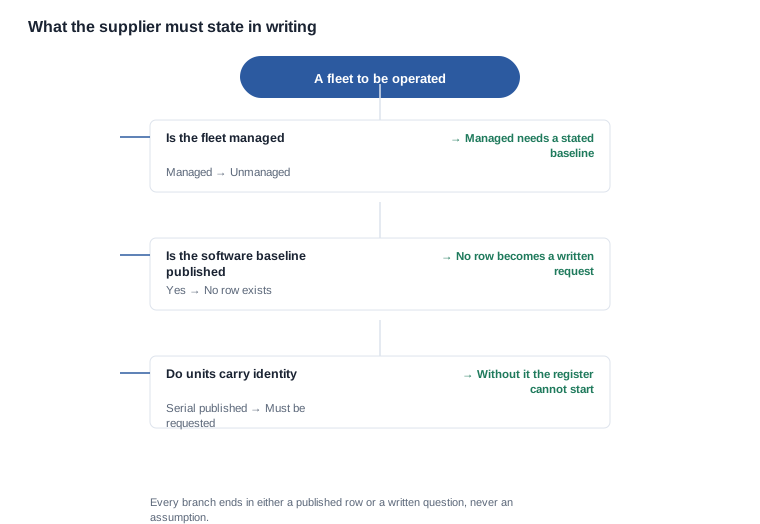
There is a specific gap here, and it is the gap that turns equipment management into a service problem. Our catalogue publishes no firmware version, no operating system, no application and no update mechanism for any model, and nothing we publish implies a shared platform.
That is a real constraint on the buyer's side of the equation, and it has to be handled as a procurement question rather than as an inconvenience. If a fleet will run unmanaged, the buyer has to accept that no unit can be assumed to behave identically to another, that fault diagnosis cannot rely on a known state, and that a security or update policy cannot be enforced at the device level. If a fleet will be managed, the baseline has to be stated per model in writing, together with the update mechanism, and the buyer's acceptance criteria have to be written against that baseline.
Either way, the decision is the buyer's, and it has to be recorded rather than assumed. A fleet that has drifted across three baselines is more expensive to manage than a fleet that was specified against one from the start.
How to evaluate the management case before you commit
An equipment management programme is easy to under-specify and hard to retrofit, so the criteria for judging it are worth settling before the order rather than after the first fault.
The first criterion is register completeness: can every unit in the fleet be identified, located and characterised from the record alone, without opening the unit or re-inspecting it? If the answer is no for any model in the proposed order, that model needs an identity question answered in writing before it is bought.
The second criterion is rotation viability: does the published runtime band, combined with the charging window the site actually has, support the usage pattern without relying on an assumption that every unit is charged? This is the criterion that separates a workable deployment from one that discovers its shortfall in week three.
The third criterion is fault diagnosability: when a fault occurs, can the owner establish the unit's specification and its baseline from the register, or does the diagnosis require a call to the supplier? Where the catalogue publishes the specification rows, the answer is largely yes. Where it does not, the supplier has to supply the missing fields as delivery conditions.
These three criteria are what a buyer should use to compare two supplier quotations, and they are worth applying because they are answerable before any commercial term is agreed. The quality consistency route covers the acceptance side of the same question, and the factory audit is the mechanism that establishes what a supplier's own quality process covers.
The trade-offs are also worth naming. A fleet that runs unmanaged devices is cheaper to specify and more expensive to operate, because no unit can be assumed to behave like another. A fleet with a single stated baseline is more expensive to specify and cheaper to diagnose. A large spare pool absorbs failures but ties up capital and needs the same charging window as the units it replaces. A tight pool maximises utilisation and makes the charging routine the single point of failure for the whole deployment.
The practical method is to cost a deployment as a whole rather than one unit: the units, the interface accessories, the dock slots implied by the rotation ratio, the spare pool, and the replacement provision sized against the acceptance criteria. Selecting the model is a shortlist question, and the shortlist has to be built on the published rows rather than on anyone's preference, with price considered only afterwards.
The questions that close the management gap
The residual list for an equipment management programme is specific, and every item is a question rather than a figure we have not published:
- Does each unit carry a serial number, and where is it recorded at delivery?
- What software baseline does each model ship with, and how is it updated?
- Is there a published capture indicator behaviour on the camera models?
- Which models publish a charging case, and what is the capacity of the cases the buyer will hold?
- What is the Bluetooth version of each model, given that the camera models publish none?
- What is the certification scope per model, and which certificate numbers can be verified?
- What is the warranty period and the returns policy for a fault against the acceptance criteria?
The commercial figures attached to a management programme are confirmed per enquiry rather than published. They cover the unit price for the specified configuration, the minimum order quantity, the production lead time, and the accessory schedule that the rotation plan produces.
Education carries one extra constraint
An education deployment adds one constraint that a retail deployment does not have, and it is not a technical one. The deployment has a term structure, and the procurement calendar runs against it.
A production lead time that is comfortable for a commercial buyer can be impossible for an institution that needs the units in place before the term starts, and the equipment plan inherits that constraint because the units have to be delivered, inspected, registered and, where a camera model is involved, policy-approved before anybody uses them. The inspection and policy steps are not visible in the delivery date, and they are the ones that consume the margin.
The way to handle it is to work the calendar backwards from the first day of use: allow the inspection and registration time, allow the policy approval time where the deployment involves capture, add the production lead time, and then work out what date the order has to be placed. That calculation is the same in every category and is unusually consequential here, because the model count is set by a timetable rather than by a budget cycle.

Where the equipment record stops
What we publish and what we will not infer
We publish the specification rows per model that a register needs: cell configuration, charge duration, runtime, charging interface where the catalogue states it, case state, the resolution class for the camera models, the Bluetooth version for the audio models, and the IP54 marking for the two models that carry it. We do not publish a firmware baseline, a platform description, a serial number scheme, a capture indicator behaviour for the camera models, a certification claim per model, or a weight for any model except the MT6 glasses body.
On smart glasses for retail and education equipment management, our position is that a register built from the published rows is a sound foundation, that the operational fields have to be requested in writing as delivery conditions, and that the rotation plan should be derived from the runtime band rather than from a preference. The OEM-ready platform page covers what a buyer can expect when the product is specified for resale, and the lifecycle support discussion covers the part of the plan that begins once the units are in service.
Sizing a fleet against rotation and charging windows
Tell us the fleet size, the deployment sites, the daily and weekly usage pattern, and the charging window available. We will return the published rows for the models that fit that pattern, the interface group they fall into, the rotation ratio the published runtime bands imply, and the residual questions to put into your delivery specification.
The retail and education solution page sets out the category context, and the AI features note covers the published feature rows across the range, which is where the differences between models in the same group usually appear.
Send the fleet size, the usage pattern and the charging window, and we will return the model set, the rotation ratio and the delivery questions.


