

Lifecycle support is the least discussed clause in an OEM agreement and the one most likely to be needed, because it only becomes interesting after something has failed and the commercial relationship has already moved somewhere else. After sales support lifecycle support is the set of commitments that have to be made now so that a support question can still be answered when the product is two years old, the original buyer has changed roles, and the distributor's brand has been sold.
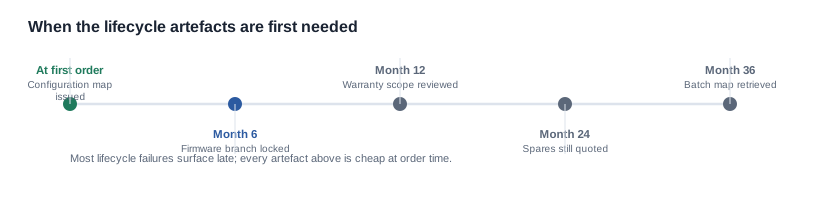
The argument below is not that warranty length matters. Warranty length is the easy term to negotiate and the least useful one to hold, because a warranty that cannot be honoured is a warranty that does not exist. The argument is that what determines whether a warranty can be honoured three years later is entirely made of decisions taken at the first order: the stability of the model designation, whether the configuration map is a record rather than an order line, whether the supplier will still build a spare part, and whether the conformity documents for the shipped configuration survive the commercial relationship.
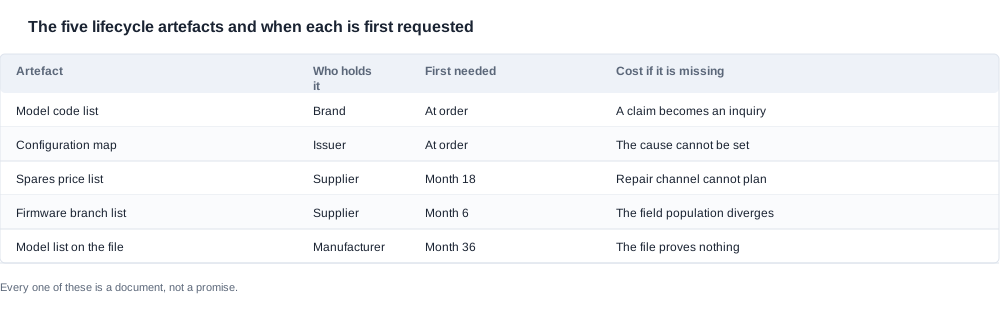
It helps to frame lifecycle support as a document-production question rather than a service question. Service is what happens when something breaks, and nobody can specify it in advance because nobody knows what will break. Document production can be specified in advance, because the documents either exist or they do not. A programme that produces five named documents at order time has a lifecycle support position. A programme that does not has a customer service position, and a customer service position decays as fast as the relationship does.
After sales support lifecycle support: the five commitments that have to be written
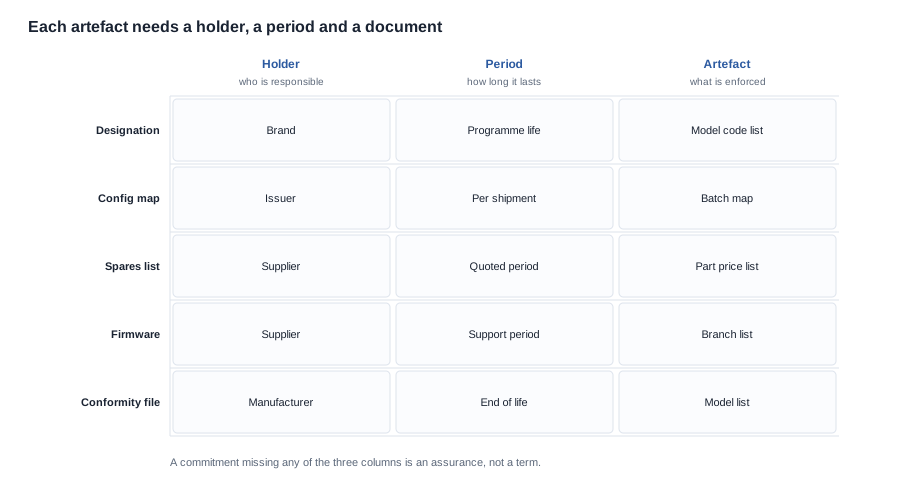
A lifecycle commitment is only real if it names a holder, a period and an artefact. Anything else is an assurance, and assurances have a short shelf life. The five commitments below are the ones that survive contact with a distributor who has changed importer of record.
The model designation and its stability. A product without a formal model designation cannot be covered by a model-specific document, cannot be traced in the field, and cannot be referenced in a support request without ambiguity. This is not a theoretical concern in this category. In our own catalogue, one entry is listed as "L2 Utral" with a note that "Utral" appears to be a typographical rendering of "Ultra", and a further designation of "Utral Pro Max" whose meaning is not published to us. The light-responsive product entry carries no model designation at all, and the bone conduction entry carries none either. A lifecycle commitment built on an unstable designation is not a commitment — it is a string that a future support agent has to interpret.
The configuration mapping, held as a record. Which cell, which charging interface, which case capacity, which firmware version, which colour, which component suppliers — for every shipped configuration. This is the record that makes a claim work, and it has to be issued with the shipment rather than reconstructed afterwards. Reconstruction is where lifecycle support usually dies: the original engineer has left, the build sheet is on a personal drive, and the only surviving version is the one attached to the purchase order.
The spare parts position. For how long the supplier commits to supply, at what price structure, and in what minimum quantity. A two-year consumer lifecycle needs a spares commitment that runs past the warranty period, because the unit that fails in month twenty-eight is the one a distributor cannot source anywhere else. A commitment that stops at the end of warranty is not a commitment at all; it is a description of the period in which other suppliers still exist.
The software position. Whether firmware updates continue, for how long, and what happens to a unit whose firmware is no longer supported. For a product with AI features this is acute, because the published position in our range is that which models are supported and where the data is stored are Not published. A feature that disappears after eighteen months is a support event and a reputation event, and it is foreseeable at the point of signing rather than a surprise.
The documentation position at end of life. Whether the conformity documents for the shipped configurations remain available, and to whom. A Declaration of Conformity has no expiry date, but its usefulness depends entirely on the model list printed on the document matching what was actually built. If the production run used a component list that differs from the one on the file, the document in the buyer's drawer is not evidence of anything.

A worked reconstruction: the unit that failed in month thirty-one
The following is an illustrative reconstruction of a lifecycle failure, not a client case — our published position does not contain client case data, and we are not going to invent one. It is included because the failure pattern repeats and the sequence matters more than the numbers.
A distributor places a first order for a configuration. The purchase order names the product by description and by a designation that is, in practice, a marketing name rather than a stable code. Nine months later the distributor's warehouse sends back twelve units described as "not connecting to the phone". The units are photographed from outside, packed in a courier box without the original tray, and accompanied by a note that says the customer could not get them to pair. The manufacturer's support agent can confirm the model by the packaging artwork. The manufacturer cannot confirm the batch, cannot confirm the firmware version, cannot confirm which radio module was fitted, and cannot determine whether the twelve units came from one run or from three.
At that point the case stops being a warranty claim and becomes an investigation, and an investigation has no clock. The unit travels in the wrong direction — it goes to the manufacturer, the manufacturer asks for more information, the distributor asks the customer, the customer has moved on. The likely cause, which nobody can confirm, is a firmware mismatch on a branch that applied to one run rather than all runs. The resolution is a credit note, because a credit note is the only instrument that does not require an answer.
Now run the same twelve units back through a programme that had written the five commitments. The designation is stable and model-specific, so the request is not an inquiry. The configuration map issued with the shipment gives the firmware branch and the module supplier, so the case starts on day one rather than week three. The spare parts position tells the distributor whether a re-flash is even possible or whether the units are scrap. The documentation position says whether the file the distributor needs for the end customer is one they can obtain themselves. The twelve units become one answered question instead of an open investigation, and the question — was this a firmware branch problem — is answerable, which means the next run is fixed rather than the next twelve units being credited.
The difference between those two outcomes is not a service philosophy. It is five artefacts, written at the first order.
One further point in the reconstruction is worth isolating, because it is where most programmes actually fail. The distributor's own records were not adequate either. The purchase order described the product in sales language, the warehouse records tracked cartons rather than units, and the only thing that tied a carton to a configuration was a shipping mark that changed between forwarders. The supplier is not the only party that has to produce a record; the buyer has to be able to produce a unit-level statement of what it bought, when, from whom and in which configuration. That statement is usually a purchase order amendment rather than a new system, and it is worth adding before the first shipment rather than after the first claim. Where the buyer's side cannot answer it, the supplier's artefacts cannot help, because nobody can say which goods the question is about.

Criteria for judging a lifecycle commitment
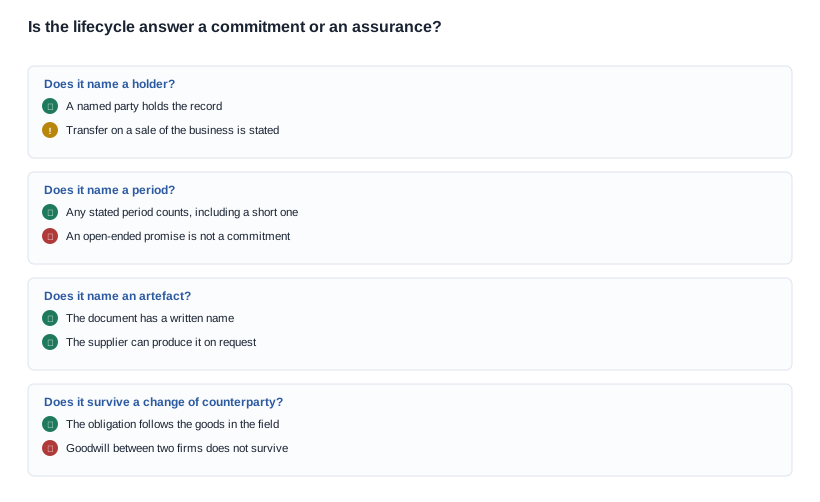
When a supplier states a lifecycle position, the useful question is not whether the answer is generous but whether the answer is checkable. Four criteria separate a commitment from an assurance, and they can be applied to any supplier's answer, including ours.
Does it name a holder? A commitment with no named party cannot be enforced by anyone. "We maintain records" is an assurance; "the importer of record named in schedule B holds the model-to-batch map and transfers it on sale of the business" is a commitment, because it identifies who holds it and what happens to it when the ownership changes.
Does it name a period? Any period at all is acceptable, including a short one. What is not acceptable is an open-ended commitment with no boundary, because an open-ended commitment is a commitment nobody has priced and therefore nobody has funded.
Does it name an artefact? The unit of enforcement. A model-to-batch map, a firmware branch list, a component list, a spare parts price list, a Declaration of Conformity referencing the shipped model list. If a commitment cannot be written as a document with a name, it cannot be audited.
Does it survive a change of counterparty? This is the criterion that distinguishes a lifecycle commitment from a relationship habit. Ask what happens to the commitment if the distributor is acquired, if the importer of record changes, or if the brand is white-labelled. An answer that depends on goodwill between two specific companies is not a lifecycle commitment, however sincere.
A fifth criterion is worth adding even though it is commercial rather than technical: can the commitment be evidenced at audit? Not audited by a third party necessarily, but by your own incoming inspection and your own goods-in records. A lifecycle term that leaves no trace in your own documentation will not be exercised, because the person who would exercise it cannot tell that it applies. The practical test is simple — when a unit comes back, does your process produce the batch reference without anyone having to go and find it?
The red flags are recognisable. A supplier that describes the support commitment in terms of effort rather than artefacts ("our engineers will do their best to help"). A term with no period. A commitment held by a named individual rather than a named organisation, which leaves when the individual leaves. A spares commitment written as "subject to component availability", which buys the supplier nothing: every factory has component availability right up until the order is placed.

The negotiation questions that move the answer
These are the questions worth asking in the meeting where lifecycle support is discussed. They are ordered by how often they produce a different answer from the one the supplier was expecting to give.
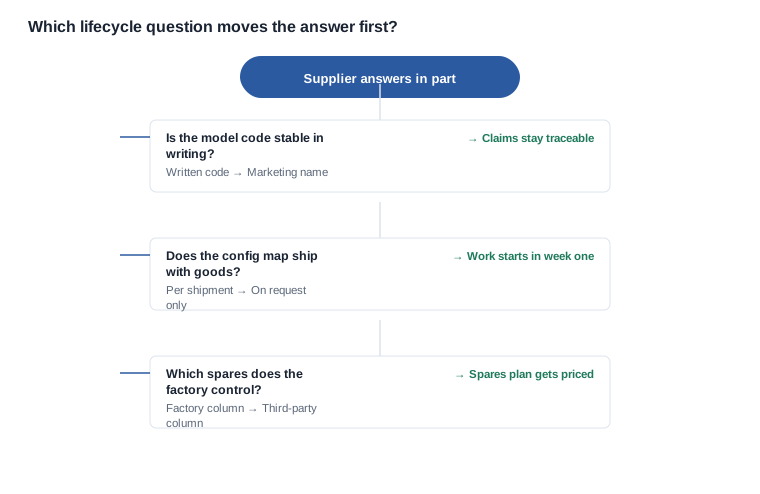
Which spare parts will still be buildable in five years, and which depend on a component supplier who may stop? Ask for the list split into two columns. The first column is what the factory controls; the second is what a third party controls. The second column is the one that determines whether a distributor can plan a repair channel.
What is the record that links a shipped unit to its production run, and will it be issued with the shipment? Not "can it be produced on request" — that is the retrofit answer — but "will it be issued with the shipment". The distinction is the whole difference between a traceability system and a filing exercise.
What happens to a unit whose firmware version is no longer supported? This is the question with the worst answers in the industry and the one most worth asking before the first product ships rather than in year three. The answer should be one of: continued update, migration to a supported branch, replacement at cost, or a stated end point. "We will do our best" is a red flag.
Which model designations will the conformity documents cover at end of life, and will those documents remain available to the distributor rather than only to the brand?
Who is the escalation route for a claim two years after purchase, and does that route survive an acquisition?
Ask the escalation question with a name attached. An escalation route described as "your account manager" is a route that ends when the account manager leaves, and account managers leave faster than any other function in this industry. The route worth having is a named organisational function with a written contact point, a stated response window, and a stated fallback when that function is unavailable. None of that requires a service-level table with penalties in it; it requires the supplier to have decided who answers a phone in month thirty-one.
The trade-off worth naming explicitly: every one of these commitments has a cost, and the supplier will price it. A longer spares period, an issued configuration map, and a firmware branch policy all carry a real cost that appears either in the unit price or in the MOQ. Buyers who want all five commitments and refuse to accept any price consequence tend to get none of them in writing.
There is a second trade-off on the buyer's side, which suppliers notice quickly. A lifecycle commitment that the buyer cannot exercise is worth nothing: the agreement obliges the supplier, but the buyer's own goods-in and returns process has to be able to hand over the right evidence at the right time. If your returns process cannot capture a batch reference from a returned carton, the strongest lifecycle clause in the agreement will be used exactly once, badly, in the first large claim. Building the buyer's side first costs process time and a short instruction to the warehouse, and it is the cheapest single improvement available to a buyer in this category.
What our published position does and does not let us commit to
Put it in the order a buyer actually needs it: what is committed, what is documented, and what has simply never been worked out.
Read the catalogue as a list of what a lifecycle commitment can lean on, and that list is short. Weight comes first: 158 g for the MT6, and Not published for every other model. The sensor model, field of view, video specification and microphone specification are Not published. The ingress test report numbers are Not published. Certification runs the other way — our catalogue publishes no CE, FCC or RoHS text and no per-model certification row, and a model-level certificate is a document to request in writing; the children's models have never been given a regulatory position in anything we publish. The service artefacts are absent as well: no published spare parts programme, no published response time, no published warranty duration, no published return address and no published firmware support period. Minimum order quantities, capacity and lead time are open internally.
What that means operationally is worth stating without softening: a support request that needs any of those items will need the manufacturer, and we will say that rather than suggest the data is on this site. That is a real constraint on lifecycle support, and it is more useful to a buyer than a confident answer we could not evidence.
What we can commit to, for a named programme with a named volume: the stable model designation for the configuration, the configuration map issued with the shipment at the granularity we actually build, the spare parts position written as a period and a price basis with the third-party dependency identified, the firmware branch policy for the specific build, and a statement of which conformity documents exist for the shipped model list. We will also state which of those we can hold ourselves and which depend on component availability, because the difference determines how much of the commitment survives an acquisition of either party.
There is one further thing we will do that costs us nothing and is worth more than it appears. For a programme we quote, we will state which of the five artefacts we can issue today, which we would have to build for you, and which we cannot commit to for this category at all. Buyers routinely build a shortlist on exactly that basis: not on the supplier with the longest warranty, but on the supplier whose artefact position is stated rather than implied. A shortlist built that way tends to survive a bad quarter better, because nothing about the programme depends on a clause that was never written down. The questions that produce that statement for a specific model are in the buyer checklist we use internally, and the process side is set out in quality gates.
The lifecycle side of a returns programme is covered in returns and RMA, the parts side in spare parts, and the commercial continuity question in supply continuity. The warranty terms themselves are in warranty policy and coverage terms.
If you tell us the model, the quantity and the expected lifecycle, we will tell you what we can commit to, which of it depends on a third party, and which of it is still open on our side. That last part is the one most suppliers leave out, and it is the part that saves a buyer a difficult conversation later.
Related reading
- After-sales and warranty support
- Supply continuity
- Warranty policy and coverage terms
- Standard OEM service scope
Send the model, the quantity and the expected lifecycle and we will tell you what we can commit to.


