
Recording practice is a term that usually describes camera technique, and in this category it means something narrower and more consequential: the set of operational decisions that determine what a recording contains, how long it survives, and whether it can be produced to somebody who asks for it later. A camera on a head is not a difficult thing to operate. A recording that has to be evidenced six months later is a different problem, and it is the second problem that separates a deployment that works from one that becomes a dispute.
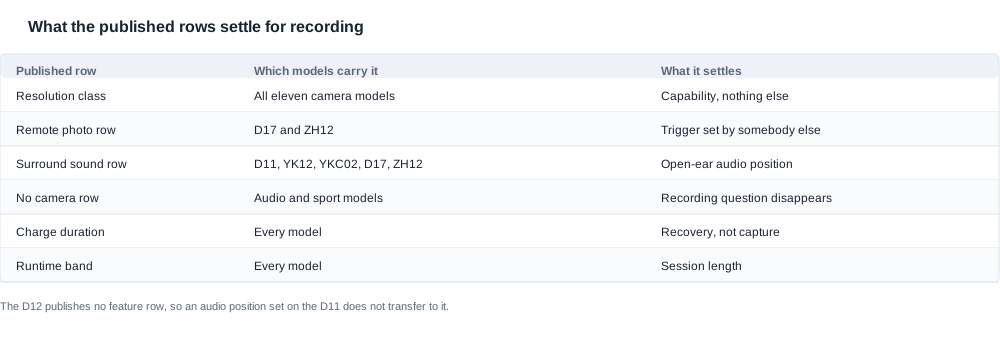
The published record in this range constrains that problem more than buyers expect. Eleven models publish a camera row, and every one of them publishes a resolution class and nothing beyond it: eight of them at eight megapixel and three at thirteen megapixel, those three being the S7 and the L1 Pro, and the L2 Utral. Nothing further is published for any of them: no sensor model, no field of view, no frame rate, no video format, no storage capacity, no stabilisation figure and no low-light performance. The remaining models publish no camera row at all.
The practical conclusion is that recording practice has to be built from the supplier's written answers rather than from the catalogue, and that the decisions worth making are a small number and can be made before deployment. What follows sets out those decisions, the questions behind each one, and the two model families whose published feature rows change the picture in opposite directions.
Smart glasses recording practices: the constraint that actually differs
Two model families, and the difference that matters in practice
The models with a camera row divide into two families once the published feature rows are read, and the difference between them is not about resolution.
The first family is the camera models proper, and their published feature rows are sparse. Most of them publish no feature row at all. The V03 Pro publishes a flexible temple row, a photochromic lens row, a Type-C charging port row and three published colours. The L2 Utral publishes two variant names and a Type-C charging interface row. The MT6 publishes a portability row, an ultra-light row and a 158 g folding charging case row. The V06 publishes an ergonomic design row, a long battery life row, a detachable inner frame row, an IP54 marking and four published colours. The S7 publishes an ergonomic design row, a thirteen-megapixel high-definition row, a detachable inner frame row and the IP54 marking. The CY03 and the V03, and the CY05 and the L1 Pro, and the KY06 and the MT5 publish no feature rows.
The second family is two sport models, and this is where the published rows change the recording question rather than the hardware. The D17 publishes a remote control photo row alongside a surround-sound row, and the ZH12 publishes a remote photo row alongside a spatial surround-sound row. A remote photo row means the shutter is triggered from somewhere other than the device, which in practice means something other than the person wearing it.
That difference has an operational consequence which is easy to miss. A wearable whose shutter is triggered externally produces a different recording from one operated by its wearer: the framing is chosen by whoever holds the trigger rather than by whoever wears the device, and the subject of the recording may not be the person who can see the frame. For a deployment in which the wearer is a member of staff doing a task and the trigger is held by a supervisor, that is a meaningful difference in what the recording actually shows.
The feature rows that change the audio position
Two feature rows in the range change what a recording contains even though neither mentions a camera, because both describe a device that projects audio into an environment rather than into an ear canal.
The D11 publishes a surround-sound row and a long battery life row. The YK12 publishes surround sound and a slim temple. The YKC02 publishes surround sound and a long battery life. The D17 and the ZH12 publish their surround-sound rows as described above. The D12 publishes no feature row at all, and it is the only audio model whose page carries none, which means that a buyer who has established an audio position for the D11 cannot transfer it to the D12 on the basis of the shared cell capacity, charge duration, runtime and charging interface.
The position to take is the same one the open-ear audio note sets out: an open-ear design projects sound into the room, so what a recording captures acoustically depends on where the device is and how close the wearer is to the subject. Our internal product record is candid about the limit here: the acoustic performance carries no third-party measurement report, and nothing may be set against a competitor's figures until a physical competitor unit has been put side by side with ours.
For recording practice, that means one question has to be answered in writing: whether the microphone captures what the open-ear output projects, and at what distance. It is not answerable from a catalogue row, and it is the question that determines whether a recording is usable as evidence.
What our documentation can and cannot tell you
The boundary here is worth stating exactly, because the category is full of summaries that blur it.
What our published material establishes is which models have a camera, what resolution class they publish, what the charge duration and runtime are, which interface they use, what their case state is, and which feature rows each model publishes. Every one of those is checkable against a unit.
What it does not establish is anything about how the camera behaves. The catalogue publishes no capture trigger description, no frame rate, no field of view, no video format, no storage capacity, no retention period, no deletion mechanism, no transmission detail and no capture indicator behaviour for any camera model. Our catalogue also publishes no application, no platform and no firmware baseline, so nothing about how capture is configured, scheduled or reviewed.
The camera imaging note covers what a capture specification has to contain, and it is the right reference for a buyer who wants to write the supplier's answer into a requirement rather than accept a general statement.
Practices that help in both settings
The six decisions to make before deployment
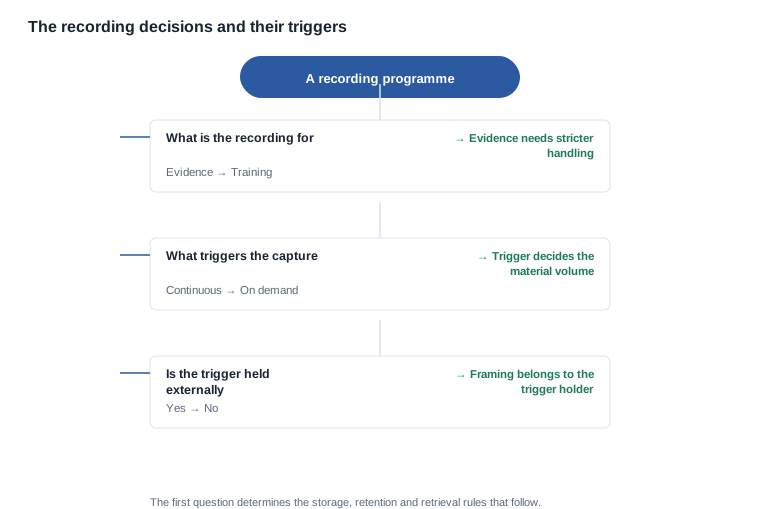
Recording practice for this category is a short list of decisions. Each one is made once, written down, and applies across the deployment.
- What the recording is for, which decides whether it is evidence, a training artefact or a review record.
- What triggers it, which is continuous, on demand, or externally triggered as the remote photo rows suggest.
- What it contains, which is decided by the published resolution class plus the answers on audio capture.
- Where the material sits, which is a storage and transmission question with no published answer.
- How long it lives, and what deletes it.
- Who may retrieve it, and who may not.
The first decision is the one that determines the rest, and it is a governance decision rather than a technical one. A recording intended as evidence has to meet evidentiary standards that a training recording does not, and the difference shows up in decisions four, five and six. Deployments that skip this step tend to apply the practices of the least demanding use to every recording, and then discover that the material they least wanted to keep is the material they kept longest.
Making the trigger decision deliberately
The trigger question has three possible answers and each carries a different consequence.
Continuous capture generates the most material and requires the most capacity, the most review effort and the most deletion discipline. It also produces the highest risk in a deployment where the subjects are not staff, because there is no task boundary to the recording.
On-demand capture by the wearer produces material tied to a task, which is usually what a training deployment needs and what an evidence deployment cannot rely on, because the person who triggers the recording is the person the recording is about.
Externally triggered capture, which is what the remote photo rows on the D17 and the ZH12 indicate, produces material framed by whoever holds the trigger. It is efficient in a supervised task and it creates a second question the deployment has to answer, which is who may hold the trigger.

Retention, review and deletion as an operating routine
Whatever the trigger, the material has to be managed, and the routine has to be written before deployment because it is labour rather than technology.
The routine has four parts. Material is reviewed, so somebody decides whether it is kept or discarded. It is retained for a stated period, so that a request arriving after the period has a defined answer. It is deleted on a trigger rather than on a schedule nobody checks. And the deletion is verifiable, so that the organisation can demonstrate that a period has expired and the material is gone.
The last part is the one that is usually skipped, and it is the one that matters for an evidence-driven deployment. A deletion that cannot be demonstrated is a deletion that has to be assumed, and an organisation that has to assume its own compliance has a gap in exactly the place it cannot afford one.
The practices that survive scrutiny
There are a small number of practices that make a recording programme defensible, and they are inexpensive. The first is to fix the trigger and the indicator behaviour and to test both on a sample unit before deployment rather than after. The second is to keep a short, quotable written policy that states what is recorded, how long it is kept, and who may see it. The third is to make the retrieval path explicit and logged, so that the organisation can answer who saw a given recording.
None of these requires a technical capability the catalogue does not publish. They require decisions, and the decisions are the buyer's.
Where retail and education press on the same decision
The two channels arrive at the same recording decisions from different directions, and a buyer who has experience of only one of them tends to assume the other is easier.
A retail buyer typically has no device after the sale, so the recording question is about staff demonstration rather than about customer capture. The recording that exists is the one a staff member makes to show a customer a feature, and its purposes are narrow: it demonstrates the product, it supports a training record for the demonstrator, and occasionally it evidences a product fault. Those three purposes have different retention needs, and the most common retail failure is keeping demonstration footage for a year because nobody wrote down that it was made to show a feature.
An education buyer has the opposite position: the device stays with the institution, and the recording question is about the institution's own people and, where learners are involved, about a governance framework the institution has to evidence to somebody else. The additional pressure is the documentary one. A retail business can lose a recording without anybody noticing. An institution can be asked to produce its recording and deletion records, and the answer has to be a document rather than an assurance.
The commercial consequence is the same in both directions and worth stating plainly. A retail buyer's exposure is limited to the units it puts on the shop floor, and a small order with a clear demonstration purpose is a reasonable way to establish the trigger and the indicator behaviour before a larger commitment. An education buyer's exposure scales with the fleet, and the questions to the supplier have to be answered before the fleet arrives rather than after, because the governance documentation is written against the answers.
Choosing a platform for each case
Choosing a platform for each case, and the questions that decide it
How to evaluate a recording specification before you commit
A recording programme is bought against a specification that is either checkable or not, and the test is whether a buyer can verify the behaviour on a sample unit rather than accept a description. That test is worth applying to every line of the specification, and it is the reason a supplier's answer has to be specific to a model rather than to a family.
Four criteria make the difference between a specification a buyer can enforce and one it can only hope for.
The first is model specificity. The eleven camera models differ from one another in what they publish, so an answer that describes the camera range as a whole cannot be checked against a unit and cannot become an acceptance criterion.
The second is testability. The indicator behaviour, the trigger and the deletion of a single item have to be observable on a sample unit, because those are the three claims a buyer would want to demonstrate rather than assert. The samples route is where that demonstration belongs.
The third is completeness against the operating routine. A specification that answers the capture questions and says nothing about storage, retention, transmission and deletion has answered the easy half, and the hard half is where the labour and the risk sit.
The fourth is realism about the supplier's own role. Our catalogue publishes no application, no platform, no firmware baseline and no capture configuration for any model, so a specification that assumes an operator interface for configuring capture is assuming something the catalogue does not carry. It has to be requested, and the request has to state whether the configuration is per device, per account or per deployment.
The red flags in a recording specification are recognisable. The most common is an answer in terms of features rather than behaviour. The second is a retention period with no deletion trigger attached to it, so in practice the material is kept indefinitely. The third is a policy that depends on somebody behaving correctly at all times with no technical support, which will eventually fail.
The trade-offs are worth stating before the order rather than during it. A deployment restricted to models that publish no camera row removes the entire data chain and is usually the most robust position available, at the cost of not supporting any recording task. A deployment with capture capability supports more use cases and carries a governance workload that has to be staffed. A recording kept for a short period costs less to govern and produces less evidence, and a recording kept for a long period does the opposite. Which trade-off is right is a decision the buyer has to make against its own risk position, and the published rows do not make it.
A deployment is costed across its whole life rather than per unit: the units themselves, the storage and retrieval arrangements where any material is kept, the review labour, the deletion administration, and the policy work that has to follow. Picking the model is a shortlist question, and that shortlist has to rest on the published rows and the answered questions, with price entering only after it is agreed.
Matching the model family to the recording job
Putting the two families together with the practices gives a workable matching, and it is worth stating because it is the part a buyer can act on without further information.
Where the recording is a training artefact and the subject is the person doing the task, the camera models with the published resolution class are the relevant group, and the decision turns on the frame rate, the field of view and the format, none of which is published and all of which have to be requested.
Where the recording is a supervised task and the framing is set by someone else, the two sport models with the published remote photo rows are the relevant group, because the trigger behaviour is published in their favour. The trade-off is the audio position: both publish a surround-sound row, so the open-ear question has to be answered before either is used for anything where what was said matters.
Where no recording is required, the audio models and the remaining sport models publish no camera row, and the recording question disappears entirely from the deployment. For a large institutional deployment, that is often the cheapest and most robust position available, because it removes the whole data chain rather than managing it.
The supplier question list
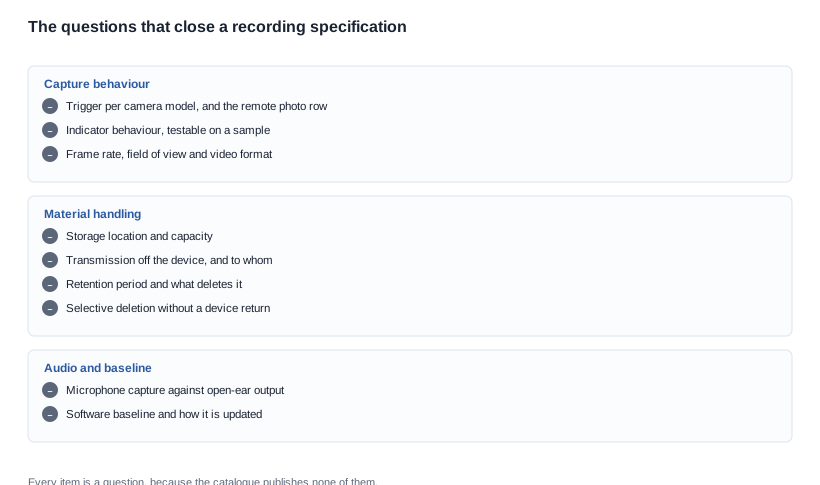
The questions below are the ones that close the recording specification, and each of them is a question rather than a figure because none of them is published.
- What capture trigger applies to each camera model, and what does the remote photo row do exactly?
- Is there a capture indicator, what is its behaviour, and can it be tested on a sample?
- What frame rate, field of view and video format do the camera models use?
- Where is captured content stored, and what is the storage capacity?
- Is content transmitted off the device, to whom, and over what transport?
- What is the retention period, and what deletes the material?
- Can material be deleted selectively, without returning the device?
- Does the microphone capture what the open-ear output projects, and at what distance?
- What is the software baseline for capture configuration, and how is it updated?
The commercial figures attached to a recording programme are settled per enquiry and never published. They cover the sample cost and route, the production lead time, the minimum order quantity and the unit price for the specified configuration. The samples route is the practical way to test the trigger and the indicator before committing, and the AI camera glasses page sets out the group those questions apply to.
Where the recording position stands
On recording practices for smart glasses in retail and education, our position is that the catalogue establishes capability and the recording behaviour has to come from the supplier in writing, and that the decisions worth making are the trigger, the indicator, the retention period and the retrieval path. We will not state a capture specification the model pages do not contain, and we will not publish an indicator behaviour that is not published for any model.
For the category context, the retail and education solution sets out the two channels separately, and the camera imaging note covers the technical detail a capture requirement has to reach.
Send the recording job, the trigger you need, the retention period your policy implies and the volume, and we will return the eligible models, their published rows, and the written question list that closes the recording specification.


