
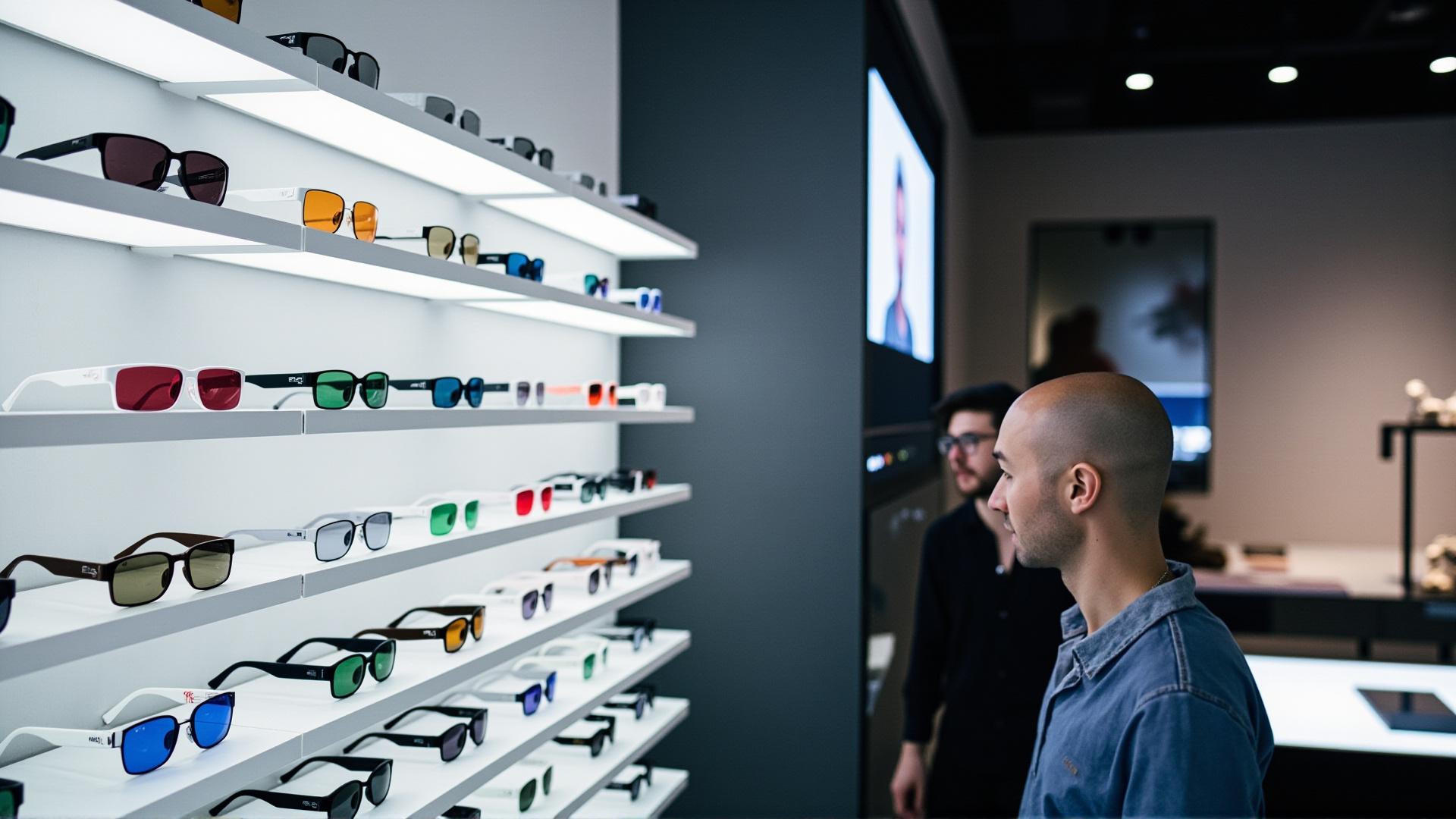
Training frontline staff on smart glasses is a channel problem before it is a technical one. The person on the counter in a phone accessories shop, or the technician running a demo table in a school hall, meets a stranger for about ninety seconds and has to make an unfamiliar object feel ordinary. Staff who can perform that demonstration turn interest into orders. Staff who can recite a specification sheet do not. This guide sets out a training structure for retail and education buyers that stays inside what the published documentation supports, so the person answering the question never has to invent a number and never has to walk it back the following week.
Smart glasses training starts with a sixty-second demonstration
The fastest way to lose a customer in this category is to open with specifications. A shopper who asked whether the glasses record video does not care that the sensor is an eight megapixel unit; they care whether it will record the child's piano recital from the back row. A shop assistant who begins with a resolution figure has already answered a question nobody asked and has lost the attention of the person who might have bought.
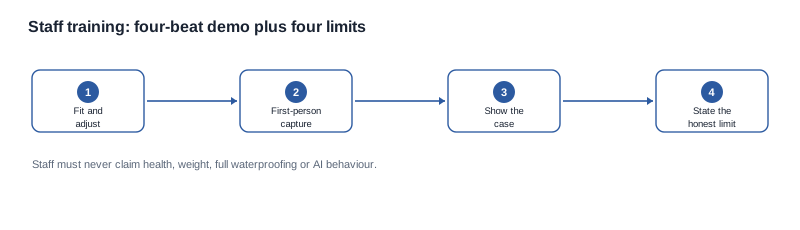
Train the demonstration first, and let the specifications appear only in response to a specific question. Four beats cover almost every first encounter in retail, and each one rests on a fact the published documentation actually carries.
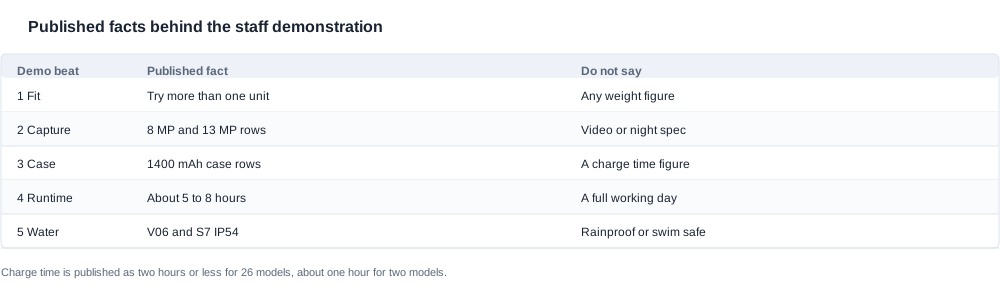
- Put them on and adjust them. Fit is the first objection and the first reassurance. Staff should practise the adjustment on themselves and on each other until the motion is automatic. The category has temple structures and profiles that differ from model to model, and the honest way to handle that difference is to let the customer try more than one unit rather than to describe a shape.
- Show first-person capture. The camera models publish two resolution families: eight megapixels across eight models, and thirteen megapixels across three. That is enough to explain the purpose without claiming anything about video format, field of view or low-light performance, none of which are published for any camera model in the range.
- Show the charging case. Several models ship with a case whose capacity is published: three at 1400 mAh, one at 900 or 1400 mAh depending on the build, and one foldable at 1200 mAh. The case in the hand answers "how often do I charge this" better than any number on a screen.
- State the honest limit. Staff who say "the published figure is around five to eight hours and it depends what you are doing" are more credible than staff who promise a full working day. The rated runtime figures across the camera range carry no published test condition, and a customer who discovers that later returns the product.
The demonstration unit on the counter and the configuration the customer receives should be the same product, or at least the same published row. A shop that demos a thirteen megapixel camera model and ships an eight megapixel build has created a returns problem that no amount of training will fix, and the mismatch is invisible in the training session because it happens later, in the packing area. Where a range is carried, write the permitted demo-to-order mapping into the training pack itself.
Rehearse the demonstration rather than describing it in the training session. A session in which staff read the demo script aloud produces staff who read the demo script aloud to customers. A session in which every member of staff performs the sixty-second sequence in front of the group, with the group timing them, produces staff who perform it. Keep the timing device visible, because the most common failure is not a wrong fact but an explanation that runs to four minutes.
Write the acceptance criteria for a good demonstration before the session starts, so that the standard is measurable rather than a matter of opinion. Three criteria are enough: it runs inside ninety seconds, it uses only published facts, and it ends with the escalation contact named. Anything a trainee cannot do without the card in their hand is not yet a trained behaviour, and a programme that measures itself against that criterion will improve faster than one that measures attendance.
The fourth beat deserves particular attention in retail, because the question about charging arrives from every customer who has ever compared a battery figure on two products. Twenty-six models in the published range state a charge time of two hours or less, and only two state about one hour. Staff should be able to say "the published figure is two hours or less" without naming a model, and should never add a number of their own to round it up or down.

Smart glasses claims staff must not make
Every claim that is not supported by published material creates a return, a dispute or, in the education channel, a procurement problem. The list of forbidden claims is short, and it is worth printing.
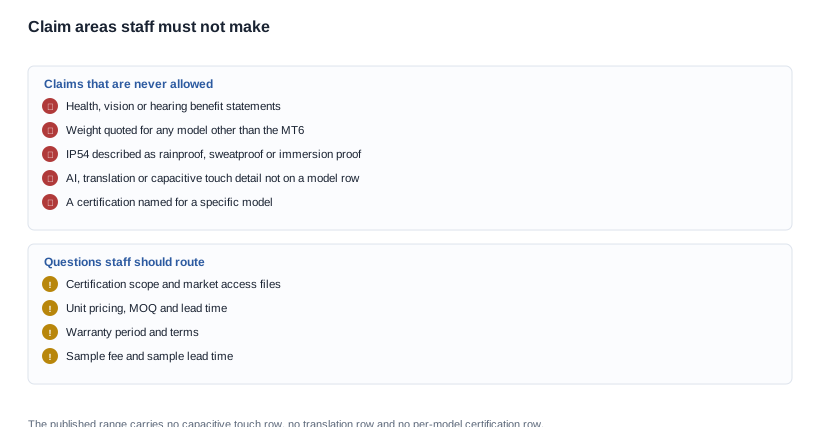
Health, vision and hearing claims. Nothing in the published range supports a statement about myopia, vision protection, hearing assistance, eye strain reduction or any other therapeutic or wellness outcome. Staff should not offer these, not even as "people say" or "it can help with". The audio range includes models published as stereo and surround listening products, and a surround sound descriptor is an audio characteristic, not a hearing aid claim. Keep that distinction in the training, because it is the one that customers most often mishear.
Weight. Exactly one model in the entire range publishes a weight: the MT6 at 158 g, and that figure covers the glasses alone, excluding its 1200 mAh foldable charging case. Staff must not estimate, interpolate or round a weight for any other model, and must not quote the MT6 figure as a system weight. A customer who lifts the case in the shop and notices the mismatch will remember that you quoted a number.
Water and dust. Only two models publish an ingress rating, the V06 and the S7, both of them camera models, and both at IP54. That designation means limited dust ingress and protection against splashing water. It is not immersion protection, it is not a rain-proof claim, and it is not a sweat-proof test result. Staff who say "it's waterproof" to a cyclist customer have made a claim the documentation does not carry, and that claim will be tested in the first week of use.
Interactive capability. The published range contains no capacitive touch row and no translation row for any model. A demonstration that shows a finger tapping a temple is therefore demonstrating something the documentation does not describe, and staff should avoid the gesture entirely unless a specific model row has been confirmed for that build. The same applies to live translation and to any AI feature detail: no per-model AI capability row is published, so staff describe a voice assistant capability where the row supports it and stop there.
Certification. The catalogue body does not mention CE, FCC, RoHS, RED or EN 18031 anywhere, and the export certification page is a picture page carrying ten patent certificate images — eight design patents and two utility models — rather than a per-model certification table. Staff therefore cannot state that a given model is certified for a given market. This is not a close call; it is the claim most likely to cause a problem, because certification language in a school or a corporate reseller agreement becomes a contractual obligation.
Commercial terms. Unit price, minimum order quantity, lead time, sample fee and warranty are not published on this site. They are confirmed per enquiry. Staff should route those questions rather than estimate them, and the training pack should name the person who answers them. A staff member who quotes a lead time from memory has created an order date the business may not meet.
Two further behaviours belong on the card because they cost nothing and prevent most escalations. The first is to answer the question asked. A customer asking whether the glasses translate is not asking for a translation, and the trained answer is short: that capability is not published for the configuration on the counter, and here is the contact who can confirm it. The second is to log the question rather than to let it disappear, so the same unanswered question is not asked by the next customer and the next member of staff. A shortlist of the questions a trained person can answer without help is the simplest way to describe what good looks like, and it is usually shorter than a buyer expects.
None of this is a restriction on what the product does. It is a restriction on what a person who is not the supplier may state on the supplier's behalf. In our view the correct behaviour for a trained staff member is to say "that figure is confirmed per enquiry, let me have it sent to you today" — and to actually send it.

Smart glasses in the education channel: procurement before performance
Education buyers work differently, and the difference appears before anyone talks about a demonstration. A school, a training provider or a college purchases against a file, not against a counter conversation. The person evaluating the product is often not the person who will wear it, and the person who signs may not have attended the demo at all. That makes the training content different in kind, not just in length.

The route below is the one that works most often, and each step has a specific artefact attached to it rather than a promise.
The first step is a specification request in writing, listing the configurations under consideration and the destination market. The second step is a sample, so that the purchasing committee handles the physical object rather than a photograph. The third is a quotation that names the minimum order quantity, the unit price, the tooling or customisation charge if any, the lead time, the packing list contents and the incoterm. The fourth is the market access file for the destination market. The fifth is the training session, held with the people who will actually demonstrate.
Three children's models exist in the published range, and their treatment in an education file is materially different from an adult model. Children's products typically attract additional requirements in their destination markets: in the European Union that normally means the EN 71 series, and in the United States it means the consumer product safety framework together with a children's product certificate. These are not catalogue rows for the A05, A06 or A07 — the published documentation carries no certification row for any of them, and the Bluetooth version is not published for those two either. The correct staff behaviour is to route the question, and to route it before the demo rather than after it.
The educational demonstration itself needs a different script from the retail one. A teacher or trainer is not evaluating an object for personal use; they are evaluating a workflow, and the workflow questions are about classroom time, management, shared use, hygiene and what happens when a unit is lost or broken. Answer those honestly: shared-use programmes need a documented process for allocation and return, and a warranty position from the supplier. Warranty is not published on this site and is confirmed per enquiry, which means it belongs in the quotation and in the evaluation file rather than in a verbal answer at the demo table.
The other structural difference is the buying cycle. Education purchases are usually budgeted a cycle or more ahead, and the evaluation file is often assembled by someone who was not at the demonstration. That is a reason to write down more rather than less at the demo: a one-page sheet with the configuration, the published facts and the open items travels well in a procurement pack, whereas a verbal answer does not travel at all.
There is one more education-specific habit worth building into the programme, and it costs nothing to set up. Ask the buying committee to record, in their own words, what they intend the device to be used for. Schools frequently discover late in a programme that the intended use was classroom recording, shared use by a cohort, or demonstration hardware for a course, and each of those uses carries a different requirement for allocation, storage, charging and insurance. Capturing the intended use in writing during the evaluation stage is what allows the supplier to quote against the right configuration and to write a warranty position that actually matches the usage pattern.
Institutions normally shortlist two or three configurations and then run a structured comparison, and this is the point at which the published rows earn their place. Two builds can look identical in a demonstration and still differ in charging method, in whether a charging case is published with a capacity, and in the runtime figure quoted against them. The acceptance criteria for the final selection are usually written down in advance — which rows must be published, what documentation must travel with the product, and what the warranty position has to cover — and a buyer who has those criteria ready will shorten the evaluation considerably, because the comparison becomes a check rather than an argument.

Smart glasses staff training artefacts and how to measure them
If a channel can only afford one training artefact, it should be a single page that a new starter can use on their first shift without a supervisor standing next to them. Everything else is optional.
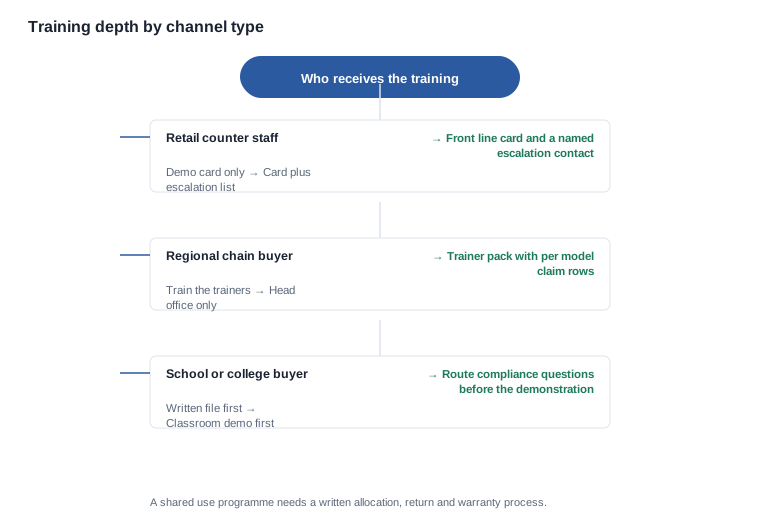
Four artefacts cover the requirement, and they are deliberately separate because they have different owners and different revision cycles.
- The demonstration card. One page, printed or pinned, with the four beats in order and the published fact for each. No prose, no model list, no adjectives.
- The claim sheet. A per-model list of what may be said about the configurations the channel actually carries, keyed by the exact model string. It should also list what may not be said about each. If a channel carries three configurations, the sheet is three rows long. That is the point.
- The escalation sheet. A named contact, a channel for questions, and a stated response time. Compliance questions, pricing, lead time and warranty all route here. Publish the response time internally even if it is generous, because a question that sits unanswered for a week teaches staff to guess.
- The question log. A shared sheet where staff record the questions they could not answer. This is the cheapest diagnostic tool in the business and it is the one most often skipped.
Training depth should follow the buying relationship. A single shop counter needs the demonstration card and the escalation sheet. A regional chain needs the trainer pack, because one person will train many locations and needs a consistent line. An education buyer needs the written file first and the demonstration second, because the compliance conversation determines whether the demonstration matters. In a chain account the due diligence happens once, centrally, and the criteria are set centrally; each branch then inherits them, which is exactly why the claim sheet has to be versioned and dated.
Measurement matters more than most training budgets assume, and it can be done without the supplier. Three numbers are enough.
- Demonstrations delivered per week. Counted by the demonstrator, not estimated.
- Units sold per week from the trained location. The commercial output of the same population.
- Returns and refunds by stated reason. The one that catches overclaiming fastest, because the reason field will name a claim the staff member made.
The ratio between the first and the second is the fastest available signal of whether training is working. If a location demonstrates forty times and sells two units, the demonstration is interesting but the product, the price or the location is wrong. If a location sells twenty units and demonstrates twice, the staff are closing on trust rather than on the demonstration, and the training risk is now in the claims they improvise to justify the sale.
The question log closes the loop. Review it monthly and you will find that the same three questions account for most of what staff could not answer. Each one is either a missing line on the claim sheet, a gap in the published documentation, or a commercial term that should have been agreed in advance. The first two are fixed by updating the training pack; the third is fixed by the supplier, which is why it is worth reading the log before the next training session rather than after it.
Training material has a shelf life, and the expiry is driven by the range rather than by the calendar. When a new configuration is added, when a model is discontinued, or when a published row changes, the claim sheet must be reissued before the product reaches a counter. Version the artefacts, date them, and remove superseded pages from the shop rather than leaving them in a drawer. A training pack that is one revision out of date teaches staff to assert figures that have already been withdrawn, and those staff members are usually the most confident ones in the store.
One last measurement is worth adding once the first three are running: the time from a logged question to a written answer. It is the number that shows whether the escalation sheet is a real route or a courtesy, and it is the number a supplier should be willing to be measured on.
Smart glasses programmes: what a supplier must put in writing
A training session cannot be built on verbal assurances. Before a programme is scheduled, a buyer should be able to point at a document for each of five things, and a supplier should be able to produce them without delay. The usual trade-off in a programme of this kind is between the number of configurations carried and the number of claims staff can hold confidently, and the resolution is not to carry fewer units but to carry fewer claims per unit.
- A per-model specification list keyed to the exact model string. The model string is the document, because two builds of the same family can differ in charging method, case configuration and published rating. Ask for the row, not the family description.
- The published specification set for the configurations carried. Resolution, battery capacity, runtime, charging method, charging case capacity and Bluetooth version are published for some models and not for others, and the difference matters when staff are being trained to answer questions. Where a row is not published, the training pack should say so explicitly rather than leave a gap.
- A quotation covering the commercial terms. Minimum order quantity, unit price, tooling and customisation charges, sample fee, lead time, warranty period and terms, packing list contents and incoterm such as FOB or DDP. None of these are published on this site; they are produced per enquiry, and the quotation is where they belong.
- A market access file for each destination market. Ask what the file contains, which models it covers, and which entity it was issued in. A supplier that cannot describe the contents of the file in a sentence is telling you something.
- A training kit matched to the configurations carried. Demonstration script, claim sheet, approved imagery and the escalation contact, with a revision date on each.
Two points deserve a direct word with buyers who are planning an education programme. First, customisation has a mechanical dimension as well as a commercial one: logo placement, colour, packaging and print tolerance all affect tooling and therefore the lead time, and they need to be specified before the quotation rather than after it. Second, the packing list should be settled in the same conversation as the quotation, because the packing list is what the receiving store, the school porter or the warehouse counts against, and a mismatch there shows up as a claim rather than a conversation.
Sample handling deserves the same level of care in this category. A sample that arrives without a written record of what it is, which configuration it is and what was agreed about it creates a second problem when the first order follows, because the two are not obviously the same unit. Ask for the sample to be labelled with the model string, the sample charge, and the terms under which the charge is credited or waived against an order. Those terms are commercial, so they belong in writing and not in a note on a delivery docket, and they should appear in the quotation that follows.
On our own side, the discipline is simple. Every claim we can evidence for a configuration, we state plainly. Every figure that does not exist in published material, we mark as not published, including inside the training material we supply, because a training pack that overstates the specification becomes the source of the dispute rather than the defence. Where a buyer needs something the public documentation does not carry — a market access file for a specific market, a warranty statement, a lead time against a specific configuration — we produce it as part of the quotation cycle rather than as a marketing claim.
For the compliance questions staff should escalate, the certification checklist sets out what to obtain and what to confirm before a programme is announced. For the channel-side structure that sits alongside training, solutions for distributors and retailers covers what resellers typically need to have in place. For the honest answer on runtime figures, battery life specifications sets out how the published rows should be read. The wider channel picture sits in retail and education solutions.
Related reading
- Solutions for retail and education — the wider channel picture
- Certification checklist — what to have on file before staff answer questions
- Battery life specifications — giving staff an honest answer on runtime
Tell us your channel, the configurations you carry and who needs training, and we will give you the published specification set and the claims to avoid.


