

Smart glasses durability engineering is not primarily a materials argument. It is a decision about which failure you have chosen to accept, because the failures that reach a customer in this category are almost never the dramatic ones. A snapped temple is rare and obvious. The failure that quietly generates returns is the slow one: a contact that stops charging reliably, a hinge that develops play, a seal that hardens, an arm that slips, a button that stops responding. Each of those is decided by choices made long before the first sample was cut, and each of them can be designed out or specified for. The discipline is telling those two options apart.
Smart glasses durability starts with the slow failures
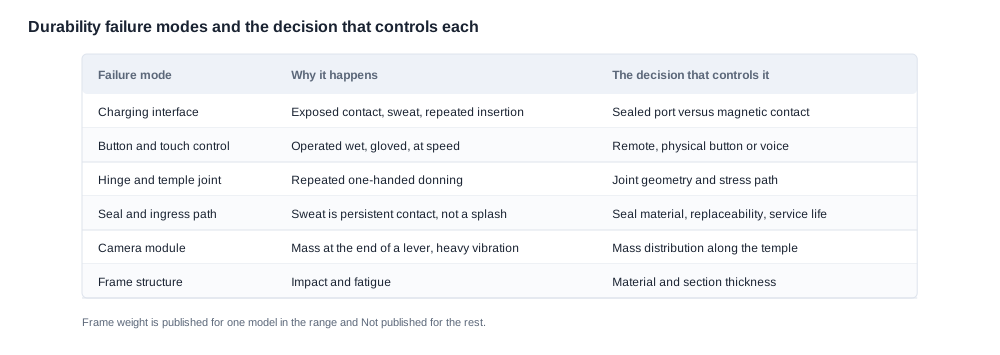
Start the design conversation with the failure you are prepared to live with, because in sport and cycling that conversation is worth more than a materials description. Six failure families account for the overwhelming majority of what comes back, and a brand that has ranked them will find the rest of the specification almost decides itself.
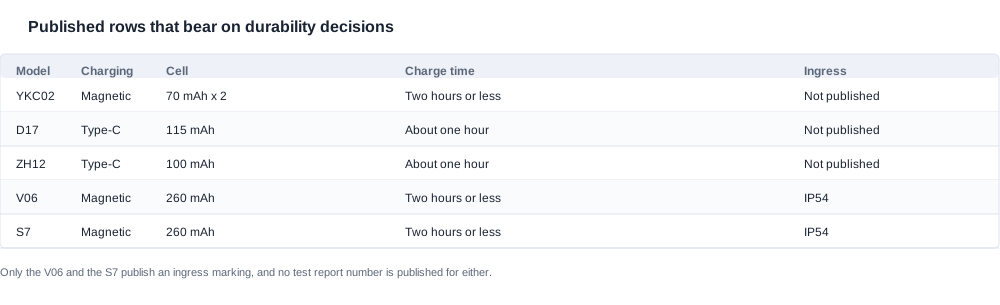
- The charging interface. A magnetic contact living in a temple that sees sweat, rain and repeated insertion cycles has a finite life, and the way it fails is ambiguous: the unit charges sometimes. Customers report that as a defect and suppliers report it as user error, which is how a small component problem becomes a returns dispute. Among the models published for sport use, charging is magnetic on the YKC02, the V06 and the S7, and Type-C on the D17 and the ZH12, and that single choice has more durability consequence than any material spec in the file.
- The control scheme. A control operated with a wet finger, a gloved hand or at speed will be operated wrongly. Two published models address this directly with a remote shutter: the D17 and the ZH12. Removing the need to reach the temple during a ride is a durability decision before it is a convenience decision, because the thing you do not touch cannot be operated badly or worn out by handling.
- The temple joint. A cycling product is donned and removed one-handed, repeatedly, often in the dark. Stress concentrates at the joint, and the usual symptom is play developing well before the part actually breaks. Play is the more expensive failure, because it is the one that a rider describes as "these have gone loose" rather than "this has broken".
- The ingress path. Two models in the entire published range carry an ingress marking, the V06 and the S7, and both carry IP54. There is no third-party test report number published for either. IP54 means limited dust ingress and protection against splashing water; it says nothing about immersion, and it is not a statement about a rider in a downpour. Sweat is persistent liquid contact rather than a splash, so the marking and the real environment are different questions.
- The camera module, where the product has one. A module at the front of a temple is a mass concentration at the end of a lever, and the vibration environment on a bicycle is severe. The published specifications for the camera models state no vibration rating and no impact rating, so this remains an evidence question rather than a catalogue question.
- The frame and the lens. The lowest failure rate and the highest visibility, which is why it attracts attention out of proportion to its frequency. A lens that fogs at speed is not a durability failure at all, yet it is one of the four most common rider complaints, and it belongs in the same design review.
Ranking the six is worth the hour it takes. A programme that decides to design out the slow charging wear and to specify for the ingress path has made a different product from one that decides to design out the ingress path and to specify for the charging wear, and the two products differ in tooling, in the accessory set, in what the warranty desk can offer and in what the product page can honestly say. The decision is not a technical detail to be made by the engineer alone; it is the point where the commercial model of the sport line is set.
One further distinction belongs at the top of the review, because it changes what you ask for. A general sport programme and a cycling programme do not fail in the same place. A general sport user tends to expose the product to impact, sweat and ordinary rain, and to use it in short bursts. A rider exposes it to continuous vibration, to a constant airflow across the front face, to repeated one-handed operation in the dark, and to a much longer session with no opportunity to charge. Continuous low-level vibration attacks solder joints and connectors in a way that discrete impact does not, and a long session means the battery is cycled harder and the charge method matters more than the impact rating. Two published rows point in the same direction here: the two models that publish the fastest charge time, around one hour, are the D17 and the ZH12, and both of them are Type-C models. A rider who carries one cable across a programme has solved a quarter of the endurance problem before the product is even chosen.
Smart glasses interfaces, contacts and the wear life question
The charging interface is the highest-leverage durability decision in the whole programme, and it is the one where the published documentation helps least, because no wear-life figure is published for any model in the range.
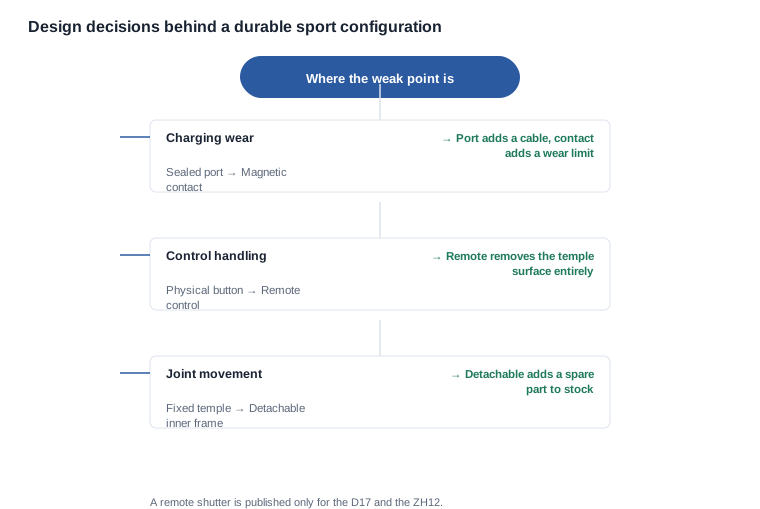
A sealed port has no exposed mating surface, and that removes the wear mechanism entirely. The cost is that the customer carries a cable, which in a sport context means a charging cable in a jersey pocket, or in a shared-use programme a stock of cables that has to be managed. A magnetic contact is far better in a retail setting because the customer just closes a case, but it introduces a contact surface with a finite insertion life and a corrosion exposure that sweat and salt will find. Neither option is free, and the trade-off is genuinely a trade-off rather than a step up from one to the other.
What the published rows do tell you is which side of that decision each model sits on. The YKC02, the V06 and the S7 publish magnetic charging. The D17 and the ZH12 publish Type-C, and those two also publish the only charge times in the range that are better than the ceiling: around one hour against two hours or less for the rest of the catalogue. So the interface decision and the charge-time decision are not independent for a sport brand — the two fastest-charging published models are also the two cable-based ones, which is a useful coincidence if you are building a programme around a shared cable.
Two further points about interfaces are worth settling before tooling rather than after it. The first is what the wear life actually is, expressed in insertion cycles, and it is not published for any model. Ask for it, and treat the absence of an answer as a design input rather than as an oversight. The second is what the interface means for the packing list and the carton. A magnetic configuration that ships with a case is shipping a second lithium cell in every unit, which changes the parcel, the declared contents and the freight profile; a Type-C configuration ships lighter and simpler. A brand that prices the product without pricing the packaging has half-priced the programme.
There is a service consequence as well, and it applies to both interfaces. A magnetic configuration is only as good as the case it arrives in, and a case dropped onto a gravel path is the most common way a magnetic product fails in the field. A Type-C configuration fails differently, but it fails at a port that is easier to inspect and to clean, and a worn port is visible to the person holding the unit. Neither observation is a substitute for a wear-life figure; they are reasons to insist on one.
The control scheme works the same way. Touch control on a temple is a contact surface that will be operated with gloves, rain and sweat, and the published range carries no capacitive touch row for any model, which means there is no documentation supporting a touch interface in the first place. A physical control removes a wear surface and a failure mode at the same time, and a remote control removes it entirely from the product body. The D17 and the ZH12 publish the remote shutter; no other model does.
Smart glasses design decisions and their trade-offs
Beyond the interface, four decisions carry most of the remaining durability outcome, and each of them can be specified differently at a cost.
Mass distribution along the temple. Forward mass works against retention and adds load to the joint, which is the joint you were already worried about. The published cell configurations give a reasonable picture of how differently this can be done: the YKC02 carries two 70 mAh cells, the D17 a single 115 mAh cell, the ZH12 a single 100 mAh cell, and the V06 and the S7 a 260 mAh cell. A dual-cell arrangement in the temple is a different mass profile from a single cell in the same space, and the charge time that comes with it is different too.
The charging case as a service item. Five models in the catalogue publish a case capacity: three at 1400 mAh, one at 900 or 1400 mAh depending on the build, and one foldable case at 1200 mAh. Two further models have a case whose capacity is not published. A case is a second cell that will also age, and if it is not serviceable or replaceable, a case failure ends the product rather than the product's battery. Treat the case as a spare part with a cycle life, or accept that it is not.
The detachable inner frame. Both the V06 and the S7 publish a detachable inner frame, which separates the fit from the electronics and gives the wearer a way to change fit without changing the electronics. It also introduces a joint that can work loose, a wear surface, and a spare part to stock. The inner frame spares are the line most often forgotten when a sport range is priced, and they are the line that decides whether a loose joint becomes a warranty event or a five-minute bench swap.
The seal and its service life. Whether the seal is replaceable, what it is made of, and how long it is expected to last in the field are all unpublished. A user-replaceable seal converts a warranty event into a service event, and that changes the economics of a whole sport line. It is also a tooling decision, which means it has to be taken early.
The trade-off running through all four is the same one, and it is worth naming explicitly because it is usually the reason a programme slips: the design that survives a season is not always the design that ships on the date the buyer wrote into the business plan. Tooling for a replaceable seal, a second battery configuration or a serviceable case costs engineering days at the front of the programme and saves warranty days at the back. Buyers who only compare unit prices are comparing the wrong end of the curve.
There is a fifth decision that is often deferred to the accessory line, and it should not be. The spare parts strategy determines what the warranty desk can do in the first year of a programme, and it is cheaper to change than to fix. A brand that stocks an inner frame can turn a loose joint into a swap at a distributor; a brand that does not stock one turns the same joint into a return, a refund and a lost customer. The published catalogue gives three models with a published case capacity and two more with a case whose capacity is not published, so the accessory question is already a live one for any sport range built on magnetic charging. Deciding which of those spare items you will hold, at what minimum quantity, and at what unit cost is a procurement decision that belongs beside the main order rather than after the first failure.

Smart glasses evidence a brand should request before tooling
Durability claims are not made in a brochure, they are made in a test report. A brand running due diligence on a sport programme should ask for the evidence in one consolidated request rather than in a series of emails, because the answers are interdependent: a seal material answer is meaningless without the environment it was qualified in, and a vibration answer is meaningless without the mounting condition.
- The wear life of the charging interface, in insertion cycles. A number here is worth more than any material description, and it should be tied to a stated environment.
- The vibration and impact testing performed, against a named standard. If the answer is that none has been performed, that is usable information for a design decision — you simply cannot quote it.
- The seal material, whether the seal is user-replaceable, and its expected service life in the field. Ask for the qualification environment alongside the material.
- The frame weight in grams, per model, for the exact configuration. The catalogue publishes a weight for exactly one model in the entire range, the MT6 at 158 g for the glasses alone, excluding its 1200 mAh foldable case. Every other frame weight is not published, so ask per model and record your own measurement on the sample.
- The ingress marking on the exact model, with the test report number, the standard and the sample batch behind it. Only the V06 and the S7 publish a marking, and no report number is published for either.
- What has been done specifically for the cycling environment rather than the general sports environment. Vibration, repeated one-handed donning, sweat and salt are a different set of conditions from a general sports claim, and a supplier who has only tested the general case will say so.
- The hinge cycle count and the wear limit, where a detachable inner frame is published.
- The battery cell's cycle life, and the runtime test condition. The published runtime figures across the camera range run from about five to eight hours, and no test condition is published for any of them.
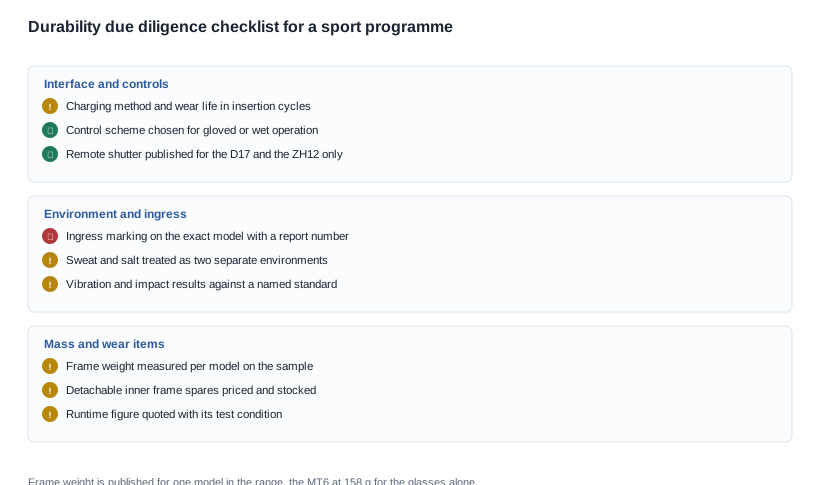
The shortlist criteria for a sport configuration should be written down before the samples arrive, because the samples will otherwise be judged on appearance. A workable set is short: the interface and its wear evidence, the ingress evidence, the control scheme, the mass distribution, the availability of a service part for the wear items, and the runtime figure quoted with its condition. Anything a supplier cannot answer from a document should not be a criterion, because it cannot be enforced.
Where an answer does not exist, the honest response is to specify for it rather than to leave it open. A brand can state that the charging interface must survive a stated number of insertion cycles in a stated environment, that the ingress evidence must name a standard and a laboratory, and that the frame weight will be measured on the sample and recorded by the buyer. Those become acceptance criteria on incoming inspection, and they become lines in the purchase agreement, which is a stronger position than a marketing claim that cannot be checked. The reverse is equally true: a criterion the buyer has not written down will never be enforced, and a supplier asked for it late will price it late.
Smart glasses durability specifications we can and cannot publish
We publish the ingress markings exactly as the catalogue states them, and we do not convert IP54 into a waterproof claim. We publish the electrical and interface rows — cell configurations, charge times, charging methods, published runtime figures — accurately, and we state plainly where a number does not exist. Frame weight is published for one model only. Seal materials, wear-life figures, vibration and impact data and test report numbers are not published across the range, and we will not reconstruct them from experience.
That position is useful in a design brief, because it tells you exactly which parts of the durability case are open. The parts that are closed are the interface per model, the charge time per model, the published runtime, the published cell configuration, the ingress marking where it exists and the detachable inner frame where it is published. The parts that are open are the wear life of every interface, the environmental qualification behind every marking, the material and service life of every seal, and the frame weight of every model except one.
Where a brand needs those open items closed, the route is the sample and the test rather than the catalogue, and the request should name the environment and the duration. A sweat-and-salt exposure profile, a temperature cycle, a drop and vibration profile and a charge-cycle count will each produce a document that can go into a purchase agreement, and each of them can be turned into an acceptance criterion on incoming inspection.
The other half of the evidence position is the record of what was asked and what was not answered. A programme that keeps a one-line register — the question, the date, the answer or the absence of one — will discover at the second order what it should have discovered at the first, because an unanswered durability question is almost always answered later at a higher price. That register is also the shortest possible handover document when a brand changes supplier or when a distributor takes over the warranty desk, since it records which questions were settled, which were conceded and which remain open. Brands that run sport programmes long enough to have a second and third generation of the same model tend to be the ones that maintain it.
Two pieces of commercial discipline belong alongside the technical work. Tooling and certification are quoted differently and are frequently bundled into a single line, so ask which one you are being quoted on: tooling is usually amortised across the first order, while certification cost and lead time follow the product family and the testing body. And because unit price, minimum order quantity, lead time, sample fee and warranty are not published on this site, they belong in the quotation, where a durability term and a commercial term can be read together rather than argued about separately.
The warranty wording deserves the same treatment as the technical rows, because a warranty term that is broader than the evidence behind it becomes a liability rather than an asset. Two lines are worth settling in advance. The first is which failures the warranty covers, and the realistic list is short: sweat-soaked temple, dropped temple, a temple joint that develops play, a charging interface that stops charging reliably, and a unit that does not complete a long ride on a single charge. Each of those should have an owner in the agreement, because a failure with two owners is a failure with none. The second is the evidence the claim requires, and asking for a short written description at the point of return is what stops a design fault being returned as a user error. Nothing about that wording is published on our side either, so it is negotiated per programme rather than inherited from a template.
The sport and cycling brand solutions page covers how this programme is structured end to end. The IP ratings reference sets out what each designation does and does not establish. The sport smart glasses range lists the published rows for the configurations in this article, and sport smart glasses for cycling covers the rider use case in more detail.
Related reading
- Sports and cycling brands
- IP ratings for smart glasses
- Sport smart glasses range
- Sport smart glasses for cycling
Tell us the discipline, the environment and the models you are considering and we will say which published figures apply and which durability evidence you would need to request.


