
Cycling is a good use case for this category and a poor one for vague product copy, because the ride has a length, the movement is continuous, and the environment is unlike an office or a shop floor. A rider puts the product on and takes it off once, it is on the head for hours, it is exposed to moving air and to whatever the weather is doing, and it may be mounted on the bike rather than carried. Those four facts decide which of the published rows matter, and they are also the facts a buyer has to ask a supplier about, because the catalogue answers some of them and not others.
The catalogue publishes three products in the sport line. One carries two 70 mAh cells, a rated endurance in the region of eight hours, a two-hour charge ceiling and magnetic charging, with a feature line describing a surround-sound arrangement and a long battery life. Another has a 115 mAh cell, a rated endurance of about seven hours, a charge time of about an hour, a Type-C port, a remote shutter and a surround-sound arrangement. The remaining one uses a 100 mAh cell, is rated at about eight hours, and takes roughly an hour to charge over the same port, with a remote shutter and a stereo surround arrangement. There is no protection rating published for any of them, no weight, no geometry and no camera specification of any kind.
That is enough to sort the products against a ride profile, and it is nowhere near enough to write a product page. This article does the sorting: what the published rows settle for a rider, the two ride profiles that generate completely different question sets, the questions a camera function raises when the unit is mounted on a handlebar, the geometry questions that come with a helmet, and the question set to send before a first order is placed.
Sport smart glasses for cycling: what the published rows can and cannot settle
Three of the five published rows carry usable information for a cycling deployment, and they carry it in a way that is easy to misread.
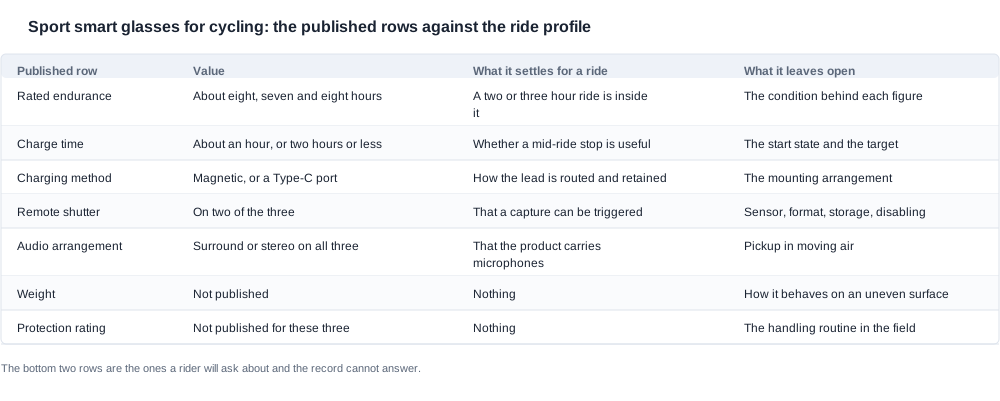
The rated endurance is the row that decides whether the product covers a ride at all. The three published figures sit at about eight hours, about seven hours and about eight hours. Against a ride of two or three hours, all three sit comfortably inside the figure, which means the endurance row is not the discriminator for the ordinary case. It becomes the discriminator only for a rider whose day contains a long ride plus a second block of use, or for a tour that exceeds the published figure. And the row has to be read as what it is: a rating published without a stated test condition, which makes it a planning number rather than a measured duration. A buyer who promises a customer "eight hours" on the strength of a rating has made a promise the record does not support, and the conditions question is the one to put to the supplier.
The charge time matters in a way it does not in most deployments, because a rider who tops up mid-ride is doing it in whatever time the stop allows. Two of the three products charge in about an hour, and one has a ceiling of two hours. Against a stop of ten minutes at a café, a roughly one-hour charge is of limited use and a two-hour ceiling is of no use, and the buyer has to decide whether the product is being sold as something that is charged at the start of a ride or something that is charged at the end of one.
The charging method matters more here than elsewhere, because a lead on a handlebar is a lead in the way. The two products with a Type-C port take a cable that the rider is likely to own and that can be routed and secured in the way a rider wants. The product that charges over a magnetic contact takes a specific lead that has to be sourced, stocked and replaced, and that has to be routed on a handlebar mount in a way the supplier should describe. The integration questions — where the lead goes, how it is retained, what happens if it is pulled — are the ones to put in writing.
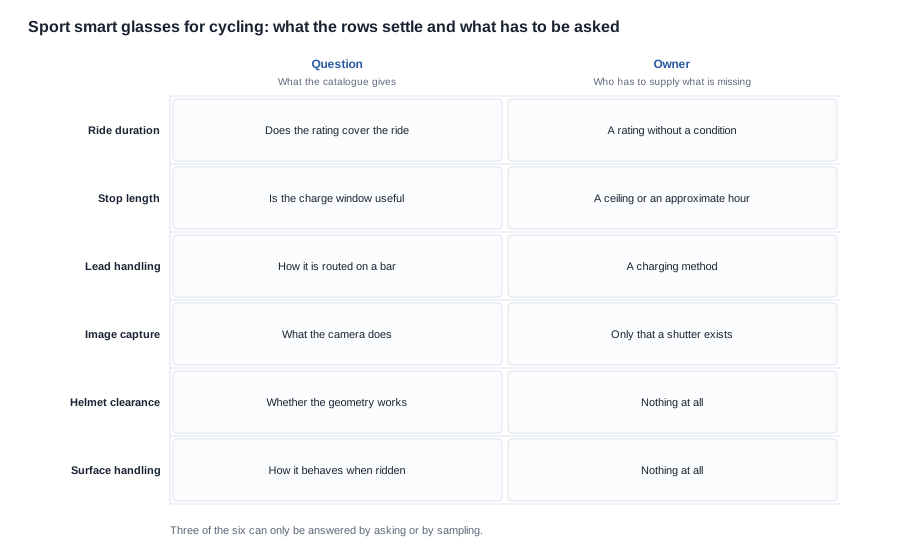
What the rows cannot settle is everything about the product as an object in a cycling environment, and it is worth being clear that this is not a complaint about the catalogue. It is a statement about where the evidence for a cycling purchase has to come from, and that is a question to put to a supplier rather than a gap to argue about. The weight is not published, and weight is what determines how a product behaves on a rough surface or in a crosswind. The geometry is not published, and geometry is what determines whether a product clears a helmet, whether a strap catches a temple, and where the controls sit relative to a glove. The camera specification is not published — no sensor, no field of view, no video format, no frame rate — so the two products with a remote shutter can be described as having one and nothing more. And none of the three carries a protection rating, so no claim about water, sweat or impact can be made on their behalf, which means the routine in the field has to be specified rather than assumed.
Two kinds of ride, and two different sets of questions
The published rows are much more useful once the ride is described, because a ride is not one thing, and because the criteria for the comparison change with it. What to ask is decided by the profile; the comparison itself is fixed by what the catalogue publishes. Two profiles cover most of what a channel will sell into, and they generate almost disjoint question sets.
The road and commute ride is bounded, predictable and usually charged at one end. A ride of thirty minutes to two hours, a fixed start and a fixed end, a destination where the product can be charged or left. For this profile, the endurance row is comfortable, the charge time is largely irrelevant because the product is charged at the end of the day, and the questions that matter are about the audio arrangement in moving air, about the geometry under a helmet, and about what happens to a product that is carried rather than used for hours. A rider in this profile will mostly be listening to something, so the audio arrangement and the control ergonomics decide the outcome.
The long and the touring ride is where the endurance and the charge time stop being theoretical. A day of riding that is interrupted, or a ride that runs past the point where the product has been used since it was last charged, changes the question from whether the product is usable to whether it survives the gap. For this profile the endurance row, the charge time and the charging method all become load-bearing, and the buyer has to ask what the product does at the end of its rated use, what happens to a partially used unit that is switched off, and what a rider should expect when the product has been on for most of a day and the charge is not within reach.
There is a third profile that a buyer should not ignore, because it is the one a distributor will ask about: the product used for navigation, prompts or communication rather than for audio. A rider who uses the product for prompts holds it in a different relationship to the environment, and the question that matters is whether the product is usable at all when it is being handled, ridden with one hand, or mounted out of the way. That is a question about control placement and about whether the product is intended to be operated while moving, and it is a question the catalogue does not answer for any of the three.
The practical value of naming the profile is that it stops the question list from being generic. A buyer who has decided that the channel is commute-led sends a short list about audio, geometry and the handling routine. A buyer who has decided it is touring-led sends a longer list about endurance coverage, the charge window and the state at the end of a long day. Neither list is wrong, and the same supplier will answer them differently.
The camera function on a handlebar, and the questions it raises
Two of the three products carry a remote shutter, and in a cycling context that is not a small feature, because it moves the product from something that is carried to something that is operated. It also moves the product into a set of questions that a buyer has to ask, because the catalogue publishes nothing at all about the camera.
The questions are specific and they are not the generic ones.
What the camera actually is. No sensor, no field of view, no video format, no frame rate and no storage arrangement is published. Whether a still is captured or a clip, how long a clip can be, and what happens to the files once they exist are all unknown, and each of them changes what a rider can be told and what a channel listing can say.
How a capture is triggered while the product is mounted. A remote shutter on a handlebar is used one-handed, or by a rider wearing gloves, or at a moment when the product is not on the head at all. Whether the trigger is a physical control on the product, a control in a companion application, or a separate button on the bike, changes the integration entirely.
What vibration does to the result. A camera mounted on a bicycle sees a continuous, low-frequency environment rather than a stable scene. Whether the product is mounted on the handlebar, on the rider, or on a stem mount is a decision the buyer has to influence at the design stage, and the supplier has to say what mounting position produces a usable capture.
What the files are and where they go. Whether a capture is stored on the product, forwarded to a paired device, or held elsewhere determines the privacy, the storage and the aftersales treatment of a product that a customer uses in public.
Whether the shutter can be disabled. In some channels the buyer will be asked for a product that cannot take a picture, or a product whose camera is visibly indicated when it is active. Neither is published, and both are ordinary commercial requirements that a distributor will raise.
What a buyer must not do is write any of this into a listing as a capability. The feature line establishes that a remote shutter exists. Everything else about it is a question, and the questions are the work.

Mounting, sizing and the helmet
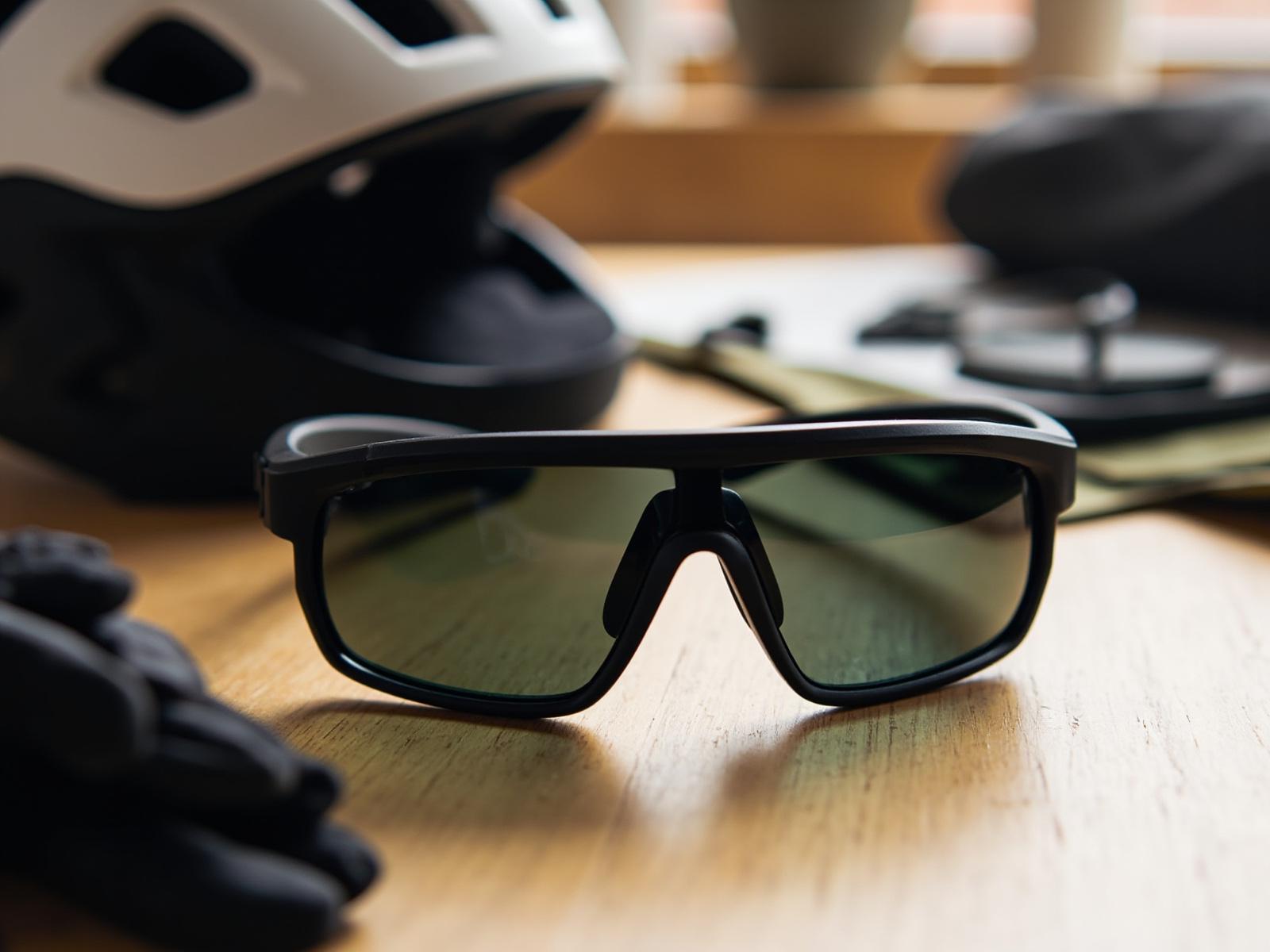
A cycling product is usually in contact with a helmet, and that single fact produces a set of geometry questions that a desk-based sizing exercise never reaches.
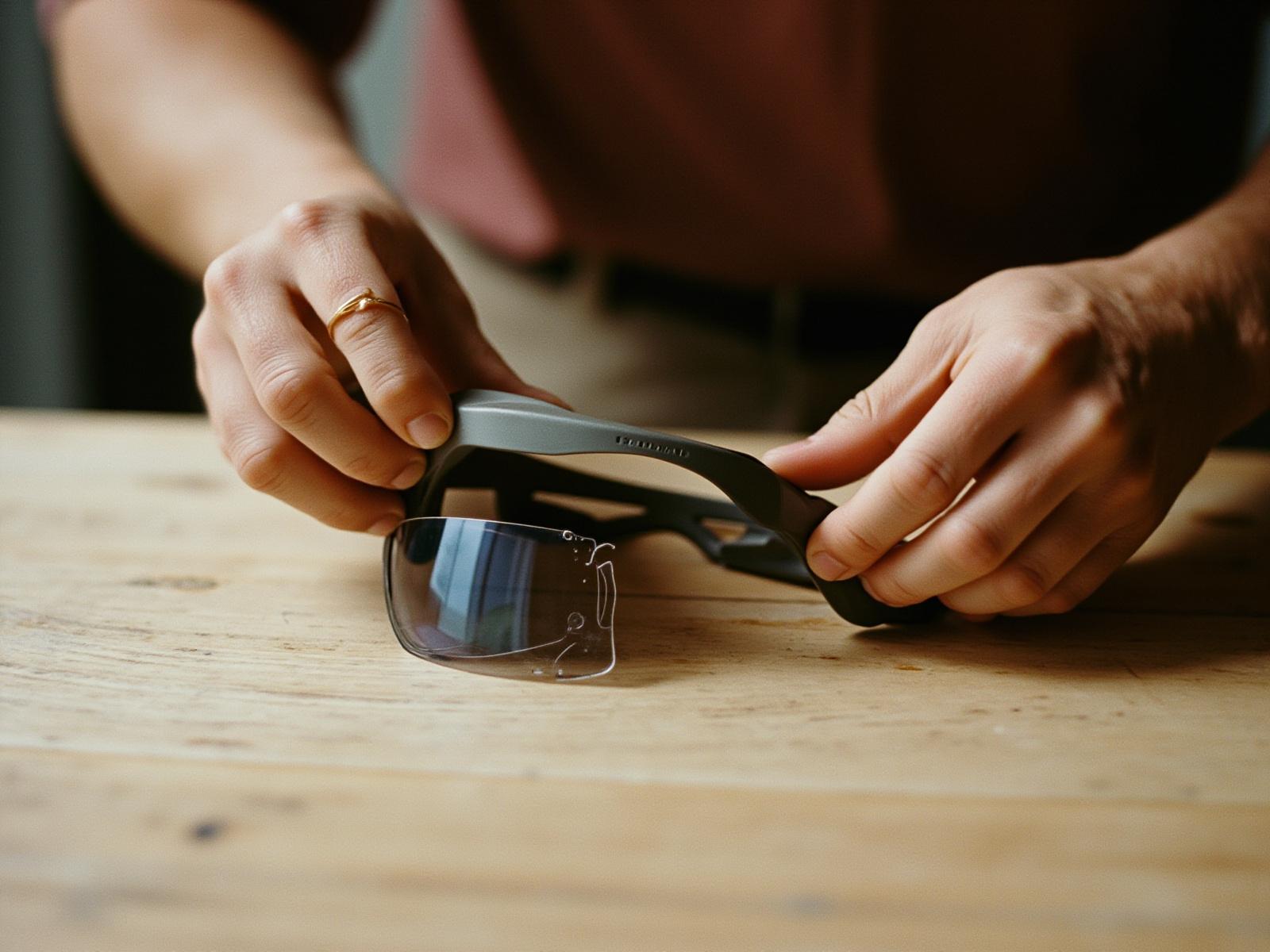
Whether the temple clears the helmet. A helmet has a retention system with straps and a cradle, and the geometry of the two has to coexist with the geometry of the product. The catalogue publishes no temple length, no lens width and no frame material for any of the three, so the question of clearance cannot be answered from the record at all.
Where the temple sits relative to the retention strap. This is the practical version of the same question, and it is a question for a sample rather than a number. A temple that lands where a strap runs will be moved by the strap, and a product that is moved by the strap does not stay where the rider put it.
Whether a helmet can be worn over the product or the product over the helmet. Some riders put the product on first, some put the helmet on first, and the order changes what the product has to clear.
Where the controls sit. A control on a temple has to be reachable with a glove on and without taking the eyes off the road, and the two products with a remote shutter have a control to place. That is a geometry question and a human-factors question at the same time, and the catalogue is silent on both.
How the product behaves on a rough surface. Weight is not published, so this cannot be answered from the record, and it is a question a buyer should put to the supplier rather than assume from the shape of the product. It is also a question whose answer is cheaper to obtain than to discover from returns.
How the product is carried when it is not being used. A rider who takes the product off at a café leaves it on a table or in a pocket, and the handling regime for that environment is part of what the buyer is buying, whether or not it appears on the packaging. The catalogue carries no protection rating for these three, so the routine in the field is a decision the supplier has to describe and the buyer has to write into the instructions.
The sizing note covers the six measurements that have to come out of a sample, and the reasons a rider's head is a harder population to size for than a desk sample. The helmet makes it harder again, because the two shapes have to coexist rather than simply meet, and a tolerance that works on a head alone will not necessarily work when a retention strap is in the way.
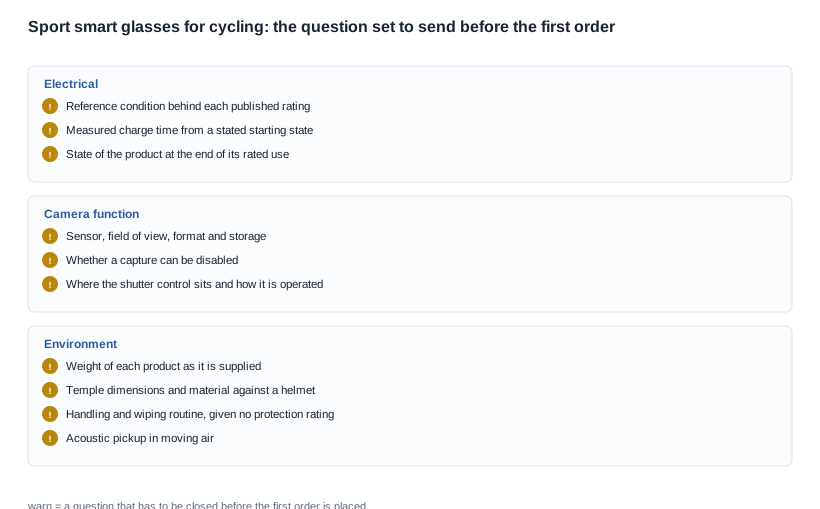
A question set to send before the first order
The list below runs in the order the answers are needed, with the slowest items first, and it is written to be sent as a numbered set rather than as a paragraph.
- The reference condition behind the published rated endurance for each of the three products, and whether the three were measured on the same basis.
- The measured charge time from a stated starting state for each, against the published ceiling or the published roughly one-hour figure.
- How the charging lead is routed and retained when the product is mounted on a handlebar, for the product that charges over a magnetic contact.
- The weight of each product as it is supplied, and the supplier's own view on how it behaves on an uneven surface.
- The camera specification for the two products with a remote shutter — sensor, field of view, still or video, format, storage and whether a capture can be disabled.
- Where the shutter control sits, and whether it can be operated with a glove on.
- The temple dimensions, the frame material and whether the temple can be adjusted, against a helmet retention system.
- The handling and wiping regime for the product, given that none of the three carries a protection rating.
- What state the product is in at the end of its rated use, and what a rider should expect if the product is switched off before the end of a ride.
- The acoustic arrangement in moving air, and what the supplier is able to say about noise pickup at speed.
Ten questions, and the test for the answers is short: each figure arrives with the condition it was taken under, each description with the method it was taken with, and each document with a date. That is also the shortlist test a buyer can apply to any supplier in this category, and it is a better test than the price because it is the one thing that cannot be faked after the first shipment. The red flags to look for are a runtime promise without a condition, a camera claim that has no specification behind it, and a weight figure quoted for a different configuration. A supplier who answers the endurance question with a reference condition and the camera question with a document is a supplier a channel can build a product page on; one who answers both with adjectives is supplying something that has to be rewritten before it is published.
The audio note for cycling deployments sets out the acoustic questions for the same use, and the wider selection sequence is set out in the buying guide for this line.
Our own position is that we publish the electrical rows and the feature details for the three products in this segment and nothing else, so we will not state a weight, a geometry figure, a camera specification or a protection rating for any of them, and we will not describe any of them as suited to a particular activity. What we can do is set out which published row answers which part of a cycling deployment, which parts of a ride profile are unanswerable from the record, and the questions that have to be put to the supplier to close them. How to choose between the three, and what a rider is actually being promised, follows from those answers rather than from the category name.
If you are building the question set for a cycling channel, give us the ride profiles you expect to sell into, the mounting method you intend to recommend, and the three configurations in front of you, and we will return the questions in priority order with the ones that can be answered from a sample separated from the ones that need a document.


