

Conclusion first: smart glasses for sports and outdoor battery planning is a question about the session, not about the cell. The assumption that a device gets charged at the end of each day is the one that breaks first in this category, and it breaks in a repeatable way — the outing lasts longer than the battery, there is no charging opportunity during it, and the product becomes a device that is switched off rather than a device in use. A buyer who plans from the published cell capacity is planning from the wrong number.
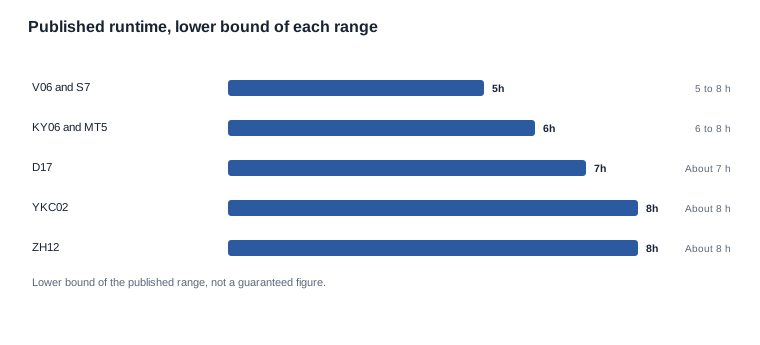
The published material is specific enough to plan against. Charge time appears in the catalogue for every model: twenty-six of the twenty-eight carry a figure of two hours or less, and two publish roughly one hour instead. Runtime appears in four bands across the models relevant to sport and outdoor use. The V06 and the S7 are published at five to eight hours; the KY06 and the MT5 at six to eight; the YKC02 and the ZH12 at about eight; and the D17 at about seven. Case capacities are published at 900, 1200 and 1400 mAh on three models, with two further models carrying a case of unstated capacity. What none of those rows carry is a test condition, and without a test condition a runtime figure cannot be transferred to your duty pattern.
Who does this planning, and against what
A brand owner is deciding what the product is for, and the session length is the first constraint that has to be written down.
A procurement manager is assembling the specification and the request, and needs to know which rows will come back published and which will come back blank.
A channel buyer is choosing between a product with a case and a product without one, and that choice is made on the duty pattern rather than on the cell.
The two numbers a plan is built from
Session length, which is a property of the activity and not of the product. A ride, a hike, a race, a ski day and a multi-day traverse are five different planning problems, and only one of them is comfortably covered by a seven-to-eight-hour published runtime.
Charging opportunity, which is a property of the environment. A vehicle, a lodge, a trailhead and a group campsite are four different answers, and the answer decides whether the case is a second battery or a weight in a pocket.
Smart glasses battery planning starts with the duty cycle
A duty cycle is a statement of how long the product is actually active, in what mix, and how long it sits idle between those active periods. It is the input that turns a published runtime into a plan, and it is the input a supplier will never provide, because it belongs to the buyer.
Three patterns cover almost all of sport and outdoor use, and they behave very differently against the same published figures.
The continuous pattern. The product is in use for the whole session — navigation, guidance, or continuous capture. This is the pattern the published runtime figures most closely describe, and a product quoted at five to eight hours will deliver something in that band if the load is what the catalogue assumed. The failure mode is treating the band as a floor.
The intermittent pattern. The product is active for a few minutes at a time and idle for long stretches. Here the published figure is not directly usable, because idle consumption is what turns a long session into a short one, and the catalogue publishes no idle figure for any model. The planning question becomes what the supplier will commit to for a stated duty pattern.
The capture-heavy pattern. The camera is running for part of the session and the rest of the time the product is idle or in a standby state. This is the pattern where the resolution tier matters, because the V06 and the S7 share the same electrical platform and the same five-to-eight-hour published runtime while sitting in different resolution classes.

The criteria a battery plan is judged against
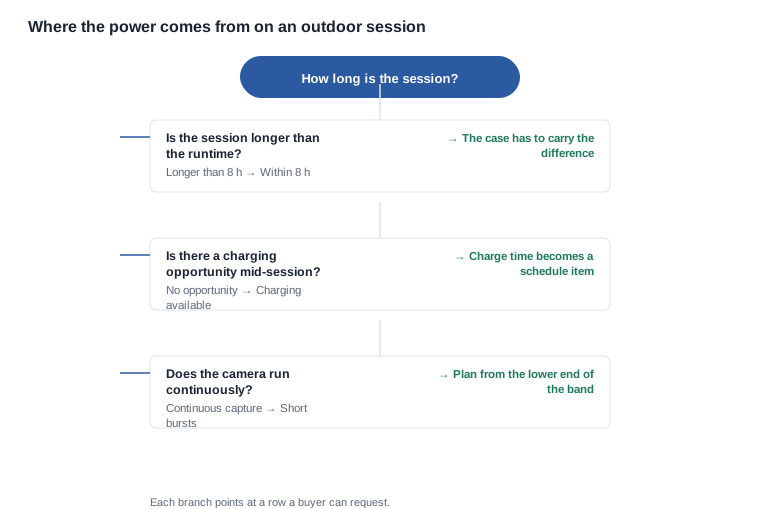
Four criteria decide whether a plan is workable, and each one disqualifies a different kind of programme. Does the session fit inside the published band? If the outing is longer than the runtime, the plan needs a second power source or a different model, and that decision has to be made before the shortlist. Is there a charging opportunity? A plan that depends on a wall socket at the trailhead is a plan with a schedule attached to it, and the schedule is what makes it fragile. What is the load during the session? Continuous capture and periodic capture are different loads against the same published figure. What is the ambient temperature? A cell in the cold holds less available capacity and its seal stiffens, and the catalogue states no working range for any model, so a winter deployment is an unanswered question rather than a solved one.
The output of this assessment should be a plan with a margin attached, not a model name. The margin is the part buyers usually skip: a route with a published eight-hour runtime and no charging opportunity for ten hours needs either a different model or an honest statement that the product runs for the first portion of the route. Deciding that margin before the shortlist is scored prevents the most expensive version of the mistake, which is a range launched on a figure that nobody stress-tested.

What the catalogue publishes about charge and runtime
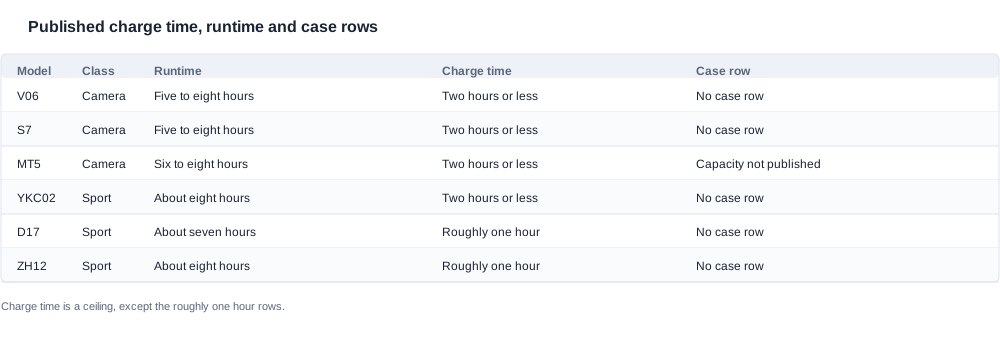
The published rows for the models a sport programme would consider are set out below, and the pattern in them matters more than any individual figure.
| Model | Class | Runtime | Charge time | Case position |
|---|---|---|---|---|
| V06 | Camera | Five to eight hours | Two hours or less | No case row |
| S7 | Camera | Five to eight hours | Two hours or less | No case row |
| MT5 | Camera | Six to eight hours | Two hours or less | Capacity not published |
| YKC02 | Sport | About eight hours | Two hours or less | No case row |
| D17 | Sport | About seven hours | Roughly one hour | No case row |
| ZH12 | Sport | About eight hours | Roughly one hour | No case row |
Two hours or less is a ceiling, and the distinction matters
Two hours or less is the figure published for twenty-six of the twenty-eight rows in the catalogue. That is an upper bound, not an exact figure, and it is a different assertion from a claim that charging completes in under two hours, because a ceiling of two hours permits a two-hour charge. Only the D17 and the ZH12 publish a faster figure, of roughly one hour, and those two are the only models in the entire range whose charge time is published as better than the ceiling.
The practical consequence is about planning rather than about marketing. If a product ships with a case that is charged overnight and the unit is topped up in the morning, a two-hour ceiling is acceptable and the difference between one and two hours is invisible. If the product has to be charged during a break at a trailhead or in a vehicle between two segments, then charge time becomes a schedule item, and the D17 and the ZH12 are the only models where the published figure is materially shorter than the rest of the range.
The runtime figures are published without a test condition
This is the gap that most often causes a planning error. A runtime published without a condition is not a number a buyer can promise. The catalogue states the hours; it does not state the volume, the screen state, the radio state, the capture rate or the ambient temperature the figure was measured at, and a buyer who writes "eight hours" on a product page without the condition is publishing a guarantee the supplier has not made.
The right handling is to ask for the figure under the pattern you will actually ship in, and to publish the figure with its condition attached. That request is one of the most valuable in the whole set, because a supplier who will commit to a duty pattern has effectively taken responsibility for the product's behaviour in your channel. It is also a good question to ask of more than one supplier, because the answers are not comparable in advance and the comparison is the point.
The questions to ask before the plan is fixed
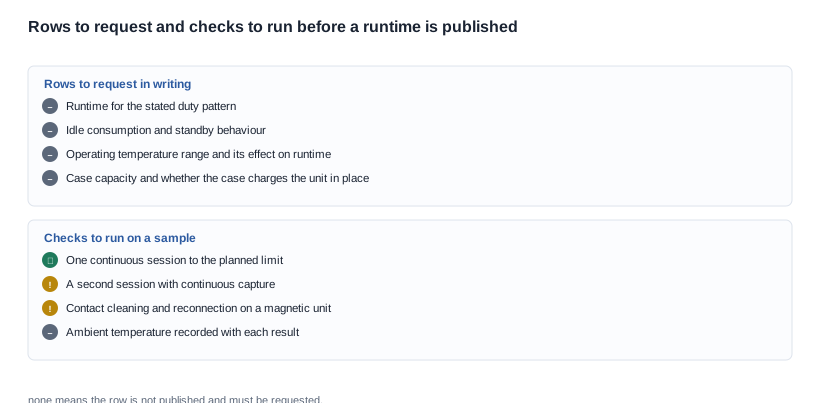
The unstated rows become a request list, and the request list is more useful sent as one document than raised piecemeal. What is the runtime under our stated duty pattern? What is the idle consumption and the standby behaviour? What is the operating temperature range, and how does it change the runtime? What is the case capacity, and does the case charge the unit in place? What is the service life of the charging contact in insertion cycles, which is the number that decides whether the accessory strategy survives a season? Asking these before you order is what separates a procurement decision from a guess.
Building a session plan from the published runtime rows
A plan in this category is a small calculation once the duty cycle is written down, and the calculation has four inputs.
Input one: the active window. Write down the longest continuous period during which the product is expected to be in use without a charging opportunity. For a long ride this is the full ride; for a hike it is the longest leg between resupply; for a race it is the whole event.
Input two: the load. A product with the camera running and a product with the camera idle are different loads, and the published runtime for the camera models — five to eight hours on the V06 and the S7, six to eight on the KY06 and the MT5 — describes a camera-dominated load rather than a light one.
Input three: the case. Three models publish a case capacity — 1400 mAh on the CY03, the CY05 and the L1 Pro, 900 mAh and 1400 mAh on the L2 Utral, and 1200 mAh on the MT6's folding case. Two more, the KY06 and the MT5, are published as carrying a case without giving its capacity. Four camera models, the V06 and the V03 Pro, and the V03 and the S7, have no case row in the catalogue, so the case position for those four has to come back from the supplier before the plan is built on it. A plan that needs a second battery has to be built on a model where the case exists and its capacity is known.
Input four: the margin. Decide by how much the plan is allowed to fall short before the plan changes. A route with a published eight-hour runtime and no charging opportunity for ten hours needs either a different model or an honest statement that the product runs for the first portion of the route.
Planning a range rather than a single model
A brand is rarely planning one product; it is planning two or three configurations for the same channel, and each configuration carries a different duty cycle because each is aimed at a different kind of session. The shortlist criteria therefore have to be applied per configuration rather than per range, and the comparison only works if every candidate is measured against the same session description.
Three practical consequences follow. First, the duty cycle description has to be specific enough that two suppliers reading it independently would plan the same way, because a general description produces two different plans and a comparison that measures the description rather than the products. Second, where the published runtimes fall into different bands, the case position becomes the tie-breaker rather than the cell, since a long session is decided by the second power source. Third, the models whose charge time is published as roughly one hour deserve their own column in the comparison whenever the channel includes sessions with limited charging opportunity, because they solve a scheduling problem that the rest of the range leaves open.
The trade-off worth putting in front of a decision-maker is between the widest published runtime and the shortest published charge time, because the range does not offer both in the same model. That is a trade-off to be presented and decided in the open, not a gap to be discovered after the order is placed.
Testing a runtime figure against a real duty pattern
Verification here is not a laboratory procedure. It is a method for establishing whether the published figure survives contact with the pattern the product will actually be used in, and it has four steps a procurement team can run without specialist equipment.
Run the session, not the demonstration
A short demonstration exercises the product in its best state: full charge, moderate temperature, light use. The failure appears in hour five. A verification plan should therefore schedule at least one continuous session that runs to the planned limit, with the product charged immediately beforehand and with the charge method the customer will actually use.
Vary the load deliberately
Run the session once with the camera used in short bursts and once with it used continuously, and record the point at which each run fails. The difference between the two results is more useful than either result alone, because it is the number that tells a buyer how much of the published runtime survives a heavy capture day.
Test the charging method the product ships with
A magnetic contact in a temple exposed to sweat and road grit picks up a film over time, and the unit then charges only some of the time — which is routinely reported to a supplier as a faulty product. If the product ships with a magnetic interface, the verification has to include the contact being wiped and reconnected, and the observation has to be recorded. A Type-C product has a different failure profile and a different care instruction, and the two cannot be assessed against each other without reading the interface row first.
Record the conditions with the result
The number is only usable later if the conditions travel with it. Record the ambient temperature, the charge method, the capture pattern and the starting state. Without those, a second run cannot be compared against the first, and the verification has to be repeated from the beginning. The battery life reference covers the measurement side, and the durability engineering reference is where the interface service life that a charge plan depends on is treated.
The commercial shape of a battery-planned programme
Battery planning is commercial because the accessory set, the parcel and the support model all follow from it, and because a product sold with a case and a product sold without one are two different programmes.
The accessory set and the parcel
Where the configuration includes a case, a second cell travels in every unit, and the paperwork travels with it: what the carton declares, how the packing instruction is worded, how the consignment is classified for transport, and how heavy the parcel is. The published case capacities — 900, 1200 and 1400 mAh — make the magnitude of that decision concrete, and the difference between a 900 mAh case and a 1400 mAh case is a packaging difference as much as an endurance difference. A buyer planning on the case's endurance should also plan on the freight, because both scale with the same object.
What the plan costs in support
An intermittent duty pattern the product cannot sustain generates returns that are attributed to the product rather than to the plan. A published runtime without a condition, reproduced on a product page, guarantees that some customer will hold the product to a standard it was never measured against. The cheapest protection available to a brand is the wording on the page and the wording in the agreement, and both cost nothing to get right at the start.
What a battery plan settles on the commercial side
- The price and the volume breaks — the part of a quotation a buyer can move.
- Whether the case is configurable, and the order quantity that goes with it.
- How the case is packed, and how a consignment is split.
- Settlement — against a passed inspection.
- Cover and the reply it promises — the period and the response time.
- The returns policy for an outdoor channel.
- Terms for a trial shipment.
- What certification and tooling amount to — outside negotiation. The testing body sets both the amount and the schedule, and the factory recovers tooling over a second order while billing certification against every family it holds. Read the quoted line back and establish which of the two it is. We publish the charge and runtime rows as the catalogue states them, including the ceiling wording and the absence of a stated test condition, and we do not convert "two hours or less" into a faster claim. Two rows in the catalogue beat that ceiling, and both of them are the roughly one hour figures published for the D17 and the ZH12.
The first three questions to settle before a shortlist
- Write the duty cycle down — the longest active window, the capture pattern, and where charging can happen.
- Send the unpublished rows in one request: runtime for a stated duty pattern, idle consumption, the temperature range, and the case position and capacity for the configurations in scope.
- Run one continuous session to the planned limit in the shipping configuration, and publish the figure together with the conditions that produced it.
The sport smart glasses range lists the models whose published rows bear on this decision, and it is the natural place to begin the shortlist once the duty cycle exists. Smart glasses for sports and outdoor battery planning is settled by the session and the conditions, and the published charge and runtime rows are the starting point rather than the answer.


