
A weather claim on a smart glasses listing is a promise the buyer cannot take back. Once a distributor, a marketplace reviewer or a retail customer sees the word "waterproof" in your listing, the expectation is set, and the returns that follow are charged to your margin and your brand name rather than to the factory that built the hardware. That is why the most useful thing a smart glasses buyer can do about weather is not negotiate a better price on a sealed product. It is establish exactly which weather facts exist, and refuse to publish a claim the evidence does not carry.
The catalogue gives a narrow and specific starting point. Two models in our range carry an IP54 marking: the V06 and the S7. Nothing else in the catalogue carries an IP marking of any kind. Around that single published fact there is a large set of published absences that matter just as much commercially. There is no third-party test report number behind the marking. There is no operating temperature range for any model in the range. There is no published thermal behaviour, no published cleaning procedure, no published immersion survival, and no published charge behaviour in the cold. The runtime figures the catalogue does carry are stated with no test condition attached at all.
Two models out of twenty-eight is a thin basis for a category-wide weather story, and it is a perfectly good basis for a precise one. The rest of this article sets out how to work from that narrow evidence base: how to read the marking correctly, how to answer the four weather cases a buyer actually meets, which facts have to be produced by sampling, and how to write a listing that survives contact with a customer in the rain.
The commercial exposure of getting this wrong is larger than it first appears, and it lands in places a buyer does not control. A marketplace listing with an unsupported weather claim can be challenged by a competitor and pulled by the platform. A retailer who takes a return on a corroded device will not negotiate the cause, they will negotiate the credit. An insurance or freight claim on a consignment that arrived wet needs a document, and if the only document is the listing, the claim fails. None of these are dramatic, and all of them are caused by a single adjective in a specification block that somebody approved in a hurry.
It is also worth being honest about what this category's buyers tend to assume. "IP-rated" is often taken to mean the device can be worn in the rain without consequence, and "IP54" is often taken to mean the same thing as a higher rating because the two digits look impressive. The correct response to that assumption is not a longer specification. It is a short, quotable sentence that a channel partner can repeat: splash protection, not immersion, and no temperature data. A sentence that short survives contact with a distributor's sales team, which is where a product description actually lives.
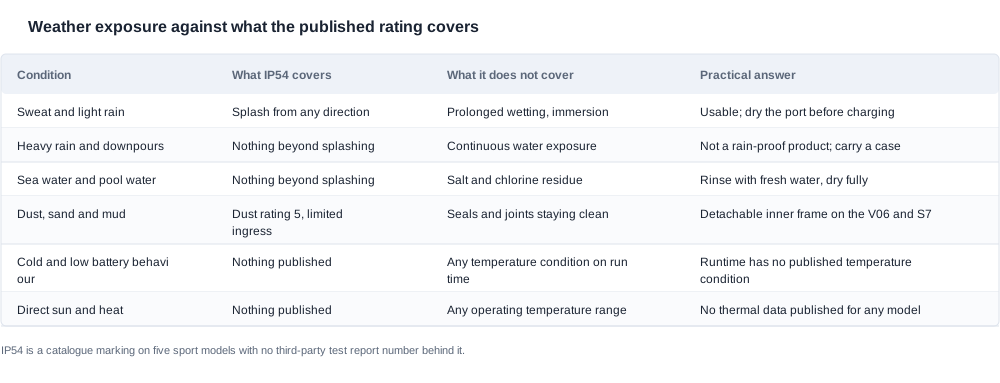
Smart glasses weather exposure: what the marking covers and what it does not
IP54 is a two-digit code under IEC 60529, and the two digits mean different things. The first digit, 5, is a dust ingress protection rating: protection against dust entering the enclosure, with limited ingress permitted rather than a complete seal. The second digit, 4, is a water ingress protection rating: protection against water splashing against the device from any direction. It is a splash rating. It is not a water jet rating, it is not an immersion rating, and it does not cover a sustained downpour, a pressure washer, a hose, or a drop into a river.
The practical consequence for a buyer is that an IP54 smart glasses product can be described as splash-protected, and cannot be described as waterproof. The word "waterproof" is a claim that the consumer will test at the worst moment possible, usually without the product in its case and usually in a way no standard anticipates. Replacing it with the bounded language of the marking costs nothing in the specification sheet and saves an entire returns stream.
What sits behind the marking is equally important, because a marking without a test report is a marketing assertion and a marking with one is a specification. Our catalogue publishes the IP54 designation for the V06 and the S7 and publishes no test report number, no laboratory, no test date and no test condition alongside it. This is not a criticism of the design; it is a fact about the published evidence, and it changes the kind of question a sophisticated buyer asks. "Do you hold the test report?" is the question. "Is it IP54?" is the easy one, and it is already answered on our product page.
That distinction also changes what you do with the answer. If the factory holds a report, you can request it, file it with your own compliance records and cite it in a channel where a buyer will ask for substantiation. If the factory does not hold a report for that model, then the marking is what it is and the only route to a stronger weather claim is a stronger product, which is a design conversation and an NRE conversation rather than a paperwork fix.
It is worth noticing which two models carry the marking, because the position is easy to misread. The V06 and the S7 both sit in the eleven-model camera range rather than in the three-model sport range. They are the platforms with a camera, a battery in the 220 to 290 mAh band, a rated runtime of roughly five to eight hours with no test condition stated, a detachable inner frame, and a published ingress marking. The sport models — the D17, the ZH12 and the YKC02 — publish none of that marking, and in exchange publish the faster charge time, the remote shutter and the twin-cell arrangement. A buyer whose weather requirement is non-negotiable and whose charging requirement is also non-negotiable is immediately in a trade-off, and the trade-off is visible in the catalogue rather than hidden in a quotation.
A second published absence deserves attention because it is the one most often assumed to exist. The catalogue publishes no capacitive touch row and no translation row for any model, and it publishes no operating temperature range, no ingress description for any model other than the two marked IP54, and no water-resistance figure for any of the audio or sport models. If your shortlist is built on a weather requirement, that requirement will not be answered by the specification table alone. It has to be answered by a question and, eventually, by a sample.
There is one further reading worth doing before you write anything, and it is about the number rather than the letters. A rating of 54 is a relatively demanding pair by the standards of this category, and the second digit in particular is not free. A design that reaches 4 in the water column has to survive splash from every direction, and the ways to reach it — sealing the seams, protecting the acoustic ports, capping the charging contacts — have visible consequences for the product. Those consequences show up as a heavier frame, a different acoustic signature, a charging arrangement that needs its own instruction, or a product that cannot be rinsed. Ask what the rating cost in product terms, because the answer tells you what the end user will notice, and a buyer who knows the trade-off can sell it honestly instead of discovering it in a warranty claim.
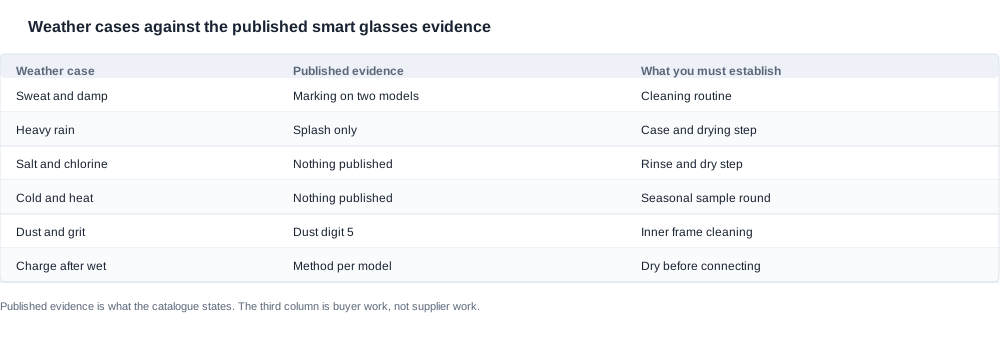
Four weather cases and the published smart glasses answer for each
Most weather conversations collapse into "is it waterproof", which is a poor question because it produces a single yes or no for conditions that behave very differently. Splitting the exposure into four cases gives each one a specific answer that can be written into a listing, a manual, or a support script.
Sweat, condensation and repeated damp use. This is the case the IP54 marking was designed to absorb, and it is the daily working condition for a sport product. The published configuration answers it in three ways. First, the marking itself on the V06 and the S7. Second, the detachable inner frame on those same two models, which is the genuinely practical answer to a contaminated frame because the skin-contact part can be removed and cleaned rather than washing the whole device. Third, drying the charging contact or port before reconnecting a cable, which is a behaviour that belongs in the user manual rather than in a spec sheet.
Rain at volume. A cyclist in sustained heavy rain is outside the IP54 marking, and a product listing that says otherwise is a listing that will generate returns. The defensible product answer is structural rather than rhetorical: a charging case that keeps the device dry between rides, plus listing language that states what the marking covers. Note also the charging-method interaction, because a device that has been rained on and is then put on a magnetic charger or a Type-C cable with moisture still in the port is a reliability risk regardless of the ingress rating. We publish charging method per model, but the drying instruction is a programme decision, not a catalogue line.
Salt water, chlorine and residue. Sea water and pool water are more corrosive to electronics than fresh water, and the mechanism is residue rather than the liquid itself: the salt or chlorine stays on the surface after the liquid evaporates and holds moisture against contacts and seams. A buyer selling into coastal or pool markets should treat a rinse-and-dry procedure as a required deliverable. We publish no cleaning procedure for the sport range, so if that procedure matters to your channel, it has to be written, agreed and shipped with the product rather than assumed.
Cold, heat and direct sun. Nothing is published for any of these. The runtime figures in the catalogue carry no temperature condition, and a lithium cell near freezing does not behave like one at room temperature, in either direction. The front of a camera-equipped frame in direct sun is the worst thermal case in the whole category. This is the case where the sample is not optional, because there is no document anywhere in our published material that will settle it.
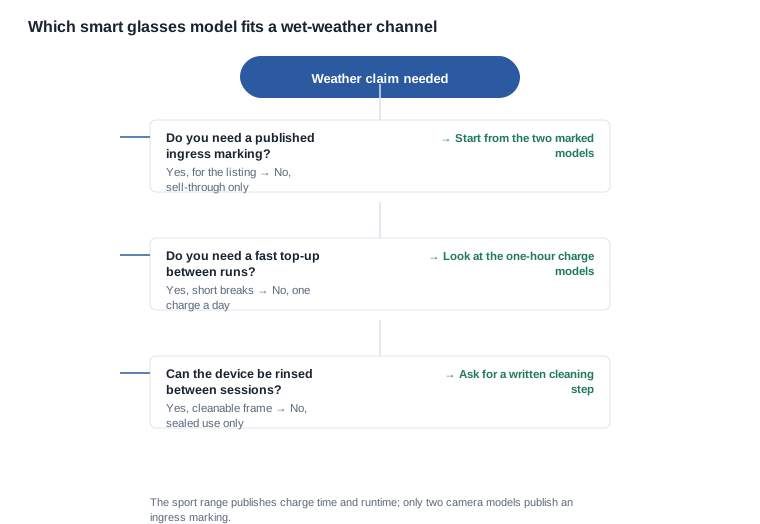
The sport range itself gives a useful contrast. The D17 and the ZH12 publish a Type-C charge of about one hour, a remote shutter, a surround audio claim and rated runtimes of about seven and about eight hours respectively, on cells of 115 mAh and 100 mAh. The YKC02 publishes two 70 mAh cells, magnetic charging, a surround audio claim and a long runtime figure of about eight hours. None of the three sport models carries an IP marking, and none of them publishes a detachable inner frame. The V06 and the S7 publish the IP54 marking and the detachable inner frame but sit in the camera range rather than the sport range. A shortlist decision for a wet-weather channel is therefore a choice between two different published strengths, not a ranking of one range over another.
The one-hour charge figure is worth more attention than it usually gets, because it changes behaviour rather than merely describing a spec. A cell that takes an hour to fill can be topped up in a break at a café, which turns a battery from a hard limit into a soft one. A cell that takes the published ceiling of two hours or less cannot be topped up in the same way. If your channel sells into long sessions, rides or shifts where the user cannot wait, that difference is a product decision and it is visible in the catalogue.
Pulling the four cases together for a concrete buyer makes the shape of the decision obvious. Take a distributor selling into coastal cycling clubs, where the complaints they expect to receive are salt residue on the frame, a device left on a car seat in summer sun, and a unit that will not charge after a wet ride. Against that profile, the V06 and the S7 answer the first case on published evidence and the second and third on none at all. The D17 and the ZH12 answer the top-up behaviour on published evidence, and the salt and the heat on none. The YKC02 answers the runtime length on published evidence, and everything else on none. Every one of those answers is a fact you can put in front of a channel partner, which is a much stronger position than a single adjective at the top of a listing.

Where smart glasses claims have to be built on samples
Three of the four cases above cannot be closed with a document, because the documents do not exist. What a buyer can do is convert them into a sample plan, which is a different and much cheaper activity than discovering the problem after tooling.
The first step is to separate the requirement into what can be observed and what has to be measured. Contamination on the skin-contact frame is observable. Whether the rating survives a specific abuse sequence is measurable but needs a defined procedure, and that procedure has to come from somewhere — most often from the factory's own test documentation, which we do not publish for these models, or from a third-party laboratory you appoint yourself.
The second step is to build the abuse sequence into the sample brief rather than leaving it to the supplier. A wet-weather sample brief that says "IP54" is a brief that tests nothing, because the sample is expected to pass by default. A brief that says "operate in the stated condition for the stated duration, then confirm function, then charge" tests something, and it produces a record you can keep.
The third step is the season. If your channel sells into a winter market or a monsoon market, the thermal data you need does not exist for any model in the catalogue, so it has to be created on samples in the actual conditions. Budget for that in the sample plan and in the timeline, and treat a winter sample round as an engineering activity rather than a formality. This is also where a factory earns or loses trust: a supplier who accepts the seasonal test without argument has a different credibility profile from one who says the published runtime is valid regardless.
The fourth step is the change control that follows. If a sample fails a weather case, the fix is usually a design change, and a design change before tooling is cheap while a design change after tooling is a negotiation about money that nobody enjoys. That is the real reason to move the weather question early, and it is why the requirement brief rather than the sample round is where the answer belongs.
A sample brief for a weather case is a short document, and most of the value is in specifying what to do rather than what to avoid. Six items carry most of the weight:
- The condition and its duration. Not "IP54" and not "waterproof" but a sequence with a start, a hold and an end, and the humidity or temperature if it matters.
- The state of the device at the start. Charged or not, case closed or open, frame assembled or the inner frame removed. Contamination tests are meaningless without a stated starting state.
- The function checks. What must still work afterwards, in what order, and how long after the exposure the check happens.
- The charging check. Whether the device charges immediately after exposure, and whether that is a pass or a fail. This is where the wet-ride complaint actually originates.
- The visual and cosmetic standard. Whether residue, discoloration, lens coating haze and marking legibility count as a failure. These are the failures that generate returns rather than tickets.
- The evidence format. Photographs, a video, a signed record, and a statement of who ran the test. A test without a record is a conversation.
A brief written this way can be sent to more than one factory without rewriting it, which matters more than it sounds: the point of a brief is comparability, and comparability is what lets you build a shortlist on criteria rather than on a relationship. It also makes the negotiation with any factory that quotes against it a negotiation about a specific, written condition, which is a very different conversation from a negotiation about a general impression.


Listing language for smart glasses sold into wet climates
The highest-leverage change a buyer can make is language, and it is free. A product described as waterproof and a product marked IP54 are different claims with different evidence behind them, and only one of them is bounded. Write the marking in the specification block, on the packaging, in the manual, and in the retail listing, using the same words in all four places. Inconsistency between the box and the listing is what produces the complaint, because the customer compares them.
The second change is expectation-setting on the case. In the sport and outdoor channel a charging case is not an accessory line; it is the answer to a downpour, and framing it that way changes both the listing and the commercial conversation about it. The catalogue publishes charging case capacity for only five models, and publishes case existence without capacity for two more, which means a case claim in a listing needs to be specific about which model it belongs to. Get that wrong in a channel and you will ship a listing for a model whose case specification nobody has verified.
The third is the seasonal trigger. Decide in advance which condition will force you to revisit the listing — the first sustained-rain complaint, the first winter review, the first marketplace listing that a competitor challenges — and set the threshold at which you go back to the factory with a sample question rather than with an argument.
The fourth is the record. Keep the published marking, the manual text and the listing text together in one file per model. When a channel questions the claim, the fastest answer is three documents that agree, and the slowest answer is a fresh round of email with the factory.
The fifth is the return path, which is where a weather claim is either vindicated or quietly abandoned. Decide before launch what your channel does with a unit that comes back corroded, wet or non-functional, and what evidence you require to accept it. Most programmes in this category leave that undefined, which means the default answer arrives instead: the listing quietly stops saying anything about weather, the returns keep coming, and nobody ever decides whether the product or the claim was at fault. If you intend to make a weather claim at all, the returns policy is part of the claim, and it is worth agreeing it with the factory rather than discovering it alone.
The sixth is the language your own staff will use. A channel partner's salesperson is not going to read your specification block; they will read the first two lines of your product copy and repeat them. If those two lines say "waterproof" because someone approved them in a hurry, no amount of careful language further down the page will correct it in the field.
A shortlist discipline for seasonal smart glasses channels
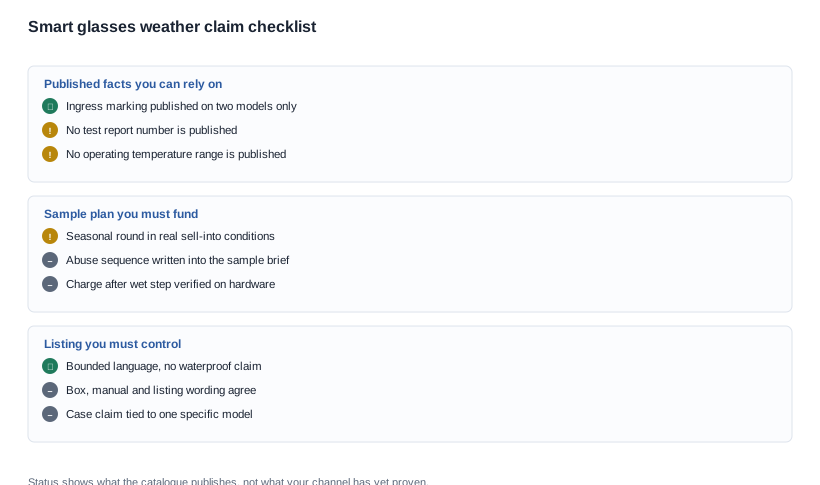
Shortlisting on weather is mostly a discipline of writing the criteria down before you look at the catalogue, because the catalogue will otherwise quietly do the sorting for you and you will end up with a shortlist of two models whether or not that was the right answer.
- Write the exposure profile, not the adjective. "IP54" is a criterion. "Usable in a wet-weather channel with a case" is a requirement. The first is a spec line, the second is a product decision that also implies a case in the bill of materials.
- Separate the two kinds of model in your shortlist. The V06 and the S7 publish the marking; the D17 and the ZH12 publish the fast charge and the remote shutter; the YKC02 publishes the twin-cell arrangement and the long runtime. A shortlist that mixes these without recording which published strength each one brings is a shortlist with no logic.
- Mark every criterion as document or sample. If it can only be settled on hardware, it goes in the sample plan with a season attached. This single column prevents most of the schedule surprises that come later.
- Set the due diligence questions in advance. The two that matter most are whether a test report exists for the marking on that model, and whether the supplier will run a seasonal sample round in the conditions you sell into.
- Decide the claim language before you negotiate price. The wording is a deliverable that costs nothing and protects the margin that the negotiation is trying to create. Writing it last means writing it under time pressure.
The trade-off across all five is the familiar one: the models with the strongest published weather position are the two that also carry a camera platform, a battery in the 220 to 290 mAh band and a rated runtime of roughly five to eight hours with no stated test condition. A buyer who needs a wet-weather claim and a long battery life in the same product is choosing between published strengths that do not sit on the same model, and that is a negotiation to have explicitly rather than a compromise to discover later.
A shortlist is only as good as the questions you put to it, and a weather shortlist needs a different question set from a feature shortlist. Six questions separate a factory that has thought about ingress from one that has copied a marking into a catalogue row. Does a test report exist for the IP54 designation on this specific model, and if so may I see it. Which lab ran it, under which standard, and on which production revision. What was excluded from the test. Will you run a sample under a specified exposure sequence, in which season, and with what record. What is the guidance for a unit that has been exposed beyond the marking. And who at the factory signs the report, so that a question six months later has a name attached to it.
Ask the same six of every factory on the shortlist, in the same order, and write the answers down. The value is not in the answers themselves, which may be identical in wording, but in the differences. A factory that answers the exclusion question in detail has an internal process. A factory that answers it with silence has a number on a spreadsheet, and you will find out which one you are dealing with when the first wet unit comes back.
The technical background sits under IP ratings and what they cover, the range itself is on the sport smart glasses page, and the sport-specific scenario is set out in smart glasses for cycling.
Related reading
- The marking in full — IP rating key specifications
- The sport channel view — solutions for sports and cycling brands
- The charging question in the same scenario — charging solutions
Tell us the climate and the season you sell into, and we will tell you what the published marking covers and what a sample still has to establish.


