

An ingress marking is the last thing a buyer should decide, and the first thing most buyers discuss. Two characters get quoted across a supplier table, the characters get compared as if one were simply a better version of the other, and the winning supplier's price is the number that goes on the purchase order. What actually decides the outcome is a line of text that nobody wrote down: what the product meets in service, for how long, and what happens afterwards. Write that line first and the code becomes a consequence; skip it and the code becomes a guess that the channel will test on your behalf.
IP rating smart glasses key specifications therefore has a specific answer. If your channel produces sweat, rain droplets and the occasional knocked drink, then a second position of 4 is the requirement, and a code carrying that position answers it. If your channel includes pressure washing, a sink, or a sustained downpour, you are buying a different programme with a different seal, a different test and a different cost, and no splash-level code will cover it. Ask for the report number before you ask for the price, and write the exposure into the order before you approve the packaging.
IP rating: what the two characters cannot carry
The short answer, and the three decisions behind it
The specification that matters is not the marking. It is the exposure description that the marking was derived from, written in the words the test procedures use, attached to the model designation and the configuration, and carried into the purchase order as an acceptance criterion. Everything else — the code, the standard, the report, the control plan — is evidence for that description, and a description with no evidence behind it is only a marketing position.
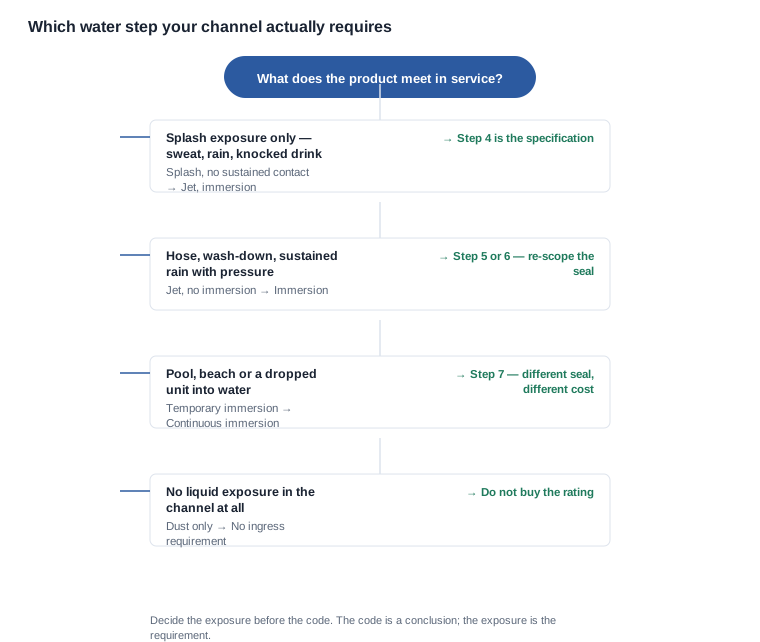
Three decisions sit inside that. The first is which of the four water steps the channel actually exposes the product to, because those steps are four different test procedures rather than one scale with four settings. The second is which solids position matters, and for most wearable channels it is the position that is never discussed: dust around a hinge and a port is a normal service condition, not an edge case. The third is what the requirement explicitly excludes, because an exclusion that nobody writes down will be filled in by the reader with the strongest possible reading, and the reader is the customer.
There is a fourth thing worth saying at the start, and it is the one that decides most programmes: in our own catalogue the IP54 marking appears on the V06 and the S7, as an annotation, with no third-party test report number published behind it and no standard, test condition, sample size or laboratory. That is not a shortcoming we are disclosing for effect. It is the reason this article exists. A buyer comparing two suppliers needs a method that works whether or not either supplier has a report, and the method that works is the one that starts from the exposure rather than from the digits.
The buyer at the moment the request arrives
The person who needs this method is usually a brand-side product manager working on a sport, outdoor or industrial line, or a channel buyer stocking a range for resale. They are not an engineer and they are not a compliance specialist. What they are holding at that moment is a pair of datasheets that each compress an entire enclosure qualification into two characters, a target landed cost, a list of markets, and a launch date that somebody has already committed to a trade show or a retail roll-out.
What they will not be holding is the digit-level detail, because a datasheet is written to be short, and the detail is exactly what a datasheet removes. Nor will they be holding a sense of which of the four water steps their channel produces, because that question has never been put to them in those terms, and every supplier in the market is quoting the same way.
What they are afraid of is specific, and it is worth naming precisely because each fear maps onto a different action in this article. The first is a claim that cannot be defended: a listing that says waterproof because a catalogue said IP54, and a customer who tests it in the rain. The second is a certification gap discovered after the packaging artwork has been approved, when the certificate turns out to name a different model. The third is a return trend that nobody can explain, because nobody in the chain ever agreed what the marking was supposed to cover.
All three are cheap to prevent at the quotation stage and expensive to prevent afterwards, and the reason they are expensive afterwards is a scheduling fact rather than a technical one. The documentary work runs on the buyer's own timeline, not on the factory's, and the artwork sits at the end of it. A marketing decision made in week three becomes a reprint in week twelve.

Where the two digits diverge: three solids positions and four water steps
Why two honest quotations can differ by a factor
Ingress protection is not a feature you add to a finished product. It is a set of design decisions — a seal line, an interface treatment, a port cover, a button seal — each of which is a tooling item, an inspection item and a validation item. That is why two products with identical electronics can carry different codes, and why the lower unit price can sit on the higher whole-programme cost.
The cost of an ingress-qualified configuration breaks into four parts, and only one of them appears on the invoice. The design change is the first: geometry, material and process have to move, and a supplier who will not name the specific items they will change is telling you the work has not been scoped. The test is the second: a laboratory fee plus a queue, where the fee is per configuration and the queue is set by the laboratory rather than by your order size. The paperwork is the third: the declaration, the technical file, the model list, and a separate label set per market, which is the part that quietly multiplies across a range. The variant tax is the fourth and the hardest to see: every colour, every logo and every private-label derivative is a configuration question, and any change that touches the enclosure, the seal or the interface can put the published marking out of scope, so the re-validation cost compounds with the range rather than with the order.
That is the mechanical reason two quotations for the same electronics can differ materially. It is also where the buyer's negotiating room sits. The room is not in the unit price. It is in the number of configurations committed, the per-colour minimum, the artwork round count, the per-market label scope, and the trigger that causes a re-validation. A channel served only from markets where approvals already exist is worth a materially better price than one that requires new testing, and that is a decision to make before the quotation rather than after it.
The positions do different work, and the water steps are not a ladder
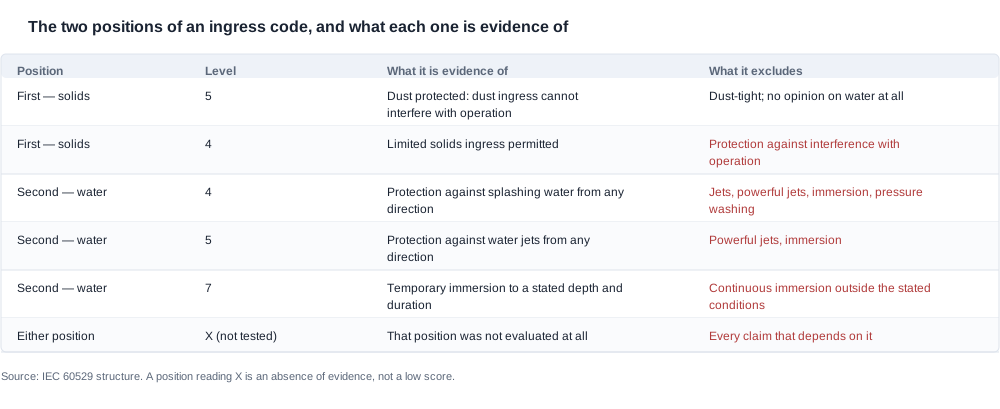
The code is defined by IEC 60529 as degrees of protection provided by enclosures, and it has two independent parts. The first digit rates protection against solid foreign objects on a scale from 0 to 6. The second rates protection against water on a scale from 0 to 9. A letter X in either position means that position was not evaluated at all, which is an absence of opinion rather than a poor score, and reading it as a low score misses the more useful fact.
The single most damaging reading in this category is treating the digits as a linear scale. They are not. A second position of 4 is protection against splashing water from any direction. A 5 is water under low pressure. A 6 is powerful water jets. A 7 is temporary immersion to a stated depth for a stated duration. An 8 is continuous immersion under agreed conditions. A 9 is high-pressure, high-temperature jets. The gap between 6 and 7 is far larger in test severity than the gap between 4 and 5, so a comparison written as "one digit better" is not merely imprecise, it is misleading in a direction that matters: it tells a buyer that a modest step up in seal design buys a proportionate step up in capability.
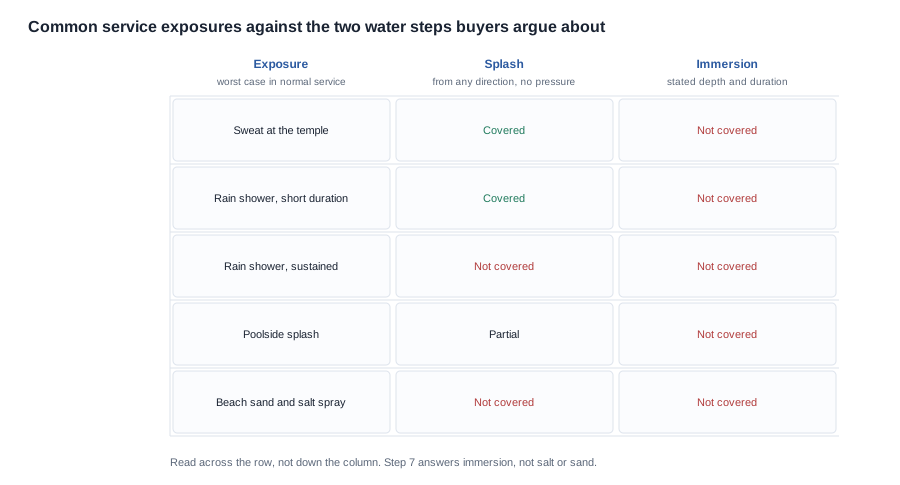
The second damaging reading is treating a 4 as waterproof. It is not immersion, not a shower, not a hose and not sustained rain. A catalogue carrying IP54 and a product page carrying the word waterproof are making two different claims, and the second one is not supported by the first. The third is the X trap: a code with X in the solids position carries no dust opinion at all, and reading it as a general score flatters the product.
The solids side has three distinct positions that get collapsed into the phrase dust proof. A 4 permits some ingress of solids. A 5 is dust protected, meaning dust cannot ingress in quantities sufficient to interfere with operation. A 6 is dust-tight, permitting none at all. A buyer who needs a dust-tight product should be able to see that word in the specification, and a buyer who needs dust protection should know that a 4 will not deliver it.
Writing the ingress requirement as a line on the purchase order
The rows that turn a marking into a specification
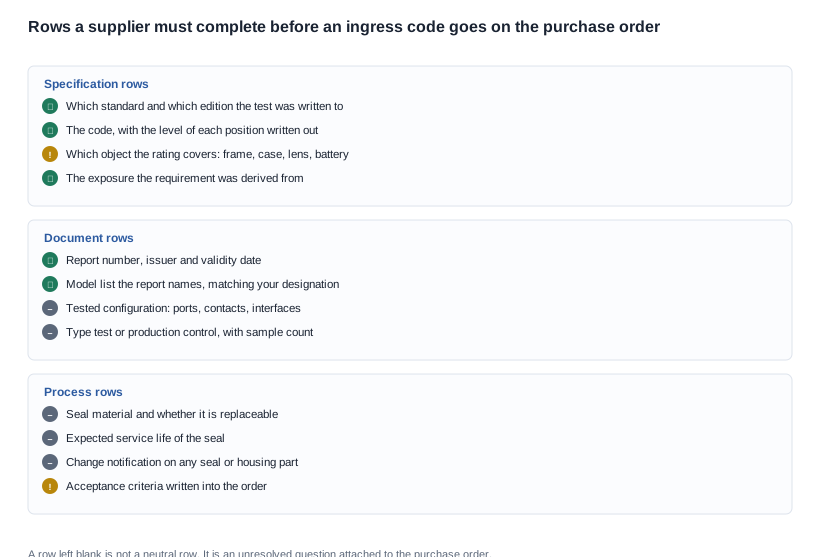
The table below is the specification request. The right-hand column is the discriminator: it separates a supplier who holds a document from a supplier who holds a phrase. Ask for all eight rows in a single email, in the order given, before the first sample ships.
| Row to demand | The pass line | What an unfalsifiable answer sounds like |
|---|---|---|
| The standard and edition the test was written to | IEC 60529, named, with the edition | Tested to IP standards |
| The code, with each position written out in words | Both positions, in plain language, with the exclusions | IP54 rated |
| The report number and the model list it names | A number a broker or marketplace can check later, naming your exact designation | We have the paperwork |
| The tested configuration | Which ports, contacts and interfaces were fitted on the sample | Not offered |
| The tested build | A production build, identified, rather than a pre-production sample | A pre-production sample |
| Type test or production control | Stated, with the sample count and the frequency | Tested internally |
| The exclusions | Written: immersion, jets, salt spray, ageing, temperature extremes | It protects against everything |
| The seal material and expected service life | The material, whether it is replaceable, and the life | High quality seals |
The thresholds, in the words you would put in the order
For the water position, the progression that matters to a buyer is this: 4 is splash, 5 is jets, 6 is powerful jets, 7 is temporary immersion. Write the one you need in words rather than in a digit. "Protected against splashing water from any direction, on the shipped configuration" is a requirement a supplier can accept, refuse or price. "IP54 or better" is a conclusion the supplier has already agreed with, and it is a conclusion you have not checked.
For the solids position, the practical question is whether your channel generates dust, grit or sand around the hinge and the ports, and if it does, whether "limited ingress" is tolerable. For a product that lives in a handbag, a jersey pocket or a workshop through a season, dust is a real consideration, and it is the position buyers skip because it is the first digit and the first digit is the one nobody argues about.
The type test versus the production control distinction matters more than it first appears. A type test tells you the design is capable of passing. A production control tells you the process holds it on unit ten thousand. A technical file and a retailer's quality team ask for different things, and the buyer who does not know which one they hold cannot tell whether they have bought a specification or a result.
The configuration is the row that catches the most expensive mistakes. A rating attaches to a configuration, not to a model family. A unit with a different port, a different contact arrangement or a different interface is a different configuration and the published marking may not travel with it. This is also where the camera-equipped models and the audio-only models part company: the two groups do not share an enclosure, an interface strategy or a charging approach, so a marking established on one is not a marking on the other by default.
The warning that these numbers are not directly comparable
Two documents carrying the same two characters can describe materially different tests, and a buyer who compares the digits rather than the documents will be wrong more often than not. The comparability traps are worth stating plainly.
The first is the standard and its edition. An ingress code defined in one edition of IEC 60529 and quoted later without the edition has an unknown provenance, because the test apparatus and the acceptance criteria are tied to the edition. The second is the sample. A type test on a single unit and a production control at a stated frequency are different documents with different evidential weight, and the word IP appears in both. The third is the tested configuration, which is the one that catches substitutions: a document for a unit with capped contacts does not cover a unit with exposed contacts, and the difference is visible on the sample in your hand.
The fourth is the axis problem, and it is the one most often written into purchase orders. A requirement written as "IP65 or better" is ambiguous, because the two positions are independent. An IP65 is stronger than an IP54 on solids and weaker on water. Writing "IP65 or better" tells a supplier you want two independent things without saying which you care about, and the cheapest reading of that ambiguity is the one that satisfies one digit and ignores the other.

Proving the requirement: from a catalogue code to a filed document
Five steps, each with its own completion test
The verification path is short, and each step assumes the one before it passed. A failure at any step tells you what the next step would have told you, which is why the order matters and why running the steps out of order wastes weeks.
The first step is to ask for the report number rather than the report. A number is the only part of a compliance document that a broker, a marketplace, a retailer's technical team or your own compliance function can check later without your supplier in the room. Ask for the numbers, with the issuing body and the validity dates, in the body of the email. Completion test: you have a number in writing, or you have a written statement that no number exists. Both are useful; the second is more useful than it looks, because it tells you what kind of supplier you are dealing with.
The second step is to resolve the number in the issuing body's register, and to check three things: the model designation on the document against the model you are ordering, the covered functions against the functions you are shipping, and the validity date against the date the goods will be on sale. Do the model comparison character by character. Where a family holds several models with similar names, this is the check that catches a substitution, and a mismatch is a stop condition rather than a query.
The third step is to establish the tested configuration. Ask which ports, contacts and interfaces were fitted on the tested sample, then compare that list against the unit in your hand, physically, before anything else is done with it. Where a charging contact or a port is exposed on the shipped unit and was capped on the tested sample, the published marking does not cover the product in your packaging, and that is a build change rather than a paperwork issue.
The fourth step is to run your own test on a sample, against a protocol you wrote before the first reading. The protocol is narrow: the specific failure mode your channel actually produces, with the duration, the environment and the pass condition fixed in advance. The sweat-and-dust case for a sport product, the saltwater-and-sand case for a beach product, the repeated-handling case for an industrial product. A generic spray test is none of these, and a code does not substitute for one.
The fifth step is to put the criteria into the purchase order. In a category with no universally quoted standard, the contract is the standard. A criterion that lives in an email is not binding. A criterion in the purchase order is an acceptance standard, and a lot that fails it is a lot you can refuse.
What you are entitled to receive, and what to do without it
Not every supplier will have every row, and the useful skill is knowing which gaps you can work around and which ones stop the programme. A missing report number, with a code and a model list in the supplier's own documentation, is a gap you can sometimes close with a factory audit or a buyer-run protocol. A missing report number combined with a claim that the marking covers your configuration is a contradiction, and a contradiction is a stop.
The middle case is the one that catches people out. A supplier who has the report but has it for a different configuration — a different interface, a different build, a different revision — is not being obstructive. They are telling you the truth about scope. The commercial answer is not to walk away; it is to decide whether the configuration can be brought into line, whether the requirement can be written more narrowly, or whether a re-test is worth its queue position in the programme.
The last case is a supplier who cannot explain the marking at all. That is worth a different question entirely: whether a rating can be established on the configuration you need, at what cost and on what timeline. For many channels the answer is that the requirement was never necessary, which is a cheaper finding than any test.

Five ways a written ingress requirement still fails after signature
The listing says waterproof and the customer returns the product after rain. The symptom is a cluster of returns from one channel with a description that says the product is broken. The root cause is that the marketing instinct was stronger than the marking, and the specification did not reach the copywriter. The prevention is to write the marking in words on the product page, to publish the exclusions next to it, and to check the artwork against the specification before approving it rather than after.
A certificate arrives naming a product that is not the one ordered. The symptom is a customs query, a marketplace rejection, or a warranty claim that cannot be settled because the document and the goods disagree. The root cause is that a family-level document was treated as coverage for a branded unit. The prevention is to make the exact model designation a condition of the purchase order and to check it against the units on receipt, physically.
Water is found in the charging interface. The symptom is a unit returned with corrosion and a customer who has done nothing wrong. The root cause is that a designed opening is an ingress path and the test protocol ignored it. The prevention is to put the interface first in the buyer-run protocol, and to write a care instruction that covers it.
A variant ships outside the covered configurations. The symptom is a consistency problem that appears after launch, usually in the colour that sold best. The root cause is that no per-variant configuration check existed, so a private-label derivative or a new colour went out without a comparison. The prevention is to put the seal, the port, the contact and the frame material on the change-control list with a notice obligation attached.
The protection is sound in year one and the returns start in year three. The symptom is a slow return-rate drift with no obvious cause and no cluster to investigate. The root cause is that the seal aged and nobody tracked a service life, because nobody asked for one. The prevention is to set the warranty against a measured failure criterion rather than a calendar assumption, and to re-test a retained unit periodically against a fresh one.
The commercial shape of an ingress-qualified programme, and what we publish
The terms worth negotiating, and the ones that are not
The setup cost of an ingress qualification is the factory's fixed cost rather than a market rate, and that is where a per-configuration minimum actually moves. The number of configurations you commit to, the per-colour minimum for each, the artwork round count and the per-market label scope are all negotiated numbers, and all of them are larger than the unit-price saving available. The market list is a negotiation as much as a decision, because a market that does not require the marking removes both a test and a label set. The re-validation cost per variant, and the trigger that causes it, are negotiable terms worth settling before the first variant is ordered rather than after it has shipped.
The certification fee and the elapsed time at the laboratory are not commercial levers. The fee is per configuration and the elapsed time is set by the laboratory, not by your order size, and pressing on either of them does not make the product arrive faster. Costed as a one-off charge, tooling is normally spread across the first order, so a buyer wants the volume the amortisation runs over and, should the programme be discontinued, an answer on the tooling and the sealing tooling. And the enclosure design itself is not a commercial variable at all: a supplier who will not change the seal material, the seal geometry or the port design is telling you the ingress performance is fixed, and the programme should be built around that fact rather than against it.
Two clauses carry most of the value here. The first attaches the report number and the exact model designation to the purchase order, so that the document and the goods are bound together. The second requires notice before any change of seal, port, contact or interface, because each of those invalidates the configuration and each of those is otherwise invisible until the next shipment.
A worked scenario: an outdoor brand turning a marking into a purchase-order line
This is a hypothetical case rather than a client project, and it is included to show the sequence of decisions rather than to report an outcome.
Assume a mid-sized outdoor brand selling into three European markets with two colourways, holding two supplier quotations that differ by a wide margin on unit price and by almost nothing on the ingress marking. The binding constraint is not the marking. It is that the brand's own marketplace listing was suspended once before for a claim it could not evidence, and the brand does not want to repeat that.
The first decision is the exposure. The brand's customers wear the product in rain and wear it with sweat on the temples, which is a splash exposure. Nothing in the channel involves a pressure washer, a pool or a marine environment, so the higher water steps are out of scope — and stating that explicitly is what stops the programme paying for a level it will never use.
The second decision is the document. The brand asks for the report number and resolves it. The report names a model, and the model list does not include the brand's own configuration, because the brand's unit differs in its charging interface. That gap converts the model designation from an administrative item into a precondition of the first order, and the brand puts a re-issue obligation and a notice obligation into the contract at that point, while the cost of doing so is still an email rather than a reprint.
The third decision is the configuration check. Before anything else happens to the samples, the brand compares the unit's port, its charging contacts and its button seals against the tested configuration on the report. One of the contacts is exposed on the shipped unit. The supplier confirms a contact cap is available as a build option, which is a change to the configuration, which means the published marking does not cover the unit as it would ship, which means the decision is now between a capped build, a re-test, or a narrower claim.
The fourth decision is the claim. Rather than re-testing inside the first programme, the brand takes the narrower option. The copy says the product is protected against splashing water from any direction and does not say waterproof, and the exclusions are stated on the listing rather than left to the reader's imagination. The listing reviewer accepts it, because the claim is now narrower than the evidence.
The fifth decision is the commercial structure. The brand negotiates the per-configuration minimum against a committed combination count rather than a unit count, because two colours with a capped build is two configurations, not one. It moves the artwork approval earlier than usual, since the contact cap is a visible build difference the packaging has to reflect. The outcome is a programme with one named precondition and a defensible claim, rather than a programme with four unowned risks. Every decisive step was taken before the sample order, and none of them was about the digits.
What our catalogue publishes, and what it does not
Here, the marking and the evidence for the marking belong in the same sentence, with the gap between them stated rather than implied. A buyer who is checking a supplier's claim should be able to run the same check on ours, and a check is only meaningful if it can fail.
In our catalogue the IP54 marking appears on the V06 and the S7, as an annotation. We publish no third-party test report number behind it, no standard, no test condition, no sample size and no laboratory, because the company has not confirmed them to us, and we will not fill those fields with a plausible-looking value. No other model in the range carries a published ingress marking, and no charging case in the range carries one either. The range as a whole covers twenty-eight models, and eleven of them carry a camera; for those camera-equipped models the catalogue does not publish a Bluetooth version, so any requirement that turns on radio version has to be raised separately rather than read off the product page.
The converse of that gap is worth stating as carefully. The absence of a marking on a model tells you nothing about how that model behaves when it gets wet — it tells you the question has not been answered in writing for that model, which is a different fact and a much less dramatic one. And a published code without a resolvable document is a claim rather than a specification, which matters the first time a broker, a marketplace, a retailer's technical team or a customs inspection asks for the file behind it.
We will not extend a splash code into the word waterproof, into rain-capable, or into immersible, and we will not present a marking as a lifetime guarantee. Seals age, we publish no ageing data for any model, and we will not put a service life on a seal nobody has tested.
Three requests for an outdoor brand starting a specification this week
Write down the exposure before you write the requirement. One line per channel: what the product meets, for how long, and what happens afterwards. If a line reads "occasionally, in the rain", you have a splash case. If a line reads "under a pressure washer", you do not, and the codes are not comparable.
Send the document request as a list rather than as a question. The standard and edition, the code with both positions written out, the report number with its model list, the tested configuration with ports and contacts, the tested build, the type-test-or-control statement, the exclusion list, and the seal material with its expected service life. A supplier who answers all eight has a documentation habit. One who answers two is telling you something you need before the deposit.
Send us the use case and we will tell you what is published. Give us the environment, the target market, the price band and the configuration, and we will say which of our models carry a marking, what the qualification would involve for the ones that do not, and which rows of our documentation answer your question today. The range is at sport smart glasses, the channel question is in sports and cycling brands, the technical background is under IP ratings and durability, and the verification procedure is in how to measure and verify an IP rating.
Where the specification method comes from
Send us the exposure your channel produces and we will tell you which digit it falls under.


