
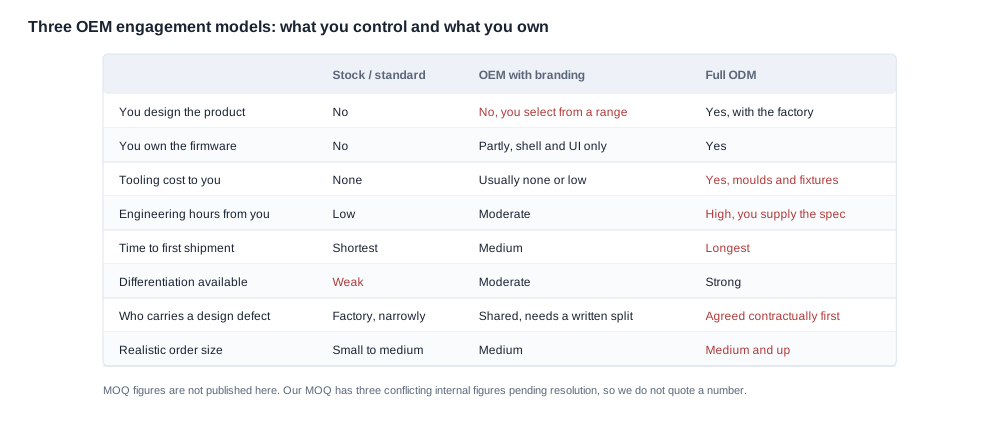
The word "OEM" covers three commercially different arrangements, and a great many disagreements between buyers and suppliers start because one side is describing the third one. The buyer believes they are buying a bespoke product; the supplier believes they are configuring an existing platform. Both readings are reasonable, and both parties proceed confidently until the point where the difference becomes expensive.
There is a second reason to separate them carefully. The three routes do not differ mainly in price, although they do. They differ in where the specification lives and who is allowed to change it. That single fact drives the schedule, the tooling commitment, the level of engineering effort a buyer has to supply, the shape of the documentation, and what happens when a unit in the field is wrong. A buyer who knows which of the three they are in can plan against it. A buyer who does not will discover it in month four, when the tooling is cut.
Here is how smart glasses OEM engagement models differ, expressed as what you control, what you own, and where the risk sits. The purpose is not to recommend one. It is to let you notice early which one you are actually in, and to know what the honest cost of changing your mind would be.
A worked mis-description shows the cost. A brand wants a camera glasses product with their logo, a distinctive colour, their name on the Bluetooth device, and a packaging design of their own. In their heads this is a bespoke product. In the factory's heads it is a configuration job on an existing platform, because every one of those six things sits on the published customisation list. Both sides are right, and the difference shows up as a negotiation about who bears the cost of the colourway that needs a new material, the packaging tooling that needs a plate, and the firmware build that needs a new identifier. Resolve it at the start and it is a quotation. Leave it until the first article arrives and it is a dispute about scope.
The three routes also differ in what they cost you to get wrong, and that is the number most worth holding on to. In the standard route, a wrong decision costs you a margin and a quarter of channel effort. In the branded route, it costs you a golden sample, an approval cycle and a documentation set. In the custom route, it costs you tooling.
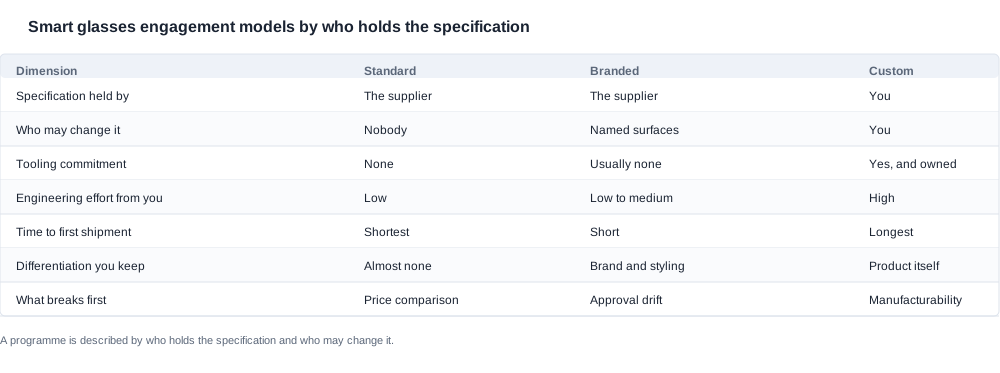
Smart glasses engagement models are a choice about who holds the specification
Start from the specification rather than from the label. In every smart glasses programme there is a document that defines what the product is, and the three routes differ in who holds it and who can change it.
In the standard route, the supplier holds the specification and it is fixed. The published parameters — camera resolution, rated runtime, charge time, cell capacity, charging interface, Bluetooth version — are the manufacturer's, and they are identical for every buyer of that model. You contribute identity and packaging, and you accept everything else as published.
In the branded OEM route, the supplier still holds the underlying specification, but a defined set of surfaces are yours to set: the logo, the colourways, the packaging, the temple styling, the visible system and interface, the Bluetooth device name a customer sees when they pair, and the firmware build. The depth of that control depends on the model and the volume, and it has to be established per project rather than assumed from a general capability list.
In the ODM route, you hold the specification. The supplier builds to it, develops it with you, and holds the tooling on your behalf. The engineering relationship changes character entirely, and so does what you owe the programme: specification discipline, engineering hours, and the willingness to be told that a design is not manufacturable in the way you imagined.
The practical consequence is that the honest description of a programme is not "an OEM programme" but a sentence naming who owns the specification and who can change it. Write that sentence into your own brief, because it is the one that governs everything else, and because it is the sentence that determines whether a change request is a configuration adjustment or an engineering change with a cost and a schedule attached.
It also determines what you have to bring to the first meeting. In the standard route you need a brand, a colour, a packaging direction and a destination market, and the rest of the conversation is about a configuration. In the branded route you need the same, plus an explicit list of which surfaces you want to control, because "customise whatever you can" produces a scope argument rather than a design. In the custom route you need a written requirement, a clear statement of which decisions are already fixed and which are open, and the engineering resource to answer technical questions at the pace they arrive. Buyers who arrive with the standard route's inputs and the custom route's ambition are the source of most of the difficult early negotiations in this category.
The standard smart glasses route and what it actually gives you
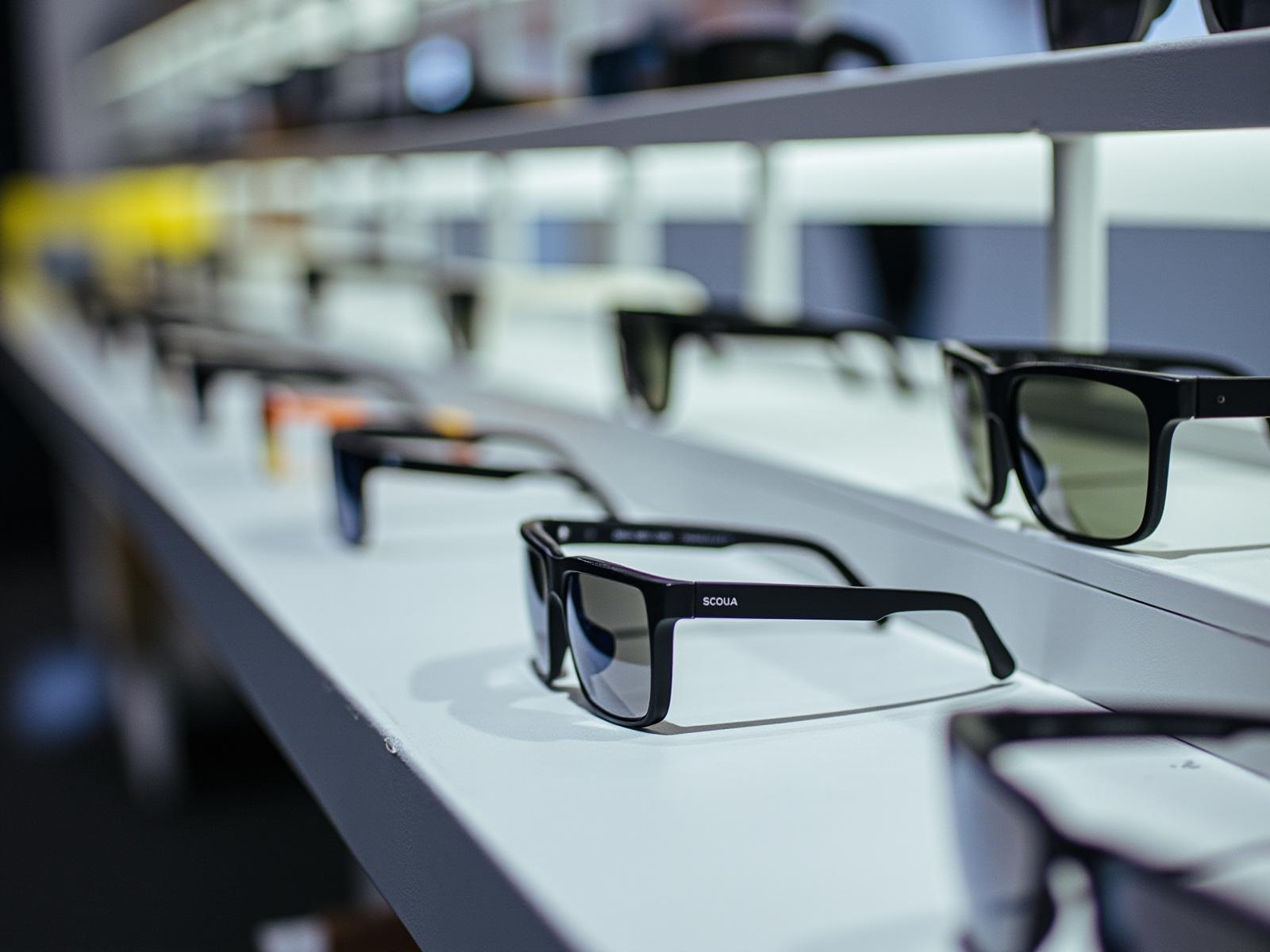
The standard route is the fastest and the cheapest, and it is more capable than buyers often assume, because the range it draws on is not small. Our published catalogue covers twenty-eight models: an eight-model audio range, an eleven-model camera range, a three-model sport range and a three-model kids range, plus AR glasses, electrochromic products and bone-conduction products listed without a model string. Choosing within it is a configuration exercise with real substance, not a single product with a logo on it.
What you gain is speed and a low cash outlay. What you give up is differentiation. Your product is visually and functionally close to another buyer's, and the published specification is the same one your competitor is quoting against you, which means price comparison is unusually easy for your channel to run.
Two published details are worth knowing before you choose. First, the published specification is a partial specification. The catalogue states charging time for twenty-six models as "two hours or less" with only the D17 and the ZH12 publishing about one hour; it publishes charging interface for twenty-four of the twenty-eight; it publishes a charging case capacity for five models, a case without a capacity for two more, and no case row at all for three. Second, the ranges are not interchangeable in the way a buyer sometimes assumes: the YKC02 is a sport model with two 70 mAh cells, not an audio model, and the V06 and the S7 are named for sport but sit among the eleven camera models. Getting this wrong is a shortlist error, and shortlist errors are expensive.
One caution specific to the standard route: the model designation, the documentation and the firmware are all things you did not choose. Make sure the name printed on your box matches the name on whatever documentation travels with the goods, and check it physically on the sample rather than on the artwork. The catalogue contains a model listed as "L2 Utral", and naming of that kind is exactly where a customs or market-access conversation starts. A production lead time, a minimum order quantity and a price are not published for any model, and all three belong in a quotation against a defined configuration rather than in a comparison you build from a website.
The standard route also has a good use that buyers sometimes talk themselves out of. If your channel is a price-led marketplace listing with modest volume and no differentiating feature, the standard route is not a compromise — it is the correct answer, and it is worth saying so explicitly to your team rather than allowing a custom ambition to survive on the slide. A programme that reaches the standard route honestly is short, cheap and low-risk, and it puts the money you would have spent on tooling into channel and inventory instead.
What a good standard-route brief looks like is worth stating, because it is short: the model, the colour, the packaging, the logo placement, the Bluetooth device name, the destination markets, the volume plan, and the date the product has to be on a shelf. That is enough for a meaningful quotation and a meaningful schedule, and anything you leave out will be filled in by somebody else, which is how a programme ends up with a device name you did not choose.
Branded smart glasses: configuring a platform you do not own
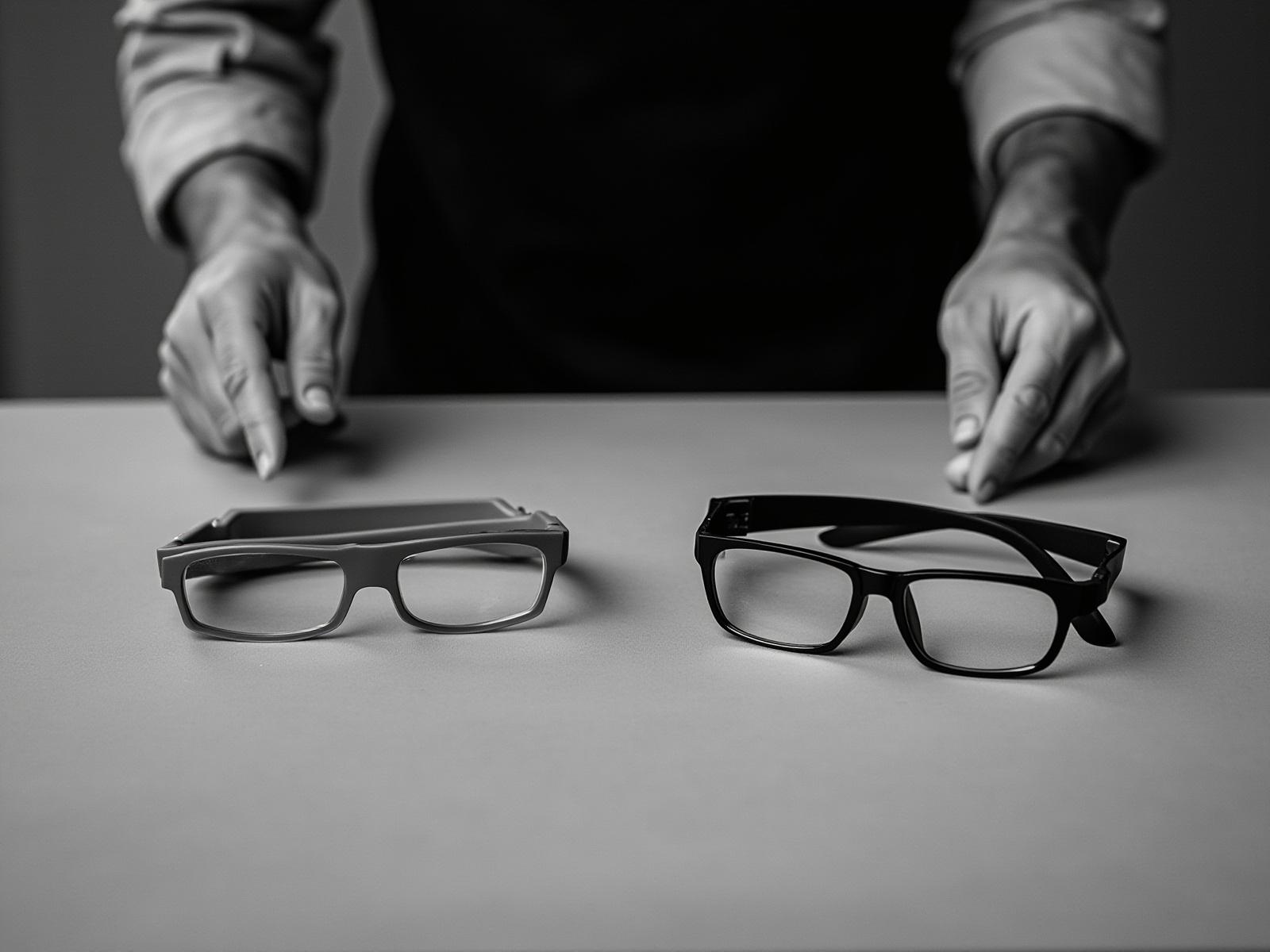
The middle path, and by far the most common one. You control the visible identity; the factory retains the underlying design. The published customisation scope covers logo, colour, packaging, temple styling, system and interface, the Bluetooth name and firmware, and how much of it is genuinely available depends on the model and the volume — a conversation that has to happen per project, because "available in principle" and "available at your order quantity" are different answers and only the second one is useful.
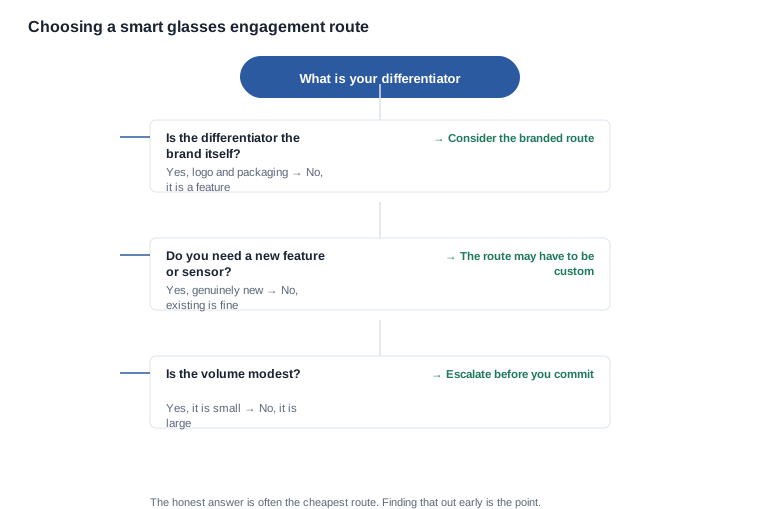
This route works when the differentiator is brand rather than function. A channel that sells on styling, on a colour story and on packaging presentation can do very well here, and it gets to market faster than a custom programme and at a fraction of the risk. A channel that wants a new sensor arrangement, a different antenna position or a thermal change will find that "we can customise the interface" was never the same sentence as "we can redesign the electronics". Drawing that line explicitly, in the quotation, at the start, is the single most useful thing you can do in this route.
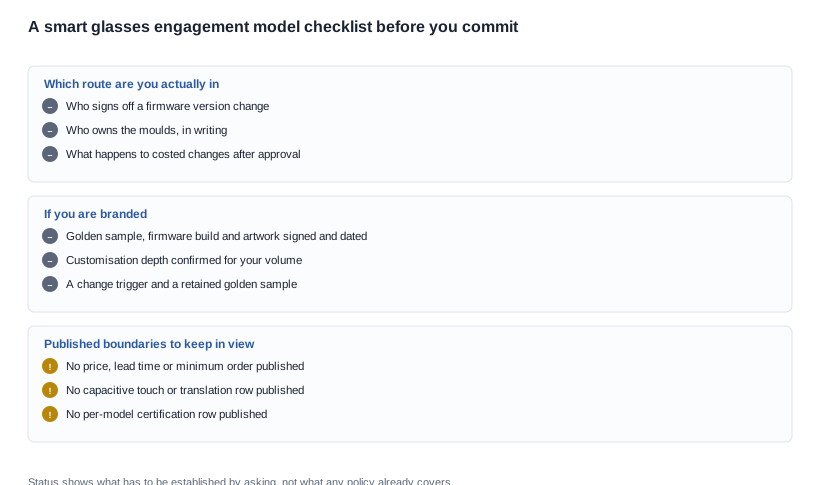
The characteristic failure here is ambiguity about who approved what. Keep a written approval record: the golden sample, the firmware version, the packaging artwork, each signed and dated. It feels like bureaucracy right up until the first shipment arrives with a colour you did not approve and nobody can say whose decision it was. In a category where a single model can carry up to four published colour options, and where the V03 Pro is the only camera model publishing photochromic lenses across three colour options, the number of visible variables in a branded programme is higher than it looks.
The second characteristic failure is the quiet one: an acceptance that has drifted. The sample you approved was built in week two. The shipping product in week twenty is a different build, because components were substituted and firmware was updated for legitimate reasons. The way to manage that is a change-control process with a trigger, and a golden sample that is retained and compared against rather than remembered.
The volume dependency in this route is worth understanding before you brief it. Colourways, custom packaging and a branded Bluetooth identity are not equally available at every order size, and the boundary moves. A buyer's negotiation therefore has two parts that are often confused: what the supplier is willing to do, and what the supplier can do economically at this quantity. The second question has to be asked separately, because the answer to the first is usually yes. The practical approach is to ask for the same customisation scope quoted at your volume and at half your volume, and to compare what changes. If nothing changes, you have bought a bespoke-looking programme at a standard price, which is a good outcome worth knowing you have.
One more thing to settle in this route is the boundary of the documentation, because the branded route multiplies the number of document variants. Every colour, every packaging design and every destination has its own label and instruction set, and the product name has to match across the artwork, the packaging, the Bluetooth identifier, the model designation in the documentation and the model designation on the unit. A programme that fixes the branding in a single place — one approved product name, one approved colour list, one approved packaging artwork — and then references it everywhere afterwards is far cheaper to run than a programme that renegotiates it per shipment.
Custom smart glasses: writing the specification yourself
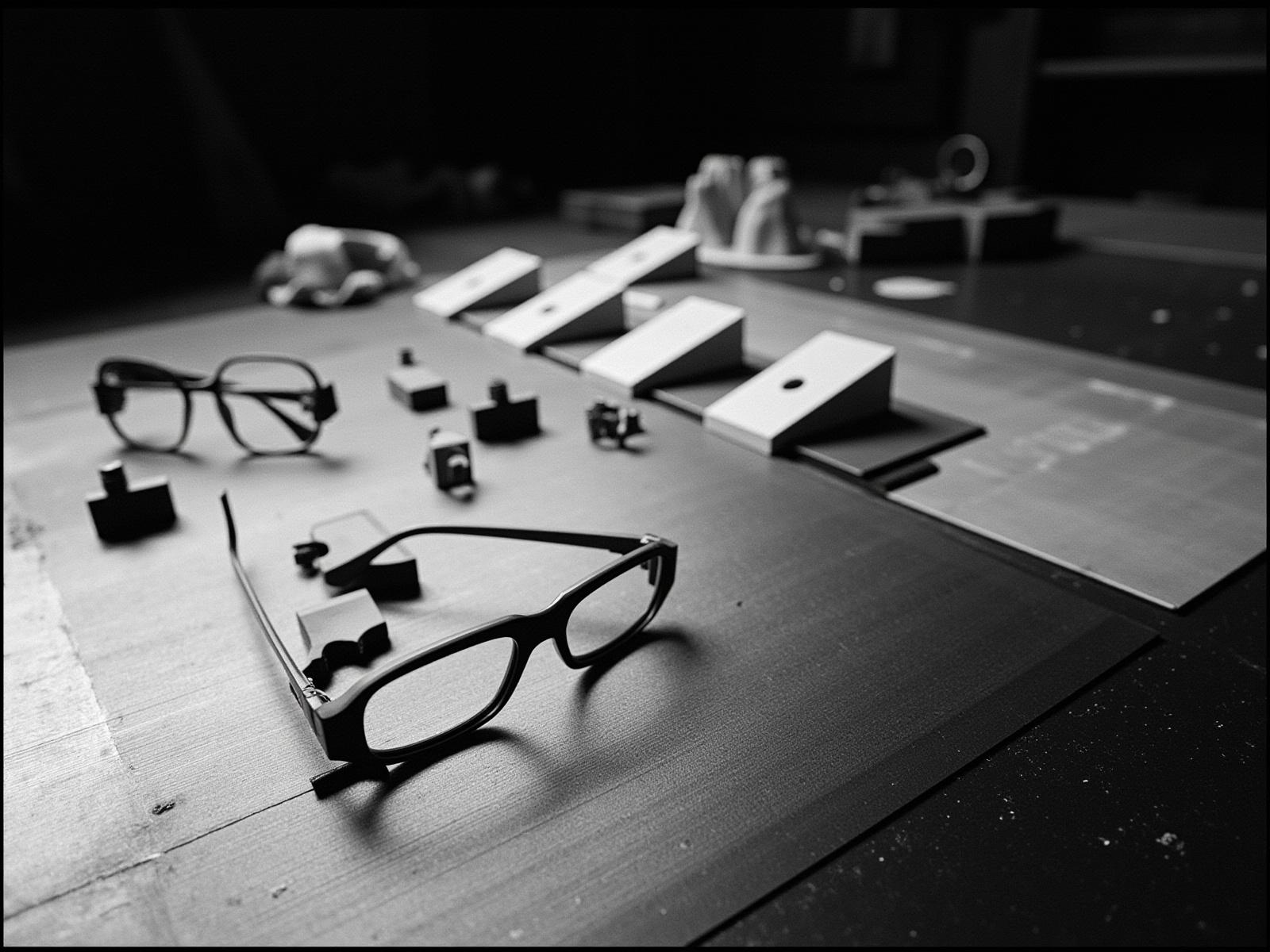
You define the product and the factory builds to it. Tooling is yours, or at least yours to pay for and yours to own — and that ownership should be written down, with asset numbers, before the first shot. The supplier becomes an engineering partner rather than a configurator, and the relationship changes character: you now need your own specification discipline, because every gap in your specification will be filled by whoever is nearest the decision, and the person nearest the decision is usually the factory.
The advantages are real differentiation and a genuine barrier to a competitor copying you. The costs are time, engineering hours on your side, and the risk that the design is not manufacturable in the way you imagined. That last one is unavoidable in this model, and a supplier who tells you a design cannot work — early, before you have paid for it — is worth considerably more than one who says yes to everything. A programme that discovers a manufacturability problem after the tooling is cut discovers it at the worst price.
The same discipline applies to the evidence the programme will run on. In this route the buyer writes the specification, and the specification has to name the things that will be measured. Our published catalogue is a useful model of how to do that honestly: where a value is not published — no cell chemistry, no cycle life, no ingress test basis beyond the two models that publish a marking, no capacitive touch row, no translation row, no operating temperature range, no certification row — the specification should not either. A requirement that cannot be verified should be identified as a requirement to be established by sample, with a method and a season, rather than written as a number that nobody will ever check.
Our page on ODM development covers the validation stage in this model, and engineering customization covers what a custom brief needs to contain.
Two things in the custom route are worth pricing separately from the unit cost, because they are the commitments that a buyer most often discovers late. The first is the non-recurring engineering work: the cost of the tooling, the fixtures, the test equipment and the engineering hours that make the first unit possible. None of those figures is published for any model, and all of them are quoted per configuration. The second is the ownership of what gets created, which needs to be settled before the first shot rather than inferred afterwards from who paid.
The advice that costs the least and is most often ignored is to keep the custom route as narrow as the differentiator allows. A programme that changes one thing about the product and holds everything else at a published specification is a custom programme with a manageable engineering surface. A programme that changes the electronics, the acoustics, the thermal design and the firmware simultaneously is four programmes, and it should be funded and scheduled as four.

Moving between smart glasses engagement models without losing time
Most programmes do not stay in the route they entered. The question is whether the move is a planned escalation, which is normal and manageable, or an unplanned one, which is what costs a quarter. Three questions, asked in the first two weeks, tell you which route you are genuinely in.
- Who signs off a firmware version change? If the answer is the factory, you are in the standard or light branded route. If it is you, you hold real control, and the cost of changing it later is the cost of getting a new approval process in place.
- Who owns the moulds, in writing? If nobody can answer, the answer is nobody, regardless of what the contract implies. This question also reveals the route, because tooling is only a serious object in the custom route.
- What happens to costed changes after approval? If nobody has a process, the price will move after the tooling is cut, and it will move in a way that arrives as an invoice rather than as a conversation.
The escalation path is worth planning deliberately, because it is cheaper than it looks. Moving from standard to branded is a configuration change: colours, packaging, a device name, a firmware build. It needs a new golden sample, an updated documentation set and a re-approval, and it does not need new tooling. Moving from branded to custom is a different move entirely: it needs a specification, an engineering review, a manufacturability assessment and tooling, and the decision to take it is really a decision about whether your differentiation is worth a year of programme time.
The failure pattern to avoid is the one where a buyer starts with the ambition of the custom route, discovers the tooling commitment and the engineering timeline in month four, and ends up shipping standard units in custom packaging on a schedule nobody planned for. That outcome is not a disaster, but it is usually expensive, because the custom route's costs have already been incurred in the time and the management attention that went into the discovery.
The trade-off across all three routes is the same one, expressed differently: the more of the specification you control, the more of the programme's risk you hold. The standard route holds the least risk and the least differentiation. The custom route holds the most of both. The branded route is the compromise most programmes should start from, and the honest test of whether it is right for you is simple: if your differentiator is branding and your volume is modest, saying so early is worth more to you than a custom proposal you cannot execute. The standard route is set out in standard OEM, and the wider programme structure is under smart glasses OEM.
The commercial terms follow the route, and it is worth knowing roughly what you are signing up for before the quotation arrives, even though the figures themselves are not published and have to be quoted per configuration. In the standard route, the terms that dominate are the MOQ, the unit price and the lead time, and the negotiation is mostly about volume and packaging. In the branded route, the one-time costs of the artwork, the packaging tooling and the custom colourway sit alongside them, and the trade-off is usually whether the branded version will sell enough extra units to cover them. In the custom route, the NRE and the tooling cost dominate the early cash requirement while the unit price stays competitive, which is why custom programmes often look affordable on a per-unit comparison and expensive on a cash-flow one.
That is the arithmetic worth doing before the quotation, because the route should be chosen by the numbers rather than the other way round. Take the difference between the branded unit price and the standard unit price, multiply it by the realistic volume, and compare that against the one-time cost of the branding plus the working capital carried while the first production run is in progress. If the answer is thin, the branded route is a marketing expense rather than a product decision, and it is better to say so before the artwork is signed than after.
The due diligence point is the same in all three routes and is worth doing regardless. The programme structure and the process behind it are described under smart glasses OEM, and the checklist of what to confirm before signing anything is in smart glasses oem requirements checklist. Whichever route you enter, the question to ask the supplier is the same one: what will you be doing differently on my programme that you are not doing on a catalogue order, and what does that cost? The answer tells you which route you are really in.
Related reading
- smart glasses OEM entry point
- ODM development and validation
- what engineering customization requires
Tell us what your differentiator actually is and we will tell you which engagement model it justifies.


