
Two buyers write their requirement briefs on the same morning and both call them a specification. One of them is a list of features, and it comes back from the factory as a list of features with prices attached. The other is a list of measurable conditions, and it comes back as a quotation, a first article and a document set. The difference was not diligence. It was the decision to write requirements that a factory can accept or reject without asking a follow-up question.
A requirements checklist is the least glamorous document in a smart glasses programme and the one that most reliably prevents a wasted quarter. It forces every requirement into an answerable form, and almost every disagreement in this category is not about what to build. It is about what a word is going to mean when somebody measures it.
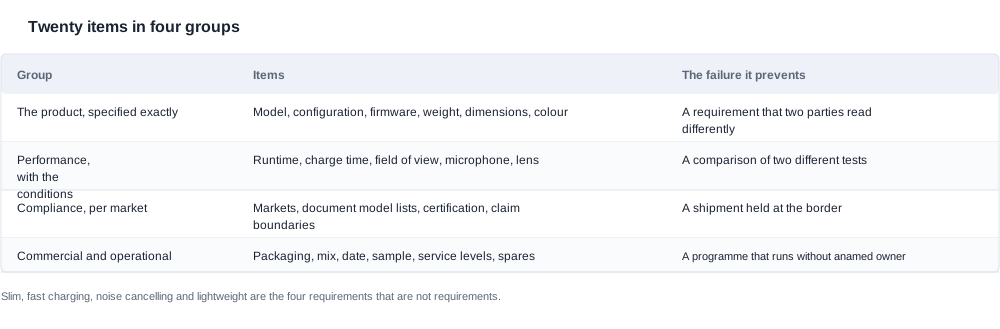
The published range gives a concrete starting set rather than an abstract one. The catalogue carries twenty-eight entries spread across six families, covering audio, sport, camera and children's entries as well as an AR platform, an electrochromic platform and a bone conduction platform. On those twenty-eight entries the Bluetooth version is published for fourteen and is not published for the eleven camera entries, for two of the three children's entries, and for the bone conduction platform. The charge time appears on twenty-six, and the charging interface on twenty-four of the twenty-eight. Five entries publish a charging case capacity. Two entries carry an ingress rating. One entry carries a frame weight.
That unevenness is not a footnote. It is the reason a generic checklist does not work here: the same row is knowable for one model and unknown for another, so a requirement file that does not name the model is a requirement file that cannot be answered. The trade-off is between the speed of a generic brief and the completeness of a specific one, and which model you eventually brief is a consequence of how much time you spend on the rows before you choose it.
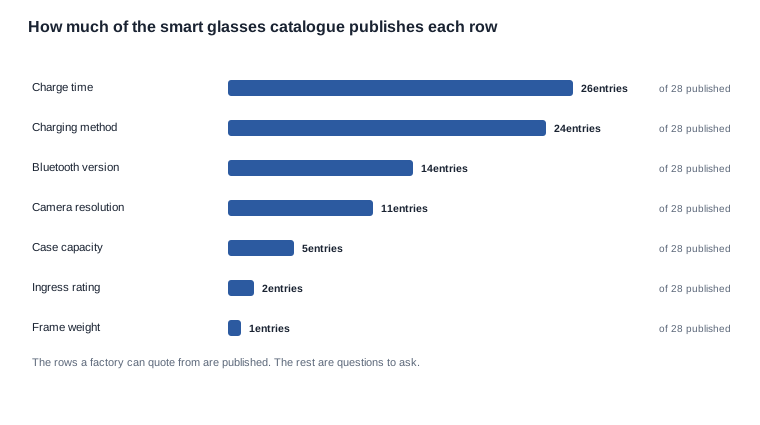
Smart glasses OEM requirements checklist: twenty items in four groups
The twenty rows below are the ones that repeatedly decide whether a programme lands on time. They are grouped so that each group has a different owner and a different kind of evidence.
Group one: the product, specified exactly. These rows describe what exists physically, and they are the rows where the catalogue can often supply a starting answer and the factory must confirm the rest.
- The model and the configuration. Name the exact entry, the cell arrangement, the camera resolution, the charging interface, the presence or type of charging case, and the colour. Naming a family is not naming a model. Our range contains entries that share a form factor and differ in exactly the rows that matter.
- The firmware revision and the app position. Which build is being quoted, and is the product a standalone device or one that depends on a companion application you are responsible for.
- The frame weight in grams, for the exact configuration in question. Only one entry in the whole range publishes a weight, and it does so for the glasses alone, explicitly excluding its foldable case.
- The frame dimensions, the temple length and the temple curve. No published row in the range gives a dimension, so this is entirely a factory-confirmed figure.
- The colour, with the process, the finish and the part it applies to. Published colour options are narrow: three on one camera entry, four on another.
- What is in the box. Case, cable, pouch, insert, manual. This is separate from the packaging itself, and it is the row most often left to a default.
Group two: performance, with the conditions attached. A number without a condition is a wish, and in this category the published figures are frequently conditions-free.
- The runtime, with the load profile, the radio condition, the temperature and the starting state of charge. On the camera entries the published cell capacity is in the region of 220 mAh to 290 mAh and the published runtime in the region of five to eight hours, and for neither of them is a test condition published.
- The charge time, with the starting state, the temperature and the charger. Twenty-six entries publish two hours or less, and two publish around one hour, which is a ceiling rather than a guarantee.
- The camera's field of view, with the convention used, plus the video resolution and frame rate.
- The microphone behaviour, with the test condition, or an explicit statement that it is not published and the evaluation will be buyer-run. No microphone specification is published for any entry in the range.
- The lens performance, where there is a lens, with the conditions and the measurement method.
Group three: compliance, per destination market. These rows are per market rather than per product, and they are the rows with the longest lead time.
- The destination markets, and the regulatory route for each one. A single product sold into several markets is several compliance scopes, not one.
- The documentation position for the exact model, with the model list on each document. The catalogue carries no per-model certification row, and the export certification page is an image-only page: ten patent certificates, of which eight are design patents while two are utility models, with no model list attached to any of them.
- The certification scope for the exact configuration, including whether a variant needs its own testing or sits under a family document.
- The claims the listing will make, and the boundary on each one. This is where a published figure becomes a question rather than a selling point.
Group four: commercial and operational. These rows are where a buyer who has skipped them discovers the cost.
- The packaging, the contents, the labelling per market and the manual with its languages. Note that our catalogue has no translation row anywhere, so any language requirement is a new requirement rather than a published feature.
- The order quantity and the mix, and the split across configurations. Mix drives setup, and setup is a price line.
- The delivery date, and which constraint phase it depends on.
- The sample, what it is for, and whether it is the production configuration.
- The service levels and the spare parts position, with windows, remedies and a period.
Twenty rows is not an arbitrary number, and it is not exhaustive either. It is the set that reliably covers the categories where an omission produces an expensive discovery: the physical description, the measured behaviour with its conditions, the per-market documentation, and the commercial and operational terms. A twenty-first row often belongs in your own file, and which one it is depends on your channel. A consumer channel usually needs a row for the retail packaging artwork approval process and another for the return reason taxonomy. A business channel usually needs a row for the importer of record and another for the accessory and spare parts list. The categories are stable; the twenty-seventh row is not.
Two structural rules keep the list usable. The first is that every row must have a single owner on your side, because a requirement with two owners has none. The second is that every row must be writable as a question with a yes-or-no answer, because the alternative is a paragraph, and a paragraph cannot be signed off. If you cannot phrase a row as a question, that is usually a sign the row is really two rows.
The purpose of the file is narrower than most people expect. It is not a description of the product you want. It is the document that lets a factory decide whether they can build it, and lets you decide whether the thing they built is the thing you wanted. That is why almost every row is either a physical parameter, a measured condition, a document, or a commercial term, and why a row that is none of those four is usually a sign of a wish rather than a requirement.
The four requirements that are not requirements in smart glasses terms
Most requirements checklists fail on a small number of words that feel like specifications and behave like preferences. These are the four that recur.
"Slim temple." Slim relative to what, measured how, and at which point along the temple? Our published range contains no temple dimension on any row, so a requirement written this way cannot be checked against anything, including against a competitor's product, because the competitor's dimension is also unstated in most listings. It is a description of a shape, and it is the requirement that decides whether frame tooling is needed.
"Fast charging." Fast relative to what, from what starting state, at what temperature, with which charger? The published figures are two hours or less for twenty-six entries and around one hour for two, and neither comes with a condition attached. Written as "fast charging", the requirement is satisfied by whatever the factory already has. Written as a figure with a condition, it becomes a component decision that you can price.
"Noise cancelling." Cancelling what, measured how, in which environment, with which metric? Nowhere in the range is a third-party acoustic measurement published. A small number of entries carry a surround-audio description on the listing, and a description is not a measurement. This requirement cannot be accepted or rejected, which makes it worse than no requirement at all, because it survives into the specification and then into a marketing page.
"Lightweight." Lightweight relative to which competitor, and in grams? Exactly one entry in the range publishes a frame weight, and it publishes it for the glasses alone. So the row is knowable for one model and open for the other twenty-seven, which means a lightness claim in your own listing is a claim about a number you cannot cite for most of your range.
Three more rows deserve the same treatment. An ingress claim: only two entries in the catalogue publish a rating, both of them IP54, so a waterproof claim across a range is unsupported almost everywhere. A capacitive touch control requirement: our catalogue has no capacitive-touch row on any entry, so the requirement is a development request rather than a configuration choice. A translated manual requirement: our catalogue has no translation row either, which makes it a packaging and documentation scope item with a real cost attached.
There is a fourth pattern that deserves its own warning, because it is the most common way a requirement file goes wrong: the borrowed requirement. A buyer reads a competitor's listing, sees a feature described in a single line, and copies that line into their own specification. The line was written by a marketing function for a page, and it was probably never a specification of anything. When it reaches the factory it has no measurement behind it, and it is either dismissed or implemented at a price nobody budgeted. The test is simple: if the requirement cannot be traced to a measurement, a document or a person who will sign it, it does not belong in the file, no matter how well the feature reads on a competitor's page.
The cure for all four is the same and it is mechanical. Take the vague requirement and write it as three things: the property, the condition, and the acceptance. Not "fast charging" but "reaches a stated charge level from a stated starting state, at a stated temperature, using a stated charger, within a stated number of minutes". The numbers do not have to be final. They have to be specific enough that a factory can say yes or no, and specific enough that a person can measure the answer. Once a vague requirement has been converted, it becomes immediately obvious whether it is a configuration choice, a component change, a development, or a line item that was simply not in the catalogue. Before the conversion it looks like all four at once, which is why it gets discussed forever and decided never.

Which smart glasses requirements need a sample and which need a document
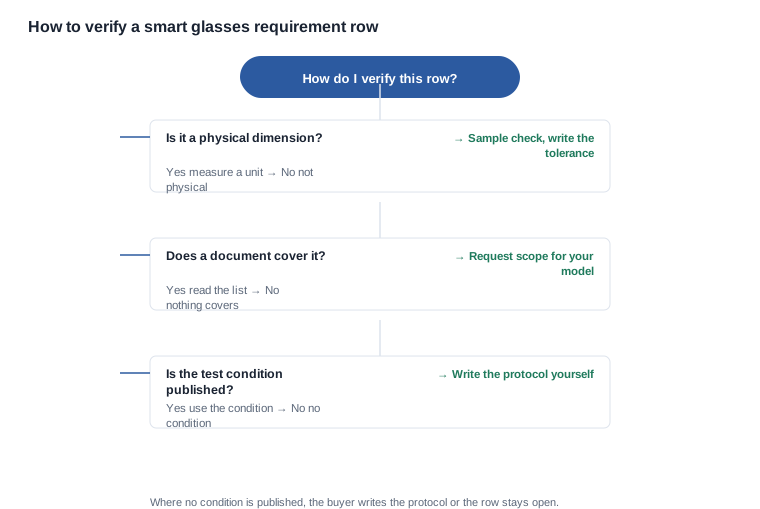
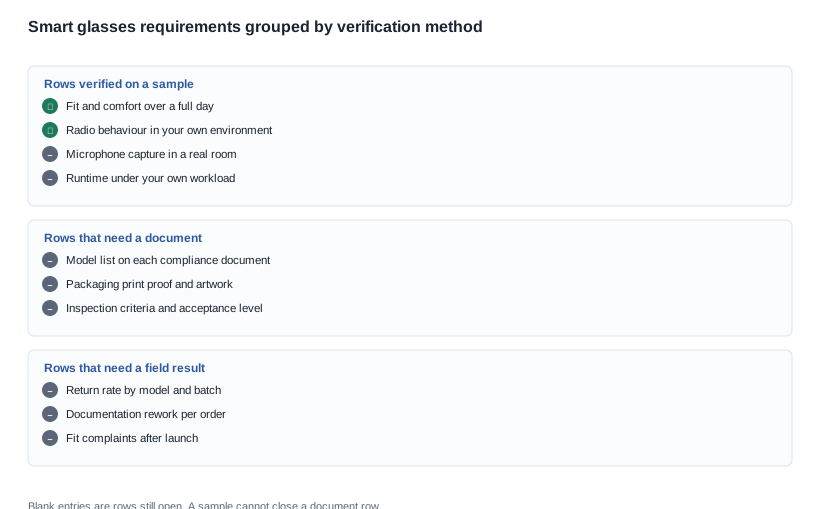
Every row on the checklist resolves into one of three verification routes, and choosing the wrong one is how a programme wastes a month.
Verified on a sample. Fit, weight in hand, radio behaviour in your environment, microphone capture in a real room, battery life under your own workload, and the feel of the temple and the controls. These cannot be answered from a datasheet because the datasheet describes a laboratory rather than your user.
Verified on a document. The model list on a compliance document, the certification scope for your configuration, the packaging print proof, the artwork approval, the traceability record format, the inspection criteria. These cannot be answered from a sample because a sample proves nothing about what will ship.
Verified in the field. Fit over a full day, the return rate by model, the documentation rework per order. These are answered only after launch, and they are the reason the checklist has to survive beyond the first purchase order.
A worked example makes the split concrete. Runtime is a sample question, because no test condition is published for any entry and no document you receive will carry one. The condition has to be written by you, which means deciding the load profile, the radio condition, the temperature and the starting state of charge before the sample is built. Charge time is the same kind of question for the same reason. Frame weight, by contrast, is a document question for the one entry that publishes it and a sample question for every other entry, which is exactly the sort of asymmetry that a single-line checklist hides.
The practical output of this step is a test protocol for the sample, written before the sample is built, with the acceptance criteria stated as numbers. A sample without a protocol generates opinions. A sample with a protocol generates a pass or a fail, and a fail at this stage is cheap.
Running the smart glasses checklist as a negotiation
A requirements checklist is not an internal document. It is the agenda for the negotiation with the factory, and the rows that determine the price are the ones you did not write down.
Three questions structure the conversation. First, which requirements are fixed by the platform, which are configurable within the published option list, and which are custom developments. Second, which requirements will you be able to verify on a sample and which need a document, because the first group is a test plan and the second is a documentation request with its own lead time. Third, which requirements are the ones you would not proceed without, since in almost every programme there are three or four and they should be settled before the quotation rather than after it.
The discipline that matters most is what to do with a row that cannot be answered. The correct answer is not an estimate, and it is not to delete the row. It is to mark it as an open item with an owner and a date, and to carry it into the specification document. A requirement that looks answered when it is not does not get discovered on a spreadsheet. It gets discovered at the pre-production sample, which is a far more expensive place to find out, and it gets discovered by the customer rather than by you.
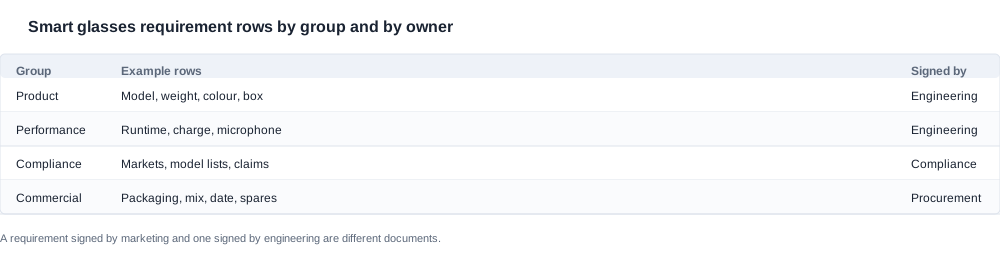
There is a second discipline worth adding: record who signs each requirement, and against what. A requirement signed off by a marketing function and a requirement signed off by an engineering function are different documents. Only the second one is something a factory can build, and if the marketing version reaches the factory first, you will build the marketing version and pay for it twice.
The commercial rows on the checklist deserve the same treatment. Unit prices, production lead times, minimum order quantities, warranty periods and the after-sales terms are all confirmed per enquiry rather than published on this site, because each depends on configuration, quantity, documentation scope and the current schedule. We would rather hand you three open lines to chase than three numbers that change between revisions and quietly invalidate a quotation you are working against.

How to run a smart glasses shortlist with real criteria
The checklist works best when it is applied to a shortlist before the shortlist becomes a preference. Two or three candidate entries is the right number to take through the full twenty rows. Ten is a list to be narrowed later, which wastes the evaluation effort rather than saving it.
Write the elimination criteria before the quotations arrive, so the criteria cannot be reverse-engineered from the answer you liked. Four are usually enough: does the published data support the requirement, is the configuration one you would actually ship, does the model fit the workload you are buying for, and can the documentation scope be closed for the markets you intend to reach.
The first criterion deserves care because it is where a buyer is most often tempted to be generous. A configuration with several unpublished rows will take longer to quote, will arrive with more assumptions, and will need a documentation conversation you had not budgeted for. That is a reason to keep it on the shortlist if the product is right, not a reason to drop it, but it is a reason to know about it in advance.
The due diligence on the checklist itself is a single exercise: pick the three rows you would be most uncomfortable discovering were wrong after launch, and ask for them specifically, in writing, for the exact configuration. Which one you pick depends on your channel. A consumer launch lives or dies on fit and on the return rate. A business channel lives or dies on the documentation position and on whether the claim in your listing can be supported. Either way, the question is the same, and the answer is either a figure, a document, or an honest statement that it is not published.
Then keep the checklist alive. The document that closes the programme should be the same document that opened it, with each row marked as verified, open or transferred to a post-launch obligation. A checklist that is used once to brief a factory and then filed away will not survive the first configuration change, and configuration changes are where requirements quietly stop matching the product.
There is a version of this checklist that is worth building once and reusing, and it is not the same document as the one you brief a factory with. The reusable version records, for each row, where the answer came from: the published row it was read from, the document the factory supplied, the sample measurement, or the fact that it remains open. That single column turns the checklist into a due diligence record for the next buyer, the next supplier or the next market, and it costs almost nothing to maintain while the answers are fresh.
The rows you cannot close deserve the most attention of anything in the file. A checklist with four open rows and a named owner for each is a manageable document that a factory can work with. A checklist with four open rows and no owner is a programme waiting to fail, and the failure will be attributed to the factory rather than to the file. When you send a requirement set to a supplier, the open rows are the most useful part of the request, because they convert a vague briefing into a specific list of questions.
One last habit is worth more than the checklist itself: run the checklist against a model you have already bought, not only against the model you are buying. Write the twenty rows for a product you know well, and see which ones you would have been able to answer at the time and which ones turned out to be open months later. That exercise takes an afternoon, it produces a far better set of shortlist criteria than intuition does, and it is the closest thing to a due diligence checklist that a buyer can build from their own history rather than from a template.
The OEM scope page sets out what sits inside a standard engagement and what sits outside it, which is useful when a row on your checklist turns out to be a scope item rather than a product item. The how to get started walkthrough gives the sequence those rows attach to, what is included sets out the deliverables, and the service levels reference covers rows nineteen and twenty in more depth.
Send us the requirement set and we will come back with the rows we can answer from what we publish, the rows we cannot, and the rows that need a sample or a laboratory.
Related reading
- OEM service levels
- Smart Glasses OEM service scope
- Smart Glasses OEM: how to get started
- What is included in the scope of work
Send the requirement set and we will come back with the rows we can answer, the ones we cannot, and the ones that need a sample.


