
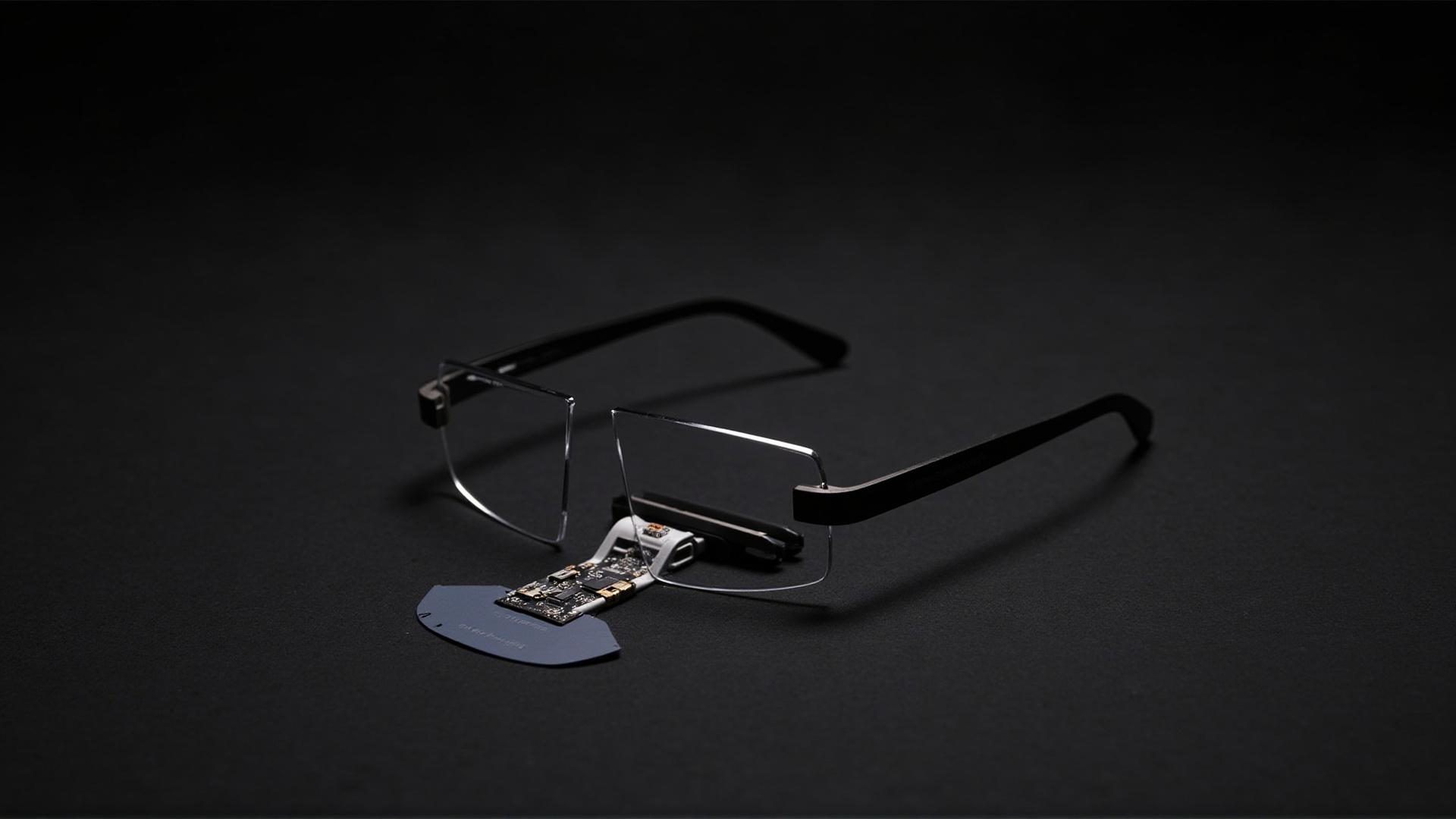
Two buyers can run the same smart glasses OEM programme, pay comparable money, ship in the same month, and end up in entirely different positions a year later. One of them owns the shape of the frame, the firmware build, the app listing and the packaging artwork. The other owns a purchase order. The hardware in the two boxes is identical. The difference was settled on paper during a conversation most buyers did not notice they were having.
Intellectual property in smart glasses manufacturing is rarely the engineering problem. Tooling, firmware and production capacity are visible, priced and scheduled. What stays invisible is the set of rights attached to what the factory already knows, and to the things you pay it to invent on your behalf.
The six assets below are the ones that generate disputes. For each of them, the honest answer is almost never a number from a catalogue; it is a clause that was or was not written, and a registration that was or was not made. Our own published position is that the range carries no published ownership schedule and no per-model certification row, so nothing in this article should be read as a claim that a particular asset is held by one party or the other. It is a method for establishing the position and for detecting it while it is still cheap to change.
Smart glasses IP ownership: six assets that need a named owner
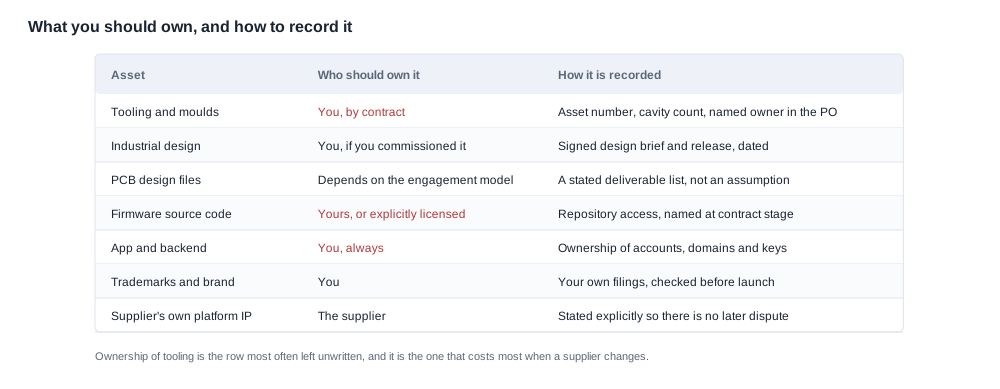
Ownership in this category splits into six assets, and they behave differently enough that a clause written for one of them will not transfer cleanly to another. The first job is to name all six, then decide which of them your programme is actually creating.
- The industrial design. Who drew the frame you are selling? If you commissioned a shape from a design studio, the shape belongs to that studio until it assigns to you. If you selected a shape from a supplier's existing range, the underlying design belongs to the supplier and what you own is the branding applied to it. The failure mode is a buyer who commissioned a design change verbally, in a meeting, and later discovered a private-label product with no design rights attached.
- The tooling. Moulds, fixtures and jigs have an asset number, a cavity count and a maintenance responsibility. Who owns them, and on what event does that ownership transfer, has to be written at the point of the first cut rather than at the point of a second colourway.
- The firmware. Source code for the application layer, the build scripts and the configuration layers your brand depends on. This is the asset buyers ask about second and receive least clearly, because the industry runs three legitimate arrangements and has no standard vocabulary for any of them.
- The app, the backend and the accounts. Domain names, app store listings, developer accounts, cloud credentials, API keys and analytics properties. These are administrative rather than technical, which is exactly why they get overlooked and exactly why they are cheap to fix early and expensive to fix late.
- Your trademarks. Logo, word mark, product names and the distinctive packaging look, registered in your own name, in your own markets, before you announce anything.
- The packaging artwork and manuals. Print files, dielines, translations and the instruction set that carries your regulatory statements. A long-lived, low-cost asset that is usually treated as a production consumable and therefore assigned to nobody.
Three of these six deserve extra attention because they are cheap to secure and expensive to replace.
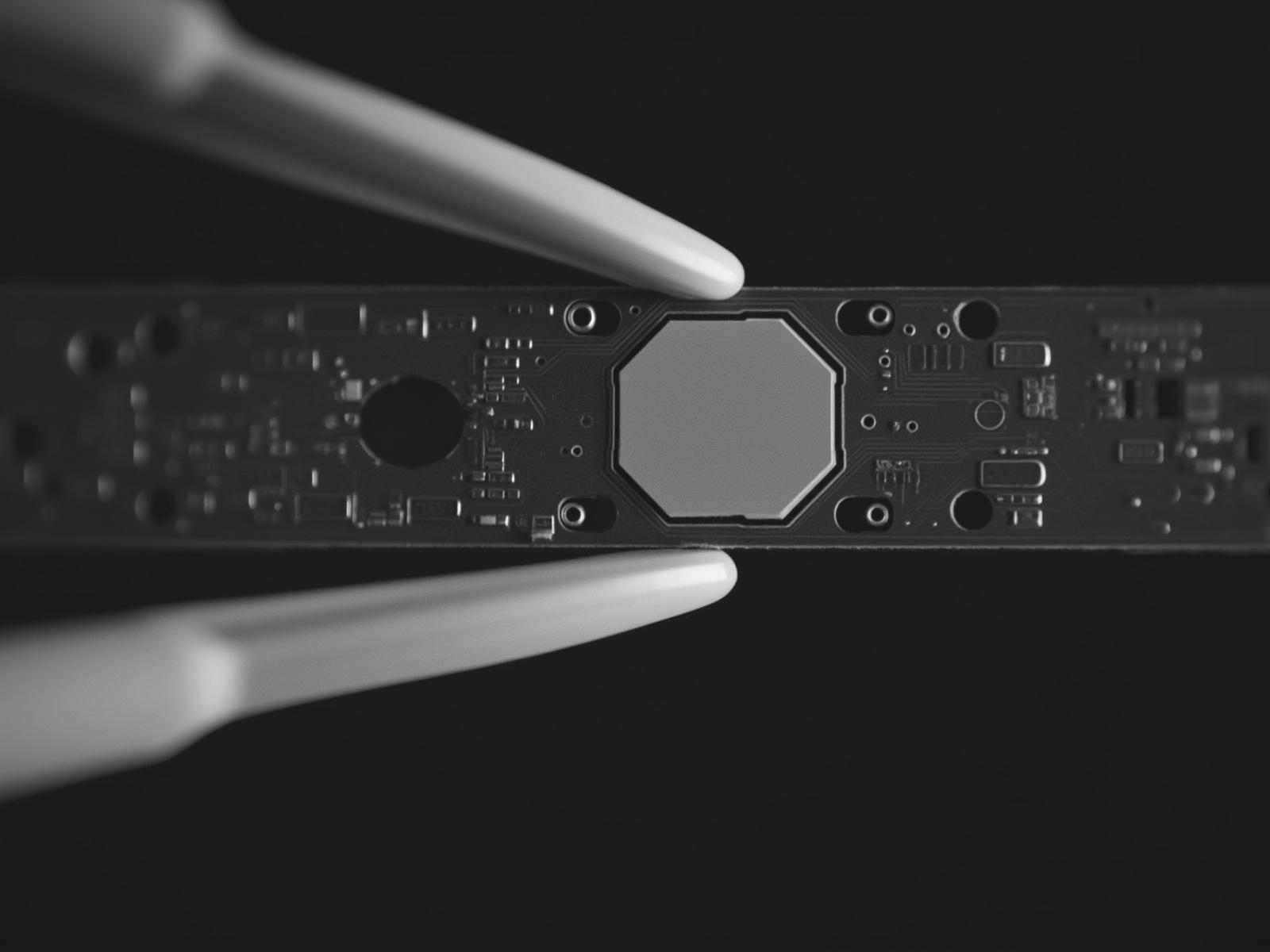
Tooling and the second market. The classic sequence is this: a brand launches in one market, succeeds, and decides eighteen months later to open a second market with a different regulatory position and a different language on the box. The mould is the supplier's, the modification is priced as a new customer, and the buyer discovers that ownership was never written down. A tooling schedule attached to the first purchase order resolves this in a single page. It needs an asset identifier, the cavity count, who pays for maintenance and modification, the trigger for transfer, and what happens to the asset if the programme ends.
Firmware and the maintenance question. The three arrangements in practice are: the supplier keeps the platform and licenses your build; the supplier writes everything to your specification and assigns it to you; or a shared model where you own your customisations but not the base. All three are defensible. What matters commercially is the third one, because a shared model means your ongoing maintenance depends on a counterparty whose commercial priorities may change. Buyers who want a choice about which arrangement they are in should ask about it before the quotation, because the answer affects the price.
Accounts and domains. This is the least glamorous item on the list and the one most likely to be lost. A developer account held under a supplier's company email is an account that can lapse, be transferred, or be used to gate a version release. Register your own domain, your own app store account and your own cloud tenant, and give the supplier the credentials they need without giving them the ownership. It takes an afternoon and it removes a category of problem entirely.
What a smart glasses platform claim does and does not cover
A supplier will almost always claim the underlying platform as their own, and in this category that claim is legitimate rather than aggressive. Platforms are how a factory amortises development across dozens of customers. The problem is not the claim; it is that the boundary is rarely drawn, so buyers discover afterwards which side of it their product sits on.
The boundary question is worth asking directly: what in this product was already ours before I ordered, and what did I create? A supplier who answers that concretely is telling you something useful, even when the answer is unfavourable. A supplier who answers in adjectives is telling you the conversation has not happened yet.
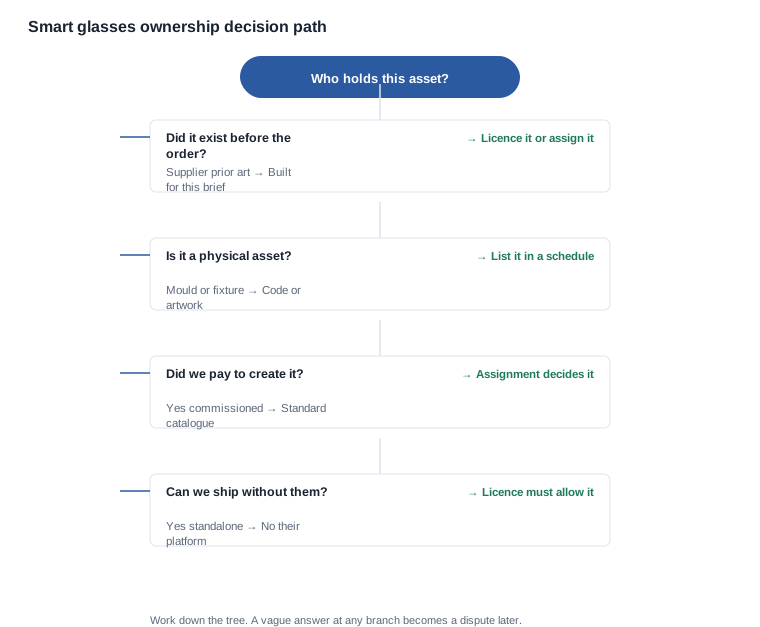
Customisation across the range is recorded by category rather than as one list, and the counts are not the same in each: seven recorded axes for camera entries, five for audio entries, five for sport entries and two for the children's tier. None of those records is an ownership position, so the question that decides the outcome is which of the recorded items leaves you holding an asset and which leaves you holding a licence. How much of that depends on the model and the volume, and it is a contract conversation rather than a catalogue conversation. The engineering customization page sets out what a custom brief needs to contain, and ODM development covers where the validation boundary sits when something is being engineered rather than selected.
A practical way to run the boundary conversation is to ask for it as a list, asset by asset, in writing, rather than as a general question about ownership. The list is short: for each of the six assets, the supplier states whether it is pre-existing, created for this programme, or shared. A list answer gets written into an annex. A general assurance does not, and it will not survive the first dispute.
There is one further distinction worth carrying through the whole programme. Ownership and access are different things. A buyer who owns the firmware but has no repository access, no build reproducibility and no right to appoint a second maintainer owns something they cannot operate. The practical test is whether you could hand the product to a different supplier and keep selling it. If the answer is no, then whatever the contract says, you have a dependency, and that dependency should be priced into your plan rather than discovered during a quality problem.
Two further categories sit underneath the six assets and are worth naming, because they are frequently overlooked. The first is upstream third-party intellectual property: the operating system build, the wireless stack, the sensor vendor's algorithms, the font in your manual, the codec licences. You do not own these and you cannot, and nobody should propose that you can. What you can do is ask which ones are present, whether any of them are licensed for your distribution model rather than for the supplier's own, and whether any of them expire or become unavailable. A font or a codec licence that lapses in year three of a slow-moving wholesale line is a real and unglamorous risk.
The second is confidentiality, which is the mechanism that makes the ownership discussion workable at all. A non-disclosure agreement is not an ownership clause and it transfers nothing, but it does determine who can see your brief, your artwork, your forecast and your launch date. In a category where several buyers may be working on adjacent products, the question of who inside the factory is allowed to know about your programme matters commercially. Ask for the confidentiality terms to name the function that holds the brief, to state that unreleased models are not shown to other buyers, and to say how long the obligations survive the programme. A non-disclosure agreement that expires on delivery is close to worthless in this category.
The three smart glasses OEM clauses that decide an ownership dispute
Most ownership disputes in this category are not won or lost in a courtroom. They are decided by three clauses, and all three can be drafted in an afternoon if you know they matter.
The background clause. This defines what the supplier brings to the table and confirms the buyer is not acquiring it. It normally takes the form of a schedule listing the pre-existing platform, the standard industrial designs available, the standard firmware baseline and any third-party software embedded in the product. Without this schedule, background and foreground are not distinguishable, and every subsequent sentence in the agreement becomes arguable. With it, the boundaries are visible.
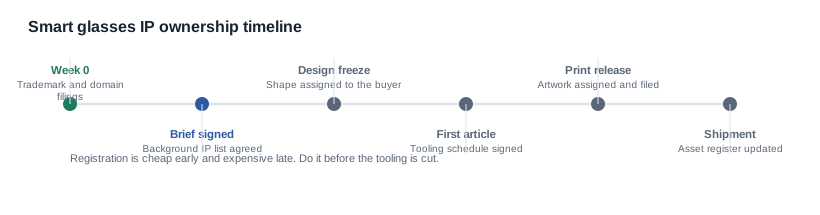
The assignment clause. This is where the work you commission becomes yours, and it is the clause buyers most often leave to an implied promise. The useful formulation is milestone-based: assignment of the design files at design freeze, assignment of the firmware build at a stated code revision, assignment of the packaging artwork at print release. Milestone assignment is easier to administer than a single assignment at the end, because the evidence of what exists at each point is already in the project record.
The licence-back clause. This defines what the supplier may keep doing after you own the result. A factory that has written firmware for your brand and assigned it to you will reasonably want to keep using the generic parts of that work for other customers. The trade-off is real and it is a negotiation, not a trick: a narrow licence-back protects you, a wide one keeps the price down and keeps the supplier able to maintain the product if you walk away. What is not acceptable is an unlimited licence-back written by accident, because it means your "owned" asset may be running in someone else's product.
Two further clauses are routinely absent and both are worth adding. Further assurance is the obligation to do whatever is needed later to perfect or record an assignment: signing a document at the factory's request, in a form a registrar accepts, in a jurisdiction of your choosing. It costs nothing to include and it closes a gap that otherwise shows up two years later, when you try to register something you thought you already owned. The second is the dispute mechanism itself: a named escalation path, a defined period for attempting resolution, and a governing law and forum. This is not the exciting part of an OEM agreement, but it is the part that determines what an unhappy buyer actually gets. Clear ownership terms with no workable enforcement route are a statement of intent rather than a contract.
Two further schedules complete the set: a tooling schedule that identifies physical assets and their ownership, and a change-control clause that states what happens to ownership when the specification changes. The change-control point is the one that gets forgotten, and it is the one that matters most in a fast-moving category. Change the temple shape, the radio module or the lens option and you may have created a new design element that nobody has assigned, and you may have invalidated a document that was built for the old configuration.
A practical negotiation position, if you want one: ask for the annexes before the price is finalised. Ownership terms that are agreed after the unit price is settled are harder to obtain, because the supplier has already priced the flexibility. The due diligence cost of asking for a document is an email; the cost of not having one is measured in years.
Smart glasses IP registrations that cost little now and a great deal later
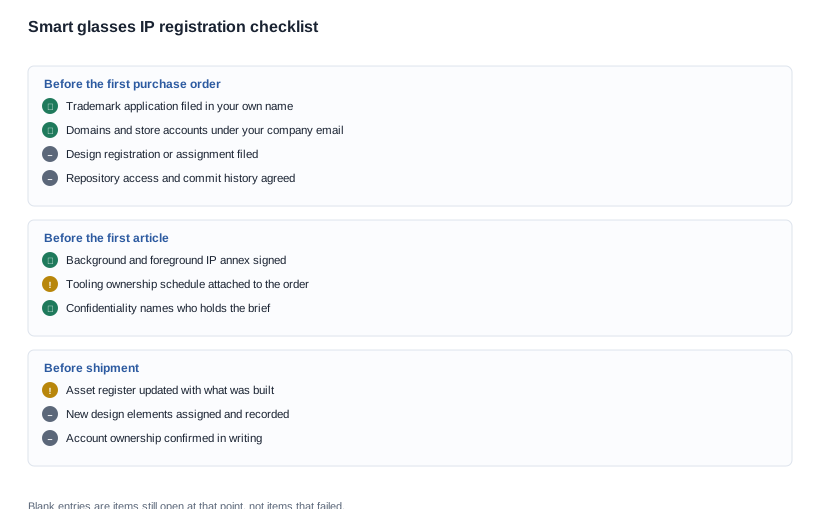
The registrations below are administrative, and every one of them takes less time than the meeting in which you decide to do them. They are also the steps that are easiest to postpone and most expensive to undo.
- Trademarks, in your own name, in the markets you intend to sell. File before you announce. A supplier's registration is not yours, and a supplier who registers your brand in a market you intend to enter is not doing you a favour.
- Domain names, app store accounts and cloud tenants, under your own corporate email. Never a supplier's, never a personal address, never a consultant's.
- Design registration or assignment for anything distinctive about the frame. The shape, the temple profile and the product silhouette are the assets most likely to be visible to a competitor first.
- Copyright assignment for code, artwork, manuals and any documentation you commission.
- A design and tooling deposit in your own name where the supplier permits it, so that the asset cannot leave the factory without your consent.

There is a fact worth stating plainly here, because it is the kind of thing buyers assume exists and then cannot produce. Our export certification page is an image-only page, and what it shows is ten patent certificates: eight design patents and two utility models. It carries no per-model row, no schedule and no ownership statement. That is a deliberate design of the page, and it is a useful model for what a publishable ownership document looks like in miniature. A picture proves that a certificate exists somewhere. It does not tell you which model it covers, who owns it, or whether it protects the variant you are about to ship.
The same logic applies to the chain of evidence inside your own programme. Keep the brief, the design file, the code commit, the print release and the invoice in the same folder, and keep them in a form that survives a change of email provider. When the question "who made this and when" is asked eighteen months later, a dated record is the difference between an answer and an argument.
A worked example makes the account point concrete. A brand launches a camera model with a companion app. The firmware build is assigned, the design is assigned, the trademarks are registered in the brand's own name. The app store listing is created during the launch because it was quicker to have the supplier's team do it, and the developer account sits under the supplier's corporate domain. Two years later the brand wants a second app for a second market, a second language, and control over release cadence. The listing cannot be moved without cooperation, the release process now runs through a team that serves forty other customers, and the brand's continuity depends on an account it does not control. Nothing was stolen and nothing was wrong. The failure was administrative, and it was entirely avoidable in a single afternoon before launch.

Due diligence questions that settle smart glasses ownership before anyone cuts a mould
If you only run one session with a supplier on this subject, run it before the first purchase order and before the design freeze, because after the first cut the options have narrowed considerably. Ten questions will produce the position, and they will also tell you how the supplier handles ambiguity.
- Which parts of this product existed before my order, and which are being created for it?
- Who owns the moulds and fixtures, and what event triggers a transfer?
- If I stop ordering, can I take the tooling, and on what terms?
- Is the firmware assigned, licensed, or shared, and can I appoint another maintainer?
- Which accounts, domains and store listings will be held in my name?
- What changes if I alter the temple shape, the radio module or the lens option after the first article?
- Which parts of the design are your existing range, and which were drawn for me?
- Do you offer exclusivity in any market, and if so on what product scope?
- Which suppliers or sub-contractors hold intellectual property inside the product?
- Who may change the firmware after launch, and who approves it?
The answers are not all going to be yes. That is fine. The value is in the shape of the answer and in the fact that it exists in writing. A supplier that answers item four with a clear, bounded position and tells you where the boundary lies is giving you something you can plan around. A supplier that answers all ten with variations of "it depends" is telling you that the programme will need a contract annex, and probably an amendment later.
If you are building a shortlist of suppliers rather than working with one, ownership responsiveness is a reasonable criteria to apply alongside price and lead time. Ask the same ten questions of each, in the same order, and compare the specificity of the answers. It is a cheap differentiator, because most buyers never ask.
Running the session well takes about an hour. Send the ten questions in advance so the answers can be prepared rather than improvised, ask for them in writing, and read the responses for a specific behaviour: does the answer name the asset, the owner and the mechanism? A response that names two of the three is a partial answer and should be chased. A response that names all three but arrives three days after you asked has told you something about how the supplier will handle the annex negotiation, which is useful information even when it is inconvenient.
For a buyer comparing more than one supplier, the comparison is not about who says the most agreeable thing. It is about who produces a specific, bounded answer to the hardest question on the list, which is the fourth: whether the firmware is assigned, licensed or shared. The three arrangements carry different consequences for maintenance, for your ability to move the product to another factory, and for the price. A supplier who draws that line clearly has done the work, and the buyer who can tell the difference between a drawn line and a vague answer is the buyer who avoids the expensive version of this article.
What we will put in writing on smart glasses IP, and what we will not claim
The position is straightforward and it is narrower than a marketing page usually is. The supplier's underlying platform belongs to the supplier and we say so plainly rather than pretending otherwise. Everything you pay to create, meaning tooling, your design commission, your firmware build, your app, your accounts and your marks, should be assigned to you in writing at the point it is created, not acknowledged after the fact. We will not put your brand on hardware we know is already sold under another name, and where a buyer asks us to develop something and then to own the result, we will say at the outset whether that arrangement is available on their configuration, because it is not equally available on all of them.
What we will not do is publish a blanket ownership statement, because it would be true only for some configurations and false for others, and a false ownership statement is worse than no statement at all. Equally, the commercial figures behind a specific configuration (unit prices, minimum order quantities, tooling costs, programme dates) are not published here and are confirmed per enquiry, and the same applies to the ownership position for any given model: it depends on what you are commissioning and on the volume.
The practical version of all of this is a single document. Before you place the first order, ask for the ownership annex in the form described above, attach the tooling schedule to the purchase order, and register the accounts and marks in your own name. If you send us the model, the configuration and the list of what you need to own, we will come back with which of it is available on that configuration and what has to be written down to make it yours. Where the honest answer is that an arrangement is not available on that configuration at that volume, we will say so at the start rather than after the artwork has been approved.
Related reading
- engineering customization and deliverables
- OEM engagement models and control
- ODM development and validation
Tell us what you need to own and we will say which of it is available on your configuration.


