

A pilot order is a test of the product and a test of the supplier at the same time, and the mistake most programmes make is treating the second as already passed. A pilot is small enough that a good factory looks brilliant: the team knows the product intimately, the components are in stock, the line is set up for one job, and any problem is solved by one of the people who built it. Scale-up removes all four of those conditions at once.
Scaling up is where the assumptions made at pilot volume stop being true. The three that break are rarely the ones a buyer expects, and they are not the ones that appear on a purchase order. They are the working capital, the quality trend across batches, and the support load that arrives after the invoice has already been paid.
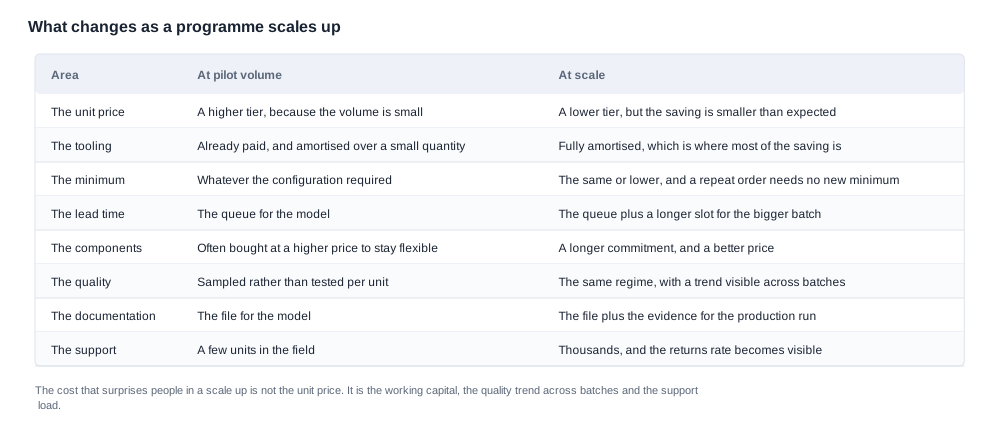
This article is about what actually changes between a pilot order and a production run, and what to settle before the larger order rather than after. The unit price, the minimum order quantity and the production lead time, together with the warranty terms and the tooling costs, are confirmed per enquiry rather than published here, so the argument is about the structure of the change rather than about a figure.
Smart glasses OEM scaling up: five things that change with volume
Five things move when a programme goes from a pilot to a production run, and a useful way to think about the exercise is to separate them from the things that do not move at all.
The things that change. The unit price, because the amortisation base changes and the component commitment changes. The cash cycle, because the deposit scales with the value and the timeline stretches. The quality behaviour, because the run is longer, larger and more likely to span a second line or a second component batch. The support load, because a larger installed base produces failures in absolute as well as proportional terms. And the schedule, because a bigger batch needs a bigger slot, and the slot you were holding is no longer the slot you need.
The things that do not change. The specification does not improve because you ordered more of it. The tooling does not get better. The documentation scope does not shrink. The cell chemistry, the charge test condition and the runtime test condition are exactly as unpublished at ten times the volume as they were at pilot volume, because none of them are volume-dependent. The published colour options stay as they are: three on one camera entry, four on another, and the temptation to launch four colourways at scale because one entry happens to publish four is a decision to create four setups rather than to buy four moulds.
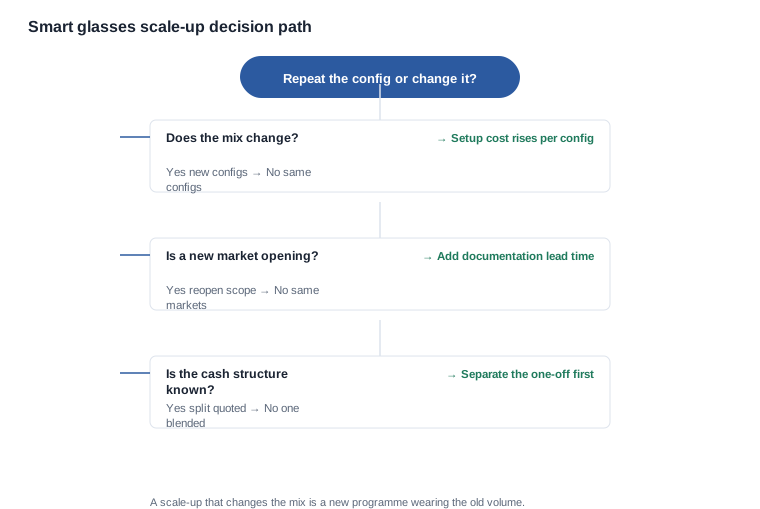
That last point is the one most often missed. Scaling up a single configuration is a procurement decision. Scaling up a mix is an operations decision, because each configuration in the mix carries its own setup, its own instruction sheet and its own stock. A buyer who scales from one model at a pilot volume to six models at production volume has not scaled by six times. They have multiplied the setup burden by six and hoped the volume discounts would cover it.
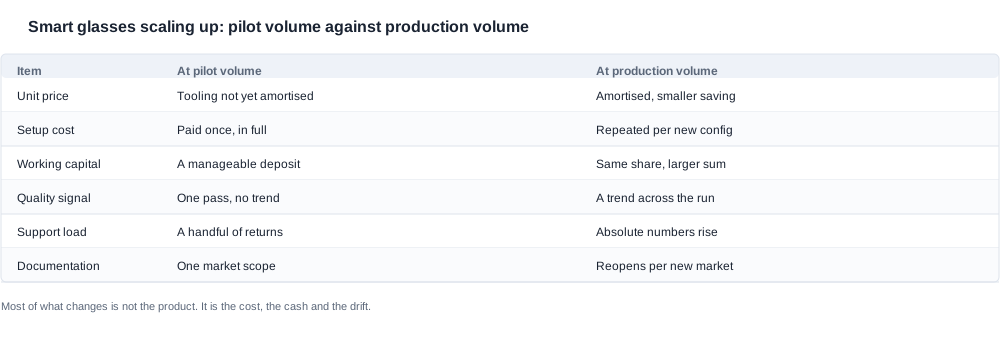
A second-order change that matters more than the first-order ones. Scaling up usually coincides with a change of market, a change of channel or a change of branding. Those are three separate changes stacked on top of the volume change, and each of them reopens something. A new market reopens the documentation scope, because no per-model certification row is published for any entry and there is nothing per-model to check against; what the export certification page carries is a set of ten patent certificate images, none of them attached to a model list. A new channel reopens the packaging, the manual languages and the labelling, and there is no translation row anywhere in the catalogue to work from. A new brand reopens the artwork, the approvals and the registration of accounts in your own name.
So the question a buyer should ask before scaling is not "can we order more". It is "what are we changing at the same time as the volume".
The most useful exercise before a scale-up order is a short written review of the pilot with three columns: what you proved, what you learned, and what you still do not know. The first column should be short, and that is the point. A pilot proves a small number of things. If the pilot proved fifteen things, it was not a pilot but a production run, and what follows is a repeat order rather than a step up.
The second column is where the configuration decisions come from. What the field data actually showed about charge time under your workload, about fit across a full day, about how the runtime behaved when the product was used the way your customers use it rather than the way the specification assumes. This is the point at which the published figures and your own experience meet, and the two are not always the same. Our published runtime figures for the camera tier sit in the region of five to eight hours with no test condition attached, so the pilot is the only place where a published number becomes your number.
The third column is the one that should govern the size of the order. Every open item in that column is a variable that will be different at ten times the volume, and some of them will be different in a way that costs money. An open question about documentation for a second market, an unconfirmed component supply position and an unresolved spare parts question all become larger when the volume does.
Then write one line that states what the scale-up is actually for. Not "to grow the business", which is a motive rather than an objective. Something like "to take the pilot configuration to the full first-year forecast for one market, with the mix unchanged". That single line is the acceptance test for every later decision, and it is what stops a scale-up order quietly becoming a different product programme.

Why the smart glasses unit price saves less than the volume suggests
A buyer who orders a thousand units and then ten thousand usually expects a proportionally better price, and the reason it is not proportional is that the tooling was already paid for at pilot volume. The mould was cut for the pilot, and that cost is now amortised over a bigger quantity, which is a real saving but a smaller one than the volume suggests. Everything else in the bill of materials moves much more slowly, because the components are bought at a price negotiated against a smaller commitment.
The saving that does arrive comes from three places, and they are worth naming separately because they behave differently.
- Tooling amortisation. A one-off cost spread over more units. This is the cleanest saving and the most predictable, because the one-off is already sunk.
- Component pricing at a larger committed quantity. Real, but conditional on the supplier being willing to hold that commitment, and conditional on the component not having moved in the market.
- The removal of setup costs. This is the largest and the least visible, because setup costs are not in the unit price at all. They include the initial programming, the first article inspection, the certification work specific to the pilot configuration, and the artwork and packaging setup.
The third one deserves more attention than it usually gets, because it is also the reason the saving does not repeat. Once the setup is done for a configuration, it stays done for that configuration. So the saving from a repeat order of the same configuration is much smaller than the saving from a first order, and the saving from a repeat order of a different configuration is close to zero, because a new configuration carries a new setup even at high volume. This is the arithmetic behind why a scale-up that doubles the volume but changes the mix can be more expensive per unit than the pilot, and it surprises people who assumed volume was the only variable.
The criteria for a scale-up shortlist are worth writing down before the quotation arrives, and they are simpler than they look. Which model will you scale first. What would have to be true about that model for it to be the right one to scale. And what you are accepting as risk if the answer turns out to be no. A due diligence step here is cheap, because the alternative is a second supplier, and a second supplier in this category costs more than the diligence does. Which one of those three answers is the least certain is usually the model question, and it is the one to settle before you commit the volume rather than after.
The practical instruction is to ask for a quotation that separates the one-off from the recurring, with the amortisation volume stated. A supplier who cannot separate them has not modelled the scale-up, and a buyer who accepts a single blended price will find the scale-up economics unpleasantly opaque at exactly the moment they are least able to argue about it.
The smart glasses working capital, which is the real cost
At a pilot volume the deposit is a manageable number. At production volume it is a different proposition, and it arrives before the product exists.
The structure in this category is usually a deposit at the order and the balance before shipment. A pilot order of a thousand units might commit a fifth of the value. A production order of ten thousand commits the same fifth of a much larger number, and it commits it four months earlier. Add the stock cycle and the picture is complete: a brand that planned its budget around the unit price has planned around a line that is not the largest one on the invoice.
The questions to ask are specific. Is the balance due before dispatch or on delivery? Is the deposit a fixed percentage of the value or a fixed amount per unit, and does a larger order change the percentage? Does the freight term change the cash timing, since an FOB shipment pays for the goods and the freight on two different dates while a delivered term pays once? And behind all of those, what happens to the stock cycle if the goods are late, because a delayed shipment with a paid balance is a cash problem rather than a supply problem.
There is a working capital effect that is specific to this category and it is not about the supplier. Every entry in our range is battery-powered, which means the shipping timeline is not entirely at the buyer's discretion, and it means the compliance and transport obligations travel with the goods rather than with the paperwork. No entry in the range publishes its cell chemistry, its cycle life or its replaceability, so the replacement cycle in the field, which drives how fast you reorder and how much you hold, cannot be modelled from the catalogue. It has to be asked for.
The second working capital trap is the one that catches a brand in its second year rather than its first. Scale-up often means committing to a volume across several configurations in order to reach a tier. That volume then sits as stock, in a market where the slow-moving colourways are the ones that took the setup commitment, and the price you negotiated assumes you sell all of it. A tier break reached by holding the wrong mix is not a discount. It is a discount plus an inventory problem.


Quality drift across smart glasses batches, which pilot volume hides
This is the failure that hurts most and is noticed least, because it takes time to appear and because it does not look like a defect.
A pilot order is small, it is often assembled from components already in stock, and it is inspected by a small team who know the product well. A production run is larger, it is spread over a longer period, it may use a second production line, and it will use components from a different batch. Each of those is a normal and legitimate change. Each of them is an opportunity for the product to drift.
The specific failure is a batch of units that is slightly off in a way that does not fail a test. A colour that is a shade different. A fit that is a millimetre out. A firmware build that has one default changed. A battery from a lot with a slightly different internal resistance. A pilot of a few hundred units will not show this, because there is no comparison. The discovery arrives as a return rate in the channel, six months after the launch, attributed to the product rather than to the batch.
There is a catalogue-related version of this that is easy to miss. For most of the range the published charge time reads two hours or less, and two entries read closer to one hour. That is a ceiling rather than a measured average, and it is a figure with no test condition attached. A production run that lands consistently at the ceiling looks like a supplier problem on paper, even though nothing is wrong. Which is exactly why the control is not the number but the condition.
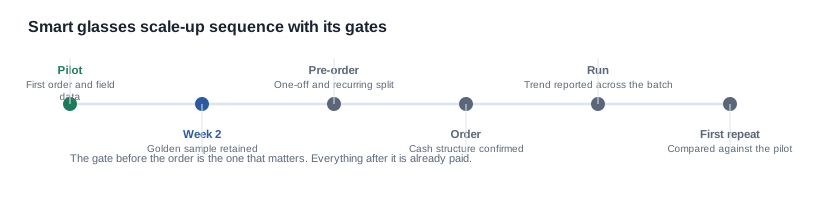
The defence has three parts. Insist on a retained golden sample from the approved pilot and compare against it, not against a fresh production unit. Ask for a trend across the run rather than a pass or a fail at the end of it, because a trend shows the drift before a customer does. And ask what the factory measures during a run, specifically. A factory that reports an in-process measurement across a production run is a factory that has seen this problem before, because you cannot report a trend you do not take.
The support load that arrives after the smart glasses invoice
At a pilot volume, a hundred units in the field generate a handful of returns, and a handful of returns is a manageable number of conversations for a founder or a small team. At ten times the volume, the same percentage is a hundred returns, and the same percentage of a larger installed base is also a larger absolute number of failures of every kind, including the ones nobody anticipated.
This is where an agreement that was perfectly adequate at pilot scale stops being adequate. The replacement process, the spare parts list, the response time and the freight arrangement were all sized for a small number of units in the field, and the same clauses will be strained at scale. The clause that breaks first is almost always the one about who pays the return freight, because at pilot volume the answer was whoever happened to be nearest, and at production volume the answer has to be a rule.
The step to take is to agree the support structure before the large order rather than after it, and to make the spare parts list a deliverable of the pilot phase rather than a question that surfaces when a distributor asks for a replacement tip. A spare parts list produced during the pilot is a list of real parts from a real product. A spare parts list produced after a complaint is a list of parts that were never checked against anything.
There is a second-order effect worth naming. The support load is not only about failures. It is about the questions. A larger installed base generates more enquiries, more "how do I pair this", more "what does this light mean", more "where do I get a replacement cable". At pilot volume those are handled by people who know the product. At scale they are handled by whoever is available, and the difference between a support team that has been trained on the product and one that has not is visible in your returns rate for reasons that have nothing to do with quality.
There is a third element of the support load that is specific to wearing products, and it arrives late. Glasses are worn on a face, in heat, in rain and in a pocket, and the failure modes that come from that are different from the failure modes a factory sees on a bench. Ingress protection is where this shows up, and it is worth being precise about what is published: exactly two entries in our range publish an ingress rating, both of them IP54, and nothing else in the catalogue publishes one. So for the great majority of the range, whether the product survives a splash or a downpour is not a published fact, and it cannot be resolved from a specification. It is a question for the supplier, and at scale it becomes a return-rate question.
That is the general shape of the support conversation at scale. The fields that matter most in the field are the fields the factory specification is thinnest on. A frame weight appears on one entry only, and it covers the glasses alone rather than the case. Acoustic behaviour is not published for any entry in the range. Whether the product supports a capacitive touch control is not published anywhere in the catalogue, and neither is whether the manual is translated. A support team asked to defend a claim they cannot cite will either avoid the question or invent an answer, and both are worse than saying plainly that the row is not published.
The structure that survives a scale-up is a written support annex attached to the programme: the spare parts list with quantities and a price basis, the failure definitions that trigger a replacement, the evidence the buyer must supply with a return, the response windows, and the period for which parts remain available. Nothing in that list needs to be agreed to a specific number today. What matters is that the structure exists before the volume arrives, because the cost of adding a spare parts list afterwards is paid in the returns queue rather than in the contract.
There is a trade-off worth naming here. Tightening the support structure raises the cost per unit, and a buyer who has just spent the negotiation on a volume discount has very little left to spend on it. That is exactly why the support annex should be settled before the commercial negotiation rather than after it. By the time the unit price is agreed, the supplier has already priced the flexibility, and the flexibility you still need is the one that costs them something.
What to settle before the smart glasses scale-up order
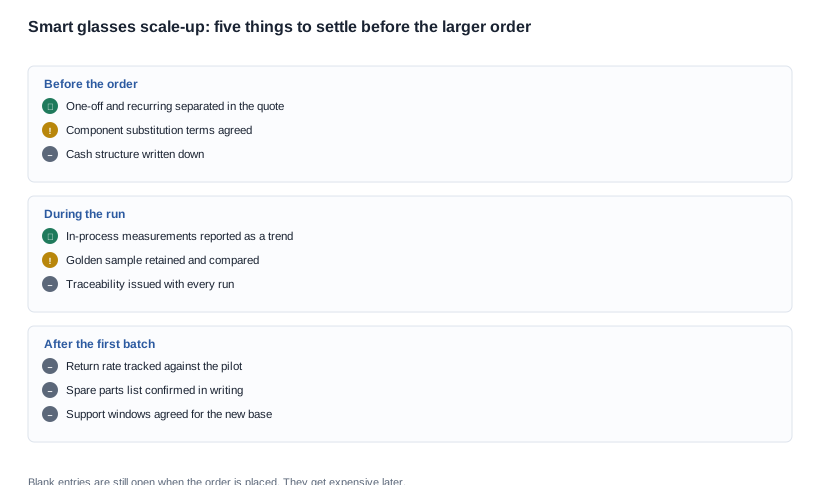
Five things, and all five belong in the conversation before the purchase order rather than after it.
- The one-off and the recurring separated, with the amortisation volume stated and the setup cost per configuration identified. Without this you cannot tell a volume saving from a configuration change.
- The component supply position for the larger quantity, including what happens if a part is substituted and how that reaches you before it reaches the warehouse.
- The quality regime across the run: what is measured in process, what trend is reported, and what the golden sample is.
- The cash structure: deposit, balance, freight term, and the consequence of a late shipment.
- The support structure at the larger installed base, including the spare parts list, the response windows and who pays the return freight.
There is a sixth item that buyers frequently add late and regret adding early, which is the change of market, channel or branding happening at the same time as the volume change. If a second market is opening, the documentation scope for that market is a separate question with a separate lead time, and it is the one most likely to hold up a shipment that was otherwise on schedule.
The negotiation itself is simpler than buyers expect, because the arguments are structural rather than emotional. You are asking for a quotation with two columns instead of one, a trend report instead of a pass, a spare parts list instead of a promise, and a cash structure rather than a price. Each of those is a reasonable request, and each of them is worth more to you than a discount of the same order of magnitude.
A scale-up should be priced and scheduled as a distinct step rather than as a larger version of the pilot. Our published product data is the material a scale-up is built on: the cell capacities, the rated runtimes, the case capacities, the colour options, the structural features, the charging interfaces, the camera tiers and the charge times, along with the seven customisation points. We do not publish our production capacity, our lead times, our minimum order quantities, our unit prices or our tooling costs, so a scale-up is quoted for a specific configuration and a specific volume rather than published as a general position.
What we will do is take a specific model, configuration and volume and quote the scale-up with the one-off separated from the recurring and the dependencies named.
Related reading
- The levels of engagement — standard OEM end to end
- The cost structure by phase — the ODM cost breakdown
- The production control that catches drift — quality gates
- The support side of scale — after-sales support
Send the model, the configuration and the volume, and we will quote the scale-up with the one-off separated out.


