

Service levels are the part of an OEM agreement that gets written last and read first when something goes wrong. Most buyers agree them in a hurry, because by that point the unit price and the sample have been settled and the remaining negotiation energy is spent. The result is an agreement that says "prompt response" and "reasonable quality", two phrases that mean nothing until the exact week you need them to mean something.
A service level is not a statement of goodwill. It is a mechanism, and a mechanism needs three named parts before it can do any work at all: the event that starts the clock, the time in which somebody must respond, and the remedy that follows if the window is missed. A clause missing any one of those is a description of an intention.
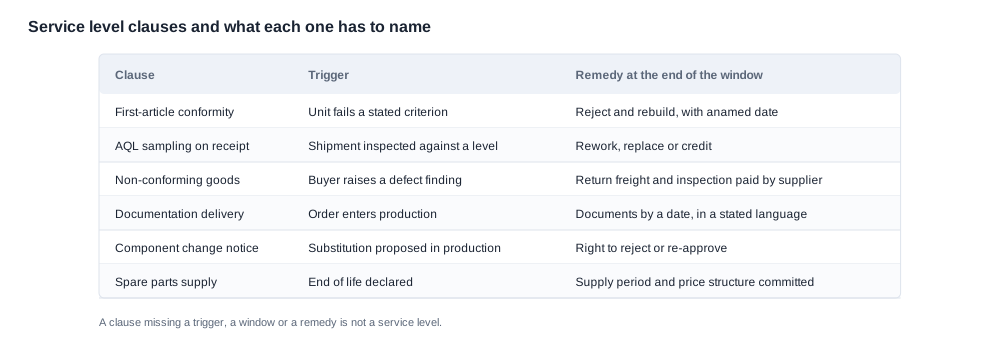
This article covers what a service level has to name, the six clauses that carry the weight in a smart glasses programme, why conformity is unusually hard to judge in this category, how to negotiate the windows, and how to test a service level before you sign it rather than after the first claim.
Smart glasses OEM service levels: the three parts of every enforceable clause
Every enforceable service level has the same three parts. Starting with the one most often left out.
The trigger. The event that starts the clock, written so that a goods-in team can observe it without asking anyone's opinion. "When the customer reports a defect" is a trigger. "If quality issues arise" is not, because it never defines whose judgement decides that they have arisen. Useful triggers in this category are narrow and written as a list: the first article fails a stated criterion; the received quantity is short against the packing list; a component substitution is proposed after the build started; a shipping document does not match the order; a unit arrives with a fault that is observable at the point of receipt.
The response window, and the remedy window, as two separate numbers. These are different commitments and they are constantly confused. A supplier who commits to "48 hours to respond" has committed to nothing about the replacement unit, which is the thing the buyer actually needs, because a replacement unit has to be picked, packed, shipped, customs cleared and delivered. The honest version of this clause names two windows: one for acknowledgement, and a longer one for the remedy being in place, and it names which of those two you are being held to.
The remedy. What happens at the end of the window, and who pays. Replacement, rework, credit or a root cause report are the four that work, and the choice between them is not stylistic. A replacement moves the cost onto the supplier and the risk onto the buyer if the fault was a one-off. Rework suits cosmetic and fit issues and does nothing for a unit that fails in the field repeatedly. Credit suits a commercial failure, such as a quantity shortfall or a late shipment, where the buyer has already sold the units onward. A root cause report is not a remedy at all but it is the clause that stops the same failure arriving four times.
There is a fourth element that is not part of the three but decides whether any of them work: the evidence. Who inspects, what they record, what the buyer must supply, and how quickly. A non-conforming goods clause without an evidence rule becomes an argument about whose photographs are more convincing, and that argument is won by whoever has a better relationship with the freight forwarder.
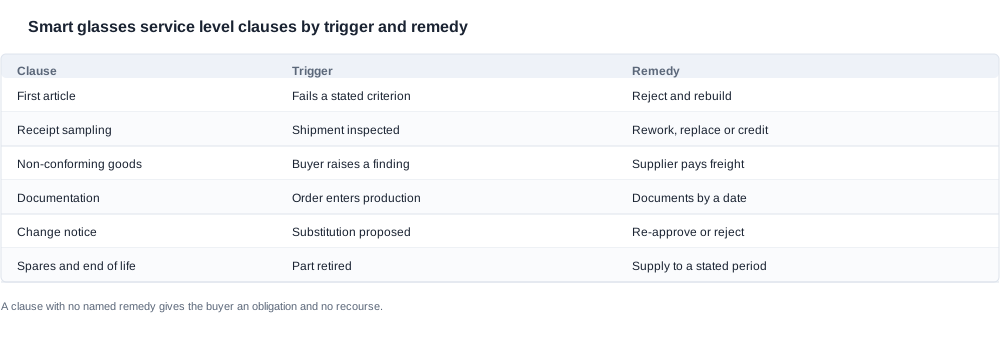

Six smart glasses clauses worth putting in an OEM agreement
These are the clauses that come up repeatedly in smart glasses programmes. The wording below is deliberately specific enough to be executable.
- First-article conformity. What happens if the first article does not match the approved specification? Name the trigger as the failing criterion rather than as dissatisfaction, name the remedy as reject and rebuild with a stated date, and name who pays the cost of the rebuild. A rejected first article can consume months, and the clause is what stops it consuming months by default.
- Sampling on receipt. The acceptance level, the number of units inspected, the inspection method and the action on a fail. Without a stated inspection level, every shipment becomes a conversation about what acceptable meant at the time, and the supplier will always be able to find a reading that passes. Pick the level with the supplier rather than accepting a default, because the level has a real cost and a real price.
- Non-conforming goods handling. Who pays the return freight, who inspects, what evidence the supplier needs before acting, and what the buyer must do with the goods in the meantime. This is the clause that decides whether a return is a five-day process or a six-week one.
- Documentation delivery. Which documents, in what language, by when, and what happens if they arrive late. This clause matters more than usual here, because our catalogue carries no per-model certification row of any kind. The export certification page shows ten patent certificate images, eight design patents and two utility models, and no model list on any of them. A picture proves a certificate exists; it does not prove it covers the variant you are shipping. The clause must name the model list requirement, not just the document list.
- Component change notification. How much notice, in writing, to whom, and what the buyer's right is to reject the change or require re-approval. This is the clause that protects a technical file from quietly becoming inaccurate, and it is the cheapest insurance in the agreement.
- Spare parts and end-of-life support. For how long the supplier commits to supply, at what price structure, and with what notice before a part is retired. For a product with a consumer lifecycle measured in years, a supplier who will not commit to spares is telling you something about the fifth year of your channel.
Two more clauses are worth adding if the programme reaches beyond a first order. The first is a documentation currency clause, requiring that a change to the technical file is notified to the buyer even when the change does not alter the physical product, because the change may alter the compliance position. The second is a field-data clause, obliging the supplier to receive returns and to report the reasons, since the supplier sees returns you never will, and the pattern across them is the earliest warning of a process drift that a quality inspection at goods-in will not catch.
Warranty and service levels are different instruments, and buyers routinely confuse them. A warranty is a duration and a remedy for the unit. A service level is a process and a timing for the response to a claim. A warranty of twelve months with no response commitment tells you nothing about how long a replacement takes. A response commitment with no warranty tells you nothing about whether the unit is covered in the first place. Both need to exist, and they are usually written in different places by different people, which is precisely why the gap between them goes unnoticed.
The returns routing is where this becomes concrete, and it should be settled before the first order rather than at the first claim. Does a unit come back to the manufacturer, to the distributor, or to the retailer? Who inspects it, and with what equipment? What must the buyer supply with the unit, and what happens to a unit that arrives with no documentation at all? Who pays the freight in each direction? And what happens to a unit that returns after the warranty period has run out but which carries a genuine fault, which is the case most often left undefined and most often disputed. Every one of these questions has a cash answer, and all of them are cheaper to agree before the programme than after.
One more clause is missing from most agreements and a buyer in this category will eventually want it: a rule for the ambiguous middle. Some faults are clearly defects and some are clearly not, and a band sits between them containing the units that will not power on after a month of use, the units with an intermittent connection, and the units whose frame finish is close enough to the approved sample that you cannot say whether it matches. Without a rule, each of these becomes a negotiation. With a rule, it becomes a decision, and the decision has already been agreed by both sides before it was needed.
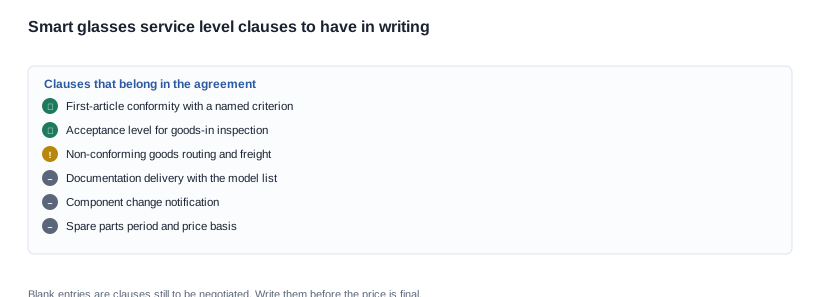

Why smart glasses conformity is hard to judge at goods-in
Two features of this product make the service level clause load-bearing rather than decorative.
The published specification is thin, and it is thin unevenly. A published entry in this range might give you a cell capacity, a Bluetooth version, a charge time of two hours or less, a rated runtime, a charging interface and a camera resolution, and nothing at all about the sensor model, the field of view, the video format, the frame weight or the ingress protection rating. Of the twenty-eight entries, fourteen publish a Bluetooth version, twenty-six publish a charge time and twenty-four publish a charging interface. Five publish a charging case capacity, two carry an ingress rating and one carries a frame weight, and that frame weight covers the glasses alone rather than the case. No microphone specification is published for any entry, and the catalogue contains no capacitive-touch row and no translation row anywhere.
Where the specification is thin, conformity cannot be judged at goods-in by inspection, because there is nothing to inspect against. It has to be judged against criteria you wrote in advance, which is a service level question rather than a logistics one. A goods-in team with a fat specification can reject a bad shipment; a goods-in team with a thin one can only count boxes.
A single configuration change can turn the product into a different one. Change the radio module, the cell or the charging interface and the documentation position, the transport position and possibly the labelling position change with it. In our range four entries do not publish a charging method at all, and while three carry no charging case row at all, one explicitly states that it has no case. A service level that requires change notification is what keeps your documentation aligned with what is actually in the box, and it is what prevents a conformity dispute from turning into an argument about which document was right.
There is a third feature worth noting, and it is about how the published numbers behave. Most of the range carries a published charge time of two hours or less, and two entries come in nearer one hour. That is a ceiling rather than an average, and no test condition is published for it. The same is true of the camera runtime figures, which sit in the region of five to eight hours with no condition attached. A service level written against a published ceiling will be triggered by units that are entirely within specification, because the figure was never a measurement of the average unit. Either specify the condition that makes the number meaningful, or do not use the number as an acceptance criterion.
Writing your own acceptance criteria is more work than most buyers expect and it is the only way the clause works. The method is unglamorous. Start from the published rows you can rely on and decide, for each one, what you are willing to accept as conforming. Then write the measurement method yourself, including the condition, the number of samples, the equipment and who records the result. Then write the tolerance.
The reason to do this yourself rather than to ask the supplier is that the supplier will give you a method that reflects their process rather than yours. A charge time measured from a partially discharged cell at a bench temperature is a different measurement from a charge time measured from empty in a car at ten degrees, and neither is wrong. The point is that one of them is the number your customers will experience and the other is the number that appears in a report.
There is a practical version of this that is almost free: a house test protocol, written once, applied to every sample you approve and every unit you receive. Three or four rows, a spreadsheet, a person and a stopwatch. It costs a day of somebody's time and it produces a comparable set of numbers across suppliers, which is worth more than any single detailed specification, because it is the same measurement applied to every product you consider.
Keep the protocol attached to the approval form as well. The unit you approved and the unit you receive should be measured the same way, otherwise the two sets of numbers cannot be compared and the golden sample becomes a decoration rather than a reference.
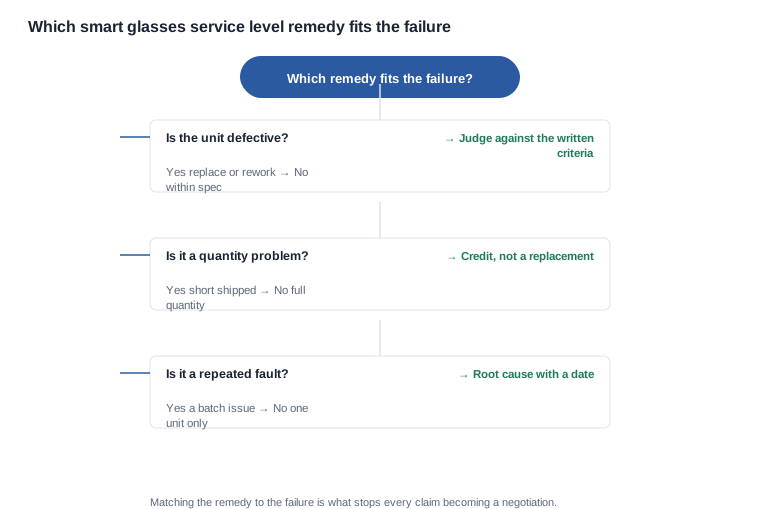

Negotiating smart glasses response windows, remedies and the trade-offs
Service levels are negotiated, and the negotiation is usually framed as a request for generosity. It is more useful framed as a request for precision, because precision is often free and generosity is not. If you are building a shortlist of suppliers, apply the same test to each of them and be explicit about which one you would rather have on your side of a failure, and about which model your goods-in team will actually be holding when the clause is invoked.
On windows. A tight window is expensive for the supplier, and the price of it appears in the unit price. The negotiation that works is to ask for a short acknowledgement window and a longer remedy window, and to make the remedy window conditional on something the supplier controls. A replacement shipped within a fixed number of days of a verified fault is a commitment a factory can make. A replacement within a fixed number of days of a complaint is not, because the complaint may be unverified, and the supplier will price the uncertainty accordingly.
On remedies. Rank them and match them to the failure rather than offering a menu. For a unit that arrives defective, replacement or rework at the supplier's cost. For a quantity shortfall, credit. For a late shipment that breaks a channel commitment, a defined remedy that is usually a credit plus a delivery priority on the next run, because a replacement shipment does not fix a missed date in a retailer's window. For a repeated failure across a batch, a root cause report with a corrective action date, which is the only remedy that addresses the cause.
On inspection levels. The acceptance level at goods-in is a genuine negotiation and a frequently botched one. Too tight and the supplier will quote a higher price and will also dispute failures more aggressively, which is worse than a low level. Too loose and the buyer absorbs the defects into the channel. The useful move is to ask what the factory's own internal outgoing inspection level is, because a supplier whose internal level is stricter than yours will rarely fail yours, and that number is often better than the one you would have chosen.
On the trade-off between service levels and price. Buyers who push service levels hard after agreeing the price tend to get a worse deal than buyers who agree them first. A supplier that has already priced the work will find reasons why a window is not possible; a supplier that has not priced it yet can include it in the quotation. This is the same sequencing lesson that appears in the development process reference, where each clause naturally settles at a different point in the programme, and it is why the development process page is worth reading before the negotiation rather than after it.

Due diligence on a smart glasses service level before you sign it
A service level is a promise, and promises should be tested before they are accepted rather than after the first failure. Six questions do most of the work, and the answers are more informative than the clause text.
- What event starts the clock, and who decides that the event has occurred?
- How long until somebody acknowledges, and how long until the remedy is in place?
- What happens to the affected units in the meantime, and who owns the freight in both directions?
- What evidence does the supplier need from us before acting, and how long does that take us?
- Which payment does this clause apply to, and does a partial shipment get treated the same way?
- What happens to the clause if the failure is caused by a component the supplier substituted without notice?
The sixth is the one that exposes the weakest agreements. If the supplier substituted a component and the product then failed, a service level with a change notification clause creates a clear answer: the substitution was unauthorised, the remedy follows the failure clause, and the change control clause is a separate breach. An agreement without a change notification clause has no way to characterise that situation, and it becomes a negotiation at exactly the moment you have least leverage.
There is a second test that is worth applying to any service level, and it costs nothing: read it as a goods-in operator who has never met the supplier. If the trigger cannot be observed at the point of receipt, or if the remedy requires a decision nobody has been given authority to make, the clause will not work under pressure. That is not a drafting quibble. It is the most common reason a service level fails, and the reason is always the same: it was written for a negotiation rather than for a Tuesday morning when a pallet arrives with a problem.
Finally, test the fit between the service level and the engagement model, because the two are not independent. A programme in which the supplier owns the design, the tooling and the firmware has more levers to pull when something fails than a programme in which the buyer has specified everything and the supplier is making to a drawing. The engagement models comparison sets out what each one puts on which side of the line, and the OEM scope page lists what sits inside a standard engagement. Where a programme is built on a platform that was designed to be contracted from the start, the OEM ready platforms range already carries much of this structure, which is why those programmes tend to reach a written service level faster and with fewer rounds.
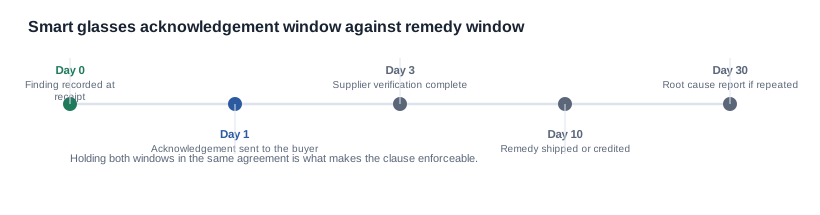
Every clause here should be executable by someone who has never met us. That means the trigger is a condition a goods-in team can observe, the window is a number rather than a description of urgency, and the remedy names who pays and what happens to the affected units. A clause that requires a conversation to interpret is not a service level.
We will not publish response-time commitments as standing figures on this site, because they depend on the programme, the configuration and the volume, and a number quoted out of that context would mislead you rather than help you. Tell us the configuration, the volume and the destinations, and we will tell you what we can commit to and what we cannot.
Related reading
- What a service level actually attaches to — OEM scope
- When an engagement model changes what we owe you — engagement models
- Where a clause gets settled during development — development process
- Platforms built to be contracted from the start — OEM ready platforms
Tell us the configuration, the volume and the destination markets and we will come back with the service commitments we can actually hold to.


