

Most of the damage in a first smart glasses programme is not caused by a technical failure. It is caused by a sequence error — a decision taken a stage earlier than it should have been, or a decision deferred until the point where it could no longer be made cheaply. The electronics are rarely the problem. The order of operations is.
That makes the subject uncomfortable, because the decisions that cause the damage look reasonable when they are made. Freezing the specification before the first article arrives looks like discipline. Comparing unit prices across two suppliers looks like cost control. Committing to three colours for a launch looks like giving the channel choice. Each one is defensible in isolation and expensive in sequence.
Below is the working list we would want a buyer to hold us to — eight mistakes, grouped by the stage at which they occur, each with what it actually costs and what to do instead. The smart glasses OEM programme structure and the standard OEM route are the two places where most of these mistakes originate, and the development risk factors list covers the failure modes on the engineering side.
A word on how to use the list. These are not supplier behaviours to shop for; they are decisions to avoid making, and several of them are decisions buyers make while believing they are being careful. A shortlist that scores each candidate on how clearly it states what is published, what is not published, and which configuration it has quoted is already applying half of this list. The other half is applied by the buyer, at the point where the specification is written and the order is placed, because that is where the sequence is set.
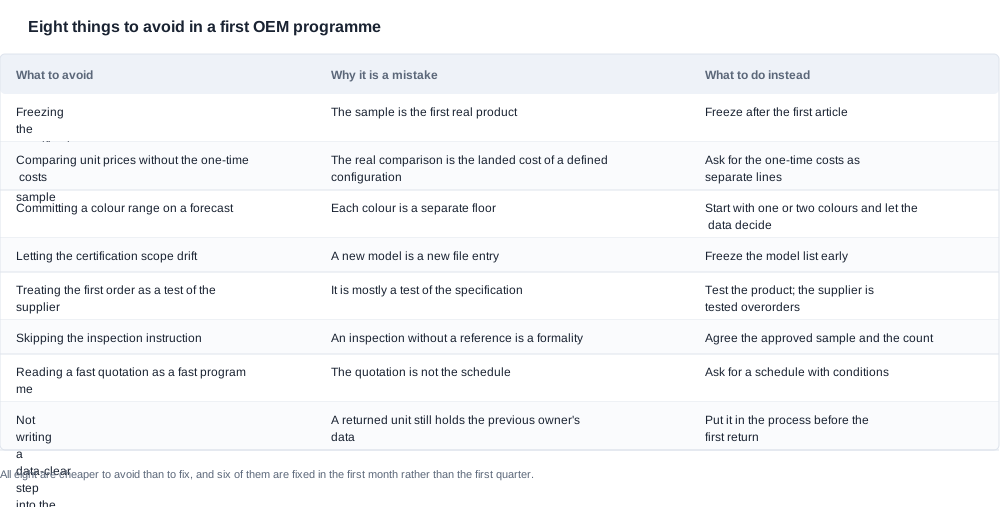
Smart glasses OEM mistakes: the specification and the money
Mistake one: freezing the specification before the sample exists. The sample is the first product. It is the first time a written specification meets a physical object, and it is the last moment at which you discover that a described feature is harder to build than the description implied. The fix is not to write a loose specification — loose specifications cost more, not less, because every party fills the gaps differently. Write the specification tightly, then freeze it once, after the first article, with every change made on the record. The alternative pattern — freeze early, then re-open the file repeatedly — is what turns a four-month programme into a seven-month one, and it is also what makes the supplier stop trusting their own input.
The cost is concentrated in the second half of the programme. Once tooling is cut, every subsequent change to the specification is either paid for twice or absorbed by somebody who did not agree to it. That is why the freeze has to happen on a date that is written down, and why the date has to be after the first article rather than before it.
Mistake two: comparing unit prices without the one-time costs. A unit price is the smallest and least stable part of a platform quotation. Tooling, first-article approval, packaging setup, artwork preparation and the documentation work are largely fixed costs, and they land on the first order in a way that a later order never repeats.
The comparison that matters is the total cash committed to the first sellable shipment, including everything that is not per-unit. Two platforms with different unit prices and different one-time costs are not comparable until both are added up, and a comparison that ignores the fixed side systematically favours the platform that is cheaper per unit and more expensive to start. None of these figures are published in our documentation — tooling cost, non-recurring engineering charges, minimum order quantity and lead time are all confirmed per enquiry — which is exactly why the buyer has to insist on seeing them in writing before ranking two quotations.
Mistake three: committing a colour range on a forecast. Each colour is a separate commitment on the production schedule, and a per-colour minimum is not covered by the order total. A brand that plans a launch colour and then adds two more "for the channel" has made three commitments rather than one, and has also expanded the colour approval work, the packaging work and the stockholding exposure.
The published colour data in this category is narrow enough to make the point: only the V03 Pro publishes a colour list, with three options, and only the V06 publishes four. Everything else in the twenty-eight entry range records no colour options at all. That means a colour programme is, for most models, a new configuration rather than a finish decision — which is a tooling and scheduling conversation, not a swatch discussion. The correction is to start with the smallest range the launch can survive, order it, and let the first season's sales data decide the second season.
The same reasoning applies to the case. Five models in the range publish a charging case capacity — 1400 mAh for the L1 Pro and the CY03, and the CY05, 900 mAh or 1400 mAh for the L2 Utral, and a 1200 mAh foldable case for the MT6 — and the L2 Utral's two published capacities mean that "the L2 Utral with a case" is two different products. KY06 and MT5 have a case whose capacity is not published, the V03 and the V06, and the S7 carry no case row at all, and the V03 Pro is listed without one either. A buyer who specifies "the camera model with the case" has specified nothing, and a programme built on that description will produce a sample with the wrong accessory and a packaging design for the wrong box.

Smart glasses mistakes that come from the scope, not the supplier
Mistake four: letting the certification scope drift. Every model is an entry in a document set, and every entry is work — testing, documentation, marking, packaging and the maintenance obligation that follows. A brand that adds a model in month four has not added a SKU; it has extended the file and the timeline.
The complication in this category is that the documentation position is frequently thinner than buyers assume. Neither CE, FCC, RoHS, the Radio Equipment Directive nor EN 18031 is named anywhere in our catalogue body, and no certification row is published for any single model; the export-certification page in our own documentation is a picture page carrying ten patent certificates, eight design patents and two utility models. So "let the certification scope drift" is often not a supplier failing to keep up — it is a buyer adding a market or a model to a set of documents that were never model-complete in the first place. The correction is to freeze the model list early, establish what each destination market actually requires, and treat additions as a scheduled, costed event rather than a response to a channel request.
Mistake five: treating the first order as a test of the supplier. The first order is mostly a test of the specification. If the specification was clear, a competent supplier will build it; if it was unclear, a good supplier will find the gaps, and finding the gaps is the programme working as intended.
A supplier is tested over a series of orders, not over one. Using the first order to interrogate a supplier burns both the relationship and the schedule, and it produces a worse second order rather than a better one — because the supplier who has just been punished for a gap now treats every subsequent change as a risk. The alternative is to spend the first order on learning, to write down what was learned, and to price the second order on the basis of a specification that has actually been built once.
Mistake six: treating the published row as the whole specification. This is the mistake most specific to this product category, and it is worth separating from the general habit of over-trusting a datasheet. The published rows here are real, but they are bounded, and several of the boundaries fall exactly where a buyer needs a number.
Consider the charge time. Twenty-six of the twenty-eight entries publish a charge time of two hours or less — a ceiling, not a figure — and only the D17 and ZH12 publish about one hour. Consider the runtime: all eleven camera models publish one, running from roughly five to eight hours on cells between 220 mAh and 290 mAh, with no test condition stated anywhere. Consider charging: the method is published for twenty-four entries, seventeen magnetic and seven Type-C, and not published for the CY03 and CY05, and L1 Pro and MT6. Consider weight: exactly one model in the whole catalogue publishes a figure, the MT6 at 158 g for the glasses alone, its 1200 mAh foldable case not included in that figure. And Bluetooth: the version is published for fourteen entries and absent for all eleven camera models, for A05 and A06, and for the bone conduction model.
Each of those gaps is survivable. What is not survivable is discovering them after the product page is written, because the gap then becomes a customer conversation rather than a planning note. The fix is to build the specification from the published rows plus the rows you have obtained from the supplier, and to mark the second group explicitly so that nobody downstream reads a ceiling as a measurement.
There is a second half to this mistake that is easy to miss, and it is the half that costs sales rather than money. A product page written from a ceiling becomes a promise the product cannot keep. "Up to eight hours of runtime" on a page that then says "up to eight hours" in the specification and is reviewed by a returns analyst who finds a customer complaining about five hours has produced a claim without an argument. The published rows support a range, and a range has to be presented as a range — including the condition under which it holds, or an explicit statement that the condition is not published. In this catalogue the runtime condition genuinely is not published for any camera model, so the honest sentence is that the figure is a published range with an unstated test condition, and that the approved sample is the only way to narrow it. Buyers who write that sentence find that it costs them nothing. Buyers who write the flattering version find it costs them a returns rate.
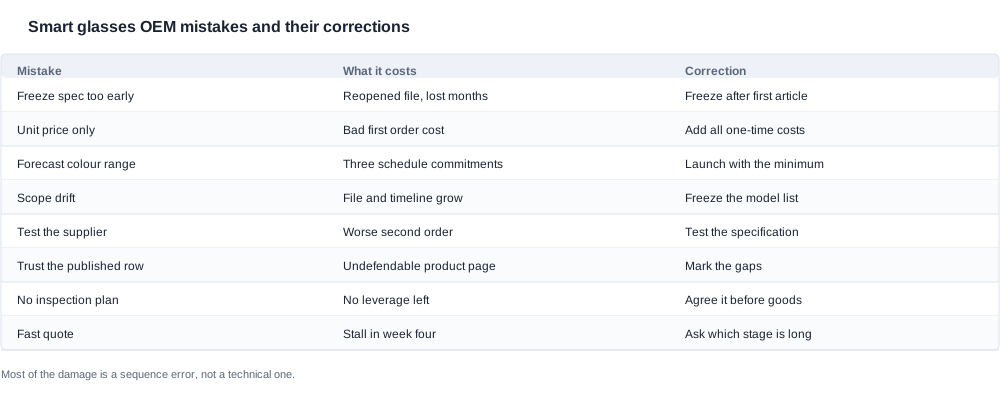

Smart glasses mistakes buyers make in the first quotation
The eight mistakes above are mostly made after a supplier is chosen. Two more are made before, and they are the ones that shape everything downstream.
Mistake nine: treating a quotation as a specification. A quotation says what a supplier believes you want. A specification says what you want. When a buyer builds the programme on the quotation and skips the written specification, the two documents eventually disagree, and the disagreement is resolved in favour of whichever one was signed. The quotation will not be signed; the purchase order will be. So the purchase order is the document that has to contain the model designation, the cell configuration, the charging method, the interface, the case option, the colour, the branding scope and the destination markets — everything the supplier needs to build one specific thing and everything you need to check when it arrives.
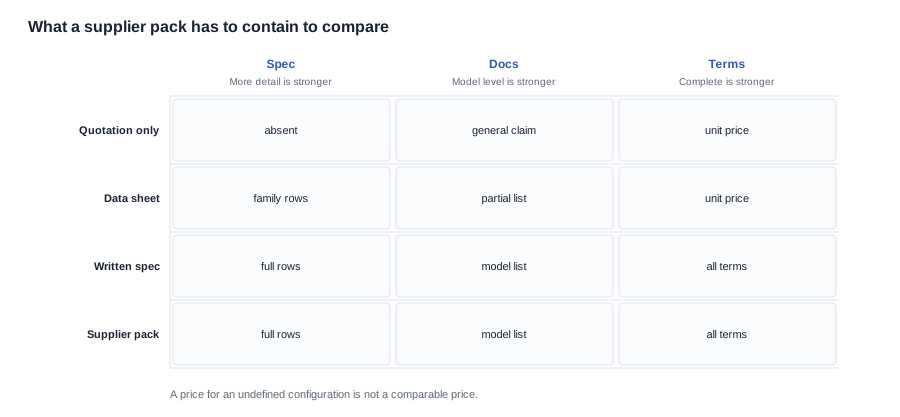
Mistake ten: asking for a price before asking what is included in it. The trade-off in this category is unusually sharp, because the published specification is uneven in ways that make a single price genuinely incomparable. A supplier quoting a model with a published cell configuration, a published charging method, a published case capacity and a published runtime is quoting a characterised product. A supplier quoting a model where the charging method is not published and the case row is absent is quoting a product whose deliverable is still being defined. The second price is not a worse price; it is a price for something that is not yet specified, and it will move.
The practical sequence is unglamorous and reliable. Ask what is included, ask what is excluded, ask what is not published, and only then ask what it costs. Ask for the terms in the same exchange: minimum order quantity, lead time, sample availability and cost, warranty terms, tooling or non-recurring engineering charges, and the payment milestone structure. None of these are published in our documentation and all of them are confirmed per enquiry, because every one of them depends on configuration, quantity, documentation scope and the current schedule — and a buyer who has not fixed the first three cannot evaluate the fourth.
The shortlist criteria that come out of this are worth stating, because they convert a price comparison into a due diligence comparison. Score each candidate on five things: whether the quotation names one configuration rather than a family, whether the specification rows behind that configuration are stated, whether the documentation position is given per model, whether the commercial terms are complete rather than indicative, and whether the supplier has volunteered what it does not publish. A supplier who fills in the fifth column without being asked is telling you something that will matter a year later, when your e-commerce team needs a fact for a product page and the honest answer is that the number does not exist.
Smart glasses execution errors that only appear in production
Mistake seven: skipping the inspection instruction. An inspection without an approved sample and an agreed sample count is a formality, and a formality protects nobody. The golden sample has to exist, the sample count has to be agreed, the criteria have to be written down, and the point at which the balance is paid has to be tied to the inspection result — because none of those things can be reconstructed after the goods have been made.
This is the step where a smart glasses programme most often loses its leverage, and the reason is understandable: the goods are already on the water, the customer is already waiting, and the commercial pressure to accept the shipment is at its maximum. The reason it is still the wrong call is that the acceptance decision is the only leverage a buyer has over the quality of the next shipment. Once it is given away, the same defect arrives in the next container.
The trade-off is real and it is the reason this mistake is so common: a strict inspection instruction costs an inspection fee and sometimes a delay, and the delay falls on a customer who is waiting. Buyers resolve that tension by accepting the shipment without an instruction rather than by agreeing the instruction in advance, because the cost of agreeing it in advance is immediate and visible while the cost of not having it is deferred and uncertain. The trade-off actually reverses if you price it properly, because a rejection at your own warehouse is cheaper than a rejection at your customer's door, and an accepted defect becomes the baseline every subsequent shipment is compared against.
Mistake eight: reading a fast quotation as a fast programme. A quotation that comes back the same day usually means the configuration was not fully specified, because a full specification takes time to read. The normal pattern is a programme that moves quickly for three weeks and then stalls, and the stall is almost always the specification rather than the factory.
The question to ask is not "how long will it take" but "which stage is the long pole, and what makes it longer or shorter". A supplier who can name the long pole — the tooling, the documentation, the sample approval, the first article — is describing a plan. A supplier who answers "about three months" without naming a stage is describing an average.

And one more, because the consequences outrun the others: no data-clear step in the returns process. A returned camera glasses unit still holds the previous owner's recordings. A returns process that does not include a documented, verifiable data-clear step is not finished, and in a product with a camera this is the mistake with the largest consequences. It costs one line in a process document to write, and it is enormously cheaper than writing it after the first complaint.
What a corrected smart glasses programme plan looks like
If you take the eight mistakes above and remove them, the shape of the plan changes in a way that is worth seeing explicitly, because buyers often assume the correction means a slower programme. It does not. It means a plan with fewer re-opened decisions, and re-opened decisions are what consume the time.
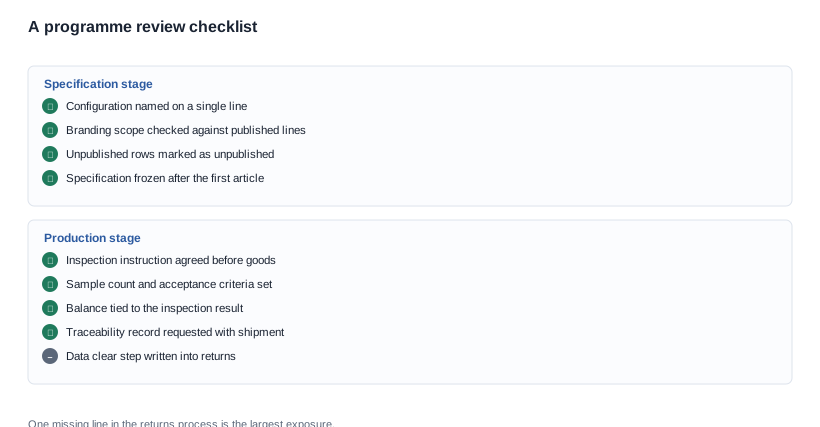
Before anything is ordered. The requirement set is written down with the configuration named as a single line: model designation, cell configuration, charging method, interface, case option, colour, destination markets, target quantity. The branding scope is confirmed against the published record rather than assumed, and what that record supplies is a count per category rather than a line-by-line list — seven axes on the camera tier, five on the sport tier, two on the children's tier with two further capabilities there marked as awaiting verification. What each counted line actually is, and whether it applies to the model you are ordering, is the question the supplier has to answer in writing before the order is placed. Anything outside that surface is scoped as development and priced separately, rather than absorbed into the standard programme. The MOQ mechanics determine whether the quantity you have in mind is a quantity the supplier can build.
During the first article. The specification is frozen once, on a date, with changes recorded. The golden sample is approved and retained. The items that are not published are collected, and the ones that remain unpublished are written into the product specification as unpublished rather than as acceptable. Colour is confirmed against an approved reference in daylight, not against a screen.
At the first shipment. The inspection instruction exists before the goods are made, with the sample, the count and the acceptance criteria agreed. The balance is tied to the inspection. The traceability record is requested with the shipment, not afterwards. The returns process, including the data-clear step, is written before the first customer can return anything.
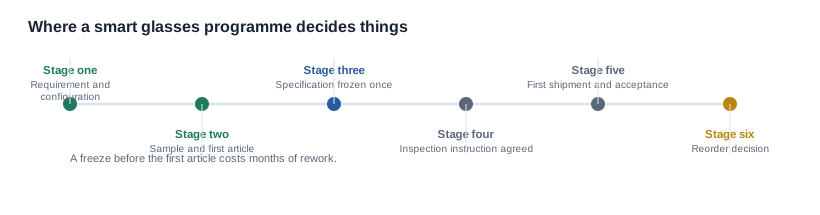
At the reorder. The reorder decision depends on three things: whether the published rows have changed, whether the configuration is still the one being produced, and whether the spares and firmware position still holds. The development risk factors list is the right place to look for the earlier version of that question.
There is a fourth phase that most first programmes skip, and it is the one that determines whether the second order is profitable: the post-launch review. Pull the returns, the complaints and the support tickets from the first hundred units and check them against the specification as written. Every mismatch is either a specification error, which you fix in the specification, or a manufacturing error, which you fix at the supplier. Buyers who do not separate the two end up treating manufacturing failures as specification problems and then re-opening a specification they had already frozen — which is mistake one again, one order later and considerably more expensive.
The corrected plan is not slower. It is simply shorter once you add up the re-opened decisions it avoids, and the savings land in the second order rather than in the first, which is the point where most buyers stop measuring.
We publish the customisation lines our catalogue lists, the capability gaps as clearly as the capabilities, and no non-recurring cost, no minimum order quantity and no lead time, because those are commercial terms rather than facts and our internal position on them is not settled. We will not print a number we cannot defend. What we can do is review a programme plan against these eight and tell you which of them it is heading towards.
Related reading
- The risk list behind these mistakes — odm development risk factors
- The standard route — standard oem
- The volume mechanics — smart glasses moq
Send us your programme plan and we will tell you which of these eight it is heading towards.


