

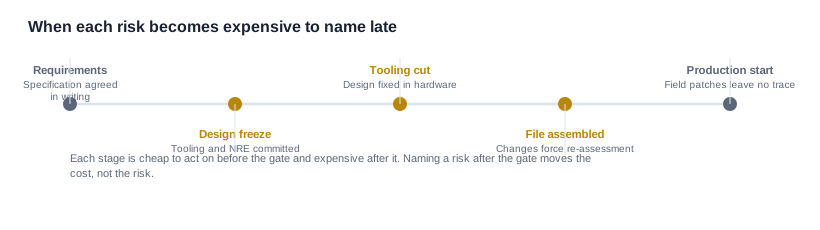
Odm development risk factors are not evenly distributed through a programme. Most of them are decided in the first few weeks, while the requirement is still being written down and the decisions still look reversible. The expensive version of each one is the version that is first named in month four, after the tooling has been cut and the file set has been assembled. Naming them early is the highest-return thing a buyer can do in an ODM engagement, because a risk named early is a decision and a risk named late is an incident — and incidents are always more expensive than the decision that prevented them, and always arrive at a worse moment.
The practical question is when to hold this review. The answer is earlier than most programmes expect, and specifically before the first quotation rather than after the first approval. A quotation is a commitment device: it fixes assumptions, it creates a comparison point, and it tends to be treated internally as a position rather than as an estimate. Holding the risk review before the quotation therefore takes place while every decision is still cheap, and holding it after means the review has to argue against commitments that already exist.
There is a second reason to hold it early, which is that the register is easier to build when nobody has a reputation attached to the plan. Once a team has committed to a volume, a date and a channel, its members have incentives to describe the programme as lower-risk than it is. In the first week of an engagement, the honest register is the one everybody can afford to write, and it is the last opportunity to write it that way.
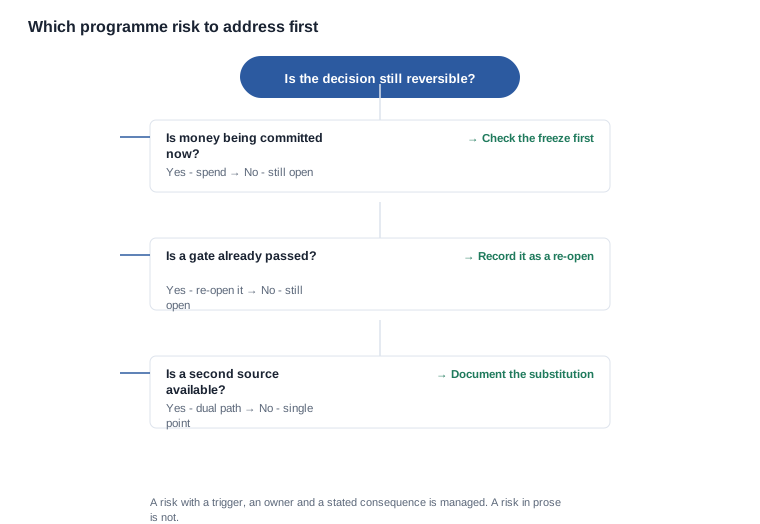
The question to ask at that meeting is not "what could go wrong" — everyone can generate hazards — but "what are we about to decide, and what would make that decision expensive to reverse". That reframing produces a shorter, more specific and more useful list, because every entry is attached to a pending action rather than to a general worry. A register where each line names the decision, the owner, the trigger and the consequence is a working document; a list of hazards is a document nobody opens twice.
ODM development risk factors and where each one is actually decided
The useful way to hold this list is not as a set of hazards but as a set of decision points, because every one of them is decided by somebody choosing to do something. That framing changes the conversation from a review of what could go wrong into a review of what is about to be committed, which is a much more productive meeting.
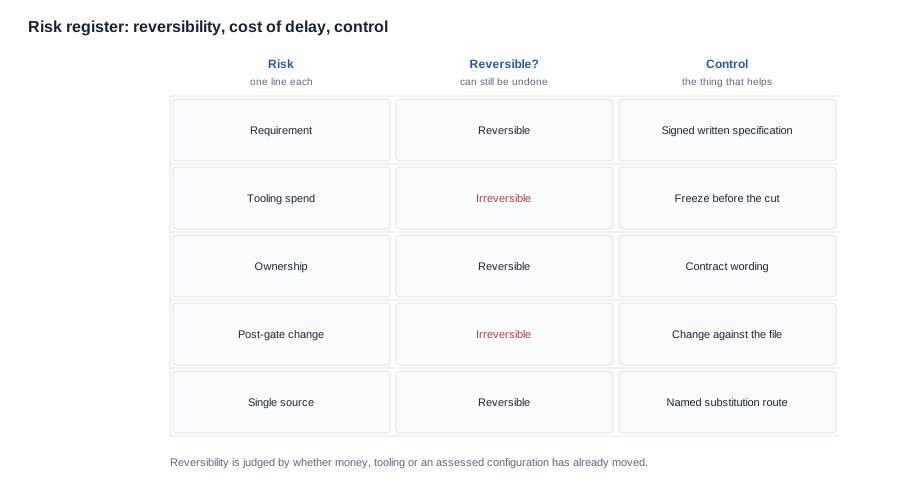
The requirement that was never actually agreed. The most common failure in this category is not technical. It is a description two parties understood differently. "Like the product you saw at the exhibition", "similar to what we had last time", "the same as the current model but with a bigger battery" — each produces a product that satisfies one party's understanding and surprises the other. The early warning is easy to spot: two people describing the same feature in different words. If the engineer and the product manager both believe they have said the same thing, the specification has to be written down before anything is built, and the writing down has to include what the product deliberately does not do.
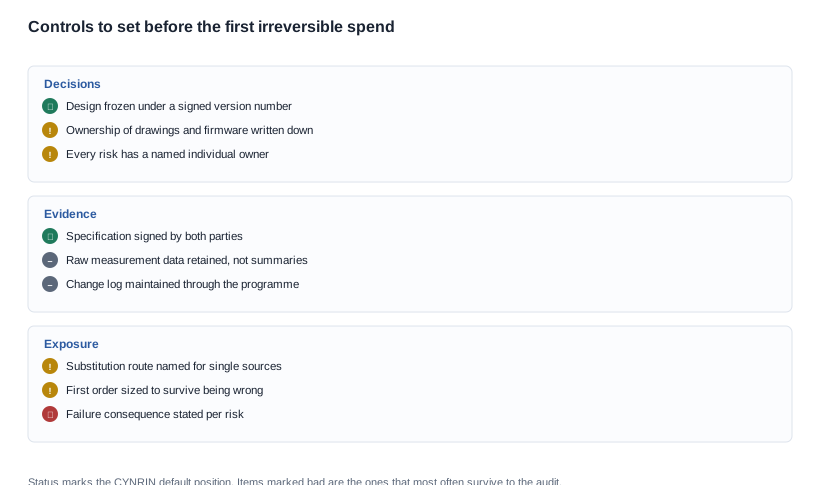
Decisions that cannot be undone. Tooling is the classic irreversible commitment. Once the mould is cut, the design is fixed in a way no amount of discussion can undo, and the money has been spent whether the product sells or not. The early warning is a tooling quotation arriving before the design is frozen, which means the tooling is being quoted against a design that is still moving. The mitigation is sequencing: freeze what can be frozen, and pay for what genuinely cannot be deferred. A programme that separates the decisions which truly need to be made early from the ones being made early because they feel urgent is worth real money.
Intellectual property ownership. Who owns the drawings, the firmware and the tooling is routinely left out of the early conversation and becomes painful later, usually once the relationship has grown enough for it to matter. The early warning is a contract that is silent on drawings and on firmware source access. This is not a question with a default answer that favours one side — a design developed jointly can genuinely be joint — and what is not acceptable is silence, because silence becomes a dispute rather than a decision.
Changes that arrive after the file is closed
Two risks share a shape: a change that is reasonable when proposed and expensive when accepted at the wrong moment.
A file set changing after it has been assembled. The file describes a set of models, and every model is an entry in it. Adding a model, changing an optical configuration or altering the mechanical description of a product all have the potential to require the file to be revisited. The early warning is a hardware change proposed once the file is assembled — which is precisely when the change is cheapest to make and exactly when it is most expensive to accept. The mitigating habit costs nothing: any proposed change is checked against the technical description before it is accepted, and the check happens while the file is still open.
Firmware regression. A later change can break an earlier behaviour that something else depended on, and the early warning is a sign that changes are being made in the field rather than inside the programme — an update sent to the customer to fix one problem while another behaviour quietly stops working. Firmware changed after production has started is also firmware that is harder to certify, because the file describes the behaviour as it was when it was written. The distinction to insist on is between a change that is versioned, regression-tested and released with the programme, and a change that is patched directly to a customer. Both can be correct; only one of them leaves a traceable position.
There is a general rule underneath both of these, and it is the one most often missing from a programme plan: a change accepted after a gate has been passed is a decision to re-open that gate, and it should be recorded as one rather than absorbed quietly. Programmes that treat post-gate changes as ordinary drift are the programmes that discover, at audit time, that the product in the carton does not match the product in the file.
The mechanism that handles this is unglamorous and should be written into the programme plan rather than improvised at the moment of pressure. Every proposed change gets three answers before it is accepted: which gate does it sit behind, which artefacts does it invalidate, and who signs the consequence. A firmware change might sit behind nothing and invalidate a regression test record; a model addition sits behind the file set and invalidates an assessed configuration. If the third answer has no name attached, the change is not ready for a decision, and the correct response is to delay it rather than to accept it informally.
What to ask the supplier here is concrete: what is your change-control procedure, who can approve a change that affects an assessed configuration, and can you show a change that was approved and what evidence it invalidated. The third question is the one that separates a procedure from a document. Most factories have the first two; fewer have a recent example of the third, and a factory that cannot produce one is either unusually disciplined or has never faced the situation.

Schedule risk, concentration risk and the forecast that did not arrive
Decisions that arrive late and move the schedule. A decision taken after the production slot is booked does not move the goods; it moves the date. The early warning is a programme where decisions are described as pending while the schedule is already committed, which are two incompatible states, and the schedule always wins. The countermeasure is unglamorous and effective: a decision log with dates against it, reviewed often enough that a decision approaching its date is visible before it becomes a delay.
The log itself is trivial to build and easily done badly. Three fields make it work — the decision, the date by which it must be closed, and the consequence of missing that date — and three habits make it fail. Listing decisions without dates, which converts the log into a wish list. Recording a date that belongs to the plan rather than to the dependency, which hides the real constraint. And reviewing it at a fixed monthly cadence, which means a decision due tomorrow is discussed at the meeting next month. The version that works treats a decision whose date has arrived as an escalation rather than as an agenda item, because the difference between the two is roughly the length of the delay being created.
The other question to ask is whether the date on the schedule is a promise or a dependency. Programmes that name dependencies — tooling, firmware sign-off, file assembly, an assessment route — can tell a buyer which part of the date is theirs to manage and which part is not. Programmes that offer a single date are asking the buyer to absorb the variance of everything on the list.
Supplier concentration. A programme built on one plant has one point of failure, and in this category the failure modes are ordinary — a materials shortage, a line problem, a quality escape that quarantines a batch. Qualifying a second source is expensive and slow, which is precisely why it is always deferred, and the deferral is what makes the risk permanent rather than temporary. The intermediate position most programmes never reach is not a second source but a documented substitution route: a named alternative component for each single-sourced item, with the evidence that a substitution invalidates already identified. That converts an unknown into a known cost.
How to evaluate that exposure cheaply is a matter of asking for the bill of materials rather than the factory's opinion of it. Which components are single-sourced, whether each has a named alternative, whether the alternative is pin-compatible or requires a board change, and what evidence a swap invalidates — those four answers, per item, produce a substitution risk register that a buyer can price. The items that cannot be substituted without a redesign are the ones that deserve a conversation about buffer stock or an alternative source, and they are usually a small number out of a long list. Signs that this has not been done are simple: a factory that cannot produce a bill of materials at component level, or one that answers the question about alternatives in general terms rather than per item.
The forecast that did not arrive. The demand assumption behind an ODM programme is usually a marketing plan rather than a demand history, which is the normal condition for a new product and the reason a first order carries more risk than a second. The early warning is an order placed against a plan rather than a forecast. The mitigation is not analytical sophistication; it is structuring the first order so that being wrong about it is survivable, which usually means a smaller first commitment and a documented ramp rather than a large opening order defended by a forecast nobody would sign.
There is a commercial trade-off hiding inside that mitigation, and it is worth naming because buyers often defer it. A small first order reduces the downside of a wrong forecast and increases the total cost of the programme, because the fixed engineering, tooling amortisation and setup costs are spread over fewer units. A large first order improves the landed unit cost and converts a forecasting error into an inventory position. Neither is wrong and the right answer depends on the buyer's balance sheet and channel, not on the factory's preference — which is exactly why the factory should present the total cost at two or three volumes rather than a single number. What to ask is therefore not "what is your price" but "what does the unit cost look like at this volume, at half this volume and at double it", and the shape of that curve is usually more informative than any single point on it.
A method for naming risks early enough to matter
Naming a risk is easy and almost worthless on its own. What makes the difference is naming it early enough that a decision is still available, recording who owns that decision, and stating what happens if it goes the wrong way. Three attributes separate a risk that is genuinely managed from one that is merely documented.
The first is a trigger rather than a feeling. "The requirement is unclear" is a feeling. "No written specification signed by both parties before the first quotation" is a trigger, because it can be checked on any given day. The second is an owner, not a team; a risk owned by engineering and marketing is owned by nobody. The third is a stated consequence, because a risk with no consequence attached produces a conversation in which everyone agrees it matters and nothing changes. Where the consequence is money, write the amount. Where it is a date, write the date. Where it is a capability, write what the programme does instead.
There is a fourth attribute that only shows up later and that experienced programme managers add without being asked: the earliest point at which the risk can still be closed cheaply. For a specification gap that is before the first quotation. For a tooling commitment it is the design freeze. For a change that would move an assessed configuration it is before the file is assembled. Recording that column turns the register from a list into a schedule, because it tells the team which items must be resolved before which gate rather than leaving the ordering to whoever argues hardest. It also gives the programme an honest answer to the question buyers most often ask at the start and receive a vague reply to: which of these things are going to stop the project, and which ones are only going to make it more expensive.
Before you commit to the register, it is worth testing it against four questions. Would a second person, reading this register, know what to do on Monday morning? If not, the entries are hazards rather than actions. Can each entry be checked on a given day without a meeting? If not, it will not be checked. Does any entry have a trigger that has already fired? If so, it is not a risk any more; it is a current condition, and it belongs in the programme plan rather than in the register. Does the register contain anything that only appears because somebody remembered it today? That last category is the most valuable, because it shows where the programme's collective memory is thin — and a programme that discovers three such items in one review has just found the cheapest possible reduction in future cost.
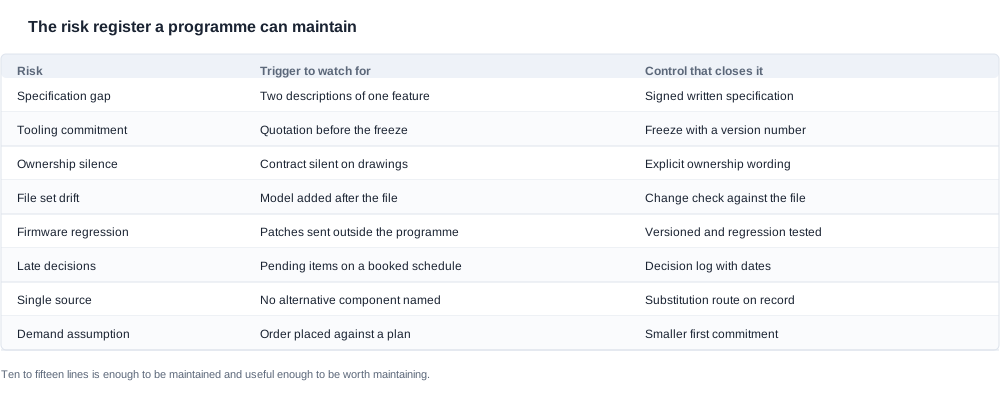
Applied to a real programme, this method produces a register of perhaps ten to fifteen lines, which is short enough to be maintained and long enough to be useful. It also tends to re-rank the list against intuition: the specification-agreement risk usually moves up because it is checked daily and cheap to fix, while the intellectual property risk moves down slightly once it is written down, because a documented answer does not need managing. That re-ranking is the point of the exercise, and it is why a register built at the start of a programme is usually different from the list of concerns a team arrives with at the end.
What we publish, and what we will commit to in writing
What we publish is the customisation capability our catalogue lists, and the capability gaps carry the same prominence as the capability itself. The bone conduction entry has no customisation capability published, and the kids range marks app and firmware customisation as unverified. We will not quote a development cost, a tooling cost or a schedule that we have not committed to in writing, and we will not describe a design as frozen when it is still open. Those two refusals are the same commitment viewed from different ends: a programme that depends on an unstated number or an assumed freeze is a programme carrying a risk nobody has named.
What we can do is tell you which of these risks a proposed change touches, which decisions in your programme are genuinely irreversible, and which are reversible at a cost nobody has budgeted. The programme structure is described under odm development, the ownership question is treated in who owns the drawings and firmware, and the irreversible spending is covered in engineering cost and tooling.
The due diligence version of the same exercise is worth knowing before you commit to a shortlist. When assessing a factory rather than running a programme, signs that a risk process is thin show up as a factory that cannot name the last configuration change it made, cannot show a decision log from a previous programme, or quotes a development schedule with no dependency named. None of those proves anything is wrong, and a factory that is currently between programmes will produce all three. What they do tell you is whether you will have usable evidence later, and that is usually the more valuable question.
Related reading
- The ownership question — drawings, firmware and tooling ownership
- The spending that cannot be undone — engineering cost and tooling
- What comes after all of this — mass production stage
Send us your programme plan and we will mark the decisions that are still reversible and the ones that are not.


