

Smart glasses wholesale programmes rarely fail on the product itself. They fail on the order in which decisions are taken: a specification gets frozen before anyone has checked which models will still be orderable, a purchase order leaves the building before the inspection gate was written down, and the reorder arrives months later needing a fresh negotiation from scratch. How smart glasses wholesale actually works end to end is a chain of lock-in points, and the only durable method is to take the cheapest decisions to reverse first and the most expensive ones last.
The reader of this article is a procurement lead, a channel manager or a founder building a smart glasses line through a distributor, a marketplace seller or a regional reseller. Nothing here quotes a unit price, a minimum order quantity or a lead time, because none of those three are published for this catalogue, and a number without the configuration behind it is a slogan rather than information. What follows is the sequence of stages, the question that belongs at each one, and the written evidence that should exist before the next stage begins.
The catalogue is the fixed reference point for the first stage, and it is worth being precise about what it contains. It carries 28 models, and how those 28 divide matters more to a wholesale programme than the feature list does: eleven camera models, eight audio models, three sport models and three children's models, plus three entries that carry no formal SKU at all — the AR glasses, the photochromic model and the bone-conduction model. Those three cannot be quoted, ordered or replenished by name until a supplier issues a SKU against them, which is a procurement fact rather than a preference.
Two published gaps constrain what any wholesale programme can promise. The catalogue text carries no CE, FCC or RoHS reference and no per-model certification row; the export certification page it does carry is a company-level page of certificate images rather than a per-model record, and those images are ten patent certificates — eight appearance-design patents and two utility-model patents. And no model publishes a touch row, only one model publishes a weight at all, and the eleven camera models publish a megapixel class but nothing about sensor model, field of view or frame rate. A quotation built on those gaps will not survive a distributor's own due diligence.
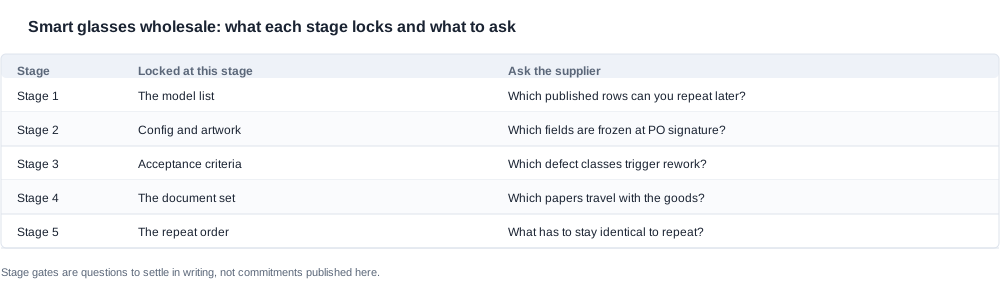
Smart glasses wholesale runs as five stages with rising lock-in
The whole method reduces to one question at each stage: how expensive is this decision to reverse? A model list can be changed between two orders at no cost beyond the inconvenience. A colour split cannot be changed without reallocating stock. A piece of packaging artwork, once printed and shipped, cannot be changed at all. A certification file, once lodged for a specific model and variant, cannot be changed without re-testing.
That ladder is the reason wholesale programmes behave the way they do. Buyers who negotiate the hard items first — the ones that cannot be undone — end up negotiating about the wrong things, because the supplier has nothing left to concede on the ones that can. Buyers who settle the reversible items first keep optionality for longer, and they discover their real constraints while those constraints are still cheap.

The five stages below are not a timeline. Stages one and two can run in parallel with a supplier audit; stages three and four happen inside a single production window; stage five happens months later and should be the least interesting of them, because the specification has already been proven.

Smart glasses wholesale stage one: choosing models that will still be orderable
Stage one is a selection task, and it should be run against published rows rather than against photographs. The catalogue publishes real product photographs for its models, but it publishes no test reports and no per-model certification record, so a buyer cannot use the catalogue to clear a model for a regulated market. What the catalogue can do is establish a repeatable rule: a model enters the wholesale range only if the rows it publishes are enough to write a specification sheet, and only if the fields that matter to a distributor are stated rather than implied.
The published rows divide into three useful groups. The first is the row set every model carries: cell capacity and cell count, charge time, rated runtime and charging method. The second group is the differentiator rows that only some models carry: colour choices appear for exactly two models in the catalogue, the charging-case row appears for part of the camera range and is absent for the rest, and IP54 appears on two models only, the V06 and the S7. The third group is what is never published: frame weight beyond a single figure for one model, a touch row for any model, and a certification row for any model.
That third group is where a wholesale programme has to ask rather than read. The questions that belong at stage one are not about features. They are about supply, and they can be written as a fixed list so that every supplier answers the same set:
- Which models do you currently run in volume rather than build to order?
- Which models have a component, platform or chip-set change scheduled in the next period?
- Which models would you stop quoting if the channel stopped moving them?
- Which models in the range carry a charging-case row, and which do not?
- Which of your models have a colour split you already hold components for?
A model that answers that question vaguely is a model that will disappear from the range one day, and a distributor who has built a listing around it will be the one who carries that risk. The list is deliberately short. A stage-one questionnaire that runs to several pages will be answered with several pages of nothing in particular, and the point of stage one is not to gather information but to remove the models that cannot be repeated.
Two structural facts sharpen the stage-one question. The camera range splits by published megapixel class into eight models at eight megapixel and three at thirteen megapixel, and the charging-case coverage inside that range is not uniform: five camera models publish a case capacity, two further models publish that a case exists without publishing its capacity, four camera models carry no case row in the catalogue whatsoever, which is a gap a distributor cannot fill with a guess. The audio range publishes a far cleaner set: eight models, all of them with a charging method stated and a runtime published. The sport range is three models, of which two publish a charge time of about an hour rather than the two-hour-or-less ceiling the rest of the catalogue uses.
None of this ranks one model against another. It tells a procurement lead which rows can be quoted from the catalogue and which have to come from a conversation, and that distinction is the difference between a specification and a guess.
Smart glasses wholesale stage two: the purchase order as a frozen specification
Stage two converts a model list into a frozen configuration, and the whole discipline of a wholesale programme sits in which fields are frozen when. The rule is that a field should be frozen at the moment its value becomes expensive to change. A model assignment is cheap to change, so it should not be frozen early. Packaging artwork is expensive the moment the print run starts, so it should be frozen last, after the product itself has settled.
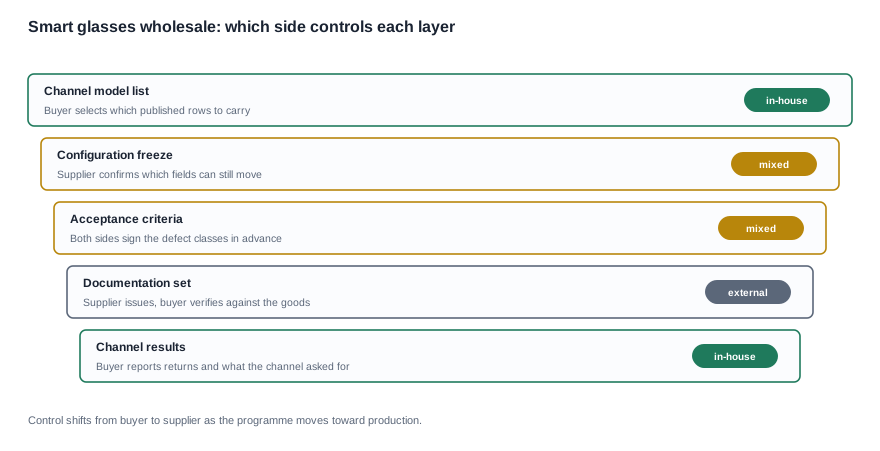
The practical consequence for procurement is that the purchase order should carry a written specification annex rather than a product name and a quantity. At minimum that annex states the model and variant, the colour split, the packaging configuration, the documentation the supplier is to provide, the inspection standard, the acceptance threshold, the payment trigger points and the delivery terms. A purchase order that says "800 units, mixed models" leaves every one of those fields to be settled by whoever has the most leverage at the moment it matters, which is rarely the buyer.
Two fields of that annex are routinely neglected. The first is the documentation list, which should name every document the buyer expects to receive with the goods and the moment it expects to receive it. Because the catalogue publishes no per-model certification record, the buyer cannot derive that list from the product pages; it has to be stated. The second is the acceptance threshold, which should be agreed before production rather than after inspection, because a threshold introduced after the goods are packed is a negotiation rather than a standard.
The third negotiation point in the annex is change control. A wholesale programme will encounter a request to change something mid-production — a packaging revision, a colour substitution, a model swap. The question to settle in advance is what a change request costs and who approves it, not whether changes will happen. A programme that assumes no changes will be interrupted by its first change; a programme that assumes every change is free will be interrupted by its second.

Smart glasses wholesale stage three: the inspection gate before the balance falls due
Stage three is where a buyer either keeps control of quality or gives it away. The mechanism is simple: a defined inspection, a written acceptance threshold, and a payment structure that makes it rational for the supplier to pass it. Where all three are present, the inspection is a routine event. Where the third is missing, the inspection becomes a negotiation that happens after the money has moved.
What a good inspection specification contains is narrower than most buyers assume. It names the defect classes that matter for this product type, states the sample basis and the acceptance number, and separates cosmetic from functional defects, because the two have completely different commercial consequences and completely different tolerances. A scuffed retail box is a re-packing task. A pair of units in a shipment with a cracked hinge or an intermittent charge contact is a different category of problem entirely, and it lands on the same shipment.
For smart glasses specifically, the defect classes worth writing down are the ones the catalogue can tell you about. Products with a charging case carry a wear item in the case: magnetic contacts degrade over time, and a case that no longer holds alignment is a case that produces a return. Products with a removable component have a second wear item: the V06 and the S7 publish a removable inner frame, and the G07 publishes a detachable temple, and each of those is an assembly point that can be damaged or fitted incorrectly in the channel. Products with a remote shutter — the D17 and the ZH12 publish that row — have a control accessory in the box, and a missing or mismatched accessory is a shelf-ready failure even when the product itself is sound.
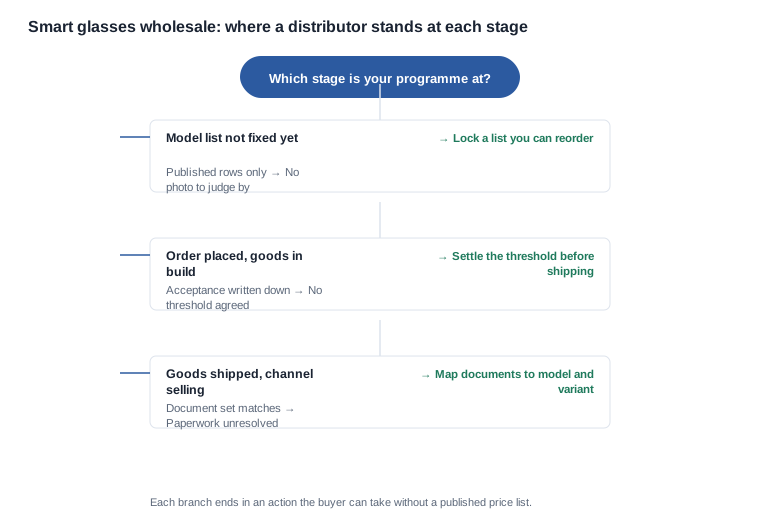
The acceptance threshold should be stated as a number the supplier has agreed to in advance, and the inspection should be documented with photographs of the packed goods and of a sample of the units themselves. A record that does not exist cannot be used to settle a claim six months later, and a claim that cannot be settled becomes a pricing argument at the reorder.
The sample basis deserves a sentence of its own, because a buyer who writes "inspect a percentage of the shipment" has written nothing usable. The basis should be tied to the risk the inspection exists to control, and in this category the risk is not evenly distributed across the carton. Units with a removable component, units with a charging case and units with a remote accessory all carry assembly risk that a sealed single unit does not, so a sensible plan samples those lines differently from the rest of the shipment. The acceptance number should be agreed at the same time as the basis, and both belong in the specification annex from stage two rather than arriving with the inspection report. An acceptance threshold introduced after the goods are packed is a negotiation, and a negotiation with the container already sealed is one the buyer conducts alone.

Smart glasses wholesale stage four: the documents that travel with the consignment
Stage four is the handover, and it is where the products that look simplest on a screen turn into the most complicated paperwork. Everything in the range is a battery product, and battery transport documentation is a separate regime from ordinary cargo paperwork; it is also a document set that has to match the actual goods in the carton, which means it has to be produced from the same configuration that was frozen at stage two rather than assembled from a template.
The document set for a wholesale consignment normally includes the commercial invoice, the packing list, the transport document, the battery or dangerous-goods documentation, and whatever compliance documentation the destination market requires. For a European destination that list includes a Declaration of Conformity tied to the radio equipment directive and the declaration the buyer must hold as importer or as the named responsible economic operator where the market requires one. Because the catalogue publishes no per-model certification record, the buyer should establish, before the first listing goes live, exactly which model and variant combinations will carry which document, and should treat that mapping as a deliverable in its own right rather than an administrative detail.
Two questions belong at stage four specifically. The first is whether the documentation in the shipment matches the goods that are actually in the cartons, and who verifies that. The second is who holds the compliance file — the importer, the distributor or the supplier — and in what format it is retained. A buyer who cannot produce the file for a specific model and variant on demand has a channel listing it cannot defend, and in several markets that is a listing that has to come down.
Smart glasses wholesale stage five: the reorder that should need no renegotiation
Stage five is the test of everything that came before it. A reorder is the moment the entire programme reveals whether it was built or assembled. If the specification annex from stage two is still valid, if the acceptance threshold from stage three is still the one being applied, and if the document set from stage four still matches the goods, then the reorder is an administrative event: the same model list, the same colour split, the same artwork, the same threshold, the same terms.
The alternative is common and expensive. The buyer re-specifies because nobody recorded the original. The buyer renegotiates the unit rate because the original quotation was never a quotation, only an indication. The buyer discovers that the case capacity or the charging method for the model in the order was never confirmed in writing and has to re-open the whole configuration. Each of those is a failure of stage two, surfacing at stage five, and each of them costs far more than the time it would have taken to write the specification down at the time.
There is one failure mode that deserves naming separately, because it is the most common and the least visible. The programme works, the goods sell, the reorder arrives, and nobody can find the specification annex. The model list was agreed in a call, the colour split was adjusted over messages, the artwork approval was given against a photograph on a screen, and the acceptance threshold was never written down at all. What happens then is that stage five collapses back into stage one, with the additional disadvantage that the supplier now holds a position nobody documented and can describe it in whatever terms favour them. The remedy is unglamorous and it is the whole of stage two: keep the annex in one place, give it a revision number, put the revision number on the purchase order, and make the presence of the annex the first item on the reorder checklist before anything else is discussed.
Two things make a reorder boring. The first is a versioned specification annex: the same document, revised, with a revision history, so that both sides are working from one artifact. The second is a reorder checklist that records what is being confirmed rather than what is being decided — that the model list is unchanged, that the colour split is unchanged, that the artwork revision number is unchanged, that the acceptance threshold is unchanged, that the document set is unchanged, and that the terms for this reorder are the terms of the original agreement unless something has been renegotiated in writing.
The channel feedback loop closes the loop. The reorder is also the only point where the buyer learns what the channel actually moved, what it returned, and what it asked for that was not in the range. A wholesale programme that ignores that signal ends up buying the same models at a larger volume for longer, and the inventory risk sits with the party that never saw the demand data.
What CYNRIN publishes for smart glasses wholesale programmes
The boundary here is deliberate. CYNRIN publishes the catalogue rows that exist, and we do not publish a unit price, a minimum order quantity or a lead time in this article, because those are not published values and a wholesale programme that plans against an unverified number will plan against the wrong number. What we will do is answer a specific question about a specific model and configuration against the same published rows, and say plainly where the catalogue stops and a supplier confirmation begins. What is published is the structural fact set: 28 models, 11 camera models, 8 audio models, 3 sport models, 3 children's models, a case coverage pattern inside the camera range, a charging-method split across the whole catalogue, and a certification position that is company-level rather than per-model.
Everything else in this article is a question to put to a supplier, written so that the answer is a commitment rather than a mood. If you want the wholesale version of this material for your own programme, the distributors and retailers solution page sets out the engagement shape, and the wholesale programme entry point is where a buyer starts. Send the markets you intend to serve, the model list you have shortlisted, and the configuration you need frozen, and the answer will be specific to those three inputs.
A smart glasses wholesale programme that has a written specification at stage two and a written acceptance threshold at stage three is already ahead of most. Everything else in this sequence is about making sure that those two documents still describe reality at stage five.


