

Smart glasses wholesale rewards a buyer who can add something to the product after it arrives, and it punishes a buyer who can only subtract from the unit rate. That is the conclusion, and everything below is either the reasoning behind it or the set of questions that turn it into a plan. The category has enough product similarity that the comparison a buyer faces is not about features — a camera, a Bluetooth radio and a battery are available across the range — but about everything that happens after the sale: what can be serviced, what can be listed, who carries the inventory, and what happens when the platform underneath the product changes.
The reader here is a founder, a category manager or a procurement lead considering a first order in this range, usually with a channel partner who has asked for a proposal. No unit rate, minimum order quantity or lead time is published for this catalogue, and none is quoted in this article; a wholesale overview built on unverified figures helps nobody, because the figures are the part that has to be confirmed in writing anyway.
The structure of the range matters to that first decision, and it is worth stating plainly before the decisions themselves. The catalogue carries 28 models, and they are not one group: eleven of them are camera models, eight of those are audio models, and the remaining nine split into three sport models, three children's models and three entries with no formal SKU at all. Within that, the published detail is uneven in ways that a new entrant will discover late if they do not examine it early — case coverage, charging method and colour splits all vary inside the camera range, and only two models in the entire catalogue publish a colour split.
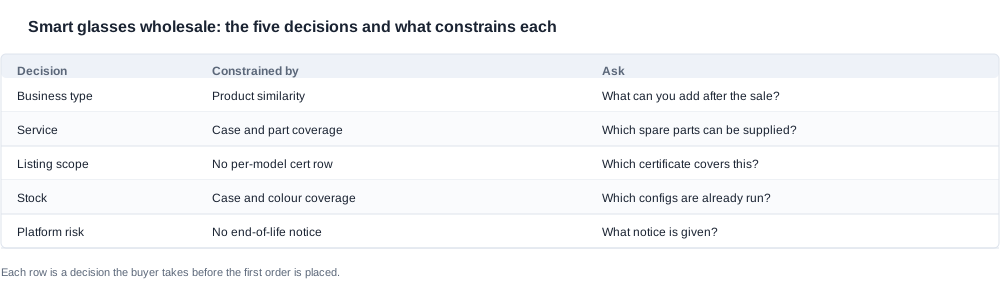
Smart glasses wholesale: the five decisions a first-time entrant actually makes
A first-time entrant in this category really only makes five decisions, and they are worth naming before anything is quoted, because each one constrains the others.
The first decision is what kind of business is being built. A buyer competing on unit rate is in the least defensible position the category offers, because the product similarity is high and the rate is the one variable every competitor can see.
The second decision is what the business will be able to service after the sale. This is the decision that determines whether the operation is a distribution business or a resale business, and it is decided entirely before the first unit is ordered.
The third decision is where the range may be listed at all. This is fixed by compliance rather than by commercial preference, and it is fixed before launch rather than negotiated afterwards.
The fourth decision is what the buyer will hold as stock, and therefore which risk sits on the buyer's balance sheet.
The fifth decision is what happens to the programme if the platform underneath the product is discontinued. This is the decision almost nobody takes consciously, and it is the one that determines whether the relationship survives its first difficult year.

The order matters as much as the content. Deciding what can be listed narrows the model list, which narrows what can be stocked, which determines what can be serviced. Deciding what can be serviced before deciding what can be listed tends to produce a range that cannot go out, because the serviceable part of the catalogue and the listable part of the catalogue are not the same set.
Smart glasses wholesale: what kind of business the buyer is building
A new entrant has three realistic positions, and they are differentiated by what they can do that the supplier cannot do on the buyer's behalf.
The price-led position is the weakest and the most common. It works for a while, because early buyers in a new category are often comparing primarily on rate. It stops working when a competitor quotes the same product at a lower rate, and the only defence available at that point is margin, which the buyer has already spent.
The service-led position is the most durable. It consists of being the party in the transaction that can solve a problem quickly: replacing a case, supplying a missing accessory, holding a spare unit while a faulty one is diagnosed. None of that requires a custom product. It requires the distributor to be organised to do it, and it requires the supplier to supply the parts, which is a question that has to be asked before the first order.
The specification-led position is the strongest but the narrowest. It consists of carrying something the channel cannot get elsewhere: a configuration, a colour, a bundle, or a documentation package for a specific market that a competitor has not assembled. The catalogue's published detail shows what can be built on rather than what cannot: two models publish colour options, and the camera range publishes several distinct case configurations, so a specification-led position has real raw material in it.
Which of the three a buyer is in determines what the negotiation is about. A price-led buyer negotiates about rate and will lose that negotiation. A service-led buyer negotiates about spare parts, documentation and lead-time commitment. A specification-led buyer negotiates about configuration and exclusivity. All three need the same underlying evidence, which is the published rows of the catalogue and a supplier's written confirmation of the rest.
Smart glasses wholesale: what you will be able to service after the sale
On a product with a narrow margin, the return rate decides whether the operation works, and the return rate is decided less by the product than by whether the channel can fix a unit rather than replace it. That makes spare parts a commercial question rather than a service question, and the catalogue is unusually useful here because it identifies exactly which parts exist.
The catalogue publishes a charging case for part of the camera range. Three models publish a 1400 mAh case, one publishes two case capacities of 900 and 1400 mAh, a third publishes a foldable 1200 mAh case, two publish a case but leave its capacity unstated, three of them publish no case row at all, and another is published with no case in the range. Across the case-equipped models the charging contacts decay with use, and a case that has lost its alignment produces a unit that fails on charging rather than on anything a buyer could have inspected.
The catalogue also publishes removable components, and each one is a separate spare-parts line. Two camera models publish a removable inner frame. One audio model publishes a detachable temple, and one audio model publishes a slim temple as a published feature. A remote shutter is published for two of the sport models, which puts a control accessory in the box that can go missing or be mismatched in the channel even when the unit itself is intact.
The practical consequence for a wholesale programme is that the compliance file is a deliverable rather than an assumption, and it has an owner. Three questions settle it before the first listing goes live. Which party holds the technical file for each model, in what format, and for how long. Which document proves the specific claim a listing will make, as opposed to a general company-level statement. And what happens to the file if the supplier's own certification position changes, since a document held for one production site does not automatically cover another.
The third question is the one that catches distributors who scale quickly, because a programme that grows from one supplier to two needs the file for both, and the file for the second supplier does not exist until it is asked for. Building it into the onboarding checklist costs one document request. Discovering it at listing time costs a listing.
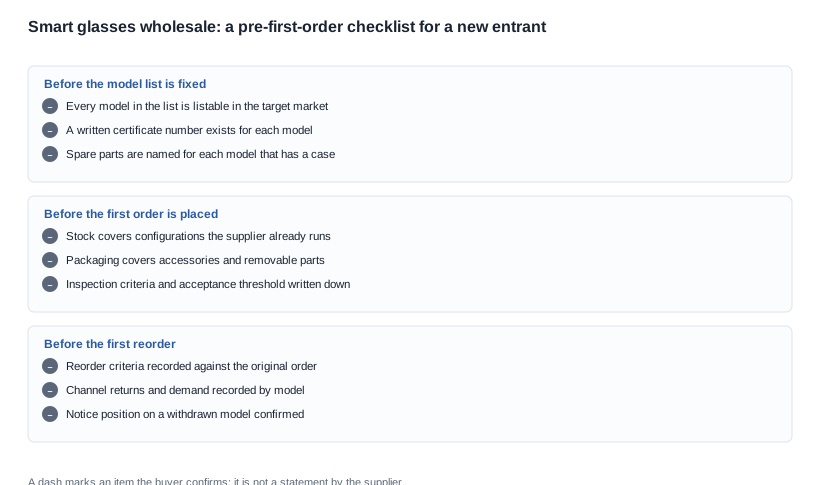
Each of these lines should be settled at quotation rather than afterwards. The questions a distributor should be asking are concrete: which spare cases can be supplied against which model, at what availability, on what commercial terms, and whether the magnetic contacts are a replaceable item or part of the case assembly. For removable components, the same question applies with an added dimension, because a removable part that the channel cannot replace quickly becomes a return rather than a repair. For the remote shutter accessory, the question is whether it is supplied with the unit in the pack and whether a missing one is a packing defect.
The catalogue's spare-part lines can be read directly into a service menu:
- Case units: three models publish a 1400 mAh case, one publishes 900 and 1400 mAh, one publishes a foldable 1200 mAh case, and two publish a case without a capacity.
- Removable inner frames: two camera models publish one, and it is a field-replaceable part rather than a repair.
- Temple components: one audio model publishes a detachable temple and another publishes a slim temple as a published feature.
- Remote shutter accessories: two sport models publish one, and the accessory can be missing without the unit itself being faulty.
Each line on that list is a separate question about availability, packaging and commercial terms, and each is a question the catalogue cannot answer because it publishes no spare-parts policy at all. A buyer who has the answers before the first order has a service model. A buyer who does not has a replacement model, and replacement is the costlier of the two operations to run.
A channel can only service what it can replace parts for, and the parts available are a property of the model list. This is the clearest reason why the model list should be settled first and the spare-parts position confirmed alongside it, rather than being treated as a detail to sort out after the first shipment has been opened.

Smart glasses wholesale: where the range may legally be listed
A distributor's market list is a compliance list, and it is fixed before the first listing goes live rather than negotiated afterwards. For each market the file has to contain the radio approval, the Declaration of Conformity, the children's standards where the product is relevant, and the battery transport documentation that every unit in this range requires.
The catalogue's own position on certification is specific and has to be handled carefully. Not one appearance of CE, FCC or RoHS occurs in the catalogue text, and there is no per-model certification row anywhere in it. The export certification page it carries is a set of certificate images with no per-model record attached, and those pictures total ten certificates: eight of them are appearance-design patents and the remaining two are utility-model patents. The separate product detail record gives the certification position for the camera, audio and sport categories, where the certificate numbers for each model are still pending confirmation, and records nothing at all for the children's category. That gap between a claim and a confirmed number is exactly where a distributor's own due diligence will go, so the number has to be obtained in writing for each model and variant that will be listed.
Two models publish an IP54 marking, and the catalogue does not carry a third-party test report reference for either of them. An IP marking cannot travel into a listing description without documentary support behind it, and a distributor that has built a listing on the strength of a catalogue line alone is carrying a risk it cannot defend.
For a European destination, the relevant instruments are the Radio Equipment Directive (EU) 2014/53/EU and the Declaration of Conformity it requires, the General Product Safety Regulation's named responsible economic operator requirement where it applies to the seller's role, and the battery transport regime that covers every unit in the range. The compliance file is a per-model artefact, and the catalogue does not provide one.

Smart glasses wholesale: what the buyer will be holding as stock
The inventory risk in this category sits with the party that ordered the goods, which is usually the distributor and not the brand. Minimums, colour splits and packaging all scale with the order, and the stock sits on the buyer's balance sheet until the channel sells through it.
Two mitigations cost nothing and are available before the first order. The first is to order at configurations the supplier already runs rather than at configurations the buyer would prefer, because a configuration the supplier already runs is a configuration whose components are already in stock. The second is to establish, before ordering, which specifications are still flexible — colour, packaging artwork, documentation scope — since those can move without a tooling charge and they are also the parts of the specification that will represent the buyer's differentiation later.
The published rows give a buyer a usable guide to which configurations carry more supply risk than others. A model with a case configuration published at a specific capacity is a configuration with a defined bill of materials. A model with a case row but no published capacity is a configuration whose bill of materials the buyer cannot yet write. A model with no case row at all is one where the packaging has to be designed from scratch. Those three are different supply problems even though the catalogue lists them as neighbouring models.
The published runtime and charge-time rows are often read as though they were planning data, and they are worth reading carefully rather than quickly. Every model in the catalogue publishes a charge time, and for 26 of them that figure is a ceiling of two hours or less rather than a measured value; only two sport models publish a figure of about an hour. Every model also publishes a rated runtime. What those two rows cannot tell a buyer is how long a unit holds a charge after a mixed day of use, because the catalogue publishes no start state, no end criterion and no test condition for either number. For stock planning they are useful as order-of-magnitude figures, and for any promise about a shift length they are not usable at all. The question to put to a supplier is what the runtime means under a defined duty cycle, and that answer belongs in the specification annex rather than in a sales conversation.
The fourth variable in a stock decision is lead time, and this catalogue does not publish one in weeks. A number without a configuration behind it is not information, and a lead time without a model list behind it is no information at all. The question worth asking is what the longest single item in the order is, who owns it, and whether the owner's position changes when the order changes.
Smart glasses wholesale: what happens when the platform changes
A wholesale programme built on a single supplier is a single point of failure, and in this category that risk is real because the underlying platforms do change. Nothing in the catalogue publishes an end-of-life policy, a notice period or a firmware support window, and all three are reasonable things to ask about.
The questions are worth putting in a specific form. What happens if a model the channel has sold is discontinued — how much notice is given, and to whom. Whether firmware or software support continues to be available for units already in the channel, since a unit that loses support becomes harder to resell and harder to describe in a listing. Whether the spare parts named in the service position remain available after the model is withdrawn, because a channel that promised replacement cases cannot honour that promise against a discontinued model. And whether the supplier has a replacement model that preserves the same case configuration, since the spare-parts position is worth very little if the parts cannot be used.
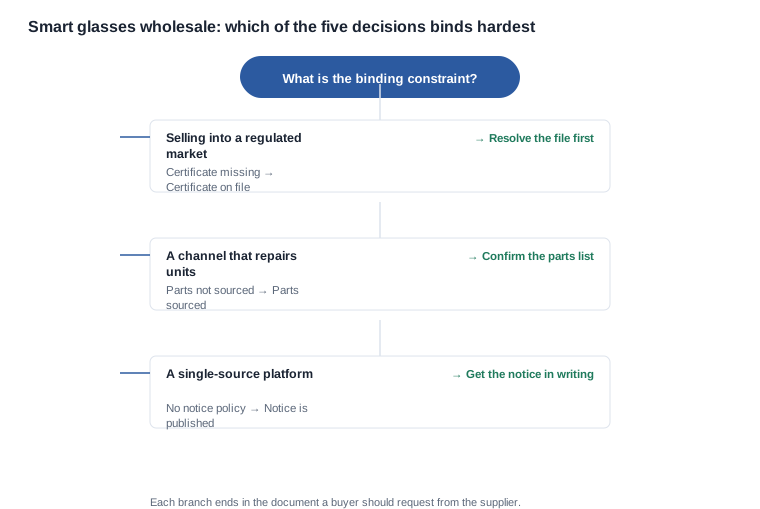
These questions have a useful side effect. A supplier who has thought about end-of-life support is telling the buyer something about how they see their own business, and a supplier who cannot answer them has a reason that is worth hearing before rather than after the first reorder.
What CYNRIN publishes for smart glasses wholesale buyers
The published side of this overview is a structural fact set rather than a price list. CYNRIN publishes the catalogue rows that exist: 28 models across four families and three entries without a formal SKU, the case coverage inside the camera range, the charging-method split across the whole catalogue, the colour coverage on two models, a charge time for every model and a rated runtime for every model, and the single weight figure the catalogue contains. It publishes no unit rate, no minimum order quantity, no lead time in weeks and no per-model certificate number, and we do not fill those gaps with estimates.
What we will do is take the models you have shortlisted, the markets you intend to serve and the horizon you are planning against, and answer against those published rows — including which of the five decisions above the catalogue already settles and which have to come from the supplier's own written confirmation. Where a number is needed and the catalogue does not carry it, the answer names the question to put to the supplier instead of inventing a figure.
Two further readings support this overview: the distributors and retailers solution page describes the engagement shape this overview assumes, and standard OEM engagement and pricing covers the commercial frame above it. The after-sales commitments page is where the service position in the third section has to be supported, and the wholesale programme entry point is where a first conversation starts.
Finally, the overview is only useful once it is tested against a specific programme. The five decisions produce different answers for a distributor serving one regulated market with a small model list and for a multi-market platform running a broad range, and the difference between them sits mostly in the compliance and stock sections rather than in the business-type section. A buyer who has answered all five in general terms has not answered any of them for their own programme.
Smart glasses wholesale is won by the buyer who can add something the supplier cannot add for them, and lost by the buyer who can only subtract from the rate. The five decisions above are how a first-time entrant works out which position they are actually in.


