

Outsourcing in this product category is normal, widespread, and not by itself a reason to distrust a supplier. A manufacturer that made every component of a pair of smart glasses in one building would be describing something that does not exist commercially. The real question is not whether a supplier outsources; it is whether the supplier can tell you precisely what it outsources, and whether that answer reaches the parts of the process you actually care about.
The suppliers that damage their credibility are rarely the ones that outsource. They are the ones that outsource and then describe the result as wholly in-house. That is a disclosure failure, not a capability failure, and it is worth separating the two because they call for different responses: a capability gap needs a different supplier, while a disclosure gap needs a better contract.
The deeper problem for buyers is that scepticism is applied unevenly. Almost everybody applies it hard to the electronics and not at all to the cells, which is a strange way round given that the cell is the component with the largest safety and transport consequences. Getting the scepticism uniform is most of the work.
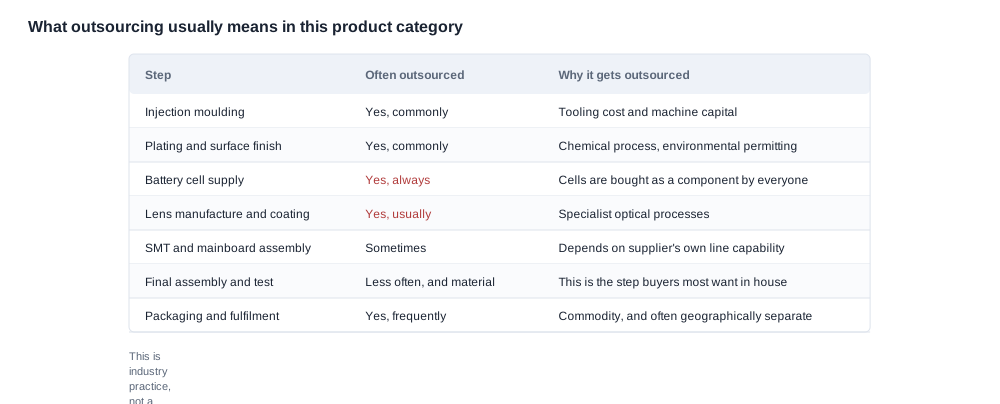
Factory vs trading company: where outsourcing is normal and where it matters
Battery cells are bought by every manufacturer in the industry. Nobody makes lithium-polymer cells. If a supplier claimed otherwise it would be a serious problem, and the fact that it is not tells you something about how buyers read these claims: they apply scepticism to the electronics and none at all to the cells, which is where the transport documentation and the safety data actually come from. Our own catalogue publishes cell capacities — the camera tier runs from 220 mAh to 290 mAh, the children's tier from 40 mAh, and the YKC02 is a sport model with two 70 mAh cells — and every one of those figures is a purchased component. Ask about the cell once, accept the answer, and move on.
Lens manufacture and coating sits in the same category. Optical surfaces are made by specialist processes, and the specialist is usually not the device assembler. The photochromic behaviour on the V03 Pro — the only camera model in the range with photochromic lenses — depends on a coating process that is very unlikely to be in-house.
Plating and surface finish is the third. A chemical process with its own environmental permitting and its own quality discipline, usually run at a partner rather than on the factory floor.
Fourth, and less discussed: packaging. Custom printed retail boxes are almost always produced by a packaging converter. A supplier claiming to print its own boxes in-house is describing a different kind of company from the one most buyers are talking to.
Fifth: the accessories. Charging cables, cases, cloths and printed inserts frequently come from the same partner as the retail packaging. Note that in our range the charging case is a separate configuration rather than a standard accessory: capacity is published for five models — 1400 mAh for the CY03 and the CY05, and the L1 Pro, 900 or 1400 mAh for the L2 Utral, and 1200 mAh in a foldable case for the MT6 — while the KY06 and the MT5 carry a case whose capacity is not published, no case row appears for the V03, the V06 or the S7, and the V03 Pro is entered without one. A model that ships with a case is shipping with a partner's part inside it.
All five are unremarkable. Ask about them once, accept the answer, and move on.
There is a useful principle behind that list, and it is worth stating because it tells you when to stop asking. The steps that are unremarkable are the ones where the partner's work is a commodity — a cell of a given capacity, a lens of a given specification, a printed box of a given artwork. The supplier buys a specification and checks it against a receiving standard, and the identity of the partner is commercially irrelevant as long as the incoming inspection works. The steps that matter are the ones where the partner's work is specific to you — your tooling, your firmware, your colour, your label, your accessory set. Those are the steps where knowing the partner matters, because those are the steps where the work carries your name.
The practical rule that falls out of this is simple: ask about the steps that carry your identity, and accept the answer about the steps that carry a catalogue number. A buyer who asks to audit the cell supplier will get a long afternoon and no useful information; a buyer who asks who holds the tooling and who prints the box gets two sentences that materially change the contract.
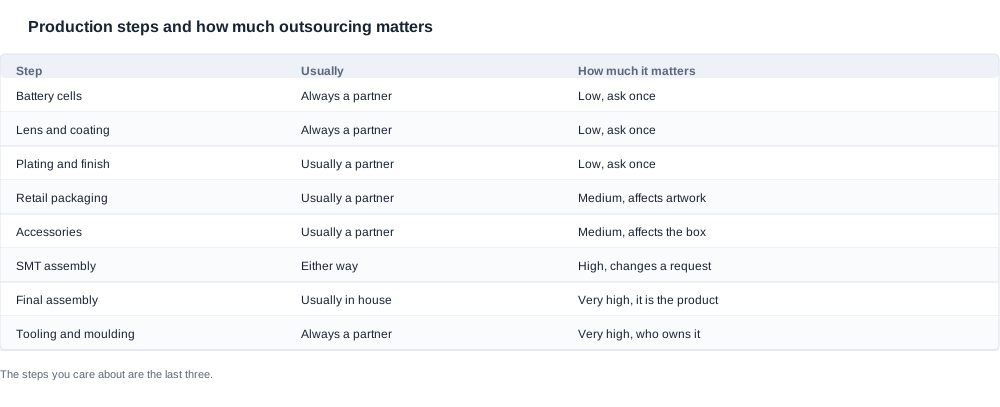
The steps that are worth pressing on are the ones where the factory's own capability is the product you are buying.
Final assembly and test. This is the step buyers most reasonably want in-house, and it is the step most worth asking about. It is where the golden sample is compared against production, where firmware is flashed, where the accessory count is verified, and where the unit that ships is the unit that was tested. If final assembly is outsourced, the supplier you are contracting with is a specification manager rather than a manufacturer, and the distinction changes every document you need: the build sheet, the inspection instruction, the traceability record and the acceptance criteria all sit somewhere you have not yet identified.
SMT and mainboard assembly. This varies more across the industry, and both arrangements are viable businesses. A factory with its own SMT line and a factory that receives assembled boards from a partner are equally common. The reason the buyer still needs to know is that a board-level change lands differently in the two cases — one goes into a process instruction, the other into a supplier negotiation with a lead time you do not control.
Tooling and moulding. Usually outsourced, usually with the tooling owned by somebody. This connects directly to the ownership question — who holds the asset number, and what happens to it if the relationship ends.

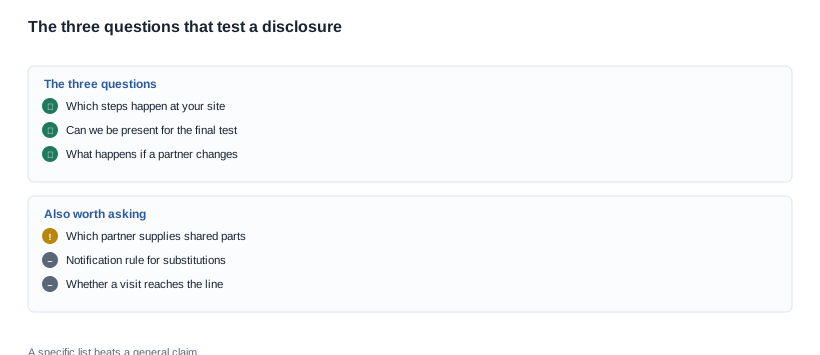
The three questions that test a factory vs trading company disclosure
The disclosure test is short, and it is worth running in this order because each answer either supports the next or contradicts it.
- Which steps happen at your site? A specific list beats a general claim. "Assembly, flashing and final test happen with us; moulding, plating, cell purchase, lens work and packaging are at partners" is a complete and acceptable answer, and it is the answer you want to hear. "We handle everything" is not an answer to the question, and neither is "we work with certified partners" without the list.
- Can you be present for the final test? This is the step where presence is worth the most and where a refusal is most telling. If final test happens at the site, being present for it should be an ordinary request. If final test happens at a partner site, the answer should be that the partner can be visited, and the visit should be offered without conditions.
- What happens if a partner changes? Substituting a component supplier without telling the buyer is the failure mode, and it is the one that damages a relationship permanently when it is discovered. Ask what notification you would receive, how much notice, and what your right to object would be — and note whether the answer is a process or an intention.
There is a fourth question that is worth asking because it takes five seconds and produces a very clean answer: which partner supplies the parts that appear on more than one model? The answer maps the platform. If the same charging interface, the same case, or the same cell turns up on models from different tiers, then those models share a component base, and the supplier is telling you something real about how the range was built.
That fourth question has a second use, and it is the more valuable one. A supplier that answers it has shown you that it knows its own bill of materials well enough to reason across the range — which is exactly the capability that makes the difference between a factory and an intermediary when something has to be changed. It also gives you a cheap way to spot a supplier whose product pages have been assembled rather than engineered: if a model carries a case row, a charging method and a colour list that would be impossible on the stated platform, the pages were written separately from the hardware.

Factory vs trading company: what changes when the split is disclosed
Disclosure does not change the product. It changes the contract, and the changes are specific enough to be worth asking for one by one.
The build sheet and the traceability record have to come from whoever performed final assembly. If the factory builds and a trading company sells, the serial or batch reference on the shipped unit is generated by the factory and has to reach you through the company. Ask in advance how that reference is generated, in what format it is delivered, and how long it is kept. A warranty claim made two years after the launch is only as good as that reference and the record behind it.
The inspection instruction has to be issued to the party that will be inspected. If the inspection is performed by the factory while the purchase order sits with the company, the acceptance decision and the payment milestone are in different hands. That is workable, but it has to be written down, because a shipment can be rejected by one party and paid for by another without anybody deciding anything.
The approved sample has to be defined by the party that built it. The golden sample is only a standard if the production units come from the same operation that produced it. If the sample is built at the factory and production happens elsewhere, the comparison is between two different things.
The substitution rule has to name who can trigger one. If final assembly is at a partner site and the partner can change a component without going back through the supplier, then the disclosure is real but the control is not. The question to ask is not whether substitutions are permitted but whether the permission to substitute lives in a document you are party to.
The market-access obligations do not move with the work. If the factory does the manufacturing and the company does the selling, the entity that makes the declaration in your market is the company, and it will need the underlying documents from the factory. Where our own published position is thin this becomes concrete: we publish no certification breakdown at model level, and our export-certification page is a picture page of ten patent certificates, of which eight are design patents and two utility models. So the document flow is not a formality — it is the thing that has to be designed, because it does not exist in a ready form for anyone to forward.
None of this makes a disclosed split a bad arrangement. It makes it a different arrangement from a single-site one, and the differences are all documentable in advance. The buyers who get hurt are not the ones who chose a split structure; they are the ones who chose it without noticing, and who discovered the difference when a claim needed a document that had never existed.
Capability versus accountability in a factory vs trading company deal
There are two different questions hiding inside "do you make this yourself", and separating them is the single most useful thing a buyer can do in this negotiation.
The first is about capability: can the organisation do the work. The second is about accountability: who is responsible when it goes wrong. A factory can outsource the second one legitimately, as long as the contract says so and the obligation travels with the goods. A factory can also outsource the first one while retaining the second, which is a more unusual arrangement and one that tells you something about how the relationship is structured.
The failure is a supplier who answers the accountability question with a capability answer. "We have our own factory" tells you nothing about who carries an obligation when a shipment fails a market-access check or a customer returns twenty units with the same fault. That is the answer given by a company that wants to sound larger than it is, and it is also the answer given by a factory that genuinely does have the capability and has simply not thought about the contractual side.
The contractual consequence is concrete. If the factory performs the work but the trading company sells it, then the entity you contract with is the one that owes you the documentation, the traceability record and the response — and if it in turn contracts with the factory, the obligation has to be written down twice before it is worth anything. That is not a reason to avoid intermediaries. It is a reason to ask whether the intermediary's contract with the factory contains the terms you need, and to require that they flow down to you.
There is a third distinction worth separating from these two, and it is the one that catches buyers most often. Capability, accountability and control are different things. A supplier can have the capability to do the work, hold the accountability for it, and still not control it — because the person who actually performs the step does not work for them and does not report to them. Control is what determines whether a request you make on Tuesday produces a change on Friday or a question on Wednesday. It is also the hardest of the three to establish from outside, and it is the one that determines the pace of the entire programme.
The way to test control is to make a small, specific, time-bound request and watch how it moves. A request that reaches the floor and comes back with a date is a controlled operation. A request that comes back with a question about who owns it is not, whatever the capability and accountability positions say.

What a factory vs trading company supplier should volunteer first
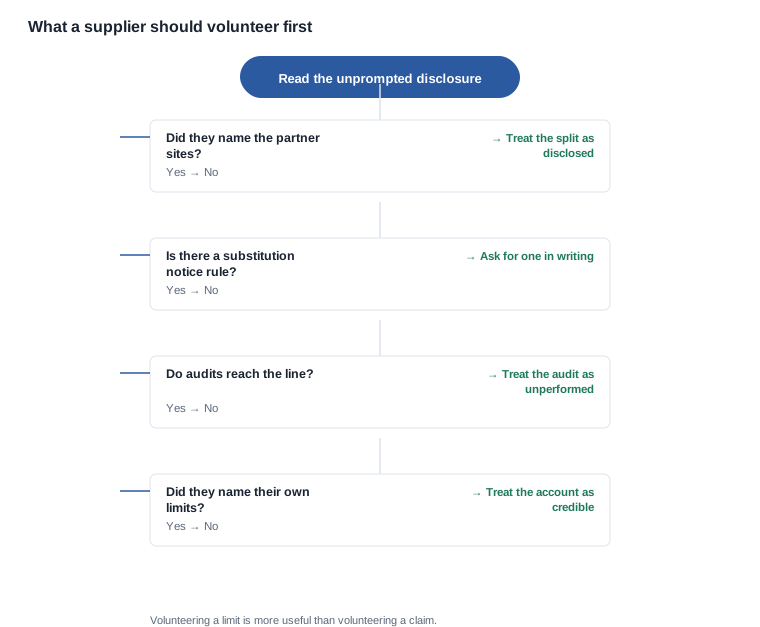
The best test of a supplier is not what it says when you ask, but what it says before you ask. Four items are worth volunteering unprompted, and a supplier who volunteers all four has demonstrated something about how it operates.
The step-by-step split, with the partner sites named. Not the categories — the sites. "Final assembly and test at our own facility; moulding at a partner in the same industrial park" is a disclosure. "We work with a network of partners" is not.
The notification rule for partner substitutions. What you would be told, and when. A supplier with a written rule for this is a supplier whose supply chain is stable enough to have a rule.
The inspection access policy. Who may visit, which areas are included, and whether a visit reaches the line rather than the offices. A supplier with a policy has decided what it is comfortable with, which is useful information either way.
The boundary of what it does not do. Every supplier in this industry has a line — the thing it will not do, the capability it does not have, the market it will not ship into. A supplier who names its own limit has given you the most useful piece of information available, and it saves you from discovering the limit at the moment it matters.
The trade-off in volunteering all of this is that some of it is ordinary commercial information a competitor could use. A supplier that volunteers its partner list has decided that the credibility is worth more than the concealment. In our experience, in this category, that tends to be the right trade — but it is a decision rather than an inevitability, and the buyer's job is to make the volunteering attractive rather than to force it.
That is worth saying plainly, because buyers often treat the question of what a supplier volunteers as a character test rather than as a negotiation. It is closer to a negotiation: a supplier discloses more when disclosure is reciprocated, when the buyer's own requirement set is specific enough to make the answer useful, and when the supplier can see that the disclosure is going into a shortlist rather than into a public document. A buyer who sends a precise requirement set and asks for a step-by-step split gets a better answer than a buyer who sends "please send details about your factory" — not because the second supplier is less forthcoming, but because the second question has no shape to be forthcoming about.
We will name what we do and what our partners do, rather than describing the result as wholly ours. Some steps in our supply chain are performed at partner sites, and we will identify them if you need to audit them. We will not publish a line count or a plant size we cannot evidence, and we will not claim vertical integration we do not have. Unit prices, minimum order quantities, lead times, sample fees and warranty terms are confirmed per enquiry rather than published, because each one of them depends on the configuration, the quantity, the documentation scope and the current schedule.
That position has a practical consequence for the way a buyer should approach us, and it is the same principle we ask buyers to apply to everyone else. Ask for the step-by-step split in writing, ask which documents exist per model and per market, and ask which figures we will not produce. Our own published position is unusually explicit about the last of those — one published frame weight across twenty-eight entries, no certification row at model level, an export-certification page showing ten patent certificates in a picture, no capacitive-touch row and no translation row anywhere, ingress markings on two models only, and Bluetooth versions published for fourteen of the twenty-eight entries and absent for the rest. A supplier who will not tell you what it does not know is asking you to sign something you have not read.
The distinction buyers should be making is not between a factory and a trading company, but between a supplier who can describe its supply chain and one who cannot. The first exists in both forms; the second is rarer in both. The factory vs trading company page covers the contractual side of the distinction, and the development process covers what should be written down before you rely on an answer.
Related reading
Ask for the step-by-step split and we will tell you what runs with us and what runs at a partner site.


