
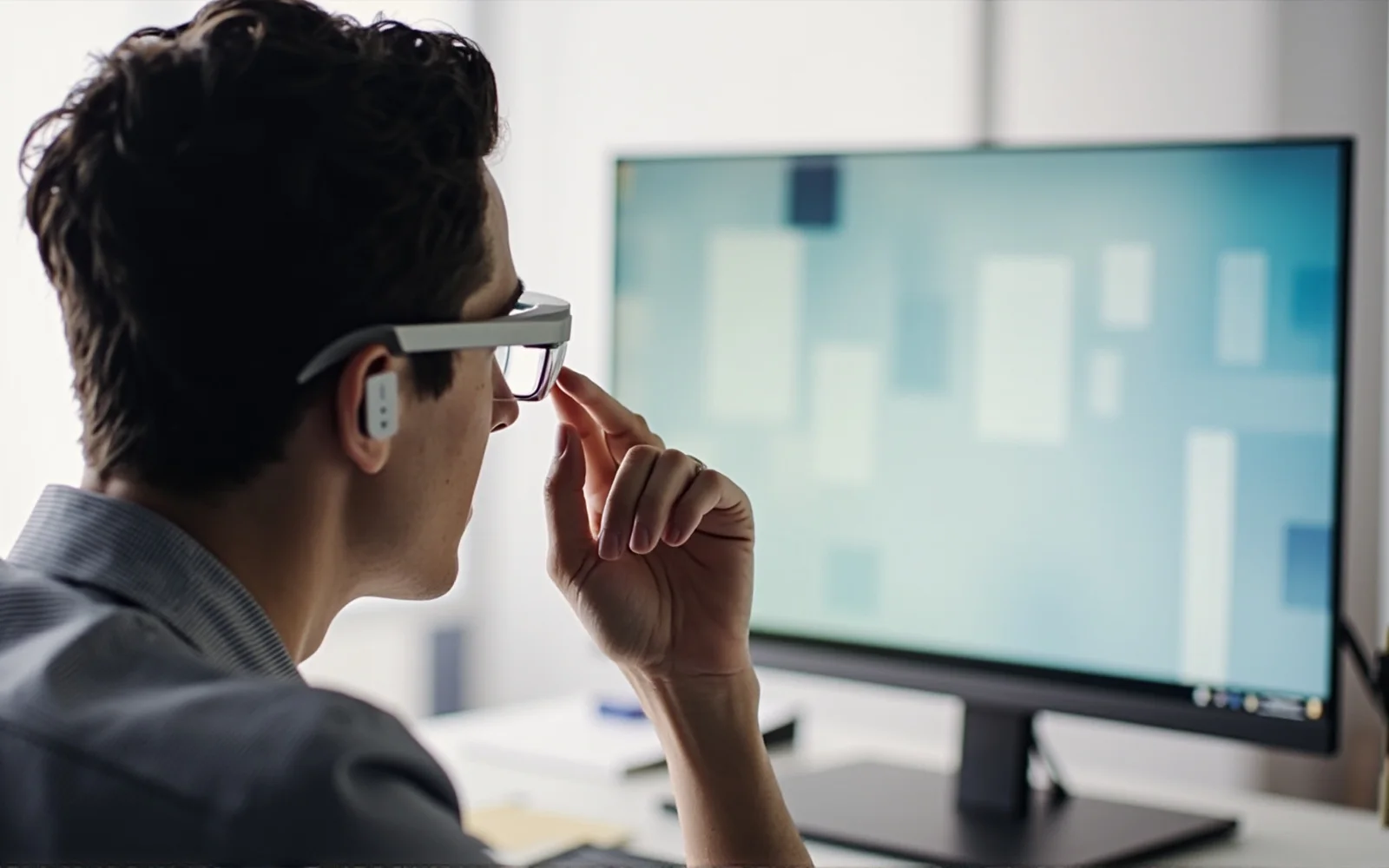
The hybrid-work pattern
Knowledge work runs on short, interrupted calls
Look at a typical hybrid calendar: a standup at the kitchen table, a quick huddle between rooms, a long meeting spent mostly listening, a walking one-to-one, and three five-minute calls that each require earbuds to be found, inserted, paired and charged. The friction is not any single call. It is the constant in-and-out of an in-ear device across a fragmented day, and the sore ear canals that follow eight hours of it.
- joining a meeting while making coffee or packing a bag
- listen-mode calls where the hands are doing something else
- walking one-to-ones around a building or neighborhood
- home-office calls interrupted by children, pets or deliveries
- hot-desks and shared offices where nobody wants a borrowed earpiece
Audio glasses answer that pattern. The device is already worn as eyewear, calls are answered by voice, and the wearer’s eyes stay on the screen, the room or the task. It is worth being precise about the audience: this is knowledge work — meetings, coordination, conversations. Guided repair on a plant floor is a different workflow with different hardware needs, covered in the remote expert assistance guide.
Hands-busy calls
Conversations that continue while life happens
The most natural work-call moments at home are not seated at a desk at all. Lunch gets made during a status call, laundry gets folded through a roadmap review, and plants get watered while a meeting runs in listen mode. Sealed earbuds support this too, but glasses remove the insertion step entirely and leave the wearer able to hear a partner in the room, a doorbell or a child calling from another room.
- cooking and clearing up during listen-heavy meetings
- taking notes or sketching with both hands, no earbud tap-hunting
- taking a quick call while walking to collect children
- staying reachable while moving between floors, rooms or buildings
Because the microphones ride on the head, voice pickup does not depend on where a phone is lying or which way a laptop is angled, and calls can be answered with a voice command while the hands are wet, full or occupied. The honest qualifier is that this fits conversational work; confidential one-to-ones and deep-focus blocks have different needs, addressed in the next section.
Video behavior changes in a subtler way. A person on glasses looks like someone in ordinary eyewear during a camera-on meeting, not someone wearing a conspicuous headset, and they can stand up, stretch or walk to a whiteboard mid-call without losing the audio link. That turns long listening blocks into genuinely mobile time instead of another hour pinned to a desk chair, and it is the difference customers tend to notice only after a week of real use.
The open-office limit
Leakage and privacy: where open-ear audio does not belong
An open sound field is not a private one. In a silent library, a quiet train car or a dense row of hot-desks, speech and audio played at conversation level can be heard by a neighbor, and an incoming call’s audio is audible to the people sitting closest. That is physics, not a defect — and it sets a real boundary on where the category fits in office life.
- Best fit: home offices and solo rooms, walking calls across a campus, quick desk huddles at moderate volume, and any setting where staying aware of the room is a feature.
- Keep earbuds for: confidential one-to-ones in open seating, focus blocks that need isolation, and desks packed close to colleagues.
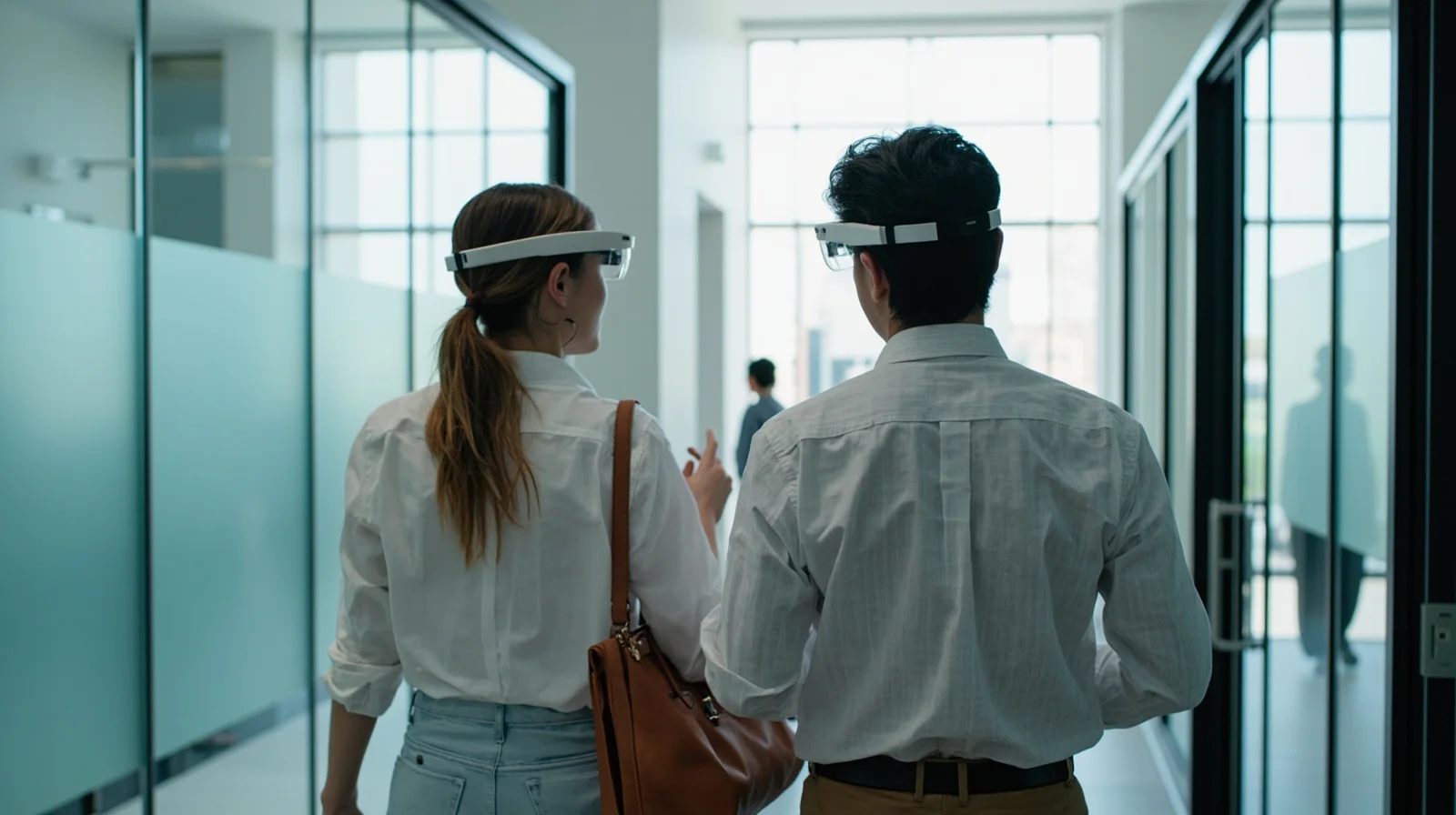
Brands should bake this into positioning instead of hiding it. Speaker configuration and tuning are reviewed per program so leakage behavior matches the intended use case, and workplace customers should evaluate units in their actual office layout during sampling. Quiet-environment discretion is one of the attributes that most directly drives reviews in this category — the full acoustic checklist lives on the audio & calls pillar.
One object on the face
Prescription frames, sunglasses and headset in a single object
For the large share of knowledge workers who already wear prescription lenses, glasses are not an extra device at all — they are the primary eyewear, upgraded with audio. Clear, sun and prescription lens strategies are specified per program rather than promised generically, so a brand can match its audience: fashion sunwear for one channel, prescription-friendly everyday frames for another.
Device count drops anyway. There is no separate headset to carry between home and office, no earbud case to lose, and no second charging ritual. On video calls the frames look like normal glasses — socially unremarkable in a way a large headset is not — which matters for client-facing days and back-to-back camera meetings. A camera-first tier such as the V03-T5 exists for lines that want optional first-person capture, but the work-call case is served well by audio-first platforms.
For most office programs the audio-first E13 is the natural starting point, with the K01 available as a second platform for value tiers and distributor brands. Frame balance, temple contact and weight are assessed during sampling so the glasses stay wearable across a full workday, not just a single demo call.
That single-device logic matters for fleet buyers as well as individuals. A company standardizing on audio eyewear avoids per-person tip sizes, shared-earpiece hygiene questions and the support cost of lost charging cases; users keep their own frames paired to their own accounts, and pairing, reset and re-enrollment behavior for managed devices is defined during program scoping rather than improvised after rollout.
Integration, kept honest
Meeting platforms, certification and what we do not promise
Buyers increasingly ask about certified headsets for specific meeting platforms. The honest answer is that CYNRIN does not blanket-claim certification for any particular meeting software. The reference platforms behave as standard Bluetooth audio devices for calls and media; deeper integration, companion behavior and firmware features are defined during engineering review and can be scoped under an ODM program.
Neither are these professional noise-cancelling headsets. Open-ear is the feature: colleagues, family and rooms stay audible. Teams that need guaranteed isolation in noisy offices or formal call-center certification should use sealed, certified headsets; glasses serve the much larger share of conversational work where isolation is not required.
Keeping that boundary clear is what distinguishes a credible office product from a gadget launch. The same hardware supports a genuinely different workflow away from the desk — field technicians receiving see-what-I-see guidance, described in remote expert assistance — but that is an industrial program, not a knowledge-worker one. For the mobile, post-arrival side of work life, see travel and commute. Brands that present the two segments honestly, rather than pretending open-ear audio covers every acoustic environment, build the durable review profile that office buyers and workplace catalogs actually reward.
Building the line
For brands equipping the hybrid workforce
The buyers for an office audio-glasses line range from consumer-electronics and audio brands adding a workday SKU to workplace catalogs and distributor brands. The consumer-electronics brands program covers brands extending into connected eyewear, while the eyewear brands program supports frame-first companies adding their first electronics tier.
- Define the persona: mostly home, mostly office, or a genuine split, because leakage acceptance differs by setting.
- Choose the platform: audio-first E13 or K01, camera-first only when capture is genuinely sold.
- Specify the lens program and frame geometry for long, camera-on comfort.
- Brand the surface: custom pairing name and firmware identity, colorways, case and multilingual packaging via customization.
- Evaluate before scale: office trials through the samples process, volumes and lead time per MOQ guidance.
The winning workday product is honest about the open-plan desk and excellent everywhere else: light on the face, quick to answer, and impossible to forget because it is already the wearer’s glasses. Scope a program through request a quote.
Buying considerations
What to specify in a work-calls audio brief
Workspace split
Share of work-from-home versus open-plan days, because leakage acceptance changes by setting.
Call mix
Short voice meetings and listen-mode calls versus confidential one-to-ones and focus blocks.
Leakage acceptance
How close the nearest desk sits and what volume discretion the office requires.
Lens program
Clear, sun or prescription lens strategy, confirmed per program.
Platform choice
Audio-first for work calls; camera-first only if capture is actually sold.
Integration scope
Standard Bluetooth call audio or deeper program-specific companion features.
Browse the application
More audio & calls guides
Keep exploring
Related reading
FAQ
Frequently asked questions
Are the glasses certified for Teams, Zoom or Google Meet?
Can colleagues nearby hear my calls in an open office?
Can people who wear prescription lenses use them?
Do the glasses offer noise cancellation for loud offices?
What MOQ applies to a branded work-calls line?
Build this use case into a private-label program
Tell us the workflow, environment and volume. Engineering scopes the platform, optics, power and documentation per program.