
The travel-kit problem
Fewer objects between home and destination
Frequent travelers know the inventory: sunglasses on the head, earbuds in a pocket, a charging case, a cable, and the low anxiety of where each one is at security, in the hotel and on the way back. Commuters carry the same kit five days a week, minus the suitcase. Every additional device is something to charge, lose or forget, and earbud cases are among the most-replaced items in travel bags.
Audio glasses attack the count directly. They are worn rather than packed: the same pair shades the eyes, answers calls, plays podcasts and delivers navigation prompts, so the earbuds and their case can stay home for many trips. Charging becomes one routine instead of two, and there is no in-ear device to remove and reseat at every shop counter, security conversation or platform announcement.
It is worth saying up front what this guide does and does not claim. Audio glasses are excellent across the arrival part of travel — stations, streets, lobbies, business-trip days. They deliberately do not replace sealing headphones in a loud cabin. That boundary is the difference between an honest product and a disappointing review.
Streets and stations
Navigation, announcements and calls with the city still audible
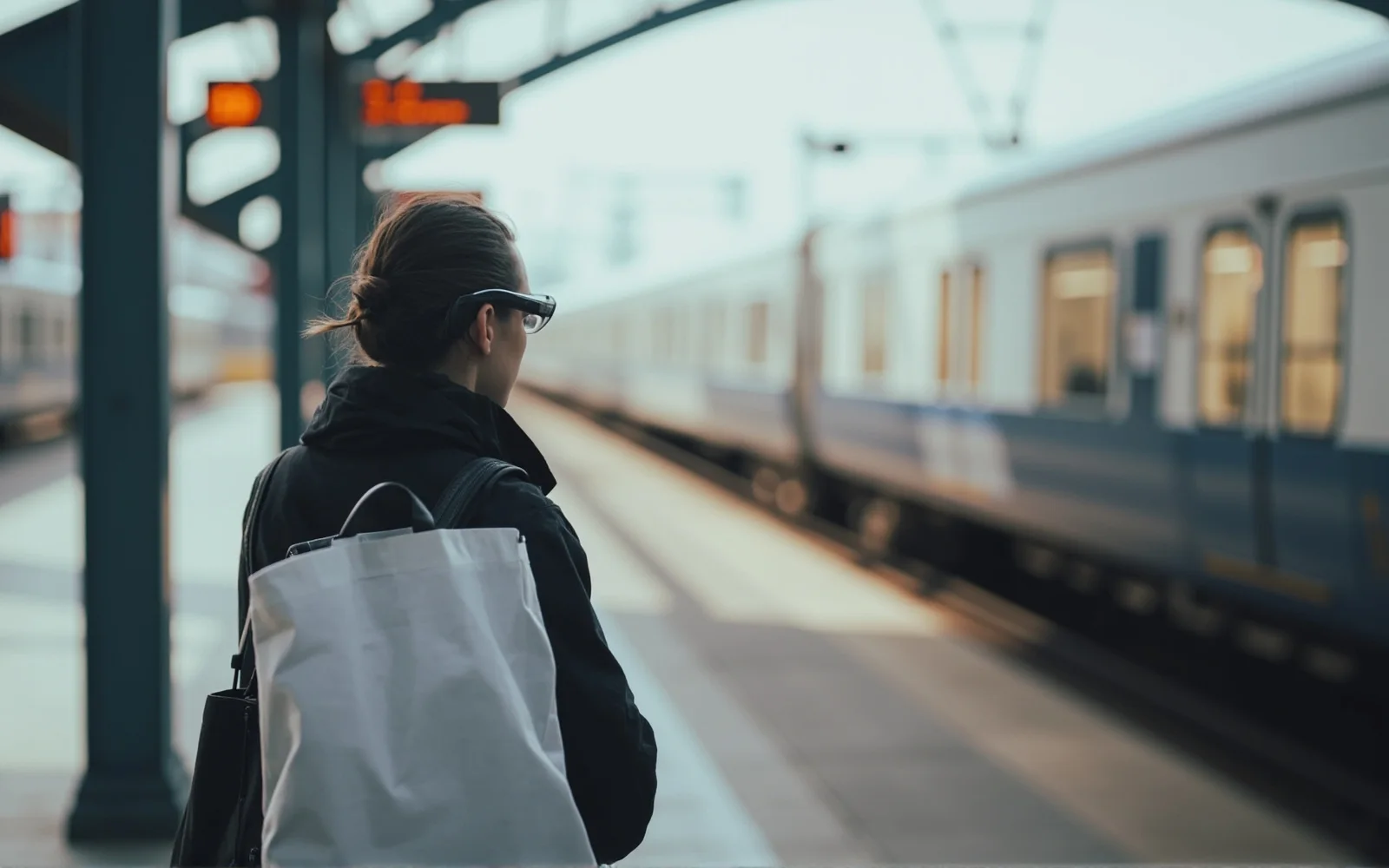
The moment open-ear travel proves itself is arrival in an unfamiliar place. Turn-by-turn directions arrive while both hands handle luggage; platform and gate announcements stay audible; taxi, check-in and coffee-counter conversations happen without an earbud-removal ritual; an urgent call is answered by voice mid-station. The wearer looks like an ordinary person in sunglasses, not someone sealed off behind a headset.
- walking directions in an unfamiliar city with traffic still audible
- hands-free coordination calls with drivers, hotels or colleagues
- podcasts during station waits without missing announcements
- taking a call while crossing a concourse or pushing a trolley
Situational awareness is also a safety argument: travelers hear approaching vehicles, bicycles and staff instructions the same way runners hear traffic, which is why the running safety and visibility guide reaches the same conclusion. On a crowded evening commute, the same property means passengers hear their stop called and people approaching from behind.
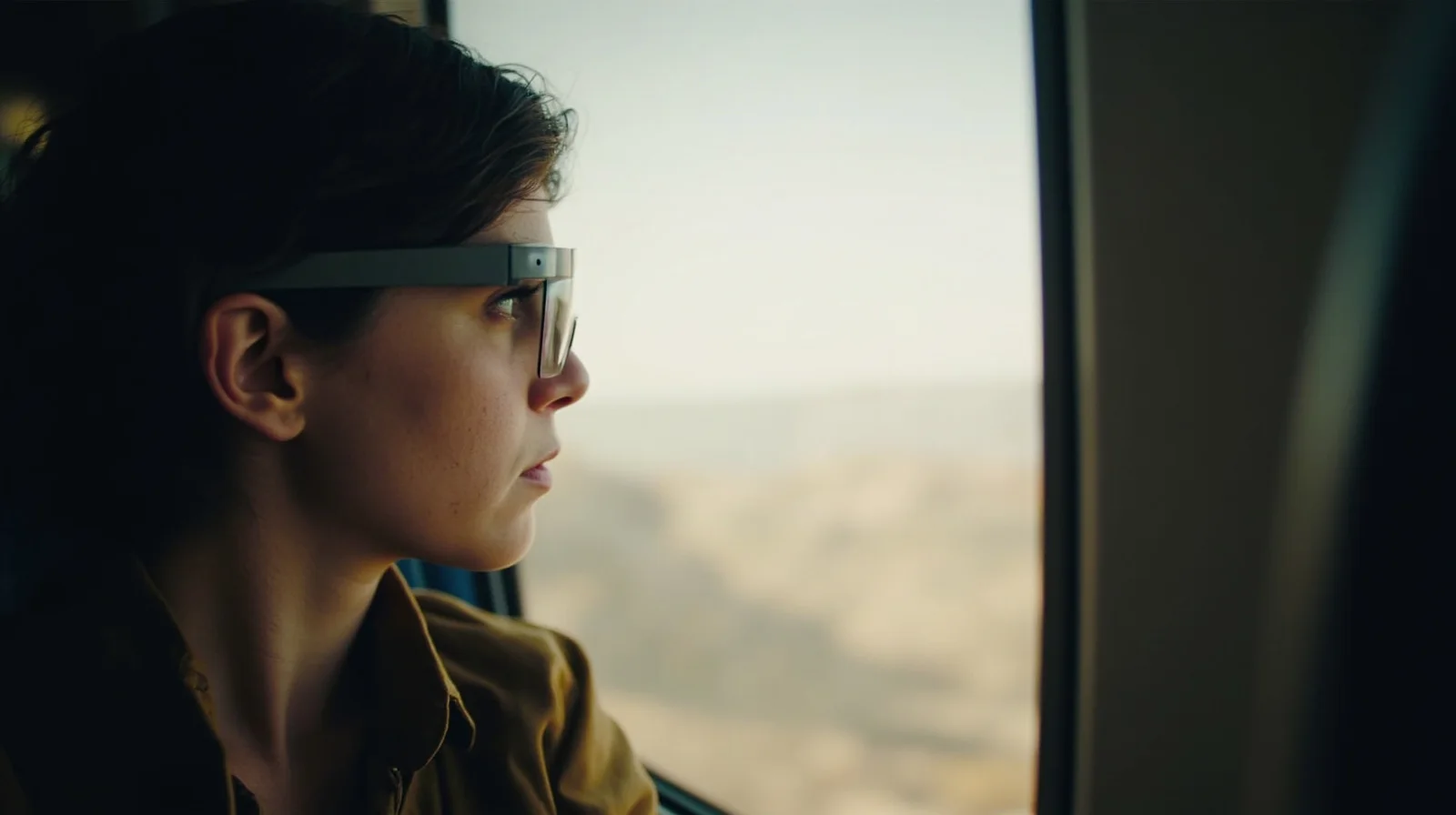
Business travelers get a second benefit that is easy to underestimate: the trip-day rhythm becomes mostly hands-free. An airport call with a colleague, a hotel check-in conversation and a lobby meeting all happen without managing an earpiece, and the wearer simply looks like someone in sunglasses. That social normality is the same reason eyewear is the easiest smart device to wear through a long travel day.
The cabin boundary
Planes and high-speed trains: where sealed headphones still win
Here is the honesty a travel brand needs on the page. Open-ear speakers cannot lower an engine’s noise floor. Under aircraft drone or high-speed rail rumble, content has to compete with the full ambient level; pushing volume that high fatigues the ear, and the open sound field leaks to neighboring seats. Sealed headphones or active-noise-cancelling earbuds remain the correct tool for movies and music during a long leg.
The realistic positioning is a two-device travel kit: sealing earbuds for the cabin or the loudest subway segment, audio glasses for everything after — the station, the street, the hotel walk, the full business-trip day of calls and navigation. Frequent travelers who have adopted the pattern describe it as choosing the device by segment rather than wearing one compromise for twelve hours.
Battery language deserves the same discipline. Runtime, standby and any quick-charge behavior are stated on the program datasheet against a realistic travel profile of navigation, calls and mixed playback — never as generic all-day figures in marketing. Brands sizing a travel line should define that profile before tooling, including whether charging happens overnight in a hotel or opportunistically between meetings.
The same logic protects the boarding and layover moments. Waiting at a gate or eating alone in a lounge is a genuinely good open-ear environment — announcements stay audible, podcast listening stays social, and a boarding call never hides inside an earbud seal. That is a large share of actual travel time, and it is where the category earns its place honestly.
Security lines and daily transit
Through the airport and onto the daily commute
Glasses ride on the face like ordinary sunglasses through most security routines, with nothing inserted in the ears to remove, untangle or hand over. Pocket contents shrink, documents stay in one hand, and gate-change or pickup calls are answered while the other hand holds a passport or a coffee. Airline and station policies vary, so no universal promise is made about screening handling.
The daily commute splits by segment, and honesty matters on both sides. Walking to the station, waiting on the platform and navigating on foot favor open-ear awareness and quick calls. Inside a genuinely loud train car, audibility is limited for the same cabin-physics reason above — sealed earbuds win that segment, and brands should say so rather than engineer disappointed expectations.
Wind is the other recurring condition: exposed platforms, bridges and rainy streets challenge every open-microphone device. Wind-noise handling and speaker tuning are platform-specific and reviewed per program during sampling, in the same way leakage is. The indoor counterpart to this guide, office and work calls, covers desk and home-office use.
The daily-commute case is strongest on the walking and waiting segments rather than inside the carriage. Queueing, transferring between lines, walking to the office from a station and stopping at a counter all favor something that needs no insertion and leaves announcements intact. Merchandising the product around those moments — rather than promising a silent train car — is what keeps ratings honest and returns low for travel-focused brands.
Optional camera tier
Impromptu capture is secondary, not the headline
A camera-first platform such as the V03-T5 adds one genuinely useful travel trick: a first-person still or short clip when hands are full — capturing an arrival board, documenting a baggage issue or sharing a viewpoint without stopping to dig out a phone. It is a nice-to-have on a handful of trips, not the reason to buy.
Travelers whose main goal is content should not be sold a calls device as a vlogging rig. Serious first-person travel video has its own requirements and its own guide, travel vlogging, with creator POV content covering the production side. When capture is included, a visible capture indicator keeps the device discreet and respectful toward bystanders.
For line architecture this argues for a familiar tier: the audio-first E13 as the volume travel and commute SKU, with a camera model positioned above it. The full positioning is on the audio & calls pillar and in the platform comparison.
Lens choice follows the same tiering. Sun lenses lead for tourist and driving retail, while clear or prescription-friendly frames fit daily commuters who wear the glasses from door to desk. Lens programs and frame geometry are confirmed per program, so a brand can run a travel-led sunwear line and an everyday commuter line without inventing a second platform.
Building the line
For brands selling to travelers and commuters
Travel and commuting is a strong merchandising angle for consumer-electronics brands, audio brands and travel-retail distributors: the use case is universal, the purchase is gift-friendly, and the device replaces something already in the bag. The consumer-electronics brands program and eyewear brands program describe how CYNRIN supplies the hardware while the brand owns the customer relationship.
- Position by segment: open-ear for arrival days and streets, with no claim of cabin noise reduction.
- Choose the platform and lens program: sun lenses lead for travel, with clear and prescription options per program.
- Tune wind and leakage for stations and streets; validate on real units.
- Package for the channel: protective case, cable and multilingual inserts through customization.
- Sample and scale: start through samples, check MOQ guidance, and scope frame or firmware changes under ODM.
The honest travel pitch is quietly compelling: one object on the face, ears open to the city, and the sealed headphones reserved for the one part of the trip where they actually help. Start the conversation through request a quote or contact.
Buying considerations
What to specify in a travel audio brief
Trip profile
Cabin time versus street and station time, which decides the one- or two-device pitch.
Noise honesty
No ANC or isolation claims; sealed headphones positioned for loud legs.
Wind and leakage
Tuning reviewed per program for platforms, bridges and quiet train cars.
Power profile
Runtime and quick-charge behavior stated on the program datasheet.
Lens strategy
Sun-led travel range with clear and prescription options per program.
Retail packaging
Hard case, cable and multilingual inserts suited to travel retail.
Browse the application
More audio & calls guides
Keep exploring
Related reading
FAQ
Frequently asked questions
Do these glasses replace noise-cancelling headphones on flights?
Can I wear them through airport security?
Can I hear navigation directions and take calls while walking?
Which platform fits a travel-retail product line?
What are the MOQ and sampling options for a private-label travel line?
Build this use case into a private-label program
Tell us the workflow, environment and volume. Engineering scopes the platform, optics, power and documentation per program.