
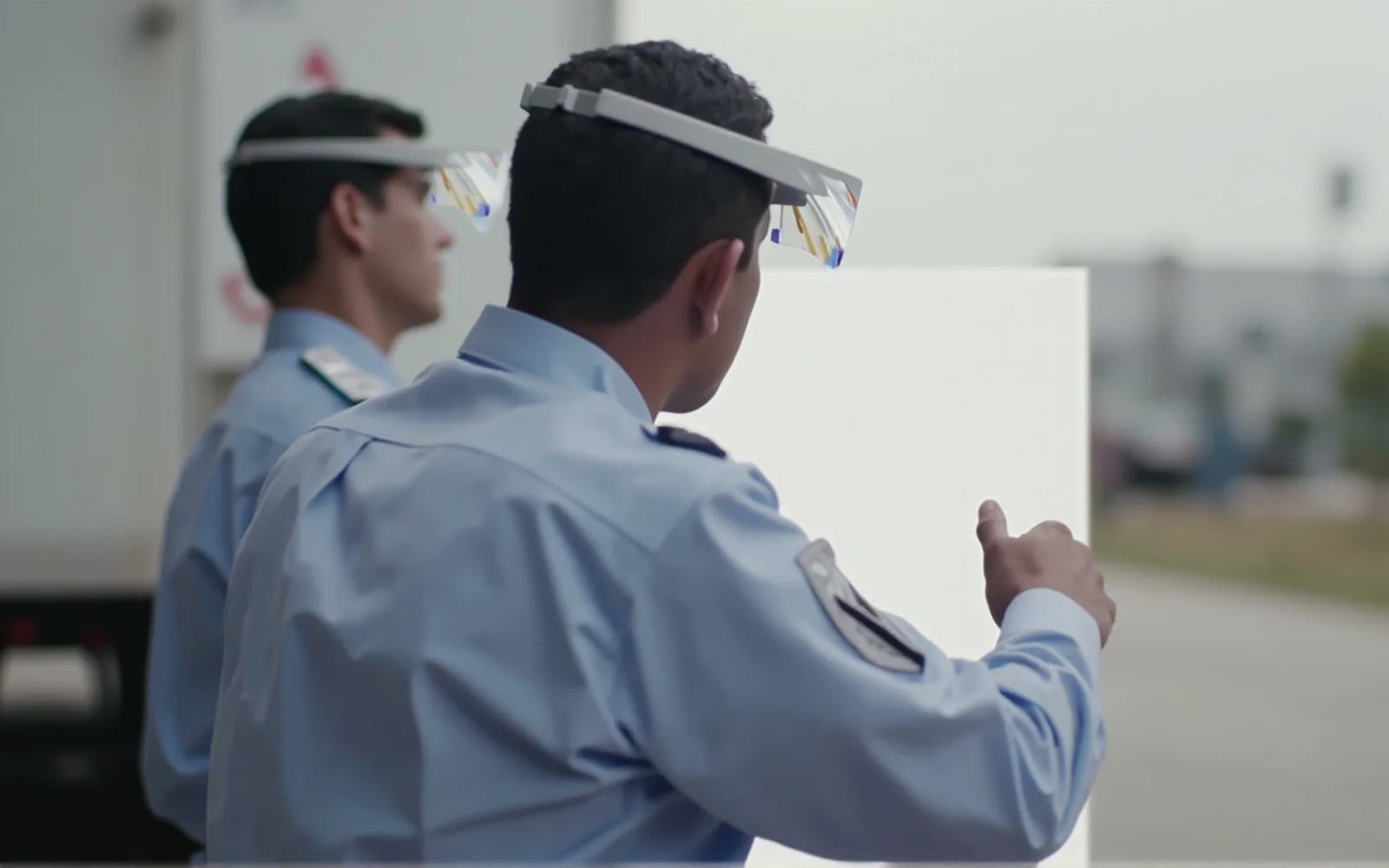
The evidence gap
Incidents are seen from the officer’s point of view; most cameras are not
When an incident develops — a confrontation, an injury, a break-in in progress, a fire alarm activation — the officer’s head turns, tracks and assesses faster than any chest-mounted camera follows. Established body-worn video is the standard evidentiary tool for good reason, but its viewpoint is fixed to the torso: it frames whatever the chest faces, misses what the eyes dart toward, and keeps requiring a hand the officer may need for first aid, direction or control.
Agencies and security operators evaluating camera glasses are usually chasing a specific gap: a true first-person record of where attention actually went, captured without a hand, in the seconds before and during an event. Such footage supports the post-incident account — the approach path, the line of sight, what was visible from the officer’s position — and it lets a remote supervisor see the same scene rather than hear a compressed description.
It is essential to be precise about what this is and is not. CYNRIN supplies connected-eyewear hardware. We do not supply an evidence-management platform, a chain-of-custody service, a control-room product or a body-camera certification. Those are provided and validated by the agency, its integrator and its software vendors under the applicable law. Glasses are a capable first-person capture endpoint; the evidential system around them is the buyer’s to define and own.
An honest capability split
What reference platforms do today versus what livestream requires
Buyers in this category ask the same two questions: can it capture first-person evidence, and can it stream live to a control room? The answers are deliberately different.
- Available on reference platforms. First-person stills and short video clips are captured through the partner companion application running on a paired device, initiated by a simple wearer control, with a visible active-state indicator. Open-ear calls let the officer talk hands-free while observing.
- Scoped as custom integration. Low-latency livestream at operational scale — many concurrent officers, control-room walling, dispatch triggers, fleet device management — is a custom ODM project jointly engineered with the customer’s software team against their network, encoding and device-management requirements. It is not a feature to assume on a datasheet.
- Owned entirely by the customer. Evidence ingestion, hashing, redaction, retention and access control live in the agency’s chosen evidence system, not on the glasses or on CYNRIN infrastructure.
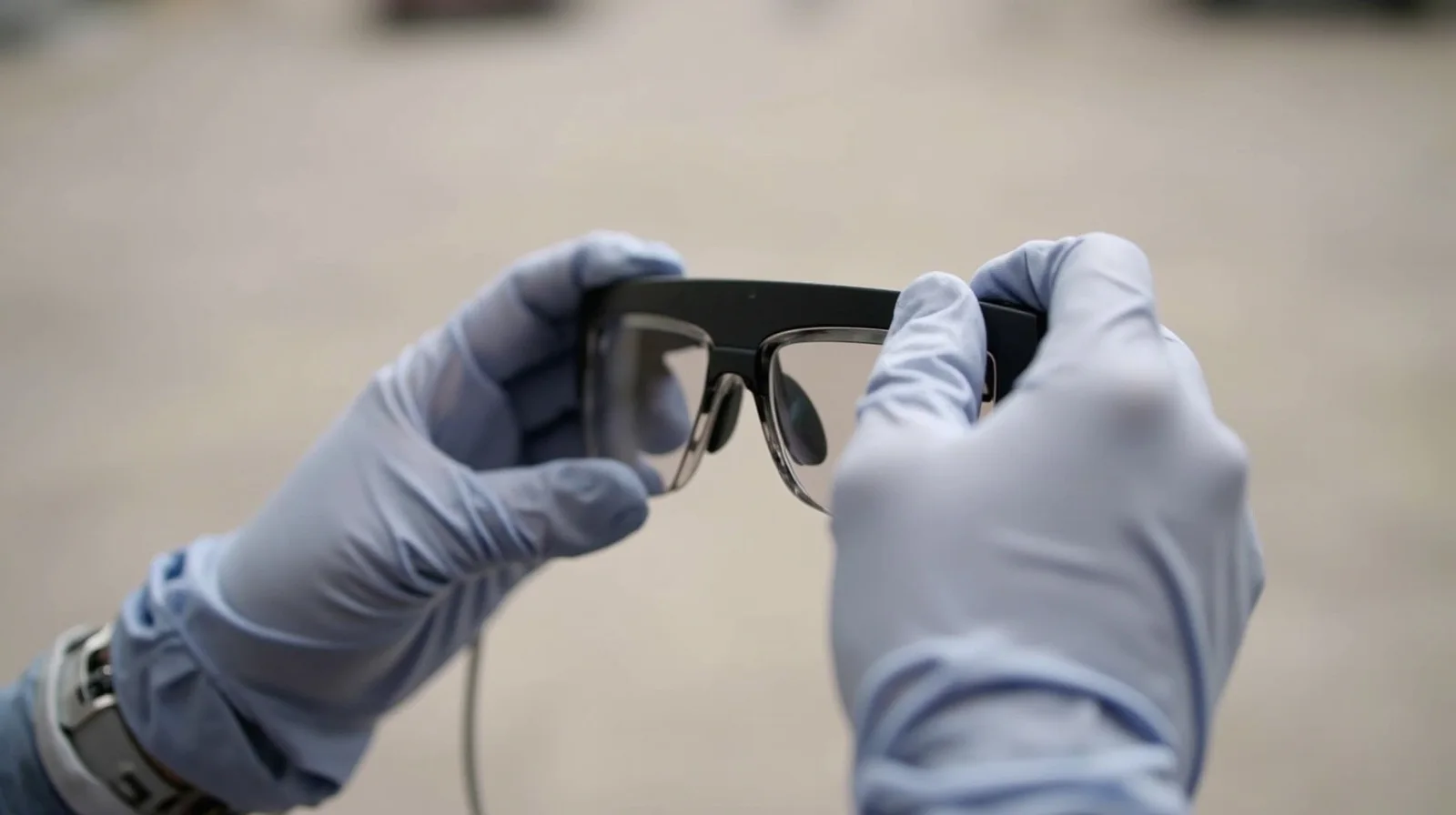
The reason for scoping livestream honestly is engineering, not reluctance. Real-time video from head-worn devices depends on uplink quality at the scene, encoding budget, thermal limits, battery profile and the receiving platform’s capacity. A vendor that promises national-scale control-room streaming as a checkbox is selling the integration work twice. We prefer to define the actual operating envelope — sites, network conditions, concurrent users — and confirm it in a pilot before any fleet commitment.
The incident minute
How first-person capture fits a real response
- Approach. The officer keeps head and hands free while closing on the scene, hearing the environment through open-ear audio and receiving supervisor instructions without an occluding earpiece.
- Capture trigger. When an incident forms, first-person capture starts through a deliberate control — not silently, and not continuously by default. The visible indicator shows active state.
- Act, don’t operate equipment. Both hands remain available for directing people, administering first aid, handling barriers or opening access — the camera follows gaze automatically.
- Remote guidance where available. Where the program includes live sharing, a supervisor joins the officer’s view to guide resource decisions; otherwise the captured media is transferred after the event.
- Hand-off into the evidence system. Media moves through the companion application into the agency’s evidence platform, which takes ownership of integrity, access and retention. The device is not an editing workstation.
Officer safety is the through-line. Every step assumes the wearer is looking at the scene rather than down at equipment, and that bystanders and colleagues can see when recording is active. For the day-to-day reporting layer around incidents, the patrol reporting guide covers checkpoint and routine logging on the same hardware.
Admissibility and governance
Chain of custody is a system property, not a glasses feature
A recording becomes evidence through handling, not through the shape of the camera. Programs evaluating first-person glasses should be explicit about four governance realities.
- Chain of custody lives downstream. Time-sourcing, integrity hashes, audit trails, access control, redaction and disclosure workflows are provided by the customer’s evidence-management system. The glasses hand media over; they do not authenticate a prosecution file.
- Storage and retention are agency-owned. Where material resides, who can view it and how long it is kept follow agency policy and local law, never a vendor cloud account the buyer cannot audit.
- Tamper resistance has real limits. General connected eyewear is not a purpose-built evidential recorder. We make no tamper-proof claim for the reference product. Controls such as restricted local deletion or enforced upload can be examined during ODM scoping, but evidentiary integrity remains the evidence system’s job.
- Indicator and notice behavior. A visible warning state shows capture to subjects and colleagues; behavior is configurable within an overt-use model. Recording notices, subject rights and lawful-use decisions sit with the deploying organization.
Admissibility itself is decided by courts and local procedure, never declared by a manufacturer. The defensible posture is the same one used across the security pillar: honest hardware capability, an overt indicator, and every legal and evidential claim owned and validated by the deploying agency and its solution partners.
Specifying the hardware
First-person optics, overt indicators and field durability
Evidence-oriented programs lead with the camera. The V03-T5 camera-first reference platform provides the first-person still and video capture path; actual resolution, low-light behavior, clip behavior and encoding options are specified per program and stated on the program datasheet rather than asserted in marketing copy. Camera placement and angle are reviewed so the captured frame matches natural gaze during walking and standing response.
The capture indicator is treated as a specification requirement: visible to a person facing the wearer, unambiguous about active state, and not designed to be defeated in normal use. Open-ear microphones and speakers are selected for intelligible hands-free speech outdoors, including wind and traffic, without blocking the officer’s ambient hearing.
Durability, sweat and weather handling, impact expectations and the call-plus-capture power profile are confirmed for the duty pattern and validated through the quality-control process; no generic ingress rating or runtime figure is promised. Programs that need communication but not evidentiary capture often evaluate the audio-first E13 or K01 platforms instead, covered further in the lone-worker and patrol guides.
Building the program
A hardware and integration path for agencies and solution vendors
Customers here are typically public-safety agencies, guarding and monitoring companies, body-worn-video and evidence-platform vendors, and security integrators. A responsible program separates what can be piloted now from what must be engineered.
- Define the intended use. Post-event first-person media, live supervisor viewing on selected sites, or control-room-scale streaming — each has a different engineering and certification footprint.
- Select and configure the platform. Camera platform, indicator behavior, capture controls, headgear fit and the duty power profile are specified for the uniform and shift.
- Scope the integration. Evidence-system connectors, live-sharing architecture and device-management behavior are engineered jointly with the customer’s software team under an ODM agreement; OEM branding and packaging run in parallel.
- Pilot the operating envelope. Reference samples support a bounded trial on real sites, including network conditions at the exact locations streaming must work.
- Commit and certify. Volumes, lead time and documentation are confirmed per program; any law-enforcement or evidentiary certification is owned and pursued by the solution owner.
The output is a defensible capability: genuine first-person capture on reliable field hardware, a livestream promise scoped to what the network and integration actually deliver, and evidence governance left unambiguously with the agency. Open the conversation through request a quote; branding and packaging options are summarized under customization.
Buying considerations
Evidence and livestream program requirements
Evidence system owner
Which platform receives media and provides hashing, audit trail, redaction, access and retention.
Livestream requirement
Post-event review, selected-site sharing or control-room scale; sites, concurrency and expected uplink.
Indicator and notice policy
Overt recording behavior, warning state, signage and the lawful basis for capture locally.
Tamper and upload controls
Required restrictions on local deletion or editing, scoped honestly as ODM behavior.
Operating environment
Weather, dust, lighting, headgear and uniform compatibility across the duty pattern.
Device management
Enrollment, assignment, charging, reset and fleet provisioning for shared or issued units.
Browse the application
More security & field work guides
Keep exploring
Related reading
FAQ
Frequently asked questions
Can the glasses stream live video to our control room?
Is footage automatically admissible as evidence?
Can an officer delete or alter a recording on the device?
Do these replace standard body-worn cameras?
Can an evidence-platform vendor private-label the glasses?
Build this use case into a private-label program
Tell us the workflow, environment and volume. Engineering scopes the platform, optics, power and documentation per program.