
The patrol documentation gap
A notebook, a phone and a radio are three tools too many
Patrol work is mobile documentation work. Between checkpoints an officer observes conditions, talks to people, checks doors and seals, and is expected to leave an accurate record of all of it. The traditional toolkit fights that task. A paper notebook gets wet, stays in a pocket and is transcribed hours later, when detail has already blurred. A phone requires stopping, looking down, occupying a hand and often removing a glove — precisely while the officer should be watching the yard, not a screen. A push-to-talk radio occupies an ear and a channel, and spoken reports are overheard, forgotten and rarely logged verbatim.
The practical result is familiar to every guarding operation. Notes are reconstructed in a batch at the end of shift, checkpoint scans are ticked off away from the actual points, and exception reports lose the small details — which seal, which fence panel, what the access point looked like — that matter in a dispute. Worse, each device drags attention downward. An officer looking at a phone at a loading bay is not observing the loading bay.
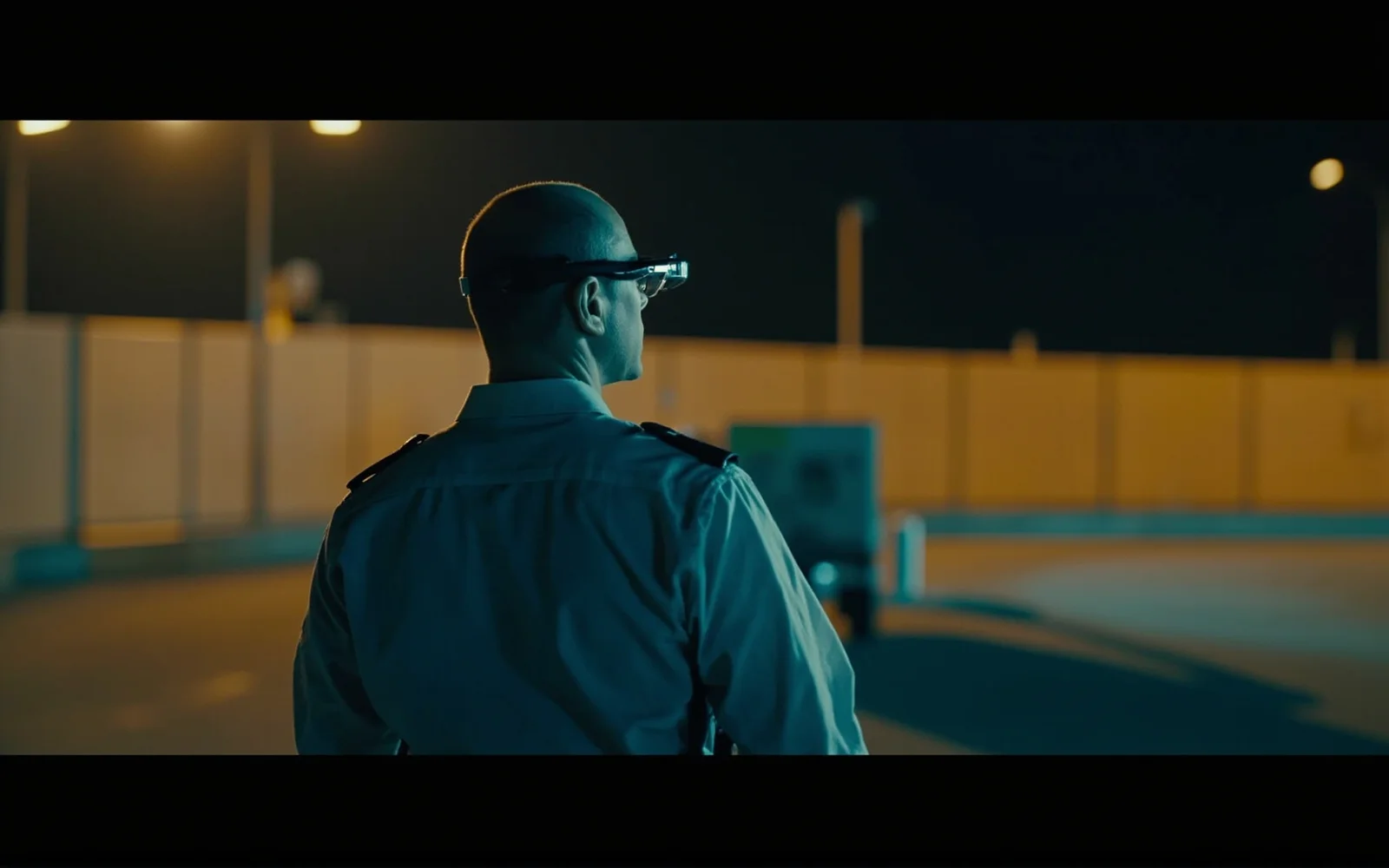
Head-worn capture changes the mechanics. A camera aligned with the wearer’s gaze records a checkpoint condition in a glance; a voice note is spoken while walking; open-ear audio carries coordination without sealing off the site. The officer’s head stays up and both hands stay free — for a torch, a gate key or a clipboard.
The boundary matters as much here as in any professional vertical. CYNRIN designs and manufactures the connected-eyewear hardware platform. The guard-tour application, incident software, dispatch console, data handling and any monitoring or legal claims are owned and operated by the solution partner or the deploying force. Eyewear is a better input endpoint for patrol reporting — not a guard-force management system from a glasses factory.
How it works on the round
Voice and glance capture, built around a walking route
A well-scoped deployment does not attempt to record an entire shift. It targets the recurring documentation moments that already exist in the route — checkpoints, exceptions and handovers — and makes capturing them effortless.
- Spoken patrol notes. At each checkpoint the officer narrates status — time, condition, anything unusual — without stopping or producing a device. The guard-force application receives the note through its dictation or media workflow.
- First-person situational photos. A forced gate, a damaged seal, a parked vehicle or a water leak is captured from the officer’s point of view with a glance-level control, while the officer keeps torch and radio free.
- Structured check confirmations. Simple voice or touch confirmations acknowledge required steps — door secured, heating checked, fire exit clear — feeding the same tour logic as a dedicated checkpoint wand, with richer context.
- Open-ear coordination. Instructions and calls arrive without an earpiece that blocks traffic, wind or approaching voices; officers keep the ambient awareness the job depends on.
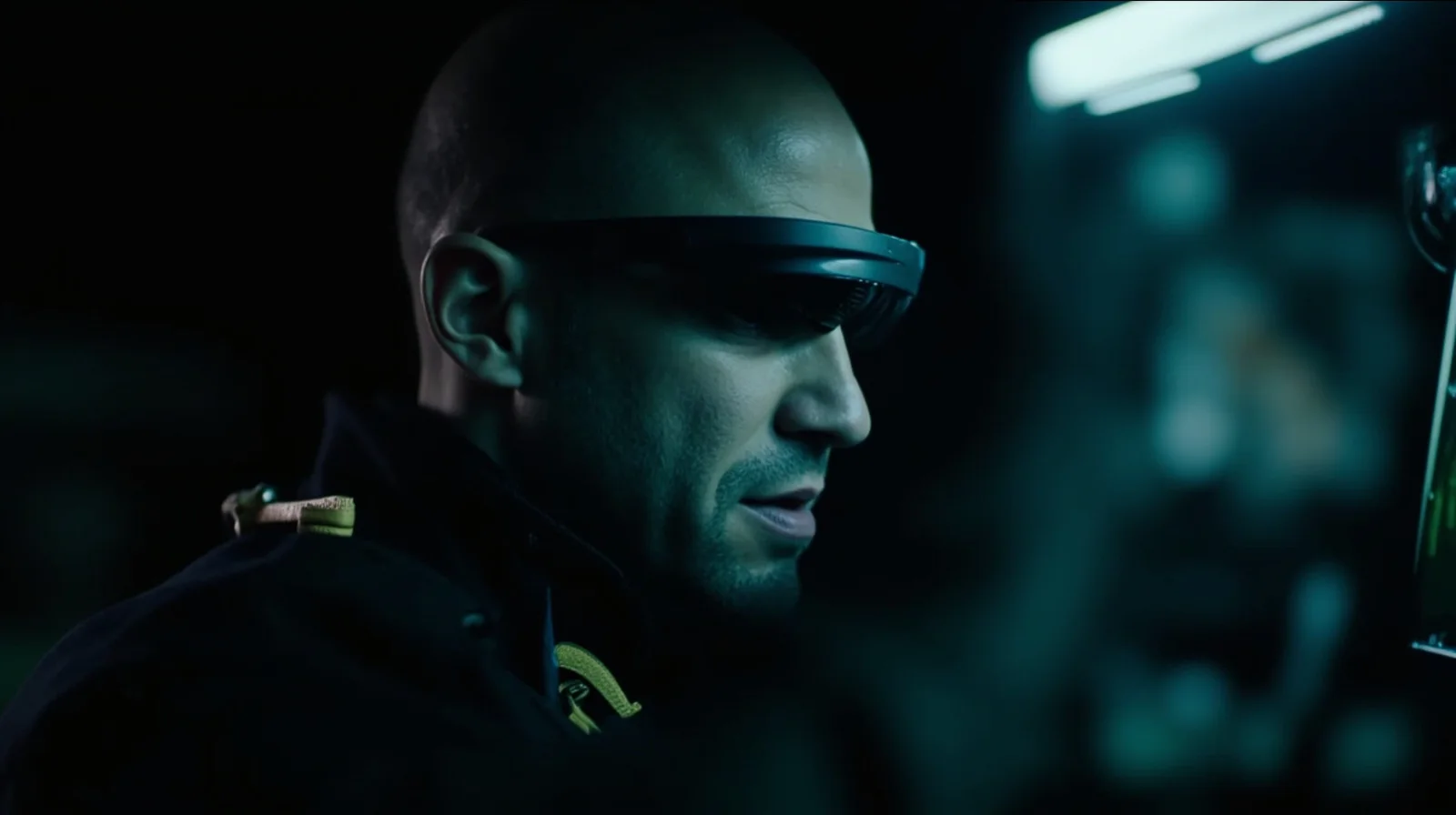
Captured material passes to the partner application on a paired device. Metadata such as time, and location where the companion application supplies it, is attached by the software layer rather than invented by the glasses. At dusk or night, officers still rely on site lighting and their torch; where a reference platform exposes supplementary lighting, its real low-light behavior is stated on the program datasheet — we do not market patrol glasses as night-vision equipment. The win is not magical sight in darkness; it is that the ordinary, honest record of the round finally gets written during the round.
Where patrols run
Four field environments that reward eyes-up reporting
The common factor is movement through a large or distributed site, often outdoors, where documentation competes with observation.
Contract guarding and mobile patrols
Officers covering multiple client sites per night need fast, defensible handovers. First-person notes and photos attached to each visit reduce disputes over whether a check happened and what was found, and give the client a richer report than a timestamp alone.
Industrial sites, logistics yards and perimeters
Fence lines, loading bays, seal checks and vehicle movements are documented while the officer keeps hands available for gates, torches and high-visibility work. The site-services equivalent on the facilities side overlaps with inspection and quality documentation practice in plants and warehouses.
Utilities and infrastructure
Dam, substation, reservoir and telecom-site inspections combine routine checks with lone-working reality; the same hardware supports both patrol logging and the coordination patterns covered in the lone-worker safety guide.
Campuses, estates and residential schemes
Concierge and estate teams walk car parks, plant rooms and common areas, logging repairs and security observations in one stream rather than splitting them across paper reports and separate maintenance tickets.
Privacy in public space
Visible indicators and lawful use are buyer policy, not marketing footnotes
A patrol camera points at members of the public who never chose the device. That makes overt, accountable capture a hard requirement, and it is why CYNRIN does not position or configure its eyewear for covert recording. Buyers should specify the following at program level.
- Unambiguous recording state. A visible indicator makes active capture obvious to anyone nearby. Indicator behavior is configurable per program — for example during photo versus clip capture — but it is designed to show state, not to disguise it.
- Bounded capture. Mature programs trigger capture for checkpoints and exceptions rather than running continuous surveillance, which is simpler to govern and easier for officers and the public to accept.
- Lawful-use ownership. Signage, notices, the lawful basis for recording in public or shared space, labor consultation and data-subject rights are the deploying organization’s responsibility under its local law. The hardware must support that policy; it cannot substitute for it.
- Access and retention in the operator’s system. Who views patrol media, how long it is kept and how it is released belong to the guard-force or incident platform, hosted and governed by the operator or solution partner.
This division — overt, privacy-conscious hardware from CYNRIN; lawful-use policy and evidence governance from the buyer — is the same one maintained across the whole security and field-work application. It is also the only model that survives scrutiny from clients, works councils and regulators.
Specifying field-grade hardware
Weather, headgear and shift-length power on the datasheet
Patrol hardware is judged in conditions that consumer eyewear never meets: rain on a night shift, dust off a haul road, sweat under headgear and cold that shortens every battery. Programs therefore specify, and validate, rather than assume.
- Weather and sweat handling. Materials, sealing and port layouts are selected for outdoor shifts; actual ingress and environmental performance is confirmed per program and stated on the program datasheet rather than promised as a generic rating.
- Headgear and prescription fit. Compatibility with hard hats, bump caps and baseball caps, and wear over prescription lenses, are checked against the real uniform. Lens tints for glare and variable dusk light are selected through customization.
- Power for the real shift. Battery budgets are tuned to a realistic mix of standby, calls and capture — not benchmark video loops — and confirmed on the datasheet. Fleet charging cases and spare power remove the risk of an unlogged second half of a long night.
- Platform choice. Camera-first programs build on the V03-T5 reference platform for checkpoint photos and clips; communication-led deployments where open-ear calls dominate select an audio platform such as E13 or K01.
For fleets, the details that make rollout survive contact with reality are specified up front: numbered units, rugged multi-unit cases, controlled pairing at shift start, and reset so a shared pair never carries the previous officer’s session. Production validation follows the quality-control process, including the agreed environmental checks for the program.
Building the fleet program
From one pilot route to a branded, managed patrol fleet
Customers for patrol eyewear are typically guarding groups, security-technology integrators, industrial site operators and facility brands that already run a guard-force or incident platform. The sensible rollout starts narrow and proves the reporting quality before scaling.
- Scope the route. Define the checkpoints, exception types and shift pattern; confirm which software system receives notes and media.
- Select the platform. Camera-first or audio-first, headgear and lens options, and the standby-plus-capture power profile matched to the actual shift.
- Configure capture and privacy behavior. Trigger model, visible indicator behavior, pairing, reset and fleet charging are defined before tooling or volume.
- Pilot with evaluation units. Run one route or one contract, measure the change in report quality and dispute rate, and validate the lawful-use notice model in the field.
- Scale as a branded fleet. Deploy under the operator or partner brand with rugged cases and quick-start material; volumes, lead time and destination-market documentation are confirmed per program.
Reference-platform samples support the pilot phase, and deeper capture or fleet-management behavior is scoped jointly with the software owner under an ODM program. Start via request a quote or review the samples process; volume tiers are summarized in the MOQ guidance.
Buying considerations
What to put in a patrol eyewear brief
Operating environment
Indoor posts, outdoor perimeters or mixed; rain, dust, temperature and night-shift exposure.
Shift length and pattern
Real shift duration and the mix of standby, radio-style calls and photo capture across it.
Evidence and consent policy
Who may be recorded, what notices are posted and how the lawful basis is documented locally.
Headgear and lens fit
Hard hat, cap or helmet wear, prescription fit, glare and dusk-light lens requirements.
Connectivity and software
Coverage on site and which guard-force or incident platform receives notes and media.
Fleet provisioning
Shared or assigned units, pairing and reset, charging cases and multi-unit packaging.
Browse the application
More security & field work guides
Keep exploring
Related reading
FAQ
Frequently asked questions
Do the glasses replace our guard tour or incident-management software?
Are officers allowed to record the public on patrol?
Are the glasses weatherproof, and can they see at night?
Will the battery last a full night shift?
What is the minimum order for a branded patrol fleet?
Build this use case into a private-label program
Tell us the workflow, environment and volume. Engineering scopes the platform, optics, power and documentation per program.