

An after sales support checklist gives a procurement team more than a support brochure does, because a brochure describes an intention while a checklist describes the lines that have to be settled in writing before the first order goes out. The lines are few, they recur across every programme, and they are the lines that decide whether a failure becomes an argument.
The structure below is deliberately narrow. It does not describe a support organisation, because that is the supplier's business and not the buyer's decision. It describes what a buyer has to establish before the order, what has to appear in the service agreement, and what has to be asked in writing so that the agreement can be drafted from an answer rather than from an assumption. Every item is written twice: once as the question to put to a supplier, and once as the line the service agreement has to settle.
Nothing in this checklist is a commitment on our side, and nothing in it is a promise about how anything will be answered. It is the list a buyer takes to a supplier and fills in.
After sales support checklist: the items a service agreement has to settle
What this checklist is, and what it is not
It is a list of questions whose answers become clauses. That is the whole mechanism, and it is worth stating plainly because the alternative is common and expensive: a buyer who asks for "good after-sales support" gets a paragraph, and a paragraph cannot be enforced, audited or priced.
It is not a description of a service organisation, and it should not be read as one. Whether a supplier runs a distributor network, a direct desk or a partner programme is the supplier's own structure, and the buyer's concern is narrower: what is covered, what evidence moves a claim, what happens to a unit that comes back, which parts exist, and who closes a gap when one appears. The organisation behind those answers is not the buyer's decision, and a checklist that tried to prescribe it would be measuring the wrong thing.
It is also not a substitute for the agreement. A checklist is a preparation document. Its value is that it is used before the agreement is drafted, when a question is still cheap to ask, and it is thrown away afterwards, when the agreement has replaced it.
The test for every item. A line belongs on this checklist if a buyer could reasonably have two different answers to it and would make a different decision depending on which one they got. If the answer is already published and settled, the line is noise. If the answer could be anything and nothing turns on it, the line is noise. The checklist is short because both kinds of noise were removed.
The three groups the items fall into
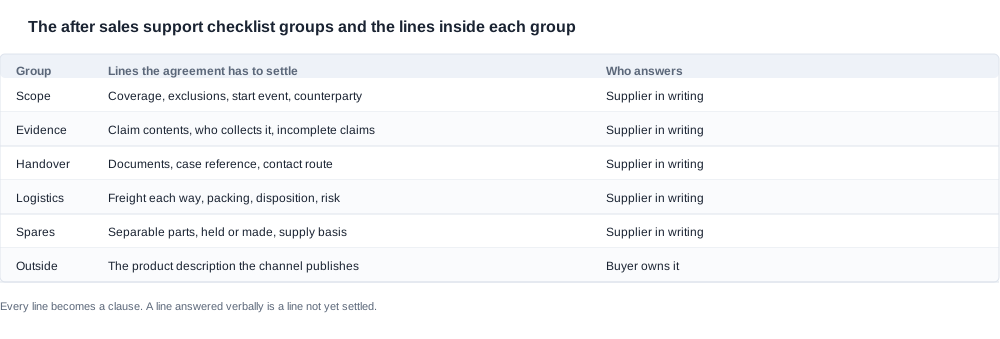
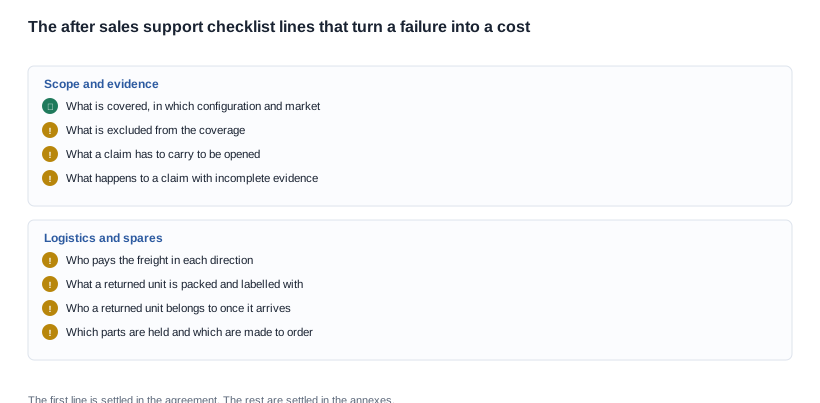
Scope and evidence. What the arrangement covers, what it excludes, what a claim has to carry, and what the buyer receives at handover. These are the lines that decide whether a failure is handled by the agreement or by goodwill.
Logistics and spares. Freight, insurance, the disposition of a returned unit, and the position on the components a service desk can reorder. These are the lines that decide whether a handled failure is also a paid failure.
The line outside the agreement. One item on this checklist does not belong to the service arrangement at all, and it is the item most often left until something has gone wrong. It is treated separately below, because putting it in the agreement is the mistake.
The grouping matters for a practical reason: the three groups are settled in different places. Scope and evidence are settled in the agreement and in the quality documentation. Logistics and spares are settled in the agreement and in the spare-parts annex. The third item is settled in the product description, which is under the buyer's control and is where it belongs.
The short form of the checklist
If a buyer wants one page rather than four, this is the one page. It is deliberately a list of lines rather than a narrative, because a list can be sent to a supplier and answered line by line.
Scope.
- The products, configurations, destinations and channels the arrangement reaches, and the ones it leaves out.
- The event that starts the coverage period, and what happens to units already in the channel.
- The counterparty that holds the obligation, and the route a claim takes through the channel.
Evidence.
- What a claim has to carry to be opened, and who collects it.
- What happens to a claim that arrives with incomplete evidence.
- Whether a claim counts against a limit while it is incomplete.
Handover.
- The documentation that arrives with the goods, and in which language.
- The reference a claim needs, and how a unit is tied to it.
- Who receives a claim, through which channel.
Logistics.
- Who pays the freight in each direction.
- The packaging and labelling a returned unit needs.
- What a returned unit becomes on arrival, and the record it leaves.
- Where the risk sits in transit in each direction.
Spares.
- Which components are replaceable individually, with part numbers.
- The components the supplier holds in stock, against the ones it produces when an order is placed.
- The price basis, the order quantity, and the period a part can be supplied for.
And the one outside the agreement.
- The product description the channel publishes, checked line by line against the published specification rows.
That last line is the one most programmes skip, and it is the one that decides whether a customer expectation was created by the product or by the copy. A service arrangement can cover a defect; it cannot cover a description that overstates what the product does, so that line belongs to the buyer and belongs in the launch workstream rather than in the agreement.
On this list, our position is narrow, and it is worth stating plainly. We do not publish a warranty period, a response expectation, a defect rate or a service scope for any model, so this article does not describe what any after-sales arrangement covers, including our own. What it does do is set out the lines a buyer has to establish, because those lines are the ones that decide whether a case is handled by an agreement or by a conversation.

Scope, evidence and the first handover

The scope lines: what is covered and what is excluded
Four lines. Each one is a question to put to the supplier, and each one becomes a clause.
What is covered. Ask what the arrangement applies to: which products, which configurations of those products, which failure modes, and which destinations. A supplier answer of "our products" is not an answer, because it leaves the configuration question open and the configuration question is where the disputes live. The clause has to name the product, the configuration and the failure modes it applies to.
What is excluded. Ask what is excluded from that coverage, and in particular what the supplier treats as outside it. Warranty on a wearable product is commonly framed by fault rather than by component, and the exclusion list is what a buyer needs to see before they design a customer promise around it. The clause has to name the exclusions in the same document that names the coverage, because a coverage clause read on its own is always read generously.
From what point the coverage starts. Ask what event starts the period and what happens to units already in the channel when the arrangement begins. The start condition is a line that is easy to agree verbally and hard to remember later, and the clause needs to state the event, not a duration.
Which party carries the obligation. Ask whether the arrangement sits between the buyer and the supplier, or between the buyer and a distributor, and which of the two holds the replacement inventory and the claim decision. A channel that buys through a distributor has two interfaces and one customer, and the agreement that sits behind the first one is not automatically the agreement behind the second. The clause has to name the counterparty and the route.
The evidence lines: what a claim has to carry
Three lines, and they are the ones that decide whether a claim is processed or parked.
What the claimant has to supply. Ask what a claim needs in order to be opened: what photographs, what order reference, what description of the symptom, what accessory was in use. This is the line that decides the shape of every customer support form the buyer writes, and a claim form designed before this answer arrives will ask for things the supplier does not need and omit things it cannot proceed without.
Who collects the evidence. Ask whether the supplier collects it, the buyer collects it, or the customer collects it. A claim that depends on a customer photographing something is a claim whose outcome depends on how a customer felt when they were asked, and that is a design decision rather than a service one.
What happens when the evidence is incomplete. Ask what the route is for a claim that arrives without the required evidence: whether it is returned, whether it is held, and whether it counts against a limit. This is the line that decides whether an incomplete claim is a delay or a refusal, and the two behave very differently in a returns analysis.
The handover lines: what the buyer receives at handover
Three lines that a buyer often discovers are missing after the first shipment.
The documentation that arrives with the goods. Ask what documents accompany the product: what specification sheet, what test documentation, what conformity information, what language coverage, what version. A handover with no documentation leaves the buyer unable to answer a customer's first technical question without opening a case with the supplier.
The reference the claim form needs. Ask what order, serial or batch reference the supplier expects on a claim, and how it maps to the units the buyer has shipped. The reference is what makes a claim traceable, and it has to be captured at the point the goods are received.
The contact and the route. Ask who receives a claim, through which channel, and in which language. A route with no named destination is a route into a general inbox, and a general inbox is where the evidence requirement and the response expectation both disappear.

Logistics, spares and the questions that cost money if unanswered
The logistics lines: freight, insurance and the disposition of a returned unit
Four lines. These are the lines that turn a technical failure into a cost, and the reason to settle them before the order is that the answers change the price of the arrangement rather than only its behaviour.
Who pays the freight, in which direction. Ask in both directions separately: the cost of getting a unit back to the point of repair or replacement, and the cost of getting a replacement out. A clause that covers only the outbound direction leaves the inbound cost with whoever happens to be holding the unit, which is the customer in a direct-to-consumer channel.
How the unit is packed and labelled. Ask what packaging a returned unit needs, what labels it carries, and whether anything has to be marked on it. A returned unit that arrives without the information needed to identify it is a unit that becomes a generic spare-parts issue, and that is a packaging question that has to be answered before the first return rather than after it.
Who the unit belongs to once it arrives. Ask what happens to a returned unit on arrival: whether it is inspected, repaired, rebuilt, quarantined or disposed of, and what record is produced. The disposition line is also the line that decides what the buyer's own stock figures mean after a return, because a unit that has been reworked and a unit that has been written off are different units.
What the insurance and liability position is. Ask which party carries the risk in transit in each direction, and what the position is when the value of the goods is difficult to evidence. This is a question about the chain of custody and it is answered in the same clause as the freight terms.
The spares lines: which parts are held and which are made to order
Three lines, and they are the lines that decide whether a repair is possible at all.
Which parts exist and which are separable. Ask which components of the product can be replaced individually, and which are replaced only as a complete unit. For a wearable product this question has a specific answer in the catalogue, and it is worth putting it to the supplier for the product being bought rather than inferring it: the published specification rows identify removable parts on a small number of models, and a model whose published rows name no removable part is not thereby a model with no removable part. The line asks which parts the supplier will supply individually, with part numbers.
Which parts are held and which are made to order. Ask for the split. A part held by the supplier is a part that can be dispatched, and a part made to order is a part with a lead time attached to it. A buyer who has not asked the question will find the answer in a returns analysis, where it appears as a repair rate and a stock requirement nobody planned for.
What the supply basis is. Ask for the part price basis, the order quantity basis, the period for which a part can be supplied, and whether a last-time-buy is possible. These are commercial terms and they belong in the spare-parts annex with the same care as the unit price. A part position without a supply basis is a part position that ends when the supplier stops building it.

The item most often skipped, and what it turns into
The line that sits outside the service agreement
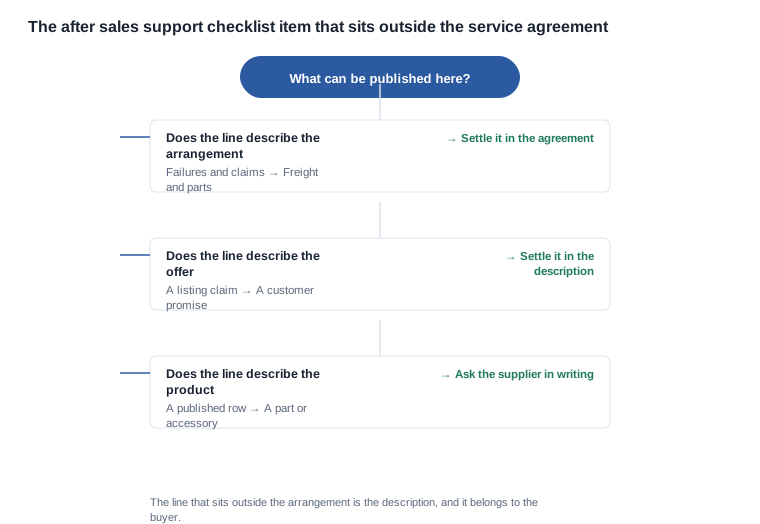
There is one item that belongs on the checklist and does not belong in the service agreement, and putting it in the agreement is the mistake that gets made.
The item is the product description. What the product is stated to do, what its published specification rows say, and what the customer-facing copy claims about it — all of that sits in the buyer's channel, under the buyer's control, and it is the document that decides whether a customer expectation was created by the product or by the description. A service agreement can cover a defect. It cannot cover a description that overstated the product.
Why it is skipped: it feels like a marketing matter rather than a support matter, so it is left to the launch workstream. Why it should not be: the description is the instrument that creates the expectation, and the support arrangement is where the expectation has to be met. A programme where the two are owned by different teams and never compared will find the mismatch at the point where a customer complains and a supplier declines a claim, which is a poor place to find it.
What to do with it. Before the first order, put the published specification rows for the product being bought next to the customer-facing description, line by line, and mark every claim in the description that does not trace to a row. That claim set is the one to resolve. Some of it will resolve by removing the claim; some of it will resolve by obtaining the evidence behind it, which is a question to the supplier. The output is a short list, and it is the list that keeps a support arrangement and a product description describing the same product.
What to write into the arrangement. Not the description itself. Two clauses. One that names the product configuration the arrangement applies to, so that the agreement and the description point at the same object. And one that records which published rows the product description is based on, so that when a row is revised, the description is revisited rather than left pointing at a superseded version.
How to use the checklist in a negotiation
Three ways, and the order matters.
Send it as a document, not as a paragraph. A checklist sent as a list produces a list of answers, and a list of answers can be pasted into the draft agreement line by line. The same questions asked in a conversation produce a conversation, and a conversation is not a source for a clause.
Mark the lines that block the order and the lines that do not. Some lines on this checklist have to be settled before the first order, because they change the price or the risk the buyer is taking on. Others can be settled during the launch period, because they change nothing about the order itself. Marking the two groups is what makes the list usable: a supplier is not asked to answer twenty questions before anything moves, and a buyer is not left believing that a line it did not settle was already covered.
Re-run it against the agreement rather than against the catalogue. The checklist describes what to ask. The agreement is what the answers are worth. Reading the two side by side after the draft arrives is how a buyer finds the line that was answered in the email but never made it into a clause, and that line is the one that matters when something goes wrong.
What this checklist leaves with a buyer is a filled-in set of answers and a list of lines for the agreement. What it does not leave with a buyer is a commitment from anybody, because the only commitment in this document is the buyer's own: to ask the questions, to write down the answers, and to put them in a contract where they can be enforced.


