

The after sales support common questions below are the ones that come up in almost every sourcing conversation about wearable devices, and they come up because a buyer has to write them into an agreement while the answers are still on the other side of the table. They are grouped here by who can answer them, because that is the question that actually decides how long the conversation takes.
Three answers are possible to most of them, and the three-part structure is the whole method. There is what the catalogue publishes, there is what the catalogue does not publish, and there is what only the supplier can answer in writing. A buyer who mixes the three gets a vague reply to a precise question; a buyer who keeps them apart gets an answer that can be drafted into a clause.
Nothing in this article is a commitment from any party, and no answer here should be read as one. Where the catalogue is silent, the article says so and points to the question.
After sales support common questions: what the catalogue settles, and what it does not
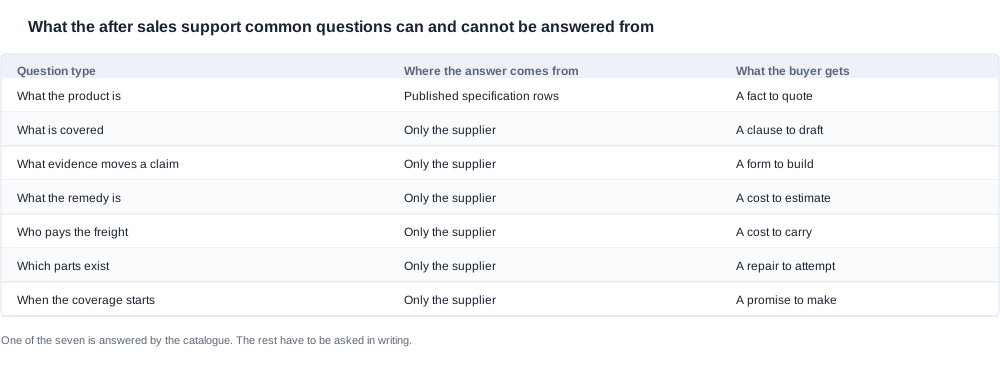
Why the catalogue cannot answer most of these
The catalogue is a specification document. It prints rows: a cell capacity and a cell count, a charge bound, an endurance figure, a charging method, a radio version, a resolution class for the models that have a camera, a charging-case capacity where one is published, an ingress marking on two camera models, and a single published weight. It is good at what it covers and silent about everything else.
Almost every question a buyer asks about the service arrangement falls into the second category. Duration of coverage, the remedy when a unit fails, who pays the freight in each direction, what evidence moves a claim, which parts exist, whether a spare part can be supplied at all, how a defect is diagnosed, what training a channel receives, what happens to the tooling at the end of a programme — none of that is a specification row, and none of it is published for any model.
There is a second reason the catalogue cannot answer them, and it is a structural one rather than an editorial one. The catalogue is written per model. A service arrangement is written per programme: per configuration, per destination market, per channel. The two do not line up, and a question about the arrangement has to be asked about the arrangement.
What this means in practice. The catalogue is a useful input to the negotiation, because it fixes what the product is. It is not a source for the service terms, and a buyer who asks a supplier to confirm a service term against the catalogue is asking the wrong question of the wrong document.
The three-part answer structure
Part one, what is published. Quote the row, name the page, and treat it as fixed. Where the catalogue publishes a specification row, that row is the baseline both sides should work from, and a discrepancy between the catalogue and the product is a discrepancy to be resolved before anything else is discussed.
Part two, what is not published. Name the gap explicitly, in the words of the question. "Not published" is a complete answer to a question about the catalogue, and it is a much sounder answer than a paraphrase that implies more than the document contains. The discipline that matters here is directional: a blank must not be written as an absence of the feature. A published specification row about a cell is not the same as a published specification row about a charging case, and a model whose page does not carry a case row is not thereby a model that ships without one.
Part three, what only the supplier can answer. Turn the gap into a written request, addressed to the supplier, in a form that can be drafted into the agreement. "Please confirm" is not a request; "please confirm whether the arrangement covers units sold through distributors as well as units sold directly, and whether the same evidence requirement applies to both" is.
The three parts answer different audiences. Part one is for the buyer's own team, part two is for the buyer's customers, and part three is for the contract. Keeping them apart is what stops a published row from being over-read in a marketing context and a verbal answer from being mistaken for a term.
The questions a buyer asks, in order
Ten questions, arranged so that the ones the catalogue can settle are asked first and the ones it cannot are asked last. The order matters, because a buyer who opens with the hardest question gets an answer drafted to move the conversation rather than an answer drafted to be used.
- What does the published specification row say for the configuration being bought?
- Which configurations exist, and how is a unit's configuration identified?
- What is published about the markings, and what evidence sits behind them?
- What does the arrangement cover, and what does it exclude?
- What event starts the coverage period, and what happens at the end of it?
- What must a claim carry to be opened, and who collects the evidence?
- What remedies are available, and what condition attaches to each?
- Who pays the freight in each direction, and what happens to a returned unit on arrival?
- Which parts can be supplied individually, and on what supply basis?
- What written certification material can be supplied for each model in each destination market?
Questions one to three have answers in the catalogue and cost nothing. Questions four to ten have answers only in the supplier's hands, and every one of them belongs in a clause. A buyer who separates the two groups before asking anything is drafting the second group rather than negotiating it.
The three states of an answer
Three states for every answer, and the state decides what the buyer does with it. A published answer goes into the specification. A written answer goes into the agreement. An answer that is neither goes onto a register with an owner against it, and the buyer's own team stops giving partial answers until it is closed.
That third state causes the most trouble, because a partial answer feels like an answer. A supplier who says the arrangement covers manufacturing defects has answered a question that was about something else, and a buyer who accepts it has a clause that does not reach the case that actually arrives. The remedy is procedural rather than clever: every answer is recorded with its state attached, and every answer that arrives without a state is chased rather than filed.
On these questions, our position is a narrow one, and it is worth stating so that nothing here is read as a promise. Our published record holds no warranty period, no response expectation, no defect rate and no service scope for any model, so no answer in this article is an answer about our own arrangements. What this article does is separate the questions a buyer can settle from the catalogue from the questions a buyer has to put to a supplier in writing, and that separation is what makes the second list draftable.

What is published, and where every answer stops
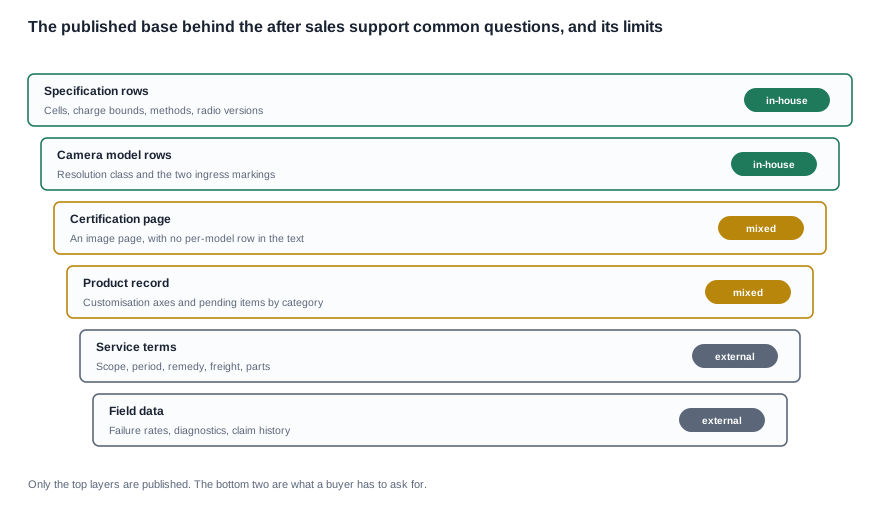
The published base: the specification rows
The catalogue covers twenty-eight models in three named groups: eight audio models, three sport models and eleven camera models. For every one of those models it prints a set of specification rows, and those rows are what a support desk can actually work from, because they are what identifies the unit in front of the customer.
What a support desk can resolve from the catalogue alone. The cell configuration and the charge bound tell the customer how long the unit is out of service between uses. The charging method tells the customer what they need to have to hand — a lead, or a contact. The radio version answers the first compatibility question. The resolution class, on the models that have one, settles the question that customers ask most about a camera-equipped product. The removable inner frame on two camera models, and the removable temple on one audio model, tell the desk which parts a service conversation is even about.
What stops there. The catalogue does not publish what any of those rows mean in service. It does not publish the diagnostics for a fault, the expected behaviour under a specific condition, the tolerance on an endurance figure, the conditions in which the charge bound was measured, the service procedure, the tooling access, or the failure rate of any model in any batch. A support desk working from the catalogue can identify a unit and describe it. It cannot diagnose it.
That boundary is the single most useful thing a buyer can establish before the arrangement is negotiated, because it defines where the supplier's obligation has to begin.
The published base: the certification page and the product record
What the certification page is. At company level, our catalogue includes an export certification page with images rather than text on it, and CE, FCC and RoHS appear nowhere in it. Nothing in the catalogue is tied to an individual model, so the certification position has to be established from documents the supplier supplies. The correct reading is therefore narrow in both directions: the position is neither evidence for a market nor a warning against one, and it is the same for every model, so it cannot separate one product from another.
What the ingress marking is. Two camera models carry an IP54 marking on their catalogue pages. Our product record states that this marking is a catalogue annotation and that no third-party test report number exists for it, and that a rating of this kind may only be claimed externally once a test report exists. So the marking is a published fact about those two products and a claim that cannot be made in a listing without the report behind it.
What the product record adds. Beyond the catalogue, our product record carries the customisation axes recorded per category, the certification status per category, and a list of items recorded as pending confirmation. Two of those entries matter directly to service questions. The record states that acoustic performance has no third-party measurement behind it, and that comparative product advantages require a comparison against a competitor's physical unit before they can be claimed externally. Both are relevant to what a buyer may write in a product description, which is where a support expectation is often created.
What the product record does not add. It carries no service arrangement, no warranty term, no response expectation and no defect data. It is a product record, and a buyer looking for service terms in it will not find them.
Where every answer stops
A useful way to hold this is as a single question applied to each row: what would change if this row were different? For the cell capacity, little would change in service terms. For the charging method, the whole accessory and packing arrangement changes. For the published weight — one model carries one — the shipping and handling question changes. That test tells a buyer which published rows have service consequences and which are simply product facts, and it is the same test that tells a support desk which rows to read out to a customer and which to look up.

The questions that only a supplier can answer in writing
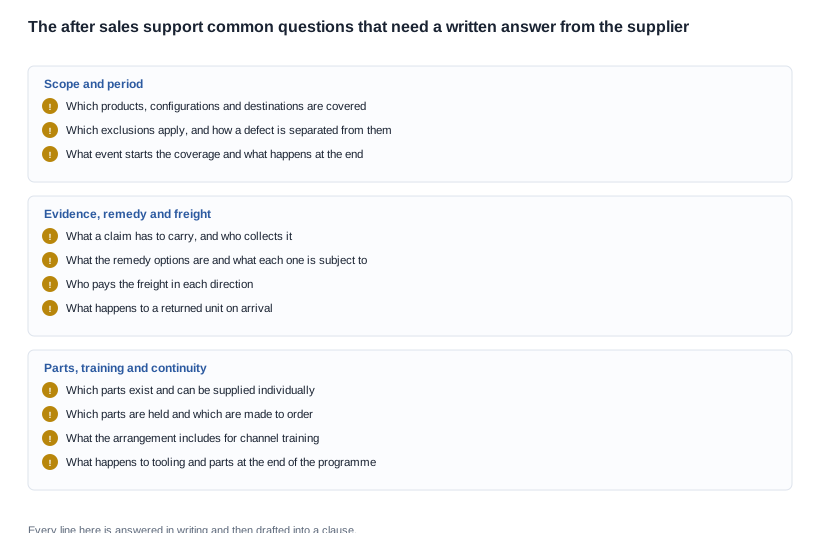
Scope and duration
What the arrangement covers. The products it applies to, the configurations of each, the destinations, and the party in the channel that carries the obligation. The published rows answer the product question and nothing else.
What it excludes. The exclusion list, and how the supplier distinguishes a defect from a situation outside the arrangement. This is the line a buyer needs before designing a customer promise, because the customer promise has to live inside the exclusion list.
From what event the coverage runs, and how long it runs. Both halves have to be written, because the first is what the arrangement means by a period and the second is the period itself. Neither is published for any model, and neither can be inferred from a catalogue page.
What happens at the end of the coverage. Whether the arrangement can be renewed, on what terms, and what happens to units still in the channel. A programme that ends without an answer to this leaves its own channel with a customer promise it cannot support.
Evidence, remedy and freight
What a claim has to carry. Photographs, order references, symptom descriptions, accessory details. The answer decides the shape of the buyer's own claim form, so it has to be specific enough to build a form from.
Who collects it. The supplier, the buyer or the customer. A claim that depends on a customer collecting evidence has an outcome that depends on the customer, which is a programme design decision.
What the remedy is. Replacement, repair, credit or refund, and what each one is subject to. Different remedies carry different cost, different stock and different evidence, so the remedy has to be chosen before the service cost can be estimated.
Who pays the freight in each direction. Inbound and outbound are two separate questions and they are usually answered in one line, which is why the buyer's customer ends up paying for one of them.
What happens to a returned unit on arrival. Inspection, rework, quarantine or disposal, and the record produced. This line decides what a returned unit is worth in the buyer's own stock figures, which is a number that appears in the range plan.
Parts, training and continuity
Which parts exist and can be supplied individually. With part numbers. The catalogue names removable parts on a small number of models and does not publish a parts list for any of them, so this is a request and not a lookup.
Which parts are held and which are made to order. The split decides whether a repair can be dispatched or has to be scheduled around a production run.
Whether the arrangement includes training. What is trained, to whom, in what form, and whether it is a one-off or a standing item. Nothing about this is published, and a channel that assumes training will be provided will find out at the point where it needed it.
What the end-of-programme position is. What happens to tooling, to the spare-parts supply, and to the ability to service a unit already in the field. This is the continuity question, and it is the one most often left until a supplier changes its product line.

Answering a buyer question that has no published answer
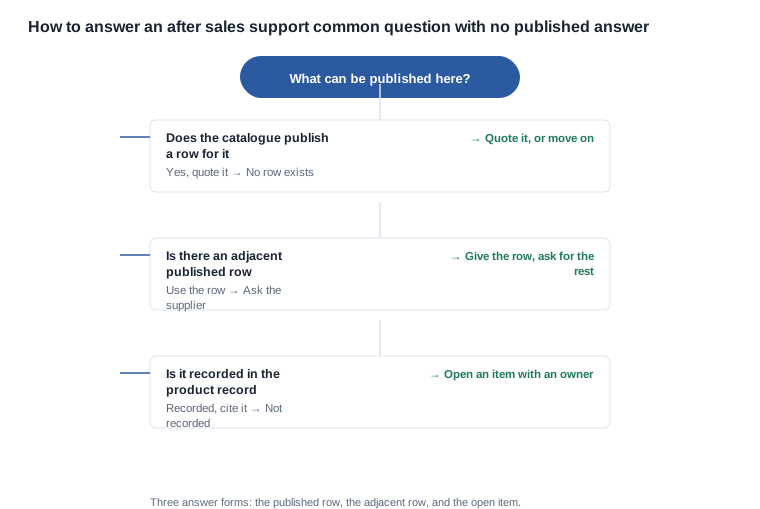
Three answer forms that hold up
When a buyer asks a question the catalogue cannot answer, there are three defensible replies and one that is not.
The honest gap. "The catalogue does not publish that, so it has to come from the supplier in writing." This is a complete answer and it costs nothing. The version that fails is the one that adds an inference — a gap described in a way that suggests the feature or the capability is absent rather than simply unrecorded.
The published adjacent. A question that cannot be answered directly is sometimes answered by a row that does exist. "The charging method is published, so you can tell the customer what they need to have to hand, but the procedure is not published, so the procedure has to be asked for." This form gives the buyer something usable now and names the part that still needs a written answer.
The recorded open item. When neither applies, the question goes on a register with an owner and the supplier as the source, and the buyer's own team stops giving partial answers in the meantime. A register is what stops the same unanswered question being asked by three different people in three different channels.
The reply that does not hold up is the one that answers a question about the arrangement with a fact about the product. It is the most common form in the category, because the product facts are the ones that are available, and it produces a conversation where both sides believe they have agreed something.
Turning a question into a line in the agreement
A question becomes a clause by losing its open-endedness. Three transformations do most of the work.
Name the object. "What is your warranty" becomes "which units, in which configuration, sold into which market, through which channel." A clause that does not name its object cannot be applied to a case, and a case that cannot be applied to a clause becomes an escalation.
Name the condition. "How quickly do you respond" becomes a clause that states what starts the clock, what the expectation applies to, and what is not counted. A clause that does not name its condition is interpreted generously by the party that benefits from the ambiguity.
Name the evidence. "What do you need from the customer" becomes a clause that lists the required items, and a clause that does not list them will be read against the supplier's own practice rather than against the agreement.
The warranty terms reference covers one of these lines in more detail, and it is worth reading alongside the scope questions above before the draft is issued, because a warranty clause and a service arrangement are two documents that have to agree with each other on the object they cover.
What a buyer should be able to say at the end of this exercise is not that the answers were good, but that every question on the list has an answer in one of three states: published, written down by the supplier, or on a register with an owner. Questions in the first state cost nothing and can be drafted immediately. Questions in the second state are the agreement. Questions in the third state are the buyer's own open items, and they are the ones a buyer should be able to name out loud before signing anything.


