

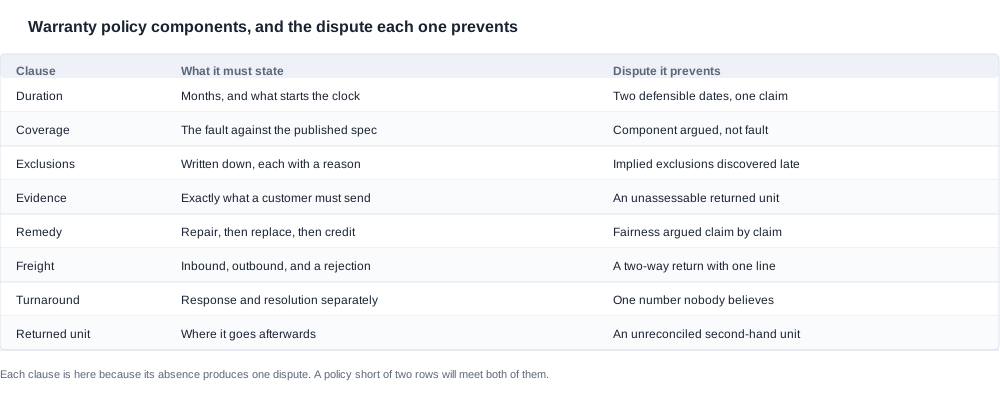
A warranty policy is a contract with your customer written in the tone of reassurance, and from the supplier's side it is the document that determines how much of a quality problem each party carries. Most policies are inadequate for one reason: they are written to reassure rather than to be enforced. Every clause below exists because its absence creates a specific, predictable dispute rather than a hypothetical one.
This is why after sales support warranty terms belong in the purchase order rather than in a support handbook nobody signs. The structure that follows is the one we would propose for a branded programme in this category, together with the question behind each clause that settles it.
One framing is worth setting out first, because it changes how the document gets written. A warranty policy has two audiences who will never read the same sentence in the same way. The customer reads it to find out whether they will be treated fairly, and the supplier reads it to find out which costs are recoverable. A policy written for the first audience and signed by the second is the source of most of the disputes in this category, because the reassurance that satisfies the reader is frequently the promise the signer cannot keep.
After sales support warranty terms: duration and what starts the clock
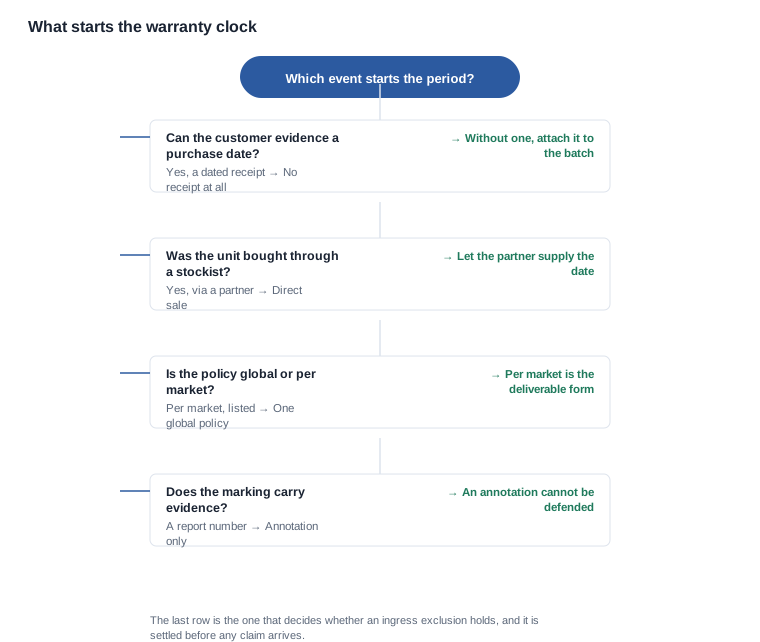
State a number of months and state what starts the clock. Purchase date, delivery date and activation produce three different answers for a customer who bought in one month and received in another, and all three answers are defensible. That is precisely why it has to be decided in advance rather than by whoever handles the claim.
The customer who cannot evidence a purchase date is the harder case. Someone who bought from a stockist may hold nothing at all, and a policy that requires a dated receipt transfers the whole problem to a support desk with no way to resolve it. Two workable options exist: attach the warranty to the production batch rather than to the sale, or allow the distributor to supply the purchase date on the customer's behalf. Both require the distributor to keep records, which is a conversation worth having before launch rather than during the first disputed claim.
An open-ended warranty creates a stock problem as well as a financial one. A policy that ends when the product category ends makes inventory planning straightforward, and buyers in distribution understand that structure immediately. An open-ended one transfers an unquantifiable liability to whoever holds the inventory, and it is quietly priced into every quotation that contains it.
Set the duration against the product's expected service life rather than against the competitor's warranty length. A warranty longer than the component supply position of the product is a promise the supplier cannot physically keep in year three, and the customer who discovers that has no better option than to stop recommending the product.
Two further points on duration are worth settling early. First, decide whether the period runs once per unit or once per purchase, because a customer who replaces a faulty unit should not restart a twelve-month period indefinitely. Second, decide whether the period is uniform across the range or varies by model, which matters when a cheap accessory shares a brand with an expensive unit and the accessory is the thing that fails.
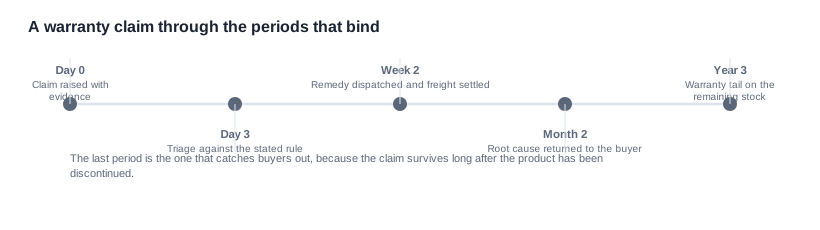
Before you commit, decide which of those two routes you are running and write it into the policy, because the difference decides who does the work at the moment of a claim. A batch-based warranty makes the supplier's records the decisive evidence; a sale-based warranty with distributor support makes the distributor's records decisive. Whichever you choose, the policy should name the record that settles the question, because that is the record the customer will be asked to produce.

Coverage defined by fault, not by component
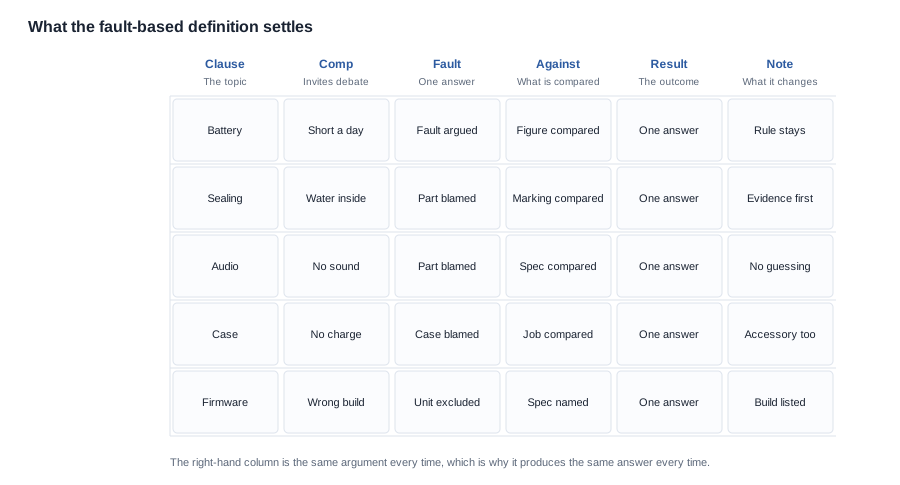
The trap is defining coverage by component. Writing that a policy covers the battery invites the argument about whether a unit that drains in four hours is a battery fault or a usage issue, and that argument has no resolution because both readings are consistent with the sentence.
Define by fault instead: the product does not perform its published specification, under its stated conditions. That single change does more work than any other clause in this article, because it points the dispute back at the specification sheet. It also means the published specification becomes a warranty instrument rather than only a marketing one, and that keeping it accurate stops being a marketing task.
The consequence on your own side is worth stating plainly. Every number on the product page becomes something you will be asked to stand behind. An endurance figure published without its test condition will eventually be tested by a customer who used the product differently, and the policy you wrote will make that your problem rather than the page's.
For customised units the definition needs one addition: which specification applies. A private-label product with a different interface, a different firmware build or a different accessory set has its own specification, and if the warranty points at a generic datasheet it points at nothing.
That last point is where private-label programmes most often fail quietly. The generic product has a specification, the customised unit inherits it on paper, and nobody notices the mismatch until a customer uses a function the customised build changed. The specification attached to a warranty should therefore be versioned by firmware build, not published as a single document, and the build number should appear on the claim form so that the right one is applied.
Exclusions, and the territory problem
Exclusions should be written down rather than implied. Consumables, physical damage, liquid ingress where the product carries no ingress marking, and unauthorised repair are the usual four, and each of them should have a sentence explaining why rather than only a sentence excluding it.
The third exclusion deserves particular care. Our catalogue marks the V06 and the S7 as IP54 with no third-party report number attached. If a customer's unit was submerged and the policy excludes ingress damage, the exclusion has to be defensible — and the absence of a test report makes it considerably harder to argue, because the argument becomes two claims about the same product rather than one claim against a stated rule.
Note the logical position this puts you in. An ingress exclusion is easy to defend when the product carries no ingress marking at all, because there is nothing to contradict. It is hard to defend when a marking exists without evidence behind it, because the customer's unit demonstrably came into contact with water and the marking suggests it might not matter. Ask for the report number or state the rating as an unqualified absence.
There is a related question that is easier to get wrong than the exclusion itself: who decides. A damage case that requires an engineering judgement is not a rule application, and a policy that routes those cases through the support desk produces an answer that depends on who answered that day. Name the decision-maker, define what evidence they weigh, and record the outcome against the claim so the next identical case is answered consistently.
Record the outcome for a second reason: it is the only way a buyer learns which exclusions are actually costing them. A policy excluded on ingress and rejected on unauthorised repair in similar numbers is not telling you where the risk sits; it is telling you the wording is doing the work. After two quarters you should be able to see whether your exclusion set is targeted or decorative, and that is a decision far cheaper to make before the volume arrives than after.
The territory problem sits alongside the exclusions. A warranty that applies globally raises questions about who provides service in each market, where a unit is shipped back to, how it is cleared, and what happens when the customer will not ship an imported product back at all. A policy stated per market is more honest and considerably easier to deliver, and it is the only version that survives contact with a customs desk.
The practical version of a per-market policy is a short table: market, named service route, return address, who pays the freight, and what the coverage period is. It is unglamorous and it removes an entire category of dispute, because almost every cross-border claim that fails in this category fails on one of those five rows rather than on the merits.
There is a fourth exclusion candidate that gets argued about more than the other three combined: unauthorised repair. It should be written as a condition rather than as a void, meaning the claim is assessed as if the repair had not occurred, rather than being rejected outright. A customer who has opened the unit to look inside it has almost certainly done so because something was not working, and rejecting the claim at that point produces an escalation instead of a resolution.

Evidence, remedy, freight and turnaround
Evidence required should specify exactly what a customer must send: photographs, a short video for an audio or camera fault, the unit's serial or batch marking, and a description of the state in the customer's own words. A unit returned without these is unassessable, and the resulting assessment delay is what the customer experiences as being ignored.
Specify the evidence in a form the customer can actually produce. Asking for a diagnostic log from a product whose logs are not documented for end users produces a guaranteed stall, and asking for a photograph of the serial marking produces a second one on units where the marking is inside the case. Both requirements are reasonable in a laboratory and unreasonable in a support desk.
Remedy should state an order of preference — repair, then replacement, then credit — so the supplier has discretion without negotiating the same question on every claim. Stating no order produces an argument about fairness on each individual claim, which is the slowest and least consistent way to run a support operation.
Freight needs two lines rather than one: who pays the inbound shipment and who pays the replacement outbound. Returns freight is large relative to the product in this category, and a single-direction policy is ambiguous exactly when it matters. Add who pays when a claim is rejected, because that line is the one that gets forgotten and then argued.
Turnaround needs two commitments rather than one: a response time and a resolution time. Buyers rarely believe a single number that covers both, and separating them is more credible than a stronger claim that will be missed.
Two further lines complete the section. The first is what happens to the replaced or returned unit, because an unaccounted second-hand unit becomes an accounting problem long before it becomes a support problem. The second is whether a claim can be reopened after it is closed, which matters because a fault that appears intermittently often gets closed on the first report and reappears on the third.
Where the programme runs in more than one market, add a fourth line: which party communicates with the customer while a claim is open. It is unusual for this to be written down and routine for it to be assumed, and the assumption fails hardest exactly when the unit is furthest from the decision-maker.

The order in which these sections are drafted is worth defending. Coverage first, because it defines what every other clause is about. Evidence second, because it determines whether a claim can be assessed at all. Remedy third, because it depends on what evidence is available. Freight and turnaround last, because they are the terms most easily negotiated upward or downward without changing the character of the policy.

A clause-by-clause checklist before signature
Run these against the draft, not against the intention behind the draft. Each question is designed to expose a gap rather than to improve the wording.
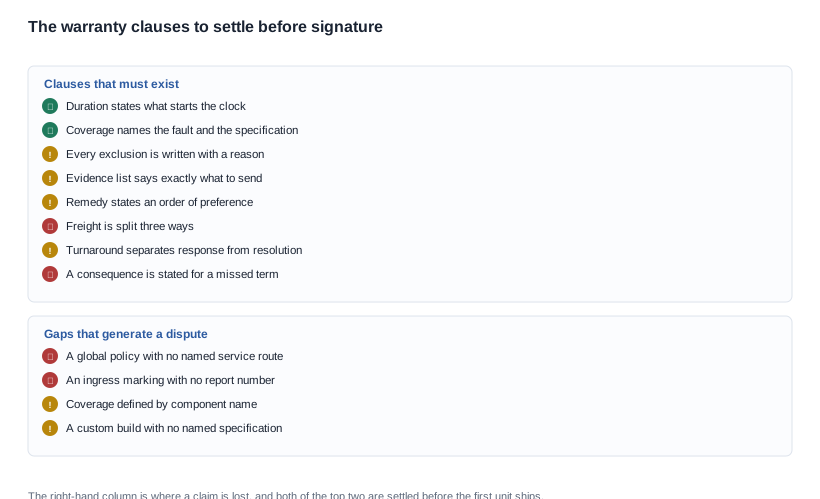
- Does the duration state what starts the clock, in those words?
- Does coverage define the fault against the published specification rather than by component?
- For a customised unit, does the policy name the specification that applies to that build?
- Is every exclusion written down with a reason, rather than implied by silence?
- If an ingress marking exists, is there a report number, and does the policy reference it?
- Is the policy stated per market rather than globally, or is a global coverage route named?
- Does the evidence list say exactly what a customer must send?
- Does the remedy state an order of preference rather than leaving it open?
- Are there two freight lines, plus a line for a rejected claim?
- Are turnaround commitments split into response and resolution?
- Does the policy say what happens to the returned unit, and where it goes?
- Is there a stated remedy when the supplier misses a commitment?
The twelfth is the one most policies omit and the one that decides whether the document is enforceable. A warranty that states obligations without consequences describes a preference, and a preference does not survive a difficult quarter or a supplier that has prioritised a larger customer.
Run the checklist with the supplier rather than alone, because two of the twelve cannot be answered without information only they hold: the ingress report number and the specification version attached to a firmware build. Both are reasonable to ask for during due diligence, and both are much harder to ask for once the customer is the one asking.
Where the policy is going to a distributor rather than direct to an end customer, add a thirteenth question: what the distributor is contractually required to do at first contact. A distributor who is expected to triage but has no written procedure will either escalate everything or close everything, and both behaviours produce data that cannot be used to set a stock policy later.
What we will and will not put in writing
We do not publish a warranty duration, a returns freight policy or a replacement rate history, because those figures are not published to us and we will not invent a number that later turns out to be wrong in a direction you did not expect. That position is deliberate, and it is the same reason we do not state a response window or a spare-parts duration on this site.
What we will do, before the first order, is agree in writing: what the coverage is, what evidence you will receive, what remedy applies, who pays freight in each direction, what the response and resolution commitments are, which markets the policy covers, and what happens to a returned unit. Each of those is a decision rather than a measurement, which is why we can commit to them, and each can be written into the purchase order in a single sitting.
It is worth being precise about why those are commit-able and a warranty duration is not. A duration is a prediction about the future supply position of components we do not control, and a number we publish today would be quoted back at us in three years as though it had been a commitment. The clauses above are decisions about how we will behave, and those we can hold ourselves to without qualification.
That distinction also explains why some suppliers publish a long warranty and others publish none. Neither position is automatically wrong, but a long published warranty without a component supply position behind it is a claim about the future dressed as a commercial term, and buyers are right to treat it as such.
A policy built on figures we would have to guess at is worse than an honest blank that you fill with your own commercial terms. If you need clauses we can meet today, tell us the markets and the failure risks in your channel and we will draft them explicitly rather than describing them in general terms.
The practical sequence that follows from all of this is short. Write coverage before anything else, because it decides what the rest of the document is about. Attach a versioned specification, because coverage without a specification is a promise with nothing to compare against. Add the exclusions with reasons, add the evidence list, and settle freight and turnaround. Read the whole document once from the customer's side, asking only whether any sentence could be interpreted two ways by someone who has had a bad afternoon — and remove every sentence where the answer is yes.
That final read is the one step most policies skip, and it costs nothing more than ten minutes with a fresh reader who has not seen the drafting.
Two failure sentences recur often enough to name them. The first is any sentence beginning "the product should", which describes an aspiration and commits nobody. The second is any sentence that names a duration without naming the event that starts it, which is the most common drafting error in this category and the easiest one for a customer to exploit without any bad intent at all.
For the commercial terms an agreement should settle rather than a conversation, see after-sales support; for the packaging requirement that makes a returned unit diagnosable, see packaging for returns; and for how a defect claim is assessed once it arrives, see handling a quality claim.
Related reading
- The repair-or-replace decision, and why the order matters: repair options.
- What happens to a returned unit: the replacement process.
- When the product itself reaches end of life: lifecycle support.
Tell us the markets and the failure risks in your channel and we will draft the clauses we can commit to.


