

Most after-sales arrangements do not fail at the point of failure. They fail earlier, in the handover, when the buyer and the supplier each believe the paperwork is the other side's job. The order goes out, the product goes out, the channel starts selling, and the first case arrives at a desk where nobody holds the document that would have decided it.
That is why the first stage of an after-sales programme is not a period of time. It is a sequence of dependencies, and each step in the sequence is only available when the step before it has produced something. The handover produces the pack. The pack produces the records. The records produce the evidence from live selling. The evidence produces the ownership split. Nothing here is a schedule, and nothing here is a promise about how long any of it takes, because the sequence is fixed by what has to exist and not by a calendar.
What follows is that sequence, written as the checks a procurement team can run and the questions a buyer can put to a supplier.
After sales support getting started: the handover before the first order

The handover pack
The handover pack is the set of documents and access that has to exist on the buyer's side before the first order is placed. It is not a request for a document set; it is the working material of the buyer's own support operation, and the test of whether it is complete is whether a case can be worked from it.
The product file. What the product is, in the configuration being bought, with the published specification rows, the accessory set, the published markings and the stated limits of what is documented. The documentation pack reference sets out what this file has to contain and how a buyer verifies the version in it.
The configuration register. Which configurations exist, what varies between them, and how a unit's configuration is identified. A programme that sells two configurations from one product needs this before it sells anything, because the support desk cannot identify the unit in front of it otherwise.
The known-issues list and the release history. The faults that are known, how each is recognised, and which units shipped against which revision. This is the document that turns a support conversation from a diagnosis into a lookup.
The parts and troubleshooting records. The pieces a service desk can order separately, the way a fault is identified, and what remains available once a unit is open.
The draft service agreement, with the clauses unagreed. The scope, the evidence requirement, the remedy, the freight position in both directions, the parts position, the coverage period and its start condition. Drafted, not signed. Its purpose at this point is to show the supplier the questions, so that the answers come back as clause material rather than as a summary.
The claim form the buyer will actually use. Drafted against the supplier's stated evidence requirement, so that the buyer's customer support form asks for what moves a claim and nothing else.
The named contacts. Who receives a claim, who owns the product file, who owns the parts list, and who is authorised to decide a replacement.
The access route. How the buyer's desk reaches the supplier's desk, in which language, through which channel, and with what reference on the case.
The test. Take a hypothetical case that has not happened, walk it through the pack, and see where it stops. Every point where it stops is a missing document or a missing name, and that walkthrough is worth doing before the order rather than during the first complaint.
The questions that have to be closed before the order
Ten questions. Each is written to be answered in writing and each one becomes either a clause or a line in the buyer's own records.
- Which products, configurations, destinations and channels does the arrangement cover, and which are excluded?
- Which event opens the coverage period, and what becomes of units that are already in the channel at that point?
- What evidence must a claim carry for it to be opened, and who collects it?
- Which remedies does the arrangement allow, and what condition sits on each?
- Who pays the freight in each direction, and what packaging and labelling does a returned unit need?
- What becomes of a returned unit once it arrives, and what record that leaves?
- Which parts can be supplied individually, with part numbers, and which are made to order?
- What diagnostic procedures exist, and what is the outcome when a procedure identifies nothing?
- What documentation does the supplier revise, what triggers a revision, and how is a revision communicated?
- What is the position at the end of the arrangement, for the tooling, the spare-parts supply and the units already in the field?
Questions one and two are the scope. Questions three to six are the claim route. Question seven is the repairability of the product. Question eight is the one that determines whether a case can be closed. Question nine is the one that determines whether the pack stays true. Question ten is the continuity question that decides what a buyer's channel inherits if the programme ends.

What has to exist before the first shipment lands
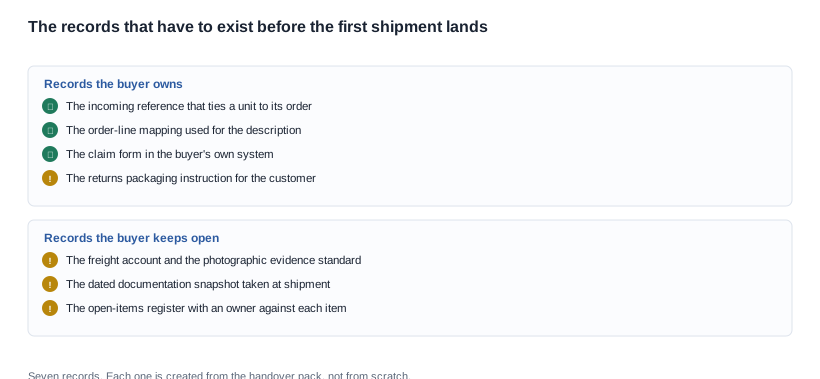
The records that have to be in place
Seven records, all of them owned by the buyer, all of them created from the handover pack rather than from scratch.
The incoming reference. How a unit that arrives is tied to the order and to the configuration it was built to. If the identification lives only in the supplier's record, then the buyer's own record has to capture it at receipt, and that is a step in the buyer's process that has to exist before the first shipment rather than being discovered when the first claim arrives.
The order-line mapping. Which published rows and which configuration belong to each line the buyer sells. This mapping is the same document the customer-facing description is written from, and keeping one source for both is what stops the description and the support desk describing different products.
The claim form, in the buyer's own system. Not the supplier's form. The buyer's form, because the buyer is the one who will receive the customer, and the buyer's form has to collect what the supplier needs and record what the buyer's own analysis needs. A form designed after the first complaint is a form designed on one sample.
The returns packaging instruction. What a customer is told to do with the unit, what they put in the box, what they write on it, and where they send it. This sits in the customer's hands, so it is written for a customer and reviewed by the supplier. A returns instruction that only the buyer's team understands produces a returns stream that cannot be processed.
The freight account and the evidence standard. How a returned unit travels, who is named on the consignment, and what photographic evidence the buyer will require at receipt. The photographic standard matters more than it sounds: it is the difference between a claim that can be triaged and a claim that becomes an argument about condition.
The documentation snapshot. A dated copy of the pack as it stood when the shipment went out. If a revision arrives afterwards, the snapshot is what establishes which revision the claim should be read against.
The open-items register. Every question from the handover list that has not been answered, with an owner and a source. This is the register that keeps the unresolved items visible to the person signing later orders.
The first-claim readiness check
A dry run, before the goods leave, and it is the most valuable thing a procurement team can do with the handover pack.
Pick a realistic case. Not an imaginary fault — a case that is plausible for this product and this channel. A unit that will not hold a charge, a unit where a customer cannot tell the two configurations apart, a unit that arrives with a damaged accessory.
Run it with the pack and nothing else. The person running the case should be someone who has not been in the conversations with the supplier. If they can work it, the pack is doing its job. If they stop, the stop point is the missing item.
Record every stop. Each stop is a document that is absent, a name that is missing, or an answer that was given verbally and never written. Each of the three has a different fix, and the difference is worth noticing: a missing document is a request to the supplier, a missing name is a request for a contact, and a verbal answer is a request for the same answer in writing.
Run it again from the buyer's side. The channel experience is different from the buyer's, and the case will stop in a different place. A claim form that a buyer can complete is not necessarily a claim form a customer can complete.
Then remove the case from the record. A dry run is a rehearsal, and a rehearsal left in the records reads later as a real event.

The first weeks of live selling, and the evidence they generate
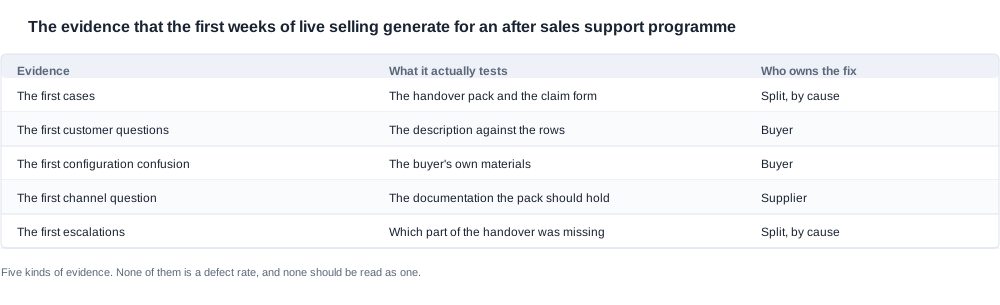
The evidence the first weeks produce
The opening period of a programme produces a small, specific set of evidence, and it is worth naming it in advance so that it gets read rather than absorbed.
The first cases. A handful of real claims, each one a test of the handover pack, the claim form and the returns instruction at the same time. The first cases are also the ones with the least information attached to them, so they are the hardest to triage and the most instructive.
The first customer questions. The questions customers ask that nobody anticipated. These are not faults; they are the gap between what the product does and what the description implied it did.
The first configuration confusion. The point where a customer or a channel cannot tell which configuration they have, or where the description did not distinguish them clearly enough. This is evidence about the buyer's own materials rather than about the product.
The first channel question. What the reseller asks when they cannot work it out themselves. Usually a question the buyer's documentation should have answered, which makes it evidence about the pack.
The first escalations. The cases that did not resolve. Their distribution across the other categories is more informative than their count, because it shows which of the handover's parts is missing something.
How that evidence should be read
The discipline is to sort each piece of evidence into one of three causes before deciding anything, because each cause has a different owner and a different fix.
The product is not doing what the arrangement says it should. This is the supplier's to own, and the evidence is a case with the documentation to support it.
The arrangement is not doing what the buyer understood it to do. This is a contract question, and the evidence is a gap between an answer that was given and a clause that was drafted. It is resolved by fixing the clause, which costs nothing, and by reading the clause aloud, which costs less.
The description created an expectation the product never promised. This is the buyer's to own, and the evidence is a customer statement. It cannot be fixed by the supplier, and it cannot be fixed by a claim.
How to read the numbers. A count of claims from the opening period is not a defect rate. The population is small, the channel is new, and the reporting is unfiltered, so the ratio that a defect rate would need is not available. What the count can be read against is the pack: which part of it the cases exercised, and whether the parts that were exercised were the ones the dry run tested. A claim pattern that matches the dry-run pattern means the handover was honest. A pattern that does not means the handover had a gap nobody tested.
What to change, and what to record. Every change made on the strength of the opening evidence should be recorded with its reason and its source. That record is what makes the next decision quicker, and it is what a quality analysis reads instead of a narrative.
The short form of the sequence
Four checkpoints, each one a question the buyer has to be able to answer yes to before moving on.
- Before the order. Can a case be worked from the handover checklist alone, without a phone call and without anything the supplier has said only verbally?
- Before the first shipment. Does every returned unit carry the reference the supplier's process needs, and does the buyer's own system hold the incoming reference that ties a unit to its order?
- In the first weeks. Is the opening evidence being sorted into the three causes — product, arrangement, description — rather than merely being counted?
- As the programme runs. Does every open item have an owner, and does the buyer know which of them are its own to close?
Each checkpoint is a test the buyer can apply to itself, and none of them depends on a date. They depend on whether the thing the next step needs exists yet, which is why they come in that order and not in a different one.
The way to use this sequence is as an assessment rather than a plan. Before the order, the buyer can name the items it cannot yet answer, which is the short form of the questions to ask. Before the first shipment, it can name the records that are missing, measured against the criteria the supplier gave. In the first weeks, it can name which part of the handover the opening cases exercised, and read the count as a red flags item rather than as a defect rate. And as the programme runs, it can name the open items and their owners. That is the practical test of how to choose a starting point for after-sales support: not whether the paperwork is finished, but whether the next step has what it needs. The trade-offs between closing a gap early and closing it properly are worth deciding explicitly, because the second one is the one that survives an audit.
On this sequence, our position is a narrow one. None of the terms this article discusses is published for any model: no coverage period, no response expectation, no defect rate, and no service scope of any kind. So nothing here describes what any arrangement covers, including our own. What it describes is the sequence a buyer can assess itself against, and the evidence a buyer can use to verify the criteria before it commits to the next step.

Who owns what, and where the gaps get closed
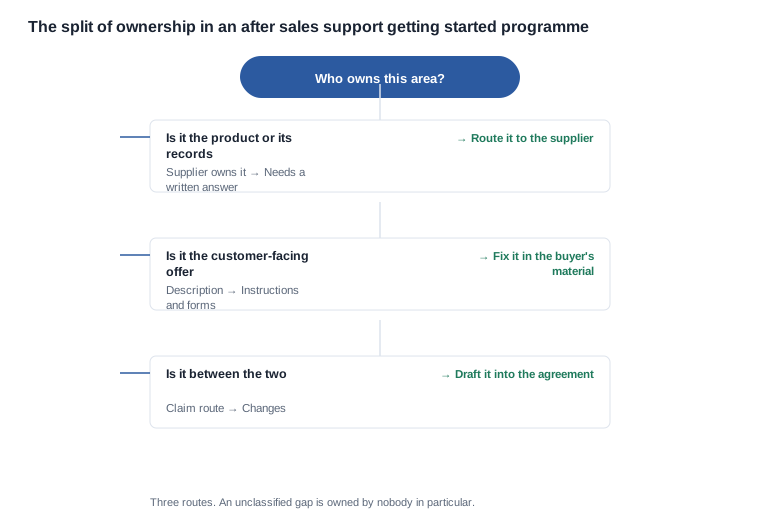
The split of ownership
Six areas, split three ways, and the split should be written into the agreement rather than agreed in conversation.
The buyer owns the description. What the product is stated to do, what the published rows behind it are, and what the customer-facing copy claims. Nothing in the supplier's arrangement can repair a description that promised something the product does not do, and this is the area where the most cases are generated and the least can be delegated.
The buyer owns the channel. The customer instructions, the returns instruction, the claim form, and the packaging that a returned unit travels in. The customer experience of a service arrangement is the buyer's, because the customer buys from the buyer.
The supplier owns the product and its records. The product file, the known-issues list, the parts list, the diagnostic procedures, and the revisions to all of them, including the obligation to communicate a revision.
The supplier owns the diagnosis. Whether a unit is defective, what the fault is, and whether it can be repaired. A buyer who attempts to diagnose on the supplier's behalf takes on a problem the supplier has the tooling for.
Shared is the claim route. Triage, the evidence requirement, the remedy and the freight in each direction sit between the two, and they need to be drafted rather than implied, because they are the areas where the two organisations' assumptions differ.
Shared is change. A new configuration, a revised published row, a changed destination market and a new product version all affect both sides, and each of them should have a defined route between them rather than being discovered by a customer.
Where the gaps get closed
A gap in an after-sales programme is not a failure of character. It is a piece of work with no owner, and the only reliable way to close one is to give it one.
The register. Every open item — an unanswered question, a missing document, a revision nobody received, a description claim with no row behind it — goes on a register with an owner, a source and a state. The register is the only artefact in the programme that is always current, and it is what a supplier audit, a quality review and a new buyer all read first.
How a gap is classified. Some gaps are documentation gaps, some are product gaps, some are contract gaps and some are description gaps. The classification decides the owner and the route, and a gap that is not classified is a gap that is owned by nobody in particular.
What to escalate, and what to hold. A gap that affects a case already open is one kind of item. A gap that affects a case not yet opened is another. The first goes to the agreement and to the owner immediately; the second goes on the register and is reviewed on the buyer's own schedule. Sorting the two is what keeps a register from becoming a queue of things that could have been handled.
When the gap turns out to be a product change. Some gaps cannot be closed with documentation, because the underlying thing has moved — a revised specification row, a different part, a changed configuration. Those become a change request with a version, and the records that referenced the previous version are updated rather than annotated.
The point at which the programme stops being a handover. The handover is finished when a case can be worked end to end from the buyer's own records and the supplier's pack, without anyone improvising. Before that point, the programme is a preparation. After it, it is an operation. A buyer who knows which side of that line they are on has an honest description of the risk they are carrying, and that description is the thing an after-sales support getting started plan is for.
What a buyer takes away from this sequence is a set of checks and a set of questions rather than a schedule. The checks are the handover pack, the incoming records, the dry run and the register. The questions are the ten that have to be closed before the order. A programme that runs them is not faster than one that does not, but it knows which of its gaps are open, and that is the difference between a support arrangement that is being worked and one that is being hoped about.


