

A response time is the easiest commitment in this category to write and the easiest one to breach without anyone noticing. Both facts matter, because a breach nobody notices is not a commitment at all — it is a number in a document that the supplier and the buyer each interpret privately and neither enforces. After sales support response times only become real when the clock has a named start, a named stop, a named owner and something that happens when it is missed.
For a buyer this is mostly a writing problem rather than a service problem. The supplier's actual responsiveness is usually better than the number suggests, because nobody measures it in the way the number implies. What makes it unrecoverable is that both parties then build a plan on top of a figure that was never operational, and the plan fails for a reason nobody can trace back to the clause that caused it.
The question worth asking a supplier is therefore not "how fast do you reply". It is "reply to what, starting when, ending when, and who does the next thing if you do not".
The practical way to avoid an unoperational figure is to write the clock as an operating instruction rather than as a commercial term. Say who opens the case, what they check, which route they choose, and what the customer is told. A response time written that way is enforced by the person doing the work rather than by a manager reviewing a report afterwards, and it is far less likely to be missed because nobody is watching for it. The commercial terms belong around that instruction — the escalation, the review, the consequence — not instead of it.
After sales support response times: which clock are you buying?
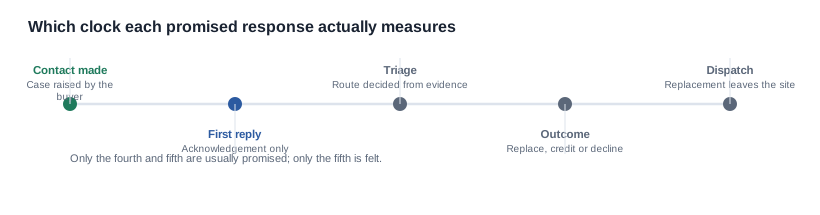
Four different clocks get sold under the same name, and they differ by more than most buyers expect. Buying the wrong one is the most common reason a response-time clause produces nothing.
The distinction that matters is between a clock that measures communication and a clock that measures progress. Communication is fast, cheap and nearly meaningless on its own. Progress is slower, more expensive to promise, and the only version that changes how a customer experiences the relationship. Most published response times measure communication, and most buyers read them as progress, which is the whole of the gap.
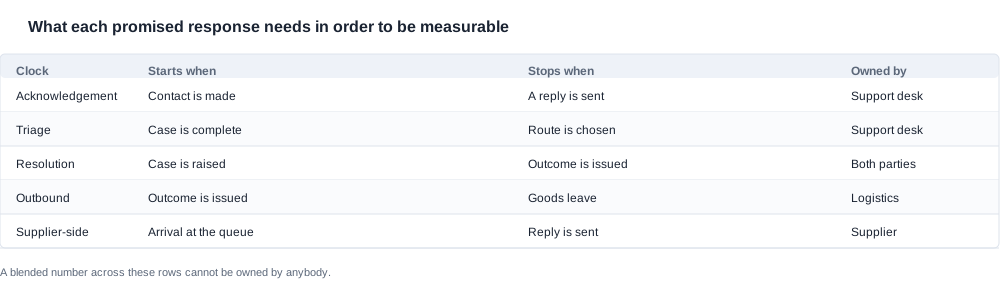
The acknowledgement clock. Time from contact to a first human reply. It is the easiest to hit and the least useful, because an acknowledgement can be automatic and can contain no information at all. A supplier with an auto-responder can hit a two-hour acknowledgement clock indefinitely without a person having read the case.
The triage clock. Time from contact to a decision about which route the case takes. This is the first genuinely useful number, because it is the point at which somebody has actually read the case and applied a rule to it.
The resolution clock. Time from contact to a final outcome — replacement shipped, credit issued, or the case declined with a reason. This is the number buyers actually mean when they say response time, and it is also the number most sensitive to the buyer supplying evidence.
The outbound clock. Time from the decision to the replacement physically leaving the warehouse. It is the number a distributor's customer feels, and it is almost never the number a supplier publishes, because it belongs to logistics rather than to support.
The trade-off between them is real. A supplier that publishes a resolution clock is publishing a number it cannot control entirely, because the buyer's evidence and the freight both sit inside it. A supplier that publishes only an acknowledgement clock is publishing a number it controls completely and that means almost nothing. Buyers should ask for the triage clock and the outbound clock, which are the two that are both controllable and meaningful.
Two further distinctions matter when comparing published figures. First, business hours versus elapsed time. A figure measured in business hours is roughly a third longer in elapsed terms, and neither party will convert it for you unless asked. Second, first contact versus first useful contact. A programme that measures from the moment the case arrives at the factory's queue rather than the moment the customer raised it will look better by exactly the length of the freight leg, and that difference is usually the largest single component of the published figure. Any comparison between suppliers is meaningless until both are on the same basis, which is a normal condition of comparing anything and is routinely forgotten here.
There is also a category of clock that looks like a service commitment and is actually a logistics commitment. The outbound clock depends on carrier collection schedules, on whether a replacement can be picked from the same location as the original, and on customs when the case crosses a border. None of that is the supplier's performance in the sense a buyer usually means, and a resolution clock that silently includes freight is measuring something the supplier only partly controls.

What starts the clock, and who owns the first reply?
The start event is where most clauses go wrong, because each party has a different reasonable answer.
The buyer starts it when the case is raised. Simple, and it makes the supplier's exposure depend on whether the case was raised properly.
The supplier starts it when the case arrives in its queue. Simpler operationally, and it quietly gives the supplier a week of latitude in some arrangements.
The supplier starts it when the case is complete. The most frequent and the most dangerous, because completeness is a judgement call, and the two sides will disagree about it at exactly the moment it matters. A buyer can easily add a week to its own case by omitting one field and not knowing it matters.
The recommendation is to start the clock when the case is raised, to state explicitly what makes a case complete, and to give the buyer a stated period in which to supply the missing field without the clock stopping — a hold that the supplier declares, with a date. That converts an argument about completeness into an action with a deadline.
There is a fourth start event worth considering, and it is the one most first-order programmes get wrong: the start of the return window rather than the start of the case. Some buyers deliberately start the clock when the case qualifies under the warranty or the returns policy, because that removes every argument about eligibility from the timing conversation. It requires a separate eligibility check, and that check has to be fast enough not to become the new bottleneck — usually a few hours. Where the volume is high and the configuration is mature, this is the cleanest structure available.
Who owns the first reply is a separate question and it should be answered separately. If the first reply belongs to the distributor rather than the factory, the clock should say so, and the agreement should say how long the distributor has before passing the case on. Multi-layer support structures are the norm in this category, and a single clock that ignores the layers produces a number that matches nobody's experience.
There is a fourth option that is worth considering for programmes with several channels: a single intake point owned by the brand. Every case arrives at one place regardless of which channel raised it, gets logged once, and is then routed to whoever owns the fault. This removes the duplicated case — the same fault reported to the factory by the distributor and to the brand by the customer — which is common in this category and which is invisible until somebody counts cases by channel. It also means the response-time measurement has a single start event, which is the precondition for any credible figure at all. The cost is a piece of the buyer's own process and a little more discipline at the channel, and the benefit is a number that can be trusted.
Is a first reply the same as a decision?
No, and the difference is where most dissatisfaction comes from. A first reply that says "thank you, we are investigating" is an acknowledgement. A first reply that says "we cannot reproduce this on your firmware build; please try the recovery step, or return the unit" is a triage decision and saves the entire exchange.
Three questions decide whether a first reply is a decision or an acknowledgement. Does it change what the customer has to do? Does it commit the supplier to anything? And does it tell the customer what happens next and by when? A reply that answers none of the three is a holding message, and a queue of holding messages is functionally identical to a queue that does not answer.
There is a specific anti-pattern worth naming because it is extremely common in this category: the automated first reply that asks for information the buyer has already sent. It produces a second round trip, it delays triage, and it makes the buyer's evidence discipline feel pointless. The fix is procedural rather than technical — an evidence list agreed in advance, checked by a person, with the acknowledgement issued only once the file is complete. That costs one check and removes an entire category of avoidable delay.

The measurement point follows from this. A queue that measures "time to first reply" will report an excellent number and deliver a poor experience, because the expensive cases are the ones that need a decision rather than a greeting. Measuring the time to a routed outcome instead makes the queue slower on paper and faster in practice, and it removes the incentive to group messages so that a single reply can cover several cases at once. That batching habit is the single largest source of delay in this category, and it exists purely because the only measure anyone looks at is the reply time.

What should a buyer write into the agreement?
Four terms, in this order, and the order matters because the later terms are meaningless without the earlier ones.
The clock type. State which of the four clocks is being promised. "Response time" alone is not a term.
The start event. State the event, not the channel. A case raised by phone and a case raised through a marketplace portal may have different start events, and the agreement should say so rather than leaving it to habit.
The stop event and the next action. A resolution clock stops at an outcome, and the outcome should name what happens next — replacement dispatched on a stated day, credit issued, or the case declined with a stated reason. A clock that stops at "the customer has been informed" measures nothing.
The consequence of a miss. This is the term most often left out and it is the only one that makes the other three enforceable. It does not have to be a penalty; it can be an escalation, a review, or a named person who gets told. What it must not be is nothing, because an unenforceable clock decays into an unenforceable clock.
Two things to keep out of the agreement. Penalties tied to a clock that the buyer can stop by withholding evidence, unless the hold is declared. And a single blended number covering both directions of the process, because the inbound and outbound legs have different owners and different constraints.
A third thing to keep out is a clock that begins before the product has any field history. A first-order programme has no baseline, no pattern of known faults, and no shipped-replacement stock, and the first few months of any support operation are slower than the steady state for reasons that have nothing to do with the supplier's responsiveness. Writing the steady-state number into the first agreement produces a breach in month two, an escalation in month three, and a renegotiation in month four — all of which could have been avoided by stating a first-quarter figure and a post-first-quarter figure separately. Suppliers accept this readily when it is raised in advance and resist it strongly when it is raised afterwards.

What to ask a supplier when they publish a number
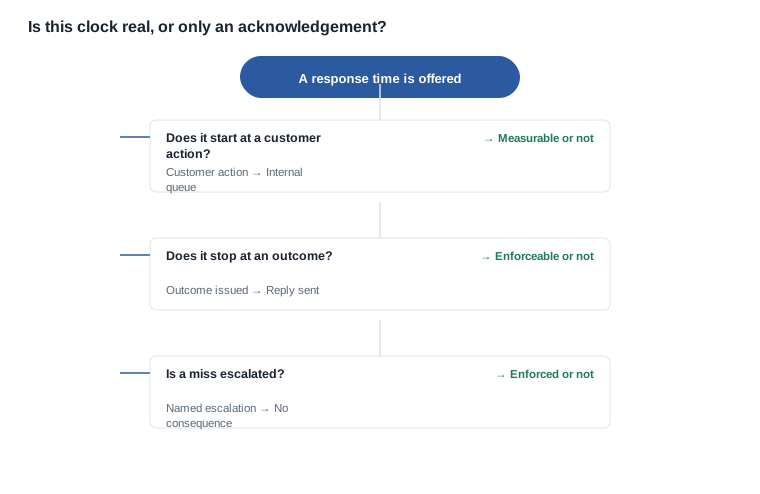
The question that extracts real information from a published response time is not "how fast is it". It is "measured how, and against what".
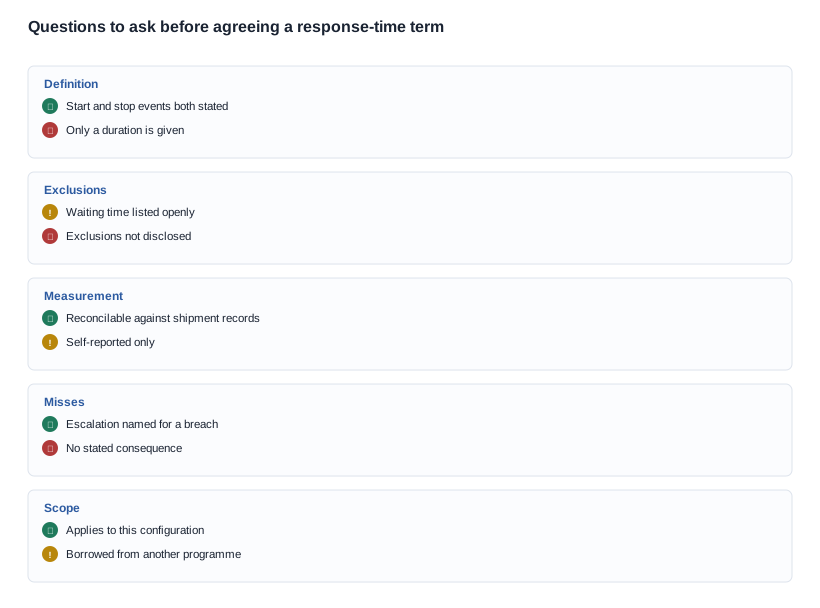
Ask what starts the clock in their own words. If the answer names an internal queue event rather than a customer action, that is the answer.
Ask what the number excludes. Time waiting for customer evidence, time waiting for a third-party carrier, time outside business hours — all three are excluded somewhere, and the exclusions determine whether the published figure will be met.
Ask how the number is measured and by whom. A self-reported figure from a support system is weaker than one that can be reconciled against shipment records. The reconciliation test is simple: pick a month, take ten closed cases, and check whether the timestamps match what the customer was told. Suppliers who can do that quickly are rare enough that the question itself is a useful filter.
Ask what happens on a miss, in practice rather than in policy. The honest answer is usually that nothing happens and the case is worked harder, which is not a reason to avoid the term but is a reason to add an escalation.
An escalation is cheaper than a penalty and usually more effective, because it changes who is looking at the case rather than what it costs. The version that works names a person and a timescale: the case is copied to a named individual the same day, and if it is still open after a further stated period it goes to the programme owner. Buyers who have used this in practice report that it changes behaviour within two or three cases, which a financial penalty frequently does not.
Ask whether the figure applies to the configuration being quoted. A response time published for a mature programme with volume does not automatically apply to a first order with five hundred units and a new configuration, and suppliers say so when asked.
There is one more question worth asking that almost nobody asks: what was the slowest case last quarter, and what made it slow. It is a better question than the average, because the average is set by the easy cases and the slow case is the one that generates the escalation.
Two more that are worth the time. Ask which fault categories the published figure is dominated by — a number driven entirely by a single recurring component problem is not a support performance figure, it is a description of that component. And ask what proportion of cases are closed without the customer sending the unit back, because that proportion is the cheapest available evidence about how much of the queue is resolvable by a decision rather than by logistics, and it determines whether the response-time clause is even addressing the bottleneck.
Our published position on response times
We will be direct. The response time is not published. The acknowledgement time is not published. The turnaround on a replacement is not published. The warranty duration is not published, and neither is our returns freight policy or our spare-parts programme. What sits behind each of those is a hole in what we know rather than a position we have taken. A response time printed on a website turns into a promise a customer can enforce.
The missing specification rows bear on the clock as well. One model in the catalogue carries a published weight, 158 g for the MT6, and every other weight is Not published. The field of view, the microphone specification, the sensor model and the video specification are Not published in our catalogue. The ingress test report numbers are Not published in the range. The catalogue publishes no CE, FCC or RoHS text and no per-model certification row, so any certificate is requested in writing, and the children's models have no regulatory position published. Software support by model and the location of stored data are Not published too, and that is a timing factor rather than a technical footnote: the share of cases a support agent can close with a software step instead of a return depends on it entirely.
What we can do is state the clock definitions we will work to for a specific configuration, what starts each of them, what we will do on a miss, and which of the four clock types we can actually evidence today for that programme. If you want that written into a proposal for a named model and volume, send us the configuration, the channels and the expected first-order size, and we will tell you which clocks we can hold and which we would have to build before we put them in an agreement.
It is worth being clear about why we will not publish a default figure. A response time that is not tied to a configuration, a channel structure and a volume is not a commitment — it is a guess with a number attached to it, and in a category where the answer depends on how many cases are resolvable by a decision rather than by a return, the guess is not even close in either direction. Publishing one would make our site look more responsive and make a buyer's first quarter worse.
Related reading
- The process the clock belongs to — replacement process
- The evidence that starts the clock — quality claims
- The commercial scope behind it — after-sales support
Send the configuration, the channels and the expected volume and we will tell you which clocks we can hold.


