

A replacement process is the procedure that runs when somebody is already disappointed, and it is the part of an OEM relationship a buyer can inspect on paper long before it is tested under pressure. What distinguishes a process that works from one that does is not speed. It is whether the process produces information. A process that ships a replacement and closes the case has solved this customer's problem and learned nothing. A process that also connects the failure to a batch, a model code and a production date has a chance of preventing the next hundred.
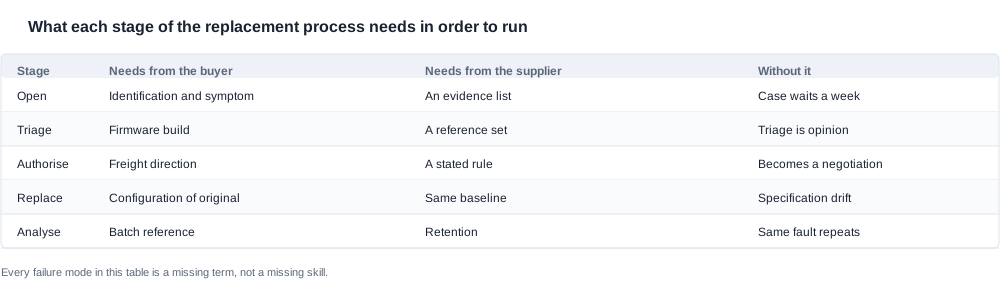
After sales support replacement process design is therefore mostly a data-design question wearing a service costume. The five stages below are the ones that recur across this product category, and the reason each one fails is nearly always the same: it assumes information the parties do not actually have.
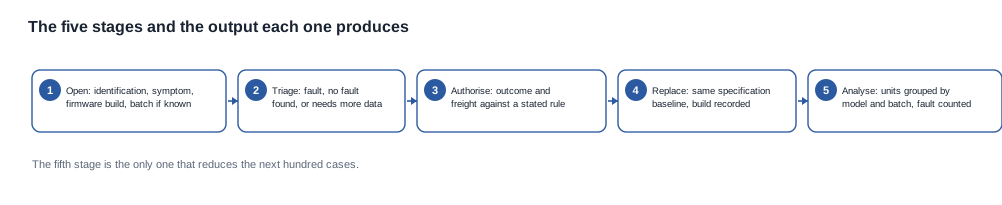
After sales support replacement process: the five stages
Stage one, opening the case with data. The quality of the decision is set here and nowhere else.
Stage two, triage. Sorting claims into those resolvable immediately, those needing a replacement, and those needing investigation.
Stage three, authorisation and shipping. The decision executed as a shipping decision against a stated rule, not a negotiation.
Stage four, the replacement itself. Which unit ships, against which specification baseline, and what is recorded about it.
Stage five, batch analysis. Grouping the returned units by model, batch and production date, counting the faults, and acting when a threshold is crossed.
Stage five is the one most often missing, and it is the only one that reduces future cost. Everything before it is a well-run queue.
The distinction between a queue and a system is worth stating at the start because the word "process" is used for both. A queue moves cases. A system changes something as a consequence of the cases it moves. Both have five stages on paper, and both are usually described in the same confident tone in a capability document. The only reliable way to tell them apart before buying is to ask what artefact each stage produces, and then to ask for one of those artefacts.
Stages one and two: opening the case, and triaging it
The customer can supply far less than a process usually assumes. They can describe the symptom, take photographs, and give a model code if they know it. What they usually cannot supply is the batch, the production date, the firmware build or a serial reference, because none of those are printed on the product and the manual rarely says where to find them.
A process that depends on the customer providing the batch will spend its first week asking for it. A process that can infer the production batch from the model code and the shipping date will start work on day one. This is worth settling at the agreement stage rather than discovering during the first warranty claim, because the answer depends on traceability set up at production — and traceability is much cheaper to design in than to retrofit.
Two further items are worth requesting in the same exchange. A photograph of the failed unit, because physical failures are diagnosable and the customer can take a photograph. And the exact symptom in the customer's own words, because a technical summary written at the counter loses precisely the detail that makes a case diagnosable.
There is a fourth item that is almost never requested and that changes outcomes more often than it sounds: whether other units from the same shipment behave the same way. A customer who says "the other pair from the same box works fine" has just moved the case from a unit fault to a possible batch question, and that single sentence can save an entire investigation. It costs nothing to ask and it is the earliest available batch signal a support process will ever get.
There is a fifth, and it protects the buyer's own process rather than the supplier's. Ask whether the customer's record of the case survives a change of staff on their side — which in a distributor means whether the case is in a system rather than in an inbox. A process that depends on one person remembering one case will look excellent for six months and fail in a way that is impossible to audit. This is the same test that decides whether a lifecycle commitment lives in a document or in a relationship, applied to a much shorter timescale.
Triage exists to sort claims into three routes. Its real output, though, is not the sorting — it is the decision about what happens to the physical unit, because that is where the value of a claim is either preserved or destroyed.
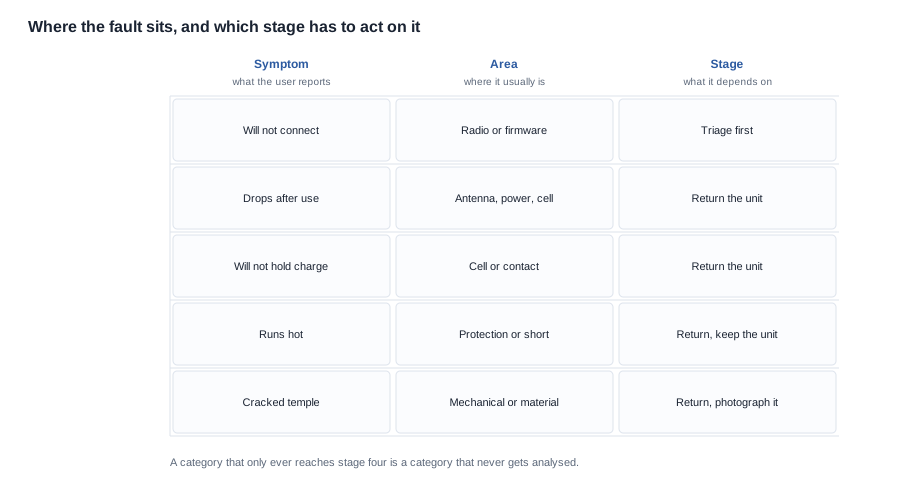
The categories that matter in this category are recognisable. A unit that will not connect at all suggests a radio or firmware issue and is rarely a hardware fault. A unit that connects and then drops suggests an antenna, a power or a cell issue. A unit that charges but does not hold charge suggests a cell or a charging-contact problem. A unit that runs hot suggests a protection circuit or a short. A cracked temple suggests a mechanical or material issue. And a customer whose app cannot find the device at all may have a phone-side problem rather than a product problem — the triage rule that recognises this saves a unit from being shipped and scrapped for nothing.
The triage rule that earns its place is the one which recognises a non-fault before the unit is ever boxed. Posting a working unit back to a factory and scrapping it because of a stale pairing record on the customer's own handset is a small loss and an entirely avoidable one, and in a category with thin margins it happens more often than it should.
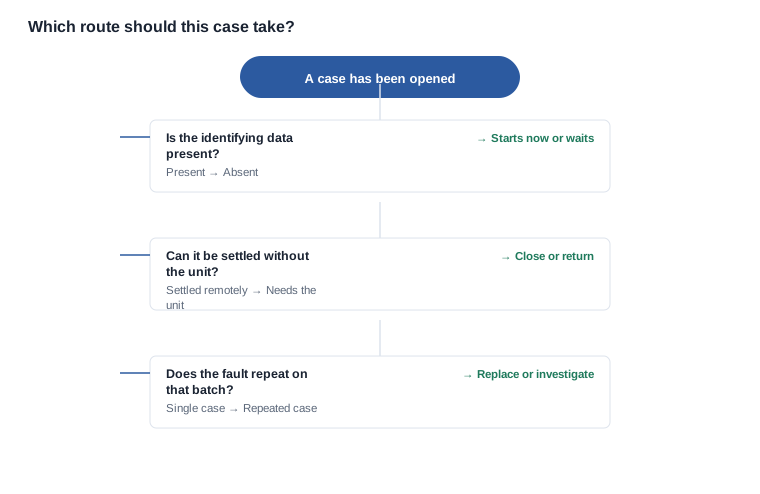
Triage also needs a reference set to work against — the approved configuration, the firmware builds in the field, the known open issues. Without one, every triage becomes an opinion about whether something looks unusual, and opinions are not reproducible. And triage outcomes need to be recorded even when the case is closed on the spot, because the distribution of closures is the earliest quality signal available and it costs nothing to keep.
Stage three: authorisation, freight and the shipping decision
By this point the decision is made and the question becomes execution. The decision itself should be a shipping decision against a stated rule, not a negotiation, because a negotiation at this stage consumes the relationship that the next four hundred claims will need.
Three terms need to be agreed in advance, and they are the three most often not agreed.
Who pays the freight, in both directions. This has a commercial edge that is easy to miss. A buyer that ships a replacement on the factory's account and recovers the unit only if it is defective is effectively funding a free trial programme, and a trial programme with no feedback loop is an expensive way to buy nothing.
What happens to the failed unit once it arrives. Returned to the customer, scrapped, or retained for analysis. The retained option matters more than it appears: a failed unit is evidence, and if the supplier destroys it on arrival the buyer can never compare a returned unit against a retained one. Establishing whether a fault is batch-related requires keeping the evidence.
What the customer receives. Replacement, credit or repair, and in which cases each applies. If the answer depends on who the buyer is at that moment, the argument will happen on every claim and none of them will be about the product.
A fourth term is worth adding before launch: what happens to a claim that goes quiet. A customer who stops replying is normally closed administratively, and the unit involved disappears from the dataset. Putting a period on the silence — a case closes after a set number of weeks without a customer reply, and the unit is retained rather than scrapped while it is open — makes the closure deliberate instead of accidental.
A fifth term is the one that quietly determines whether any of this works across borders: what the clock starts from, and what happens when the unit crosses a customs boundary. A warranty unit returning from another market may need to be declared, described and valued for import, and a process that assumes the unit can simply be posted back will stall at a broker rather than at a warehouse. The question to ask is not whether the supplier has done this before, but whether the buyer will supply the paperwork for it — because in most cases the buyer, as the importer of record in the original direction, is the party holding the documents that the return needs.

Stage four: the replacement itself, and the drift problem
A replacement unit is a new unit, and it is not necessarily the same as the unit it replaces. If the original came from a production run with one firmware build and one component set, the replacement may come from a later run with a different build. The customer experiences this as the fault being fixed and something else breaking; the supplier experiences it as a support case that should not exist.
The fix is procedural rather than technical. A replacement should ship against the same specification baseline as the original, including the firmware build, and the process should record which build was shipped. Where a customer already has units in the field, this is the point at which a firmware update strategy becomes worth discussing properly, because it is the only mechanism that keeps a mixed population behaving consistently.
There is a second aspect of drift that is more expensive and less discussed: component substitution. If a part is changed mid-life — a new cell supplier, a revised hinge, a different lens module — then the replacement unit is not the original unit, and the buyer's technical file may no longer describe what is in the customer's hands. Where substitutions happen, the right answer is not to forbid them but to require them to be recorded against the model designation, so that the file and the field stay aligned. A model designation that quietly changes its content is a traceability problem long before it is a service problem.
The same logic applies to the packaging and the accessories, though it is easier to overlook. A replacement unit shipped in different packaging from the original will not be recognised by the customer as the same product, and the accessories will not match if the case or the charging interface has changed between runs. In a configuration where the charging interface is part of the product's identity, a replacement that arrives with the wrong interface is not a repair — it is a second fault with a claim attached to it. Recording the specification baseline at stage four is what catches that, and it costs one field.
Stage five: batch analysis as the output, not the paperwork
This is the stage that turns a support function into an engineering function, and it is the one most often absent. The returned units are grouped by model code, by batch and by production date, and the fault is counted by category. When a fault rate crosses a threshold on one batch, something happens: a hold, an investigation, a component change, a process adjustment. When the same fault appears across many batches, the cause is usually in the design or the firmware, and the fix is a product change rather than a production change.
Without this stage a factory handles the same defect a hundred times, individually and expensively, and the defect never goes away. With it, the defect is fixed once.
Three things have to exist before a batch claim can be worked, and only one of them is technical. Something that ties the claim back to the production run — the batch marking again, without which there is no batch, only a suspicion. A count kept by fault category rather than as one returns total, because a rising total says nothing about which fault is growing. A decision rule for what happens when a count crosses a threshold, because an investigation triggered by judgement gets deferred every time the volume is high.
The fourth requirement is the one most often assumed rather than arranged: someone has to be allowed to act on the finding. Batch analysis that ends in a report which nobody is permitted to act on produces the same outcome as no analysis, with more paperwork. The action that follows a finding may be a hold on the next shipment, a component change, a process adjustment or a customer notification, and each of those sits with a different function — production, engineering, manufacturing or commercial. Naming which function owns the response is what stops a confirmed defect from sitting in an inbox until the next shipment has already left.
The commercial consequence is worth stating for buyers. A batch handled as an engineering event protects the next order. A batch handled as a queue of refunds protects only this month, and it generates a stream of credits against the same part number that looks like a supplier problem and is actually a process problem. Suppliers notice the difference immediately, because one of the two produces a component change and the other produces nothing except cost.
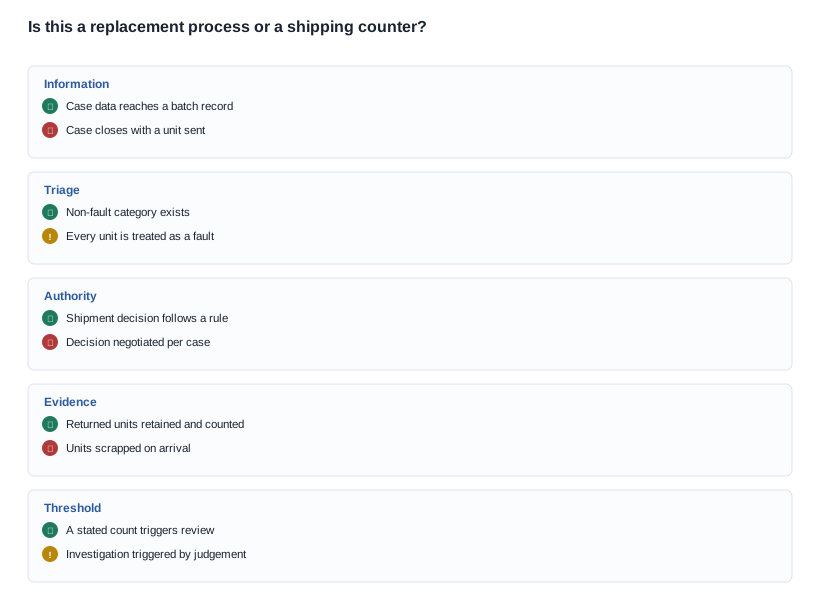
Two failure patterns are worth naming because they are common and neither is visible in the process document. The first is the batch analysis that exists but is performed on credits rather than on units — a spreadsheet of refunds by month, which produces a number nobody can act on because it cannot be tied to a production run. The second is the threshold that exists but has no owner, so when it is crossed the finding is reported to the party who has no authority to change anything. Both are fixed by naming an artefact and a name rather than by analysing more carefully, which is why the stage is cheap to establish and expensive to leave ambiguous.
Questions to ask, and what we could evidence today
Before you commit to a supplier's replacement process, these are the questions that distinguish a quality system from a shipping function.
Show a worked example end to end — a case opened, the evidence supplied, the route chosen, the unit returned, the outcome, and where the cause was recorded. Most suppliers can describe four of those six.
The reason that test works is that it exposes the seams. A process that looks complete as a diagram usually has a gap between two stages, and the gap shows up as a missing handover: nobody owns the unit between triage and authorisation, or the cause is recorded in a system nobody in the factory can read. Asking for a real case rather than a process description surfaces the seam immediately, and it does so without asking anyone to criticise their own process.
What does the process assume the customer can supply, and how does it handle the fields the customer cannot supply? A process that assumes the batch was supplied will always start in week two.
What are the triage categories, and is a non-fault category included? An explicit non-fault category is the cheapest available improvement to a claims process.
What is the threshold that triggers a batch investigation, and who has the authority to act on it? A threshold expressed as "a trend" is not a rule.
What happens to a returned unit on arrival, and for how long is it retained? Retention without a stated period is not retention.
Does a replacement ship against the same specification baseline as the unit it replaces, and is that recorded? If the answer is no, ask what happens when the two differ.
Our own position is honest about its limits. Our replacement procedure is not published, our response time is not published, our warranty period is not published, our spare-parts list is not published, our return address is not published and our freight policy is not published. The minimum order quantities, capacity and lead times behind all of it are still open internally. We are not going to describe a process we cannot evidence with paperwork.
What the specification does not carry narrows the replacement process in the same way. A single model has a published weight — the MT6 at 158 g — and the weight of every other model is Not published. The field of view, the video specification, the sensor model and the microphone specification are Not published across the range. The ingress test report numbers are Not published either. No CE, FCC or RoHS reference appears in the catalogue text and there is no per-model certification row, so the documents behind a given model are requested in writing; the children's models carry no regulatory position of any kind. Our designations are not fully settled either. The catalogue writes one model "L2 Utral", noting that this is a typographical rendering of "Ultra", and it writes a second one "Utral Pro Max" without publishing what that means. Two entries carry nothing at all: the light-responsive one and the bone conduction one. Which models run which software, and where the data lives, is Not published too — here that matters because a replacement shipped without a stated firmware baseline cannot be shown equivalent to the unit it replaces.
What we can do is take a specific model, configuration and volume and tell you which of the five stages we can evidence today and which we would have to build before we put them in a customer contract. That distinction is usually more useful to a buyer than a single claim, because it tells them where their own effort has to compensate. Stage one and stage two can be made to work with a one-page buyer instruction. Stage five requires the factory's own records to exist first, and no amount of buyer diligence can substitute for them. The related positions are in returns and RMA, the evidence requirement in quality claims, the clock in response times, and the parts the fourth stage depends on in spare parts.
Related reading
- The service commitment the process delivers — after-sales support
- The evidence the first stage needs — quality claims
- The parts the fourth stage depends on — spare parts
Tell us the volume, the number of configurations and the markets, and we will say which of the five stages we can evidence today.


