

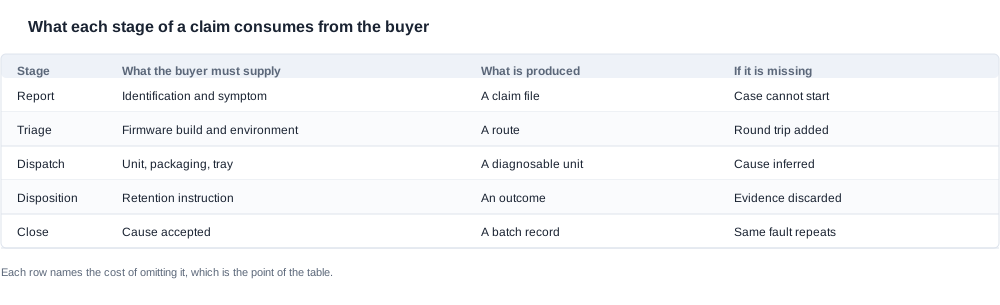
A quality claim is a transaction with a piece of investigation attached to it, and most claims fail in the first hour rather than the last. The reason is almost never a dispute about whether the unit is faulty. It is that the claim arrived without the evidence needed to decide, so the case waits for information that only the other party can supply, and by the time the information arrives the commercial mood has changed. After sales support quality claims work when the evidence requirement is written down before the first order, not when somebody remembers to chase it during a difficult week.
The other structural point is that a quality claim is not an isolated event. It is a sample of one from a production run, and the same claim handled well a second time is a different claim with a different purpose. Whether a claims process produces information or produces credits decides what the next order looks like.
That distinction has a cost attached, and it is worth naming at the outset because it is usually the thing buyers optimise against. Producing information takes longer on any single claim: the unit has to be retained, the analysis has to be recorded, the cause has to be written even when it is inconclusive. Producing credits is fast and produces nothing. A programme that has never asked which of the two it is optimising will discover the answer in the fourth quarter, when the same fault appears in the next order and nobody can say why.

After sales support quality claims: what a claim has to carry before it is a claim
Four items decide whether a claim can be worked on day one, and none of them are unusual.
The unit's identification. A batch marking, a serial marking, or a purchase order reference that maps to a shipment. If the unit carries none of these and the buyer's records do not either, the claim becomes an inquiry, and an inquiry has no clock and no resolution.
The fault as described in the user's own words. Not a category, not an internal code — the sentence the customer would use. "It will not connect to my phone" and "the sound cuts out after a minute" are actionable. "Quality problem" is not, and the translation from one to the other loses the detail that makes the case diagnosable.
The state of the unit. What has already been tried. Whether it has been charged, whether it has been re-paired, whether it has been dropped, whether the packaging and accessories came back with it. A unit that has been re-paired by the customer before being returned is a different investigation from one that has not, and the difference is invisible unless it is asked about.
The firmware build. Where the product has one. Most claims in a connected category turn out to be resolved by a firmware step, and the build number is what identifies whether that step is available. This single field removes a large share of avoidable returns.
The reason these four matter is that they are cheap for the buyer to capture and expensive to reconstruct. A photograph of the marking, a sentence, and a build number take under two minutes at the counter; reconstructing the same three facts six weeks later, from a unit that has passed through three warehouses, is a project.
Who captures them is a decision that has to be made explicitly rather than assumed. Three models work in practice. The retail counter captures them, which gives the best data and the worst consistency. The distributor's returns desk captures them, which is a reasonable compromise and needs a one-page instruction. The customer captures them at the point of contacting support, which is the best data of all but requires a form that is short enough that people finish it — and a form with fifteen fields will be abandoned, which is worse than a form with four.
The criteria for choosing between them are simple: whoever captures the evidence must be given the field list, must not be asked to diagnose anything, and must be able to leave the claim incomplete rather than filling in a guess. That last point is where most evidence quality is lost — a returns desk that believes an incomplete claim is worse than no claim will invent the missing field.
The five parts of a claim file
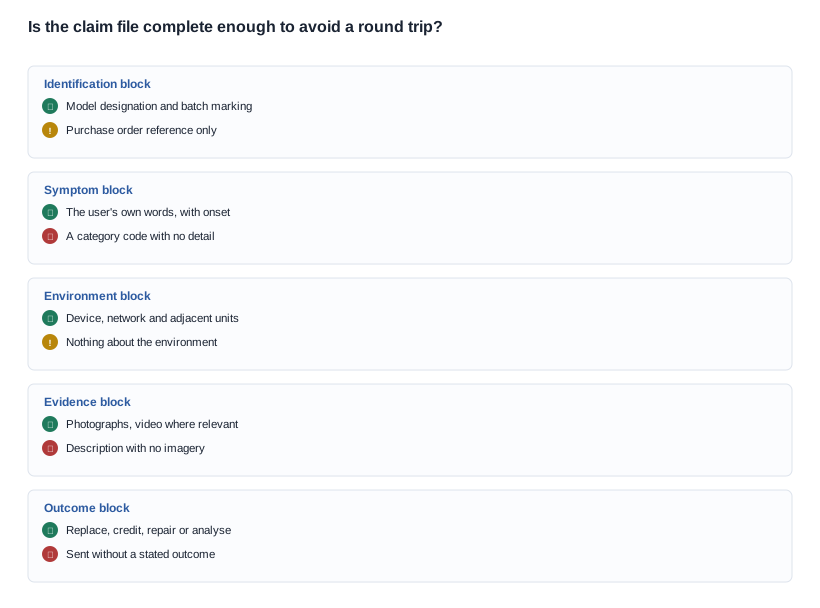
A claim file that a supplier can act on has five parts. Anything less and the supplier has to write to the buyer, and the round trip is where claims die.
The identification block — model designation, batch or serial marking, shipment reference, and the date the unit reached the customer.
The symptom block — the description in the user's words, when it started, whether it is intermittent or constant, and what has already been tried.
The environment block — the phone or device it was used with, the network it was connected to, and whether other units in the same batch behave the same way. That last question is the one that separates a unit fault from a batch fault, and it costs a customer nothing to answer.
The evidence block — photographs, a short video where the fault is audio, camera or connectivity, and the packaging state if the packaging is in question.
The requested outcome block — replacement, credit, repair, or analysis only. This should be stated explicitly rather than inferred. A buyer who sends a unit back "for attention" without stating the outcome gives the supplier a choice, and the supplier will make the cheapest one.
There is a fifth kind of information that belongs in this block even though it is commercial rather than technical: whether the buyer intends to continue ordering that batch. It is not an accusation, it is context, and it changes how a supplier prioritises the analysis. Buyers frequently leave it out because it feels like pressure, and then wonder why a claim on a discontinued batch was treated as routine.
The blocks are deliberately blunt. Their purpose is not to gather everything that could be relevant but to make the claim resolvable in one exchange. A file that produces a decision on the first exchange is worth more to both parties than a richer file that takes three, because the exchange is where the relationship is spent.
It is also worth stating what a claim file is not. It is not a negotiation document, and a claim file that includes opinions about responsibility, requested remedies or blame will be returned unread. The identification, symptom, environment, evidence and outcome blocks are all factual, and any paragraph arguing a case belongs in the commercial conversation rather than inside the evidence. Suppliers read hundreds of these files, and the ones that survive that volume are the ones containing only what is needed to decide something.
One further field earns its place in most categories: whether the customer is a direct user or a channel customer. A claim that came back through a retailer carries an extra layer, because the retailer will have its own policy and its own customer relationship, and a resolution that ignores that layer gets relitigated at the retailer's counter.
Triage categories that decide the route
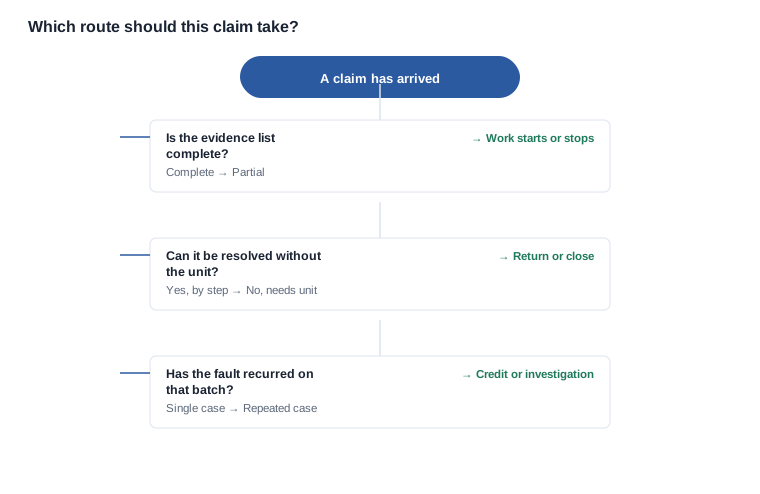
Triage exists to sort claims into three routes: resolved immediately, needs a replacement, or needs investigation. The useful part is not the sorting — it is that the category determines what happens to the physical unit afterwards, and that is where most claims quietly lose their value.
The route that closes without a return. Claims where the answer is a firmware step, a pairing reset, or a configuration instruction. These should be a large share of claims in a connected category, and if they are not, the reason is usually that the firmware build was never captured and the supplier could not tell whether the step applied.
The route that needs a return. Claims where the unit cannot be assessed remotely. These are the ones where the evidence requirement earns its cost, and where the packaging decision made at order time determines whether the returned unit is worth anything.
The route that needs investigation rather than a decision. Claims where the fault exists on one unit but not on the adjacent one. These should be routed to analysis with the unit retained, not to a credit, because a credit closes the case and destroys the evidence that would have prevented the next ten credits.
The triage rule worth the most is the one that spots a non-fault before anybody spends a unit on it. A stale pairing record on the customer's own handset, a charging case that was never in the box, a unit that was never charged because the cable never arrived — none of these is a defect, and none of them should consume a replacement. Claim systems in this category always grow such a case eventually, usually as a line in a support training note rather than as a code in the system, which is exactly why it then works twice.
Two structural points about triage that are worth designing in rather than discovering. First, triage has to happen against a stated reference set — the approved configuration, the firmware build list, the known open issues — or every triage becomes an opinion about whether something is unusual. Second, triage decisions need to be recorded even when they close a case, because the distribution of triage outcomes is the cheapest quality signal available before any unit is analysed. A category that is growing in triage is a category that is about to become a batch problem, and the two-week warning is the whole value of the exercise.
Questions to ask a supplier before you sign a quality agreement
These are the questions worth asking in the meeting where the quality terms are set. Each is written to produce a term rather than an opinion.
What evidence does a claim have to contain, and does the supplier reject incomplete claims? A supplier that accepts everything will work slowly and blame the buyer later; a supplier that rejects without explanation will blame the buyer immediately. Ask for the evidence list and ask what happens when it is not met.
What is the triage route for each fault category, and what happens to the unit on arrival? Analyse and retain, return to the customer, or scrap. The second question matters more than the first for most buyers, because a retained unit is the only way a batch pattern can ever be seen.
How long does a claim stay open without a customer reply, and what happens then? An open claim with no reply is usually closed administratively, and the units involved disappear from the data. A stated rule — for example, that the case closes after a stated number of weeks unless the customer replies — is fairer than silence.
Which fault categories are treated as batch issues, and what triggers a batch investigation? A threshold expressed as a number per batch is a term. A threshold expressed as "a trend" is not.
What does the supplier need from the buyer that it does not get today? In practice the answer is almost always the same: a unit-level statement of what was bought, when and in which configuration, issued at shipment rather than reconstructed later.
Two more belong in the same list. Ask who at the supplier owns a claim that has been open for more than a stated period — an unnamed owner is the usual reason a claim goes quiet rather than being resolved. And ask what the supplier does with a claim it cannot reproduce, because in practice the honest answer varies between "retained and recorded as unreproduced", "credited", and "closed with no cause", and only the first of those improves anything. Where to negotiate is the second question: the evidence list and the disposition are usually straightforward, while the threshold number and the retention period are the two terms that most often need work.
Two red flags to watch for in the answers. A policy that describes the outcome as a replacement "at the supplier's discretion" has moved the decision to the moment of maximum pressure, and a policy that promises a turnaround without stating what starts the clock has not actually promised anything — the clock usually starts when the unit is received, which may be a week after the claim was raised.

Batch claims: when one return becomes a systemic issue
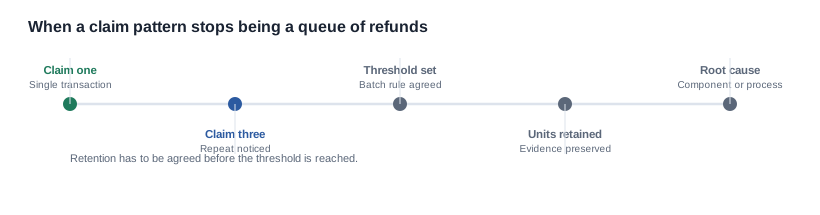
The transition point is worth naming, because the handling changes completely once it is crossed. A single claim is a transaction. A pattern across a batch is an engineering event, and the commercial instinct to credit it one unit at a time is what makes it expensive.
Three things have to exist for a batch claim to be worked properly. A unit-level link between the claim and the production run, which is the batch marking again — without it, there is no batch, only a suspicion. A count, kept by category rather than as a single return total, because a rising total tells you nothing about which fault is growing. A decision rule stating what happens when the count crosses a threshold: hold, investigate, component change, process adjustment, or notification.
The trade-off to name is the one between credit speed and pattern visibility. Crediting quickly keeps the channel happy and destroys the unit, because a credited unit is normally returned in a condition that cannot be analysed in any detail — often without the accessories, sometimes without the packaging, frequently after the customer has tried to fix it. Where a pattern is suspected, the only thing that keeps the evidence is a slower decision on a small number of units. Buyers who have been caught by this usually arrive at the same rule: fast credit for isolated claims, retained units for anything that repeats.
There is a commercial point as well. A batch claim handled as an engineering event protects the next order; a batch claim handled as a queue of refunds protects only this month. Suppliers notice the difference, because one of them generates a component change and the other generates a stream of credits against the same part number.
The buyer-side consequence is that batch claims need a different approval path, not just a different cause. A single replacement is an operational decision any competent person can make. A hold on a shipment, a notification to a channel partner or a component substitution is a commercial decision with a different approval chain, and if the process only has the first kind, the batch claim will be resolved the cheap way every time. Building that second path before it is needed is the difference between catching a pattern in week three and catching it at the next factory audit.
What we publish, and what we will write into a quality agreement
Stated plainly, because a buyer agreeing quality terms needs to know which answers are measured and which are simply absent.
Our warranty duration is not published. Our claim rate is not published. Our response time is not published. Our disposition policy for returned units is not published. Each of those is an absence in what we know rather than a position we have taken, and we would rather put the gap on the page than print a figure we cannot defend. The specification gaps land on claims in the same way. A frame weight exists for one model only — 158 g for the MT6 — and the weight of the rest of the range is Not published. None of the sensor model, the field of view, the video specification or the microphone specification is published. We publish no ingress test report number for any model. Regulatory status is narrower than it looks: the catalogue publishes no CE, FCC or RoHS text and no per-model certification row, the documents behind any model therefore have to be requested in writing, and the children's models sit outside anything we have published. Any claim that depends on one of those figures has to reach the manufacturer for it, and we would rather name that dependency than let a reader assume the data sits with us.
What we will do for a specific programme is put the five claim blocks into the agreement, state the triage routes for the fault categories that configuration can produce, state the disposition of returned units including retention and its period, and state the batch threshold that triggers an investigation. We will also state which of those we can evidence today and which require us to build the process first, because the difference is what a buyer is actually buying.
That distinction is worth spelling out. A written evidence list is something we can commit to immediately, because it describes how a claim is opened rather than how a product behaves. A triage route for a fault category requires someone to have seen the fault category, which for a new programme means it does not exist yet. A batch threshold requires volume history to set sensibly, which for a first order means it has to be a placeholder with a review date rather than a number pretending to be derived. Writing all three in the same register would be dishonest, and a buyer who later discovers that a threshold was invented will discount the rest of the agreement as well.
Where our published position does constrain a claim answer, we will say so at the point it arises rather than at the point it becomes a problem, and we will name the party who holds the missing figure. That is the part of this process we can guarantee today.
The related process is in returns and RMA, the evidence question in packaging for returns, the clock in response times, and the parts position that limits what can be repaired in spare parts.
Related reading
- The process that receives the claim — returns and RMA
- The evidence the packaging has to carry — packaging for returns
- The clock the agreement has to start — response times
Send the models, the volume and the markets and we will tell you which claim terms we can evidence today.


