
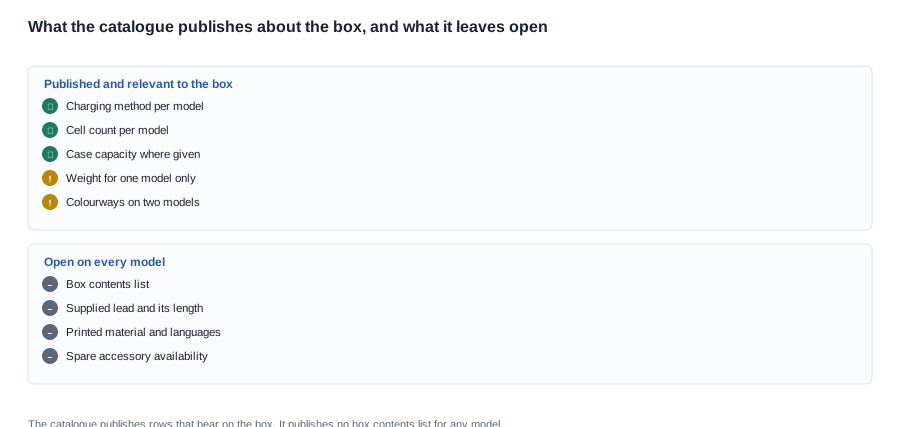
The box is the first physical contact a buyer has with a product, and for AI camera glasses it is also the point where several of the catalogue's gaps converge into a single practical question: does the customer receive everything they need to charge the unit and use it. The catalogue settles less of that than the question implies. There is no published box contents list for any camera model, no packing list, no statement of what printed material ships with the unit, and no published set of accessories beyond one row that appears on some pages and not others.
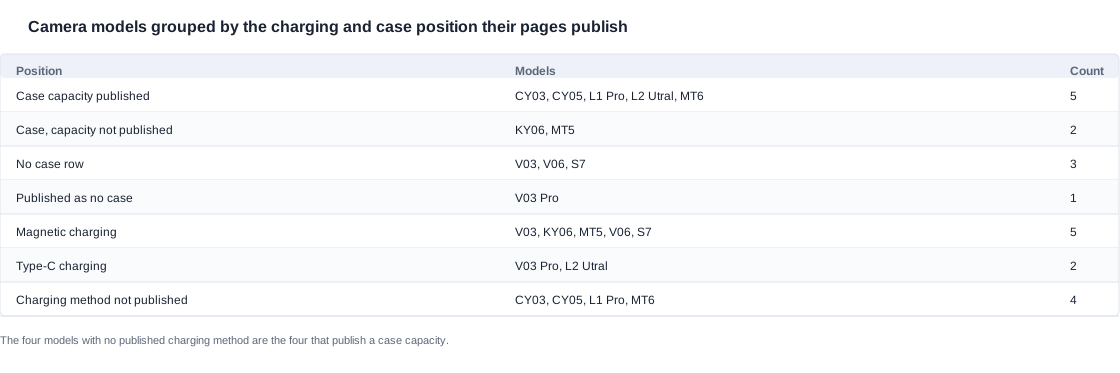
What the catalogue does publish, across the eleven camera models, is enough to build a correct packing list per model rather than for the category. Seven of those eleven pages carry a charging-case row. One page states in words that the product is supplied without a case. Three pages carry no case row at all. Two situations therefore put no case in a camera box, and a buyer who cannot tell them apart will mis-state the contents of one of the eleven.
This article is about turning those published rows into a per-model question list, and about keeping a packing list as a packing list.
AI camera glasses: what the catalogue actually settles
Start with what is published, because most of it is not what a buyer expects a catalogue to publish and it is all relevant to the box.
The charging method is the row that decides the box before any accessory row is read. Five camera models publish magnetic charging, which means the unit charges against contacts and therefore needs a cradle or a case to charge at all — a cable by itself does nothing for it. Two camera models publish Type-C, which means a cable, and the cable is a commodity that a customer replaces themselves. Four camera models publish no charging method at all, and that is a blank row rather than a statement.
The cell configuration is published on every page. Every camera model publishes a single cell value, and those values run from 220 to 290 milliampere-hour across the eleven; the twin-cell designs in this catalogue sit in the audio and sport groups rather than among the camera models. So the charging question a camera buyer inherits is not about a pair of cells but about the accessory: what holds the contacts, and whether it is supplied.
The case row is published on seven pages and is the row that actually names a physical accessory. Where a capacity is published, the page also gives a number that a logistics team can work with. Where a case is recorded but the capacity is not, the buyer learns that an accessory exists and nothing about its size, its weight or its charging behaviour.
The weight is published on exactly one page in the whole range. The MT6 page carries 158 grams, and that figure describes the glasses body as it ships — with the battery and camera fitted and without the folding case — while the weight of the folding case itself is not published. So for one camera model in eleven, a parcel-weight calculation is possible from the catalogue, and for the other ten it is a question.
The colours are published on two pages, one with three and one with four. A model with several colourways means several stock lines and several printed inserts, and the box contents for a given build should be stated per colour rather than once for the model.
Two published rows reach into the box on specific models. The V03 Pro and the S7 publish a removable inner frame, which means a second physical part travels with the unit and has to be counted, identified and accounted for at returns. The L2 Utral publishes two variant names side by side and a case capacity row carrying two values, without saying which name goes with which value — so even on a page that names the accessory, a buyer cannot be certain which capacity is in the box until the order line is answered.
What is not published, for any camera model, is the box contents list itself. Nobody has said whether a lead is supplied, of what length, or at all. Nobody has said what printed material accompanies the unit — a manual, a quick-start card, a warranty card, a declaration, a cleaning cloth. Nobody has said in which languages the printed material appears. Nobody has published which accessories are available separately, which are supplied with every unit, and which are optional.
One pattern in the published rows is worth putting in front of a buyer because it changes the question that has to be asked. The four camera models that publish no charging method are exactly the four that publish a case capacity. Two of those four publish 1400 milliampere-hour, one publishes 900 and 1400 together, and one publishes a 1200 milliampere-hour folding case. That is not proof of anything, and the catalogue does not connect the two rows. But it does make the request that has to be put obvious: where a page names a case with a capacity and leaves the interface blank, the first question is whether the case is the charging path or the storage accessory, because the answer determines whether a customer can charge the product at all once the case is lost.
That observation is the practical heart of a packing list for this group. A packing list answers the question a customer asks when the product arrives and does not work, which is almost always about power. Whether the answer is a cable, a cradle or a case with a published capacity, and whether the item in the box is the only one the customer will ever need, are questions the catalogue can raise but does not answer.
The camera models with a case row, and the two without one
Seven camera model pages carry a case row, and the seven divide into two groups.
Five of them publish a capacity. Three publish 1400 milliampere-hour — the CY05 and the L1 Pro, and the CY03. One publishes a single row containing two values, 900 and 1400, on the L2 Utral page, alongside two parallel variant names. One publishes a 1200 milliampere-hour folding case on the MT6 page.
The remaining two of the seven record that a case exists without publishing its capacity: the KY06 and the MT5. Their pages say a case is part of the configuration and stop there. That is a different commercial object from a case with a stated capacity, because a buyer can plan the freight weight and the shelf allocation for the second and has to request the first.
Two of those rows need particular care.
The L2 Utral row publishes two capacities in one line and two names in another, and it does not say which capacity belongs to which name. A buyer therefore cannot write "the L2 Utral ships with a 1400 milliampere-hour case" and treat it as settled, because the catalogue leaves two capacities in play for two names and publishes no correspondence between them. The order line has to name the variant and the capacity together, and the request has to establish which combinations are actually buildable.
The MT6 row is the only one in the range that publishes a case and a weight at the same time, and the two figures need to be kept apart. The 158 grams is the glasses body; the folding case is a separate object with a published capacity of 1200 milliampere-hour and an unpublished weight of its own. A parcel-weight estimate for this model therefore has two parts, one of which is missing, and the missing part is the one a courier quotes on.
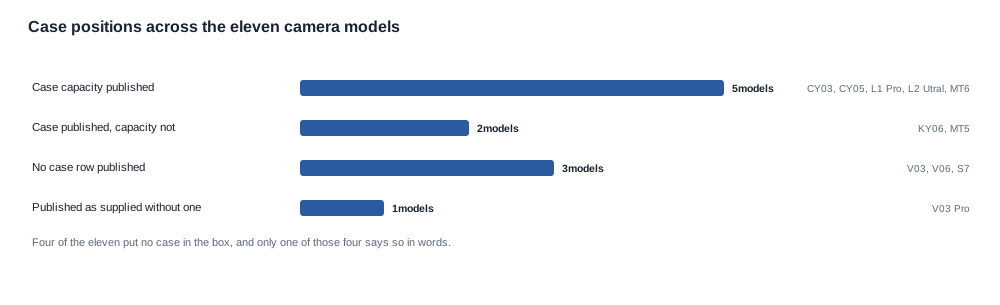
Now the other side of the heading, which is where the two situations come from.
One page states the absence in words. The V03 Pro is published as supplied without a charging case, and that is a statement rather than an omission. Everything about that model's box follows from it: there is no accessory line for a case, there is no spare to stock, the returns inspection has one fewer item, and the customer needs the Type-C lead and whatever else the page names. The order line for that model should say so explicitly, because a buyer working from a general impression of camera models will otherwise assume a case is present. The V03 Pro pre-order note covers that model's own configuration in detail.
Three pages say nothing. The V06 and the V03, and the S7 publish no case row at all, and a blank row is a question that has not been answered. A blank row is not a statement that no case ships, and it is not a statement that one does. This is the distinction that decides a packing list: a stated absence can be written into a picking instruction, while a blank row cannot, and a buyer who writes the absence into the picking instruction on the strength of a blank row will be wrong on some proportion of the units that arrive.
So the two situations are not two counts of models. They are two different kinds of answer, and the practical consequence is that a camera model's packing list can only be written after the case position has been established in writing. For the model that publishes an absence, the request is short: confirm the absence and list what replaces the case in the box. For the three models that publish nothing, the request has to establish the position first, and the answer may be a case with an unpublished capacity, a cradle without a case, or no accessory at all.
There is one more dimension to the box that follows from the charging methods rather than from the case rows. A camera model that charges magnetically and has no published case row needs something with contacts in the box, whatever it is called; a model that charges over Type-C needs a lead; a model whose charging method is not published may need both a lead and a cradle. A packing list is therefore not a list of accessories but a list of what makes the unit operable, and the operative question per model is always the same one: what does the customer need in hand for this product to work.

The rows a box cannot settle, and the questions that can
A packing list is the smallest part of a purchase file, and it is worth being clear about what it cannot do. Receiving a box tells a buyer what was shipped, which is useful for a goods-in check and useless for a specification. Almost nothing that a buyer needs in order to describe the product to a customer can be established from the contents of a box.
The camera behind the resolution class is the first thing on that list. For every camera model the catalogue prints the pixel class and nothing else — no sensor, no lens specification, no angle, no frame rate, no file format, no storage capacity, and no statement of where recorded footage goes. A box does not answer any of that, and the angle the camera covers is what decides whether the product can do the job it was bought for.
The radio version is the second. No camera model in the range publishes a Bluetooth version, which is notable given that the audio models all do. So what the camera products connect to is a question for every one of them, and it cannot be read off a specification label in a photograph.
The endurance conditions are the third. Every camera model publishes an endurance figure, but not the conditions behind it — not the recording mode, not the volume, not whether a link was active, not whether a case was in use. A box does not carry those conditions.
The charge definition is the fourth. The catalogue publishes a charge time for every model in the range, but not the state the cell starts in, not the point at which the charge is treated as complete, and not what the figure covers when a case is involved. A pair of units can both be taken from flat to full and still finish the job at different moments, and nothing in the box tells you which state a unit arrived in.
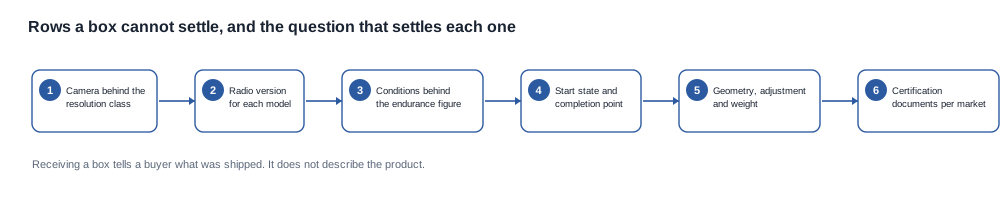
The physical specification is the fifth. Frame dimensions, adjustment, and — for every camera model except one — the weight. Geometry cannot be read from a box either, although a careful buyer can pick a unit up, and the difference matters because weight is one of the inputs to the freight rate per unit and therefore to the landed cost on a bulk order.
And the paperwork is the sixth. The catalogue's export certification page is a page of images rather than text, its text carries no reference to CE, FCC or RoHS, and no per-model certification row appears anywhere in it. So a model's certification standing cannot be read off the catalogue, and it cannot be read off a box either — except in the form of documents that should be inside it — which is a reason to ask what printed material travels with the unit rather than an answer.
The method that turns all of this into a workable request is to write one item per published row, in the form of a question with a named expected answer. A published cell becomes a question about what the two cells do. A published charge figure becomes a question about what it covers and from which state. A published resolution class becomes a request for the field of view, the recording rate and the storage. A published colour list becomes a question about the printed insert and the artwork per colour. A published accessory becomes a question about what it does, whether it is supplied with every unit, and whether it can be replaced on its own. The criterion for a good question is simple: it can be answered yes or no, or with a number, or with a document, and it can be checked at a goods-in bench by somebody who was not on the request.
The red flags in a reply are the mirror image of that. A box described as a sentence rather than a list cannot be checked item by item and hides the absence of an item. An answer that covers the camera range generally rather than the model and build cannot be filed. And an answer that says an accessory is included without saying whether it is included with every unit or only some leaves the picking instruction wrong for some part of the order.

Writing a packing list without turning it into a customisation list
Before you order, work out how to evaluate the eleven models: sort them by the position their pages take on the accessory, because that single field decides more of the logistics than the cell or the resolution class does. Run the group as a checklist, model by model, and take three lines for each one — the box contents, the charging path, and the build the answers will be attached to. Where a row is printed, the question to ask is what it covers in practice; where a row is blank, the question to ask is the one that produces an itemised answer. The trade-off is straightforward: a fuller accessory position adds freight weight and a second spare line, and a buyer who cannot yet price the accessory cannot put a total cost on the unit. The signs that a model is ready to order are an itemised box list, a named charging path, and a written answer attached to the build.
There is a trap in a piece like this one, and it is worth naming before anything else. The question "what should be in the box" invites an answer that lists things a brand owner might ask to be changed — a different colour, a different printed insert, a different name on the product. Our internal product record for the camera category carries seven customisation axes, and we are not going to name them here, because listing an axis in public is the same as announcing that it is available. A buyer who reads a list of axes on a product page concludes that those axes are negotiable, and the commercial consequence of that misreading is a contract dispute rather than a bad page.
So a packing list and a customisation list are different documents with different audiences, and they have to be kept apart. A packing list says what is inside the box for a given model, build and colour. It is fixed, itemised, and checkable at a bench. A customisation list says what may be changed, under what conditions, at what cost and against what minimum quantity. It belongs to a quotation conversation, where the terms are stated and agreed, and not to a product page or a general article. The test for which document you are writing is simple: if the line can change without a new agreement, it is not a packing line.
The commercial terms that sit behind the packing list belong in the quotation, and for this group they are unusually numerous, because the eleven camera models differ from one another in the things that decide what travels. Colour counts vary from none to four. Case positions vary across published capacity, unpublished capacity and no row. Charging methods split three ways. Cell configurations split across four values. The quotation therefore has to state, per configuration, the minimum order quantity, the lead time, the unit price, the printed insert per colour, what is included in the box, what is available as a spare, the accessory prices, the warranty and defect policy, the payment terms and the incoterms. None of that is published for any camera model, and all of it has to be requested.
The list below is the request this group should start from, and each line is written as the request that closes it.
- Identity and build. The product name and build reference printed on the unit and the carton, and the build the file covers.
- The box contents. An itemised list, per configuration, stating what is in the box and what is not.
- The case position. Whether a charging case is supplied, its capacity, its weight, whether it charges the frames or stores a charge placed into it by other means, and whether it can be replaced on its own.
- The charging path. Which interface the frames use, what the customer needs in hand to charge the unit, and whether the figure covers the frames alone or the frames with an accessory.
- The supplied lead. Whether a cable is included at all, how long it is, and whether the frames will accept power from any Type-C source or only from the one supplied.
- The printed material. What accompanies the unit, in which languages, and whether any conformity document travels inside the box.
- The removable parts. Where a model publishes a removable component, which sizes exist, how a size is marked, and whether a spare can be ordered separately.
- The camera behind the class. The sensor and its lens, how much of the scene the camera takes in, how many frames a second it writes, the file format, the storage behind it and the place a recording is kept — none of which a box can tell you.
- The radio. Whether each camera model carries a radio and which version, since no camera model publishes one.
- The endurance and the charge. The conditions behind the endurance figure, and the start state and completion point behind the charge ceiling.
- The physical details. Frame measurements, whether the frame adjusts at all, and how much the unit weighs — published for one camera model in the group only.
- The market file. What certification and conformity paperwork the factory holds against each model and each build, and which destination markets each document was issued for.
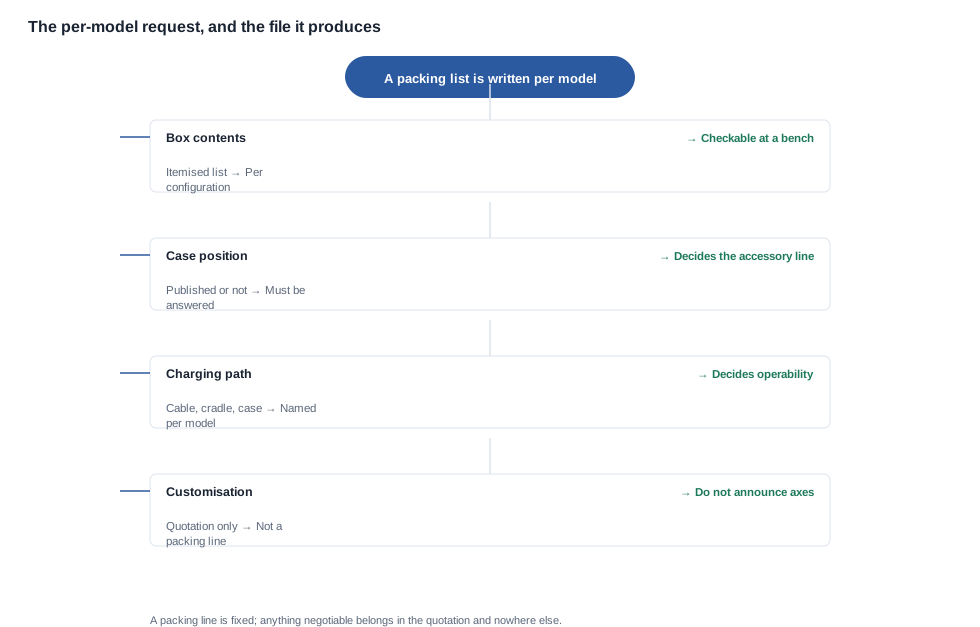
The order of those lines is deliberate and it is the same order the range imposes. The first three decide what is physically in the parcel, and they are the ones a goods-in bench can check. The middle ones decide what the product does, and they are settled by a sample or by a document. The last ones decide whether the shipment can clear and be sold. A buyer who runs them out of order will end up with an approval signed against an assumption, and the assumption will be discovered in the first customer complaint.
Two ways this file goes wrong are worth naming, because both are easy to produce. The first is a packing list written in a marketing register — "a complete set of accessories to get you started" — which tells a bench nothing and hides an absence. The second is a packing list that quietly includes an accessory the catalogue has not published, which is a claim about availability rather than about contents, and it is the one that turns into a procurement dispute when the reorder arrives without it.
The record a completed file produces is short, and it is what the first consignment is judged on: the box holds what the packing instruction says it holds, item for item; the accessory that makes the unit operable was in the box; the configuration matches the order line; the documentation arrives in the languages the destination market needs; and the documentation covers both the build and the market it was issued for.
On this group, our position is that the catalogue publishes enough to build a correct per-model packing list and not enough to build a correct one for the category, because the accessory position changes from model to model. We publish the charging methods, the cell configurations, the case capacities where they are published, the colourways and the single weight figure as they appear, and we do not publish a box contents list for any camera model, because we do not have one that is agreed across the eleven. Price, lead time, minimum order quantity and case weight are not published for these models either, and we will not estimate them. We do not publish a customisation axis on a product page, for the reason given above. The signs that a file is genuinely closed are that every one of the twelve lines carries a written answer naming the build, the packing instruction is itemised rather than descriptive, and the configuration record on the file matches what arrived. Whether to call the file closed is a scheduling call the buyer makes, and the test is those twelve lines.
Tell us which model in the group your channel is short of a packing list for, and we will set that request out in the form our documentation team files against one model of the group.


