A form-factor comparison is usually framed around appearance, and appearance is the least consequential thing about it. What actually differs between a sport model and a camera model is the job the unit has to do in the customer's hand, the way it is powered, the parts that come off it, and the evidence a channel needs before it repeats a marking on a carton. Those four things are what this article sets out, because they are what a range plan is built from.
The two products on the table here sit in different categories of our range, and the differences below are consequences of that rather than variations on a theme. The ZH12 is a sport model. The S7 is a camera model, and it publishes an imaging entry, a removable inner frame, a rating marking, and a magnetic charging method, while the sport model publishes a remote photo entry, a surround sound entry, a Type C lead and a radio version. A buyer who reads the two pages side by side sees two different products, and the useful question is not which one is preferable but which rows a channel's own requirement lands on.
Nothing here describes how either product performs, and no figure is estimated. Where the record is empty, the article says so and names the party who can close the gap.
Zh12 smart glasses vs S7 form factor: a sport frame and a camera frame
The category difference is the whole difference
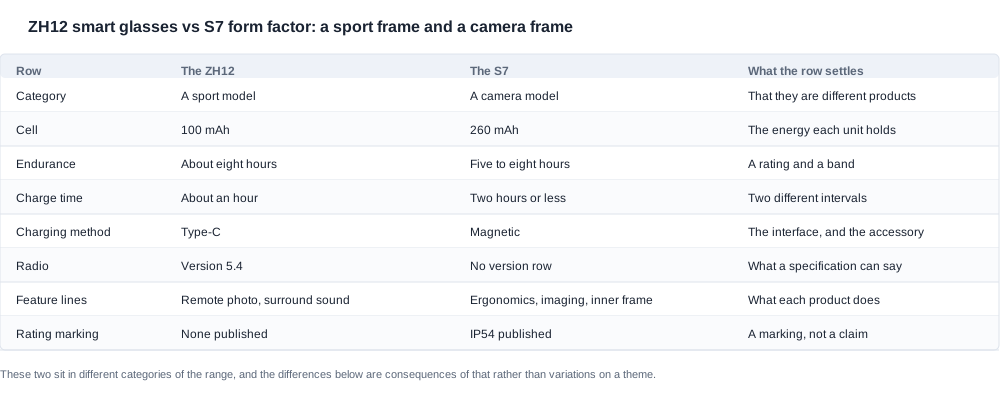
Our range separates into three groups, and a buyer choosing between a sport model and a camera model is choosing between groups rather than between positions on a scale. The sport group is small: three models. The camera group is large: eleven. The audio group sits between them: eight.
That structure matters for procurement in two ways. The first is that a camera model carries a camera specification and a sport model does not, so a channel with a camera proposition and a channel with a sport proposition are running two different programmes rather than one programme with two products in it. The second is that the accessory and documentation work scales with the group rather than with the model count, and a camera model generally brings more of it.
The practical consequence for the two models in this comparison is straightforward. The S7 publishes a thirteen-megapixel imaging entry, an ergonomic design line, a removable inner frame and a rating marking. The ZH12 publishes a remote photo entry and a surround sound entry, in Chinese rather than in English, and it publishes no imaging entry at all.
Which means the remote photo entry on the sport model is not a camera. It is a control for something else, and treating it as a small camera is the single easiest mistake to make when a buyer reads the two pages together. A buyer who has described a product as "a camera model with a remote shutter" has described neither of them.
The rows, in the order a range plan meets them
Category and function. A sport model and a camera model are not substitutes, and the function entries make the difference explicit rather than implicit.
Cell and endurance. A hundred milliampere-hours against two hundred and sixty on the camera model, and about eight hours against a band of five to eight. Both figures are ratings rather than day plans, and neither product publishes the conditions behind its own figure.
Charge time. About an hour on the sport model and two hours or less on the camera model. Two different intervals, and the shorter one is shared with another sport model in the range rather than being unique to it.
Charging method. A Type C lead on one side and a magnetic contact on the other, and this is the row that decides what a channel buys, packs and explains.
Radio. A version is published for the sport model and none for the camera model, so a specification written for the camera side has a blank where the sport side has a row.
Removable parts and the rating marking. A removable inner frame is published for the camera model and no removable part is published for the sport model. A rating marking of IP54 is published for the camera model and none for the sport model.
The two rows that decide a programme
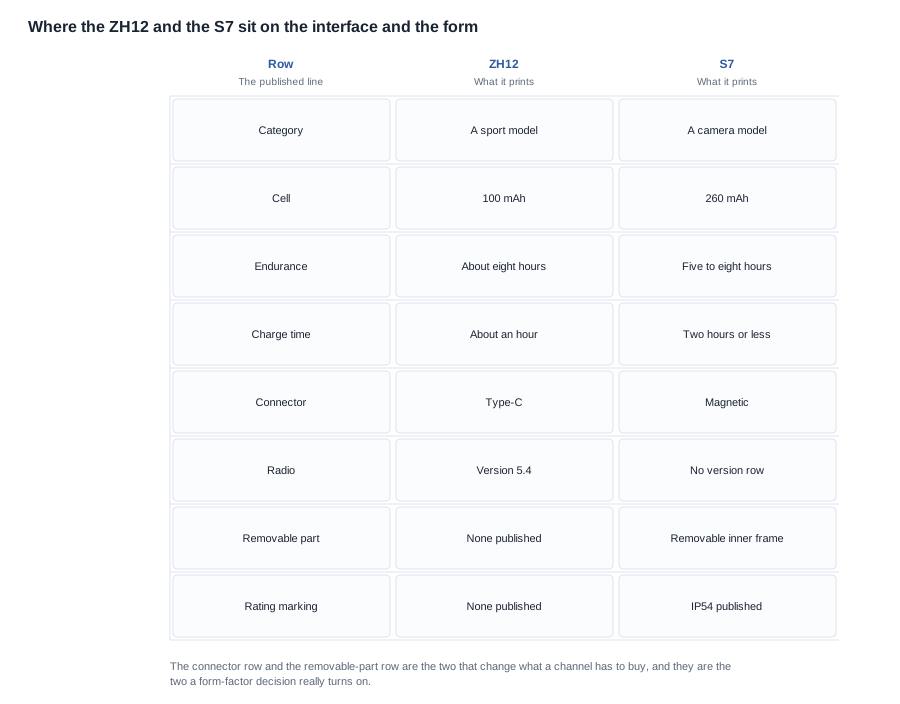
Put the eight rows in a different order and two of them separate from the rest. The connector row and the removable-part row are the two that change what a channel has to buy, stock, train and explain. The rest of the rows are specification, and specification is comparatively cheap: it is a number in a document.
The connector row, because a magnetic contact and a Type C lead are two different accessory programmes, two different spare-parts policies and two different customer instructions, and a channel carrying both models carries both programmes.
The removable-part row, because a part that comes off is a part that can be lost, damaged, replaced, ordered again or argued about, and a channel that has not planned for that is planning for a support queue it has not budgeted.
The interface difference, and what it means for the accessory order

The charging row is the one that gets under-estimated, because it looks like a detail until somebody has to order the spares.
A magnetic contact changes what a spare is. A contact-based interface implies a proprietary source, and a proprietary source implies that a customer who loses the charger cannot recharge the product from a lead they already own. That is a support question before it is a hardware question, and a channel that has not asked whether a spare is available has not answered it.
A Type C lead changes what a customer expects. A lead is a commodity, a lead is replaceable from any supplier, and a lead is something a customer already owns. That makes the battery story simpler and the spare-parts story smaller, and it also means a channel can offer a lead without carrying it as a stocked line.
The two together decide the packaging. A carton that holds a magnetic-contact product and a carton that holds a lead product are not the same carton, and the artwork, the insert, the printed instructions and the contents list all follow from the interface rather than from the product. A channel running a shared insert across a range with two interfaces is saving artwork cost and creating a support problem at the same time.
They also decide the counter. A shop that wants to demonstrate the camera model needs the contact in front of it, and a shop that wants to demonstrate the sport model needs a lead. Neither of those is a big deal until a channel runs both and has to carry both.
The questions the interface raises
- What exactly is supplied in the box for each of the two models? A contact, a lead, a lead with a contact at one end, a pad, or a dock. The catalogue prints the method and not the object, and the object is what goes in the box and what a customer sees.
- Can a replacement be obtained separately for each, and at what lead time? This is the spare-parts answer, and it is the one that decides whether the interface is a convenience or a dependency.
- What is the packed dimension and the shipping weight with the supplied object in place? Two numbers per model, and they belong in the freight model before the first shipment rather than after it.
- What does the unit report while it is charging, and what does the customer check to know it is done? A charging method with no observable state generates a support contact on the first night.

A removable inner frame against a remote shutter
The last two rows of the comparison are the ones that look like accessories and are actually design decisions.
The removable inner frame, and how rare it is
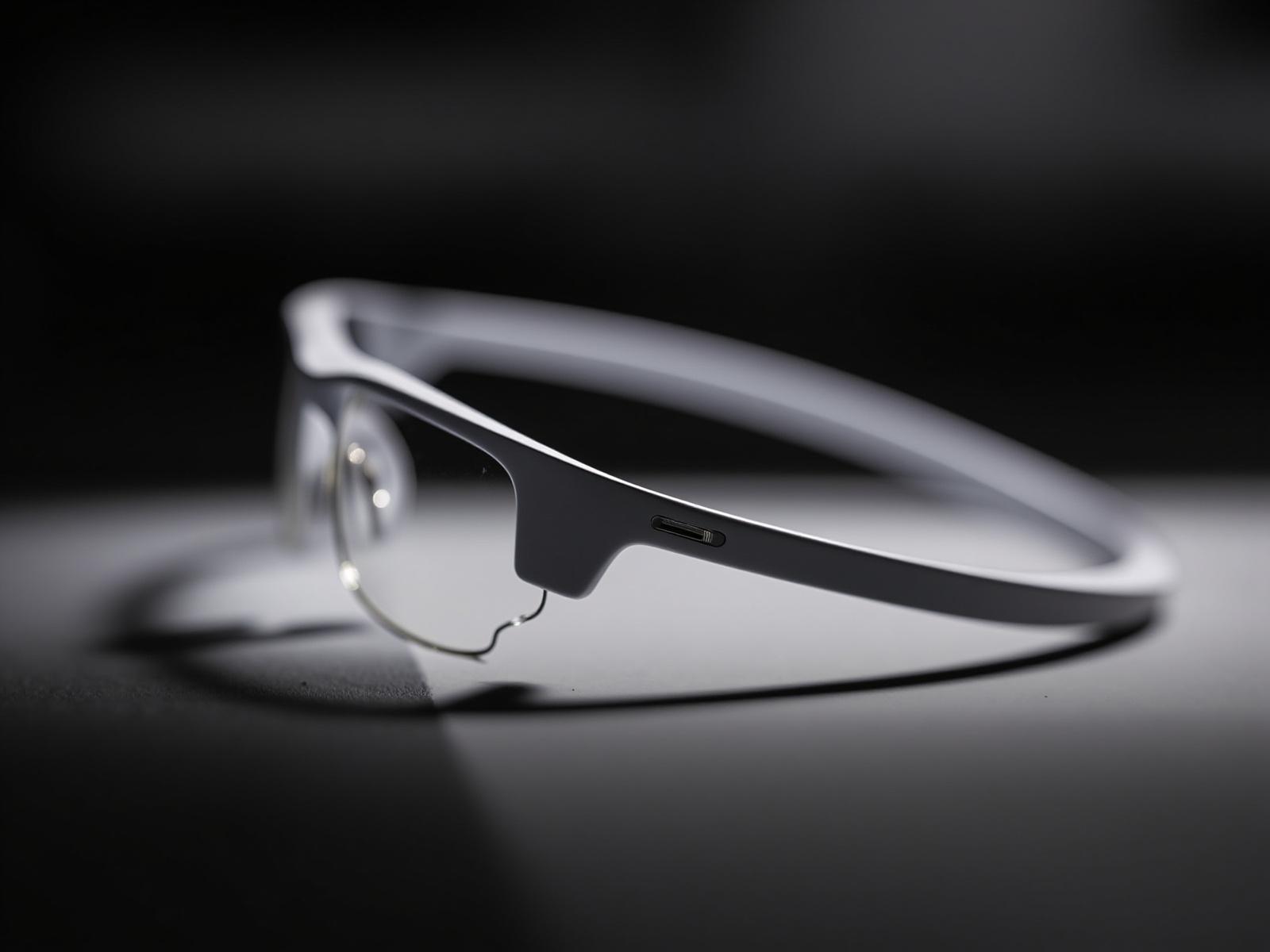
The camera model publishes an inner frame that can be removed, alongside a line describing an ergonomic design and the thirteen-megapixel imaging entry. A removable part is unusual in this range: across the whole catalogue there are only three published places where something comes off, and two of them are the inner frames on the two camera models that share the same published specification, and the third is a detachable temple on an audio model. So the inner frame is a genuine structural feature of the camera model's form rather than a routine accessory.
Three things follow for a buyer, and all three are commercial.
It changes the configuration. A unit can arrive with the inner frame fitted, with it removed, or with a different one, and a channel that has not specified which of those it is ordering does not know what it is buying. This belongs on the order line rather than in a conversation, and it belongs there before the artwork is approved, because the artwork shows the frame.
It changes the spare-parts programme. A removable part is a part that can be replaced on its own, and that is a service proposition rather than a unit proposition. A channel that has not asked whether the inner frame can be ordered separately, and what it costs, is going to discover it in the first returns analysis.
It changes the physical checks a buyer makes. A frame with something removable on it has an interface that can wear, and a buyer reviewing a sample needs to know what that interface is called, what it is made of and what "removed" is meant to describe. Nothing published says.
The remote photo entry, and what it is not
The sport model publishes two function entries, and they are written in Chinese rather than in English: one covering a remote photo function, the other a surround sound function carrying an extra qualifier. The remote photo function is shared with another sport model in the range, and it is a control rather than a camera: nothing published says what it triggers, what it pairs with, what it requires the user to have, or how the camera it controls is specified.
That last point is the one a buyer should press on, because the sport model publishes no imaging entry of its own. A channel that sells the sport model on the strength of a remote photo entry, without establishing what is being photographed and by what, is describing a control and not a camera, and a customer who expected a camera is a customer who returns the product.
Three questions close the gap:
- What does the remote photo function trigger, and what does the paired device have to be?
- What does the surround sound entry describe — the channel arrangement, the configuration, or the processing?
- What is published for the camera that the remote function operates on, if the unit does not carry one?
And a fourth that belongs in the same request: what is the report behind the rating marking on the camera model, and what does it cover? A marking printed on a catalogue page is a published fact about the product, and it becomes a claim about the product the moment it appears on a carton, a listing or a specification. Our catalogue supplies the marking and no test report, so the evidence has to be requested before the marking is used.
The three questions the removable row raises
- What is the inner frame, how is it fitted, and what does removing it change?
- Does the unit ship with it fitted, and is that written on the order?
- Can it be ordered separately, and what does a replacement cost the channel?
The rows a channel can state, and the rows it has to produce
A comparison like this one is only useful if it separates the rows a channel can state from the rows a channel has to produce, so here is that separation for these two models, with the criteria a buyer can evaluate against.
Publishable as printed. The category of each product and the function entries it carries. The cell figure. The endurance figure, in the form the catalogue uses, which is a rating for one and a band for the other. The charge time, as a bound. The charging method. The radio version on the sport model, and the absence of one on the camera model. The removable inner frame on the camera model. The rating marking on the camera model, as a published fact about that product.
Producible by the buyer. The imaging behaviour of the camera model, which no published row behind the class describes. The behaviour of the two function entries on the sport model. The weight of either unit, neither of which is published. The packed dimensions and shipping weight of each. The condition behind each endurance figure.
Not obtainable at all without a request. A test report behind the rating marking, since our catalogue publishes the marking and not the report. A written description of what the removable inner frame is. A written description of what the remote photo function triggers and what the paired device has to be.
The criteria for deciding whether the open items are worth closing before the artwork is the one a channel should apply to any form-factor decision: does the item change what the customer can do, does it change what the channel has to buy, and does it change what the channel may say. A remote photo function changes the first and the third, and it is worth two written questions. A packed dimension changes the second, and it is worth one measurement.
The rows a form-factor decision actually rests on
A form-factor decision is a decision about four things: the physical job, the power, the parts, and the evidence. The published rows settle the first three for both models and leave the fourth open, and a channel that can separate those four is able to make the decision on a specification rather than on a preference.
What the rows settle
Reading across the two catalogue pages gives nine rows in total: the category, the two sets of function entries, the cell figure, the endurance figure, the bound on charge time, the charging method, the radio version where one is published, the removable part, and the rating marking. That is nine rows, and for these two models they do not overlap at all, because the products are in different groups. A buyer does not have to weigh them against each other, which is the single most useful thing a form-factor comparison can tell you.
What the rows do not settle
Everything about how either product behaves in use. The camera model publishes an imaging class and no detail behind it: no sensor, no coverage, no rate, no storage, no format. The sport model publishes two function entries and no detail behind them. Neither publishes a weight, so no comparison of how the two sit in the hand can be made from the catalogue at all, and a channel that wants it has to weigh a sample of each.
And that is the honest limit of a form-factor comparison. The rows tell a buyer which product does which job, what each one has to be powered with, what comes off it, and what a marking on it means. Everything else is a measurement, and the measurements are cheap compared with the mistake.
The commercial read for a channel
A channel running both models is running two accessory programmes. Two charging objects, two spare-parts policies, two sets of customer instructions, and two entries in the packing list. That is the cost, and it is worth it if the two models serve two different customers, which is the condition under which a form-factor decision usually makes sense.
A channel running one model inherits that model's rows and its gaps. Choosing the camera model means inheriting an imaging specification to describe and a removable part to support. Choosing the sport model means inheriting a remote photo function to explain, and a product that has to be described by what it controls rather than by what it captures.
A channel that has not asked about the marking should not print it. The IP54 line is published for the camera model, and it is published for one other model in the range as well, so it is a fact about a pair of camera models rather than a differentiator between them and a sport model. What makes it usable is a report, and the report is a request.
The order in which the questions get asked matters. The physical job first, because it decides whether the two models are even candidates for the same slot. Then the interface, because it decides the accessory order. Then the removable part, because it decides the service model. Then the evidence, because it decides what a channel may print. In that order the programme has a shape by the time the artwork is due.
The trade-off a buyer should evaluate before going further is between a programme that carries one model and a programme that carries two. One model halves the accessory work and the documentation work and leaves the channel with a narrower proposition. Two models reach two different customers and double both. A buyer who cannot name the second customer in advance is buying complexity, and the criteria for deciding are whether the two rows that differ can be read as two propositions, and whether the open items on the camera side can be closed before the artwork is due rather than after it.
Two products, not two answers to one question
Our published rows for these two products are what the catalogue prints for each of them, and we will not extend them into a preference, because the rows describe two different products rather than two answers to one question. We will not describe either as the faster to charge in the range, because about an hour of charging is published for two of the sport models, and we will not claim the rating marking on the camera model as a product claim, because we publish the marking and not a test report behind it.
What we will do is take the physical job your product has to do, map it onto the nine rows above, and tell you which of them your requirement lands on, which of them are silent for your own product, and which questions have to be put in writing before anything reaches a carton.
Give us the job the unit has to do, the order in which you intend to enter your markets and the configuration under discussion, and we will mark the rows against those three answers and hand back the questions that remain open.