The question in the title has a framework answer rather than a product answer, and the reason is worth stating before the framework. These two models sit in different categories of our range. One is a sport model, with a remote photo entry and a surround sound entry written in Chinese. The other is a camera model, and the entries on its page are a magnetic charging method, a rating marking, a removable inner frame and an imaging entry. A comparison that ends with a name on it is not a comparison, it is a preference wearing a specification as a disguise.
What a buyer can do instead is run the requirement through three gates. Each gate reads one published row, each gate can end the comparison on its own, and a requirement that reaches none of them tells a buyer that these two products are not the decision it is trying to make.
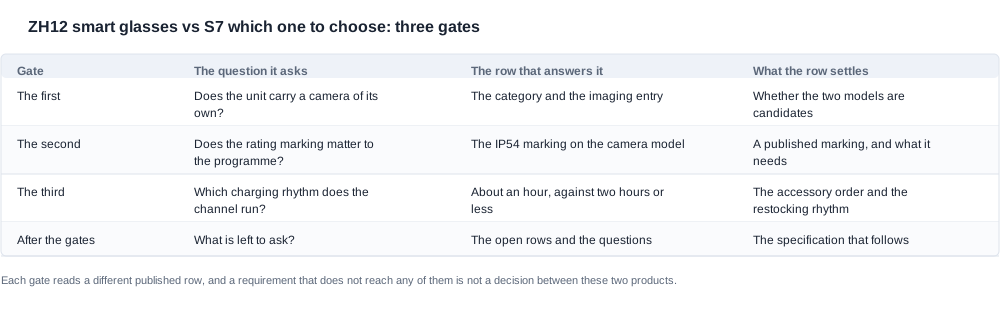
The three gates, in the order they go in, are these. Does the unit have to carry a camera of its own? Does the rating marking have to appear on the carton? And what charging rhythm does the restocking plan assume? Everything else is a detail inside a gate rather than a reason to prefer one product over the other.
Nothing in this article describes how either product performs, and no figure here is an estimate. Where the record is empty, the article names the party that can close it.
Zh12 smart glasses vs S7 which one to choose: three gates and what each one reads
Why a framework beats a recommendation here
Three reasons, and they are structural rather than editorial.
The two products are not substitutes. A channel that has a camera proposition and a channel that has a sport proposition are running two programmes. There is no version of this comparison in which one of the two rows answers the same question, because they are answers to different questions.
The published rows are thin on the things that decide it. A camera model publishes an imaging class, and no further detail about it. The sport model publishes two function entries and nothing further about them. Neither publishes a weight, so the catalogue offers no way to compare how the two sit in the hand, and no way to compare behaviour in use either.
What a channel can actually decide is a scope question. Does the unit carry a camera, does the marking have to be printed, and what is the restocking rhythm. Those are three questions with three published rows behind them, and answering them is a much shorter piece of work than the comparison they replace.
How the gates are used
Each gate is a filter, and a filter can end the process. If the first gate ends it, nothing else needs to be known, and the buyer has saved the cost of evaluating a rating marking that was never going on the carton. If the first gate does not end it, the second gate runs, and if the second gate does not end it either, the third one runs and the specification that follows is assembled from what the three gates have left open.
The order matters, and the reason is that the gates are not equally expensive. The first gate costs a reading. The second costs a document request, because a rating marking is a published fact but a claim about it needs a report behind it. The third costs a measurement and an accessory decision. Running them in the wrong order means paying for the expensive one before knowing whether the cheap one would have answered the question.
The last branch is the most useful one
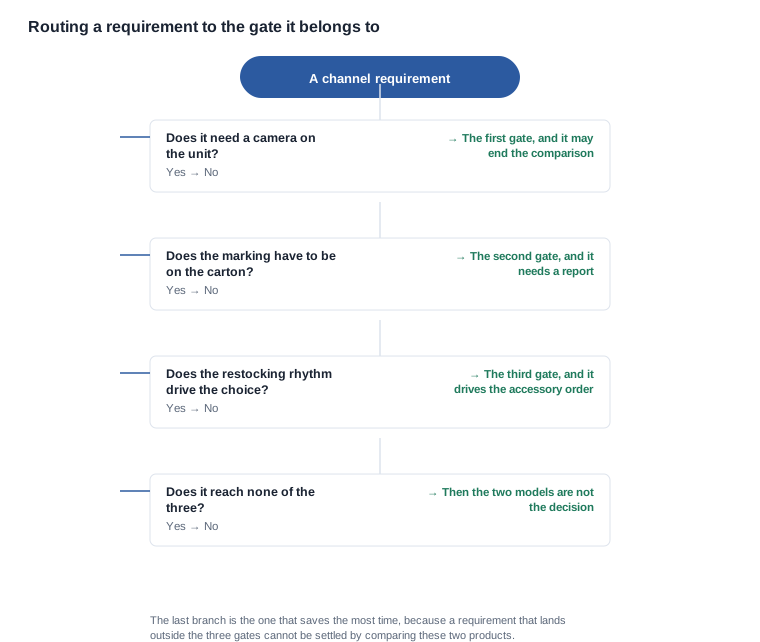
A requirement that reaches none of the three gates cannot be settled by comparing these two products, and that is a genuinely valuable finding rather than a dead end. A buyer who arrives at that branch has learned that the decision it was trying to make is not a product decision at all: it is a decision about the range, the channel or the market, and it needs a different shortlist.
That branch is also where a lot of buying conversations actually end, and it is rarely noticed, because the conversation is still going and the products are still on the table.
The three gates, stated so they can be run in order
- Does the unit have to carry a camera of its own? The category and the imaging entry answer this. If the answer is yes, one of the two products leaves the shortlist, and the work moves to the rows behind the imaging class.
- Does the rating marking have to appear on the carton? The IP54 marking published on the camera model answers this, subject to the report behind it. If the answer is no, the gate closes at no cost, and if the answer is yes, it becomes a documentation item with an owner.
- What charging rhythm does the restocking plan assume? The charge time row answers this, with roughly one hour published for the sport model and a ceiling of two hours or less for the camera model. This is the one gate the buyer closes alone, and it decides the accessory order rather than the product.
A requirement that reaches none of the three is not a comparison between these two products. It is a statement about the range, the channel or the market, and the right next step is a different shortlist rather than a different answer.

The first gate, camera or no camera
The first gate asks one question: does the unit have to carry a camera of its own?
The published rows that answer it. The camera model publishes a category and a thirteen-megapixel imaging entry. The sport model publishes a category and two function entries, neither of which is an imaging entry, and the remote photo one of those is a control rather than a camera. There is no imaging entry on the sport model's page, and the catalogue does not publish a camera specification for it.
Why the gate is decisive rather than advisory. A channel that needs its customers to capture something with the unit itself is in the camera model's group, and a channel that needs the unit to control something else is in the sport model's group. The two propositions are not variations and the gate does not need a comparison to close it; it needs a reading of two category lines.
The mistake this gate prevents. The remote photo entry on the sport model reads like an imaging feature, and a buyer who reads it as one will put a product without a camera into a camera proposition. The entry says that the unit can operate a photo function; it does not say that the unit photographs. The two published pages contain nothing that settles what the paired device is, which means a buyer who has passed this gate still has a question to put in writing.
What has to be asked once the gate is passed. What the imaging class covers, and what sits behind it: no sensor, no coverage, no rate, no storage capacity and no format are published. And, for the sport model, what the remote photo function triggers, what the paired device has to be, and whether the function is available at all in the configuration being ordered.

The two paths out of the gate
If the unit must carry a camera, the camera model is the only one of the two in the catalogue that publishes an imaging entry, and the specification work moves on to the rows behind the class, all of which are blank.
If the unit must not carry a camera, the sport model is the one whose published function entries describe a control rather than an imaging, and the specification work moves on to the behaviour of those two entries, which is also blank.
Either way the gate converts a vague preference into a short list of unanswered rows, and that is a stronger position than the one where two products are still on the table.

The second gate, and the row that answers it
The second gate asks whether the rating marking has to appear on the carton. It reads the IP54 marking published on the camera model, and it is the gate that most often turns into a documentation question rather than a specification question.
What the marking is and what it is not. The camera model publishes an IP54 marking. Two models in the camera group publish it, so it is a shared fact of that pair rather than something that separates a camera model from a sport model. What it is not is evidence: our catalogue publishes the marking and supplies no test report behind it, so a channel that repeats it on packaging, in a listing or in a specification is making a claim about the product, and the evidence for that claim has to be requested from the manufacturer first.
Why it is a gate rather than a line. A channel that has decided the marking will not appear on the carton has closed the gate, and everything about the marking stops mattering. A channel that has decided it will appear has two questions in front of it, and both of them are questions for the manufacturer: which report stands behind the marking, and what the report covers. A report for one configuration is not a report for another, and a marking printed for a range is not a marking for every unit in it.
The two questions to put in writing. Which test report supports the published marking, and which model designations and configurations does it cover. And, separately, what the channel may state if the report is not available: the answer has to be written down in the artwork approval rather than decided in a corridor, because a marking that is printed once is very hard to take back.
What a buyer should not do. The red flags here are simple. Printing the marking because it was printed for the model, without a report. Extending a report across a configuration it does not cover. And treating the presence of a marking in a catalogue as though it were a warranty of the product's behaviour in the conditions the customer will meet.

The third gate, and the order the questions go in
The third gate asks what charging rhythm the restocking plan assumes, and it reads the charge time row on each page: about an hour on the sport model, and two hours or less on the camera model.
What the row settles, and what it does not. It settles that the two models have different published intervals. It does not settle the state either interval starts from, what either restores, or what a channel's restocking rhythm is in practice. Those are three separate things, and the published figure is only the first.
The point about sharing. About an hour of charging is published for two models in the sport group rather than one, so a channel that describes a short charge as something the sport model does will find that another model in the same group does it too. That matters for a listing, because a differentiating feature that another product in your own range also has is a weak claim, and for a decision it matters because a requirement that lands on that row cannot separate the two sport models from each other, let alone a sport model from a camera model.
What the gate actually decides. The accessory order, and nothing else. A channel whose restocking rhythm assumes an hour has a different charger, a different spare-parts policy and a different customer instruction from a channel whose rhythm assumes two hours or less, and that is a purchasing decision rather than a product comparison. It is also the decision that a channel makes with the least information, because both figures are published and the choice is a commercial one.
Why it comes last. Because it is the only gate that the buyer can close without anyone else's help. The first gate is a reading. The second needs a document. The third is a decision. A buyer who has a preference on the charging rhythm but no camera requirement and no marking requirement has, in effect, already decided, and the useful work is to write that decision into the specification rather than to look for a product that agrees with it.
The one thing the third gate cannot do is settle a question about what the unit does, because a charge interval says nothing about a working day. A channel that expects a customer to run a sport model through a long session and a camera model through a long recording has a workload requirement rather than a charging requirement, and that requirement belongs to the first gate's branch rather than to this one.
The questions the three gates leave open, once they have been run
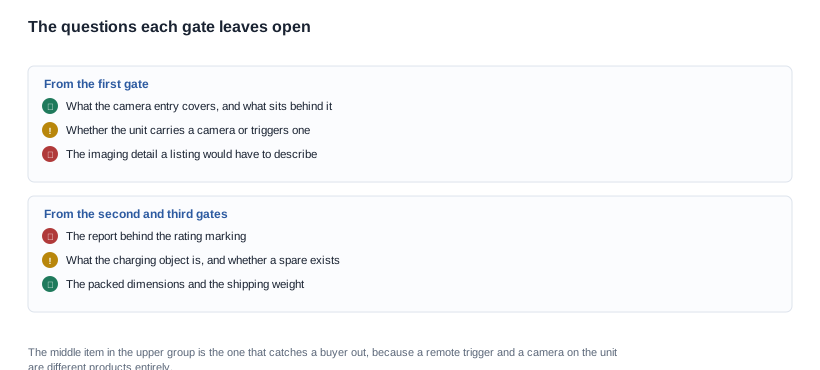
The six items in the checklist are the residue of a comparison that has been run properly. They are not all open at the same time: the first three belong to the camera branch, the second three to the sport branch, and the fourth and fifth are common to both because the packing and the charging object have to be settled either way.
The criteria for deciding which of them to close before the artwork is the one a buyer should apply to every open row in a programme: can the customer do something they could not do before, does the channel have to buy something it does not hold today, and is there a claim on the carton that depends on it. A row that changes none of the three can wait for a second order, and a row that changes the third has to be closed before a carton is printed.
There is a fourth criterion that is not about the row at all, and it is the one that catches the most programs. A question that can only be closed by a sample, and a sample order that has to be placed before the configuration is settled, produces a sample of the wrong thing. The order of the questions therefore matters more than the number of them: settle the configuration first, then order the sample, then run the measurements, because every measurement taken against the wrong configuration has to be taken again.
The commercial shape of the outcome
Whatever the gates return, a buyer ends up with one of three states. A camera programme with an imaging specification to write, a rating marking to evidence, and a magnetic charging accessory to stock. A sport programme with two function behaviours to describe, a Type C lead to supply, and no camera to explain. Or a conclusion that neither of these two products is the answer, which is a less costly outcome than either, because it arrives before the sample order rather than after the first returns analysis.
The trade-off inside each branch is a normal one. The camera branch carries a documentation and accessory workload of its own, and returns a proposition with a wider customer appeal. The sport branch carries a different workload and returns a proposition built on controlling something else rather than on capturing. The published rows do not say which of the two is right for a given channel, because that answer is a property of the channel.
The decision a buyer has to make at the end of the gates is a scoping one, and scoping decisions are worth naming because they are made under time pressure and rarely recorded. How much documentation work will the programme carry, and who in the organisation owns it? How many accessory lines will the channel hold, and who stocks them? What will the support desk be able to answer on the first call, and what will it have to escalate? A buyer who answers those three in advance has a programme; a buyer who answers them after the first returns analysis has a lesson, and the lesson lands harder.
Our position on this choice
What the catalogue prints for each of these two products is what we can put in front of a buyer, and we will not tell a buyer which one to choose, because the choice is a property of a programme and a channel rather than of a product, and because the record we hold does not contain the information that would decide it. We will not describe the sport model as the one with the faster charge, because the roughly one-hour figure belongs to a pair of sport models in that group, and we will not treat the camera model's rating marking as a claim, because a report behind it has not been published.
What we will do is run your requirement through the three gates, tell you which gate closes it, which rows that leaves in play, and which questions have to be put to the manufacturer before anything goes on a carton.
Give us the requirement in one sentence, the order in which the markets will be entered and the configuration under discussion, and we will walk the gates with you and hand back the open items with an owner against each one.
What comes back is a short document rather than a name, and that is the point of the framework. It tells you which gate closed the comparison, which rows are still open and who can close them, and which of the questions are worth sending today because they are free to ask. The three gates are the part of this comparison that can be done before anybody spends anything, and they are usually enough to make the product decision that the specification was never able to make on its own.