A ZH12 smart glasses vs V06 spec comparison is a row-by-row exercise. It is unglamorous, and that is its advantage: a row is either published or it is not, and a procurement team can check every line of it in a few minutes without a sample, a test lab or a supplier call. The trouble starts when a row that happens to be identical on two models is read as a property of those two models rather than as a property of the group they both belong to, and the trouble spreads from there into the copy, the listing and eventually the range plan.
This is what a review of the two sets of published rows looks like when it is done properly. The rows are set out one by one. The rows that differ are separated from the rows that match. The matching rows are then checked against the range rather than against the other product, because a row that is identical on two models says more about the group than it says about either of them. And the blanks are listed, because a blank is the only kind of row that cannot be checked by reading.
Two things this article deliberately does not do. It does not name a winner, because a published row cannot decide that and because the rows for these two products do not even overlap. And it does not fill a blank, because the blanks are the commercially important part of the comparison and they belong to a conversation with the manufacturer rather than to a paragraph written by a catalogue.
Zh12 smart glasses vs V06 spec comparison: the rows that line up and the rows that do not
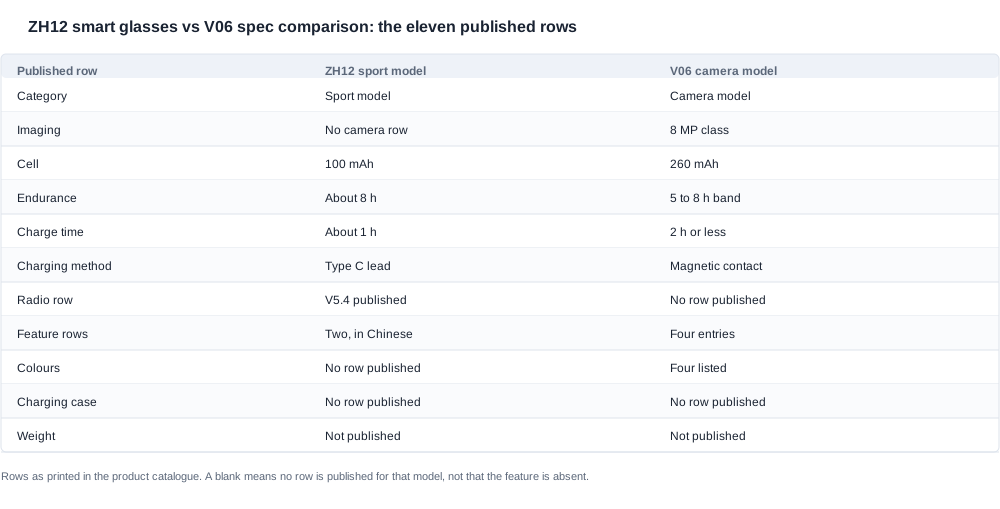
The eleven rows, and what each one is for
Category. A sport model and a camera model. This is the row that settles whether the two products are competing for the same slot, and they are not. Everything below inherits from it.
Camera. The camera model publishes the eight megapixel resolution class. The sport model publishes no imaging entry, and the two function entries it does publish describe a control and a sound characteristic rather than a camera.
Cell. The sport model carries a hundred milliampere-hours; the camera model carries two hundred and sixty. Both are single cells, both are published, and neither of them says what the unit does with the energy.
Endurance. A single rating of about eight hours, against a published band of five to eight hours. A rating and a band are different kinds of measurement, which is why this row is the one most often over-read and the one a comparison should handle most carefully.
Charge time. Roughly an hour against a ceiling of two hours or less. Both are bounds, and the one-hour figure is a property of a pair of sport models rather than a distinguishing line for either of them.
Charging method. A Type C lead against a magnetic contact, and this is the row that changes what a channel has to buy, pack and explain.
Radio. A version published for the sport model and no version row for the camera model.
Feature lines. Two on the sport model, written in Chinese, covering a remote photo function and a surround sound function. Four on the camera model, covering an ergonomic design, a long-endurance line, a removable inner frame and a rating marking. The long-endurance line is a published feature entry rather than a figure, and it should be read as an entry rather than as a performance statement.
Colours. Four are listed for the camera model and none for the sport model, which is a configuration question rather than a specification one.
Case. Neither product has a charging-case row in our documentation. That is an absence in the record rather than a statement that either product has no case, and the two cases are not the same absence.
Weight. Not published for either of them, and not published for any model in the range apart from one. There is no way to compare how these two sit in the hand from the catalogue, and a channel that wants that comparison has to weigh a sample of each.
Which of the eleven actually decide anything
Four of them, and they are the same four that decide every comparison in this category: the category, the function entries, the charging method and the rows that are blank on both sides. Everything else is a number that a buyer can read, check and put in a document.
The rows that differ between the two products are numerous, and their number is not evidence of a large difference. Two products in different groups differ on almost every row, and the difference is a fact about the categories rather than about the products. A buyer who counts differences is counting categories.
How to compare the rows that differ without turning them into a verdict
A buyer who intends to compare rather than to rank needs a method that survives a review, and three steps carry most of the weight.
Split the rows into three piles rather than two. The usual sort is same and different, and it produces the misleading result, because a row that is filled on one side and blank on the other gets filed under 'different' — which is true and useless. A three-way sort separates rows that differ on values, rows that match on values, and rows where only one side publishes anything. Once the one-sided rows become a pile of their own, each of them turns into a question, and a question can be given an owner, a date and a place in a due-diligence file. That is the difference between a comparison and a complaint.
Evaluate each differing row by what it changes downstream. A row is commercially live if it alters one of three things: what the customer can do, what the channel has to buy and pack, or what the channel may say in print. The charging method row reaches all three. The radio version row reaches the third. A colour row reaches none of them for a B2B channel, and putting it in the specification without saying so is how a 3000-word comparison ends up with a 300-word specification in it. Working the eleven rows against those three questions is how to decide which differences deserve a place in the document and which belong in a note.
Write the criteria down before the numbers arrive. The criteria for this comparison are short and they are not negotiable: a figure that carries its unit and the method behind it, a condition somebody else could reproduce, and the date it was produced. If a row cannot be written to that standard, it does not go in the specification — it goes in the list of things to ask. Setting the criteria in advance is also what stops a procurement team from drifting into a comparison it did not intend to make, because the criteria decide what the comparison is for. A comparison written to settle an accessory programme produces a different document from one written to settle a carton claim, and the buyer should say which one is being done before the rows are read.

The camera rows, and the category they belong to
The camera model's page carries the entries that make it a camera product: an imaging class at the eight megapixel level, a removable inner frame, a rating marking, and an ergonomic design line. The sport model's page carries a different set entirely, and the two sets have almost nothing in common beyond the electrical rows that every product in the range publishes.
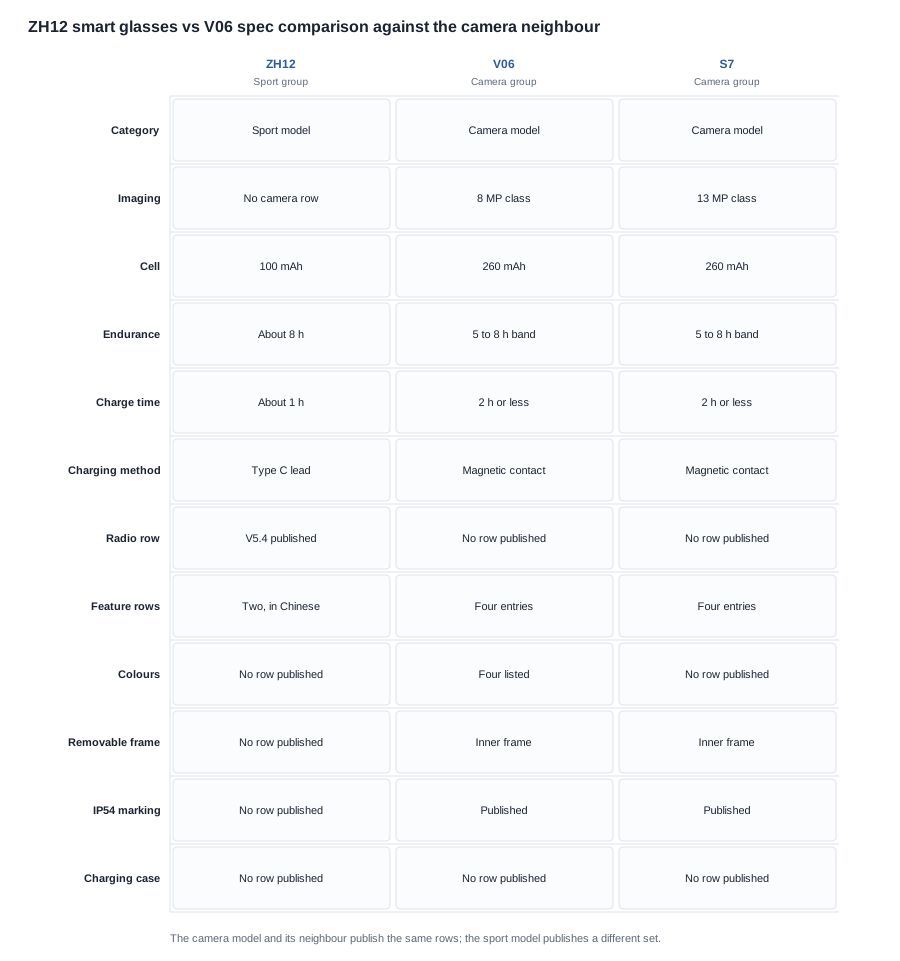
The camera neighbour that shares six published rows
This is the part of the comparison that most often surprises a buyer, and it is worth handling carefully.
The camera model on the left of the matrix has a neighbour in the camera group with which it shares six published rows: the cell, the endurance band, the charge ceiling, the charging method, the removable inner frame and the IP54 marking. The ergonomic design entry appears on both catalogue pages as well. What separates the two of them is the imaging class, which is eight megapixels on one and thirteen on the other, and the colour line, which appears on one and not on the other.
What this means for the comparison. A buyer who has read only these two pages and is now thinking about the camera model as though its specification were distinctive of it is mistaken about half the sheet. Those rows are the camera group's rows, and they are what a camera product in this range looks like on paper. They are a useful description of the category and a poor description of the individual product.
What this means for a range plan. It means a channel that carries two camera models is carrying two products that are nearly identical on paper, and the differences that will be visible to a customer are the imaging class and the colour. That has a consequence for the accessory and the packaging: the two will share a charging programme, and the parts that differ are the parts that have to be named on the order line.
And what it means for the sport model. The rows the two camera models share are rows the sport model does not share with them, which is another way of saying that the camera group's common specification is a specification for a camera product and not a general one. A buyer comparing the sport model against the camera model is not comparing against a product that happens to be similar; they are comparing across a boundary.
The function entries, and what they do not say
The sport model's two entries are written in Chinese on the catalogue page, one covering a remote photo function and one covering a surround sound function with an extra qualifier. Neither entry says what the function does in operation, what it pairs with, or what the user needs for it to work, and the camera model's four entries are equally silent about behaviour: an imaging class with nothing behind it, a removable inner frame with no description of what it is or how it is attached, a rating marking with no report, and a design line that is a design line.
A comparison is supposed to make the products more intelligible, and the function entries are where it usually fails, because two labels that sound like features are treated as features. The discipline is to read each entry as a statement of existence rather than as a description, and to write the gap next to it.
What the category rows mean for a procurement shortlist
For a channel building a shortlist, the category row is the first filter and it is a hard one, because these two products are not two answers to a single requirement.
Decide what the requirement is before the models are compared. A requirement phrased as "a pair of smart glasses" will produce both of these products and neither of them as a deliberate choice. A requirement phrased as "a sport model for an active channel" or as "a camera model for a content channel" produces one. This is the criteria step in its most practical form: write the requirement as a sentence that names the use and the customer, then test each shortlisted model against it. Two products that sit in different catalogue groups will pass the same loose requirement and fail the specific one, and the cost of discovering that after the order is a range that has a gap in it.
Budget the two categories as two programmes rather than one. A channel that carries both is committing to two accessory routines, two packing specifications, two sets of customer instructions and two lines in the after-sales file. That is a supply-chain decision rather than a product decision, and it belongs in the same file as the unit price, the lead time and the MOQ questions rather than in the specification sheet.
Check what the group rows will let you write on the carton. The rating marking is the clearest case. It appears on two of the eleven camera models and on none of the sport models, so it is a category entry rather than a property of the product a buyer is comparing. Our catalogue publishes the marking and no test report behind it, and a marking that has been printed on a carton for one model cannot be withdrawn for the other. The red flags in a draft listing are specific: the marking repeated without a report, an endurance band reduced to a single runtime, and a group row written as though it were exclusive to the product in the photograph. A due-diligence checklist for this comparison should catch all three before the artwork is signed.

The rows the two models share, and what sharing them does not mean
Two of the eleven rows are identical on both sides, and both of them are blank.
The case row is absent on both. Neither product has a charging-case row in our documentation, and an absent row on two products is one gap rather than two findings. It also does not say that either product has no case. A channel that needs to know what is in the box has to ask, and the answer may differ between the two even though the row is the same.
The weight row is blank on both. And because the weight is unpublished across the range apart from a single model, there is no comparison to be made here at all, for these two or for any others. A channel that wants to describe how a product feels has to weigh it.
The sharing of a blank is easy to overlook, and it is worth noticing what it hides: two products that look identical on the two rows where the catalogue is silent, and completely different on the rows where it speaks. A comparison built on the published rows therefore produces a much sharper picture of the difference between the two products than of either of them, and a much weaker picture of what a customer would actually receive.
What a buyer can state, and what has to be asked
Stated as printed. The category of each product, the function entries each carries, the cell figure, the endurance figure in the form the catalogue uses, a charge time published as a bound, the charging method, the radio version on the sport model, the removable inner frame and the rating marking on the camera model, and the four colours listed for the camera model.
Asked in writing. What the imaging class covers and what sits behind it. What the two sport-model function entries do in operation. What the removable inner frame is and how it is attached. Whether a replacement can be obtained for it. The report behind the rating marking. The case position for each product. The weight and the packed dimensions of each.
Not to be inferred. That the camera model carries more information because it has more rows. That the rating marking is a warranty. That the sport model's longer-looking runtime means it runs longer. That a shared row is a property of the two products rather than of the group they sit in.
A verification sequence for the shared rows
Two shared blanks cannot be closed by reading, and a buyer who wants to close them before the order rather than after it needs a sequence rather than a request.
Weigh and measure a sample of each, before the order is placed. A single unit of each model, weighed with the accessory that ships with it and measured in the packed box, settles more than a paragraph of correspondence and settles it in a form that can go into the freight model. Record the method and the date, because a sample result without a method is an anecdote.
Ask the two blank rows as two separate questions. The case row is blank on both, but the answer for the sport model and the answer for the camera model need not be the same, and a single combined question invites a single combined answer. The weight question has the same problem: one figure for the range is not a figure for either product.
Ask for the evidence rather than the conclusion. For the rating marking the request is a report; for the case position the request is a packing list; for the weight the request is a declared figure with the units and what the measurement includes. A supplier who answers with an adjective has not closed the row.
Write the answers into the specification with their limits attached. A verified figure with a method and a date travels into a tender response, a spec sheet and a returns analysis. An adjective travels into none of them. This is the small discipline that decides whether a comparison survives the first audit that meets it, and it costs one clause in the document.
Where the comparison stops, and what has to be asked

The sequence in the image is the reading discipline, and each of its six steps exists because of a specific way this comparison goes wrong.
The four questions the comparison raises
- What does the imaging entry cover, and what sits behind it? The sensor, the coverage, the rate of capture, the storage and the format are all unpublished for this class of product, and a listing that describes any of them is describing something nobody has stated.
- What is the removable inner frame, and does the unit ship with it fitted? A part that comes off is a configuration item, an accessory line and a service question, and all three need to be settled before an order rather than after it.
- What is the report behind the rating marking? Our catalogue publishes the marking and no test report behind it. The marking is a published fact about the product; repeating it as a claim is a different act, and the evidence for it has to be obtained first.
- What is the case position for each product? One question per product, because the row is blank on both and the answer is not the same on both.
The checklist, and the cost of leaving each line open
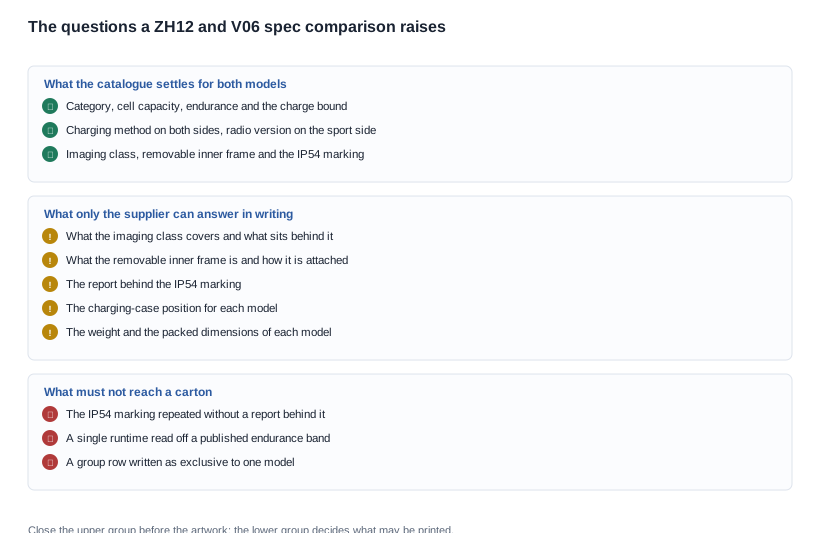
The criteria for deciding which of these to close before the artwork is the same one a buyer applies to any comparison: whether it changes what a customer is able to do, what the channel has to buy, and what the channel is allowed to print. The first line in the upper group does all three, the last line in the lower group does none of them in a way that blocks anything, and the middle line in the lower group is the one that decides whether a printed claim is safe.
The trade-offs to evaluate before you commit
A comparison that stops at the specification leaves the buyer with a sheet and no decision. Three trade-offs are worth pricing out explicitly, and each of them can be assessed against the rows rather than against a preference.
Specification effort against measurement effort. Some rows can be closed with a sample and a question. Others cannot be closed at all without a test programme, because the published figure is a band and the customer-facing claim needs a spread. A buyer who funds the measurement programme gets a runtime it can defend; a buyer who does not gets a runtime it cannot, and the difference between those two positions is a defect rate and a support cost rather than a line in the specification.
Carrying one model against carrying two. Two models means two charging routines, two packing specifications and two lines in the service file. One model means a single routine and a thinner range. Which of the two is right depends on the channel's coverage requirement and on nothing in either catalogue page, so it belongs in the business case rather than in the comparison.
Saying less against saying more. The published rows support a short, defensible claim set. Every additional phrase a listing adds beyond that is a phrase a supplier's quality control, a customs check or a customer can pull the specification apart on. The trade-off to evaluate is not how much the copy can say, but how much the channel is willing to defend.
The useful thing about assessing a trade-off this way is that it produces a decision a buyer can take to a supplier and a manager without a slide. Each item names the row it rests on, the action that closes it, and the cost of leaving it open. That is what a comparison is for.
What the comparison is worth once it is done
A comparison like this one is worth doing for a reason that is easy to miss, which is that it tells a buyer what not to write as well as what to write. Eleven rows produce four usable specification lines, two shared blanks, two one-sided blanks and a list of questions. That is a smaller output than a marketing comparison produces and a much more useful one, because a specification is the document that survives a review, a tender response and a returns analysis, and a marketing comparison is the document that has to be rewritten when the first customer contradicts it.
Our position on these two products
For both of these products the printed rows are the whole of what the catalogue holds, and we will not extend them into a ranking, because the two products are in different groups and the rows do not overlap. We will not describe the camera model as the one carrying the fuller specification, because its specification is largely the camera group's specification, and we will not repeat the rating marking as a claim, because the marking is published without a report behind it.
What we will do is take the specification you have to write, mark it against the eleven rows, and tell you which lines it can be written from, which lines are shared with a wider group, and which questions must go to the manufacturer before the document is issued.
If the draft specification, the sequence of markets you intend to enter and the configurations under discussion can be sent over, the eleven rows above can be marked against all three, and the remaining blanks can be returned as a list with an owner against each one.