

Most suppliers will answer almost any question you put to them about AR glasses display technology, and the answers will be worth very little. A supplier who has a display programme can describe the panel, quote a field of view, name a coupler and discuss brightness for an hour without telling you a single thing that could change a purchasing decision. The reason is structural: most of those questions have a factual answer and none of them has a decision attached, so the answers return as information rather than as commitments. The question set that works is much shorter and much more awkward, because each one is designed to force a condition, an owner or a cost out of the answer. This article sets out that set in the order to ask it, what a usable answer sounds like, and the point at which a supplier's answer is telling you to move on to somebody else.
AR glasses display technology: the seven questions that settle a programme
The short answer on asking a supplier about AR glasses display technology
Seven questions do most of the work, and they fall into three groups that have to be asked in that order. The first group establishes whether there is a conversation to have at all: does this product contain an image, and who owns the display programme. If the answer to either is unclear, the remaining five questions produce answers about a product you are not buying, and the evaluation has to start again somewhere else.
The second group forces the measurement conditions. For each headline figure the supplier has quoted, ask what the number was taken under and who stands behind the condition. The point is not to interrogate the supplier; it is to move a figure from the category of a claim into the category of something a buyer can compare with another supplier's figure. The AR glasses display technology checklist is the same list arranged for sending rather than for asking.
The third group finds the structural gap: which parts have a second source, what a change of display or coupler costs, and what happens to the quoted figures when the programme changes. These are the questions that determine whether the price you are negotiating today is the price you will pay in year three, and they are the ones a supplier is most likely to answer generously and vaguely.
Three things make the difference between a set of questions and a useful evaluation. The first is that every answer is written down in the same place, in the same format, for every supplier. The second is that each question has a completion test — a named party, a number, a document or a date. The third is that a question that produces a vague answer is recorded as unanswered rather than being allowed to become an assumption, because an assumption fills the cell in the comparison table and then compares itself against a competitor's fact.
Who this is written for, and what the conversation has to settle
The reader is a procurement manager or a product lead who is running an evaluation of AR-capable suppliers, most often with two or three quotations in hand and a need to choose before a tooling decision. The decision is not technical. It is which supplier's programme will still be true in eighteen months, at what price, and with what evidence behind it if the product underperforms in the field.
What that reader is managing is the cost of a wrong decision rather than the price of a right one. A wrong display programme in this category is not recovered by re-ordering: the housing, the firmware assumptions and the marketing material have all been built around figures that turn out not to hold. The cost of finding out late is a re-engineering cycle and a re-approval cycle, and both of them sit on the launch schedule where nobody can hide them.
The second thing being managed is the evaluation itself. A supplier evaluation has a budget of meetings and a budget of patience, and neither is unlimited. The question set in this article is designed to spend that budget in the right order, because the first two questions can end a supplier evaluation cheaply and the last two can end it expensively. It is better to learn in week one that a supplier does not own the display programme than in month four.
What a good evaluation should look like before the first call
Before any supplier is contacted, it is worth deciding what the comparison sheet should look like, because the sheet determines what the questions are for. A sheet with a row per figure and a column per supplier, plus a column for the condition each figure was taken under, is the minimum that makes two quotations comparable. A sheet with a column for who signed each figure is better. A sheet with a column for what happens to that figure if the component changes is the one that stops a programme from being quietly re-based.
This preparation is also what makes the evaluation fair. Suppliers who know the criteria are being applied give better answers, because they can prepare the evidence rather than being asked for it cold. And a supplier who cannot fill a cell does so in the first round rather than the fourth, which is worth more than any refinement to the questions themselves.
Two things are worth deciding before the first call as well. Whether a quote that has no conditions attached is still eligible, or whether the conditions are a qualifying condition of the evaluation. And who inside the buyer's organisation owns the optical decision, because a supplier that is asked the same question by two people with different expectations will produce two answers, and the buyer will have to arbitrate between them.

What the first three questions are actually establishing
The first three questions are not technical and they are not difficult. They are difficult for the supplier to answer well, because a good answer discloses something about the structure of the programme that a supplier has a commercial reason to be vague about.
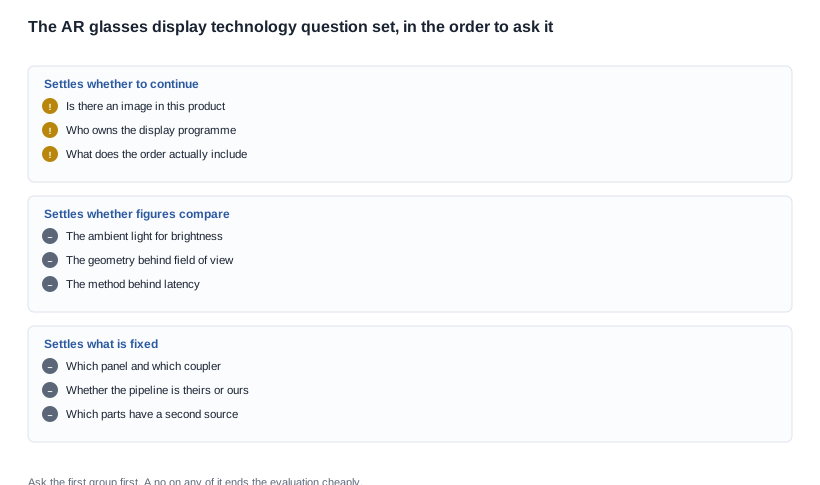
Question one: does this product contain an image, and if so, which one? The question is asked in this form because "is this an AR product" is not answerable and "does it contain an image" is. A supplier that answers with a family name has answered a different question. The useful answer names the display architecture and says whether the image is generated by the product or by an attached phone or host device, because that single fact determines whether the performance figures belong to the product being quoted or to a device the buyer may not be buying.
Question two: who owns the display programme? Not who supplies the display, which is the easier question with a more agreeable answer, but who is accountable for the figures the supplier is quoting. The answer is usually a module supplier, a partner company, or the factory itself, and each of the three leads to a different follow-up. A module supplier means the figures will be quoted with a condition attached or not at all. A partner means there is a party you may never speak to, which is a risk in itself. The factory itself means there is one place to escalate to, which is worth paying for.
Question three: what does the order actually include? This question exists because the boundary between a product and an ecosystem is where commercial disputes live. A display programme may be quoted as a unit, as a development kit, as a reference design, or as a component the buyer is expected to integrate. The unit price, the lead time, the warranty and the support responsibility are completely different in the four cases, and the quotation often does not say which one is being offered.
The three questions together are what the AR Display Technologies pillar cannot answer for you, because they are questions about a specific supplier's programme rather than about the technology. If the answer to any one of them is vague, the practical response is to record it as an unanswered cell rather than to press for a better answer, because the information will not improve with repetition and the evaluation will not be decided on this supplier anyway.
The questions that force a measurement condition into the open
Once the programme is established, the next set of questions attaches conditions to the figures already on the quotation. The technique is the same each time: take a headline figure, ask what it was measured under, and then ask who stands behind the answer. The second half of the question is what separates a supplier who has done the work from one who is relaying a number.

The sequence above is deliberately short. The five questions, applied to each figure on the sheet, produce a comparison table that two suppliers can be assessed on. The last step is the one that protects the order: a figure that still has no condition attached after the exchange is rejected rather than carried forward with a note.
The condition questions that matter most are these. For brightness: the ambient illuminance, the angle of the ambient source, and whether the figure is at the panel or at the eye. For field of view: whether it is horizontal, vertical or diagonal, whether it covers one eye or both, and where the eye is expected to sit. For resolution: whether it is a panel figure or a delivered figure, and what the delivered figure is in pixels per degree under the quoted field of view. For latency: what motion was measured and whether motion to photon was the method. For colour: the colour temperature, and what the behaviour is at the edge of the field.
There is a question worth asking about every figure that is not about the figure at all: is this a specification the supplier will warrant, or a measurement they performed? The two are quoted with different words, usually, and the difference is worth more than the number. A supplier that volunteers the distinction is telling you that its documentation is real.
What a usable answer sounds like against a soft one
The table below is the practical output of the condition questions. It is not a scoring sheet; it is a translation table, so that the buyer can tell a soft answer from a usable one without needing to know anything about optics.
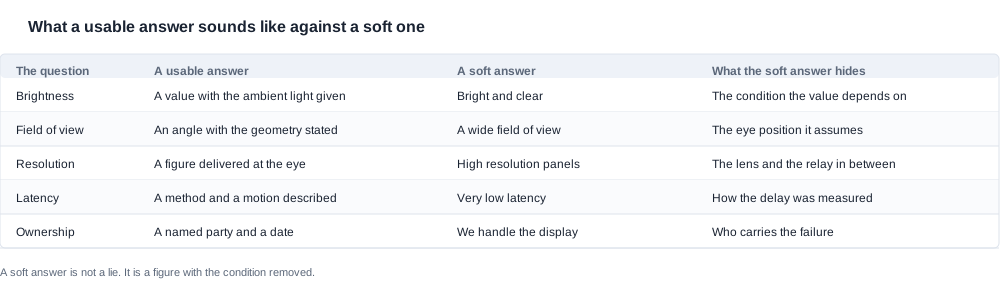
A soft answer is not a lie. It is a figure with the condition removed, and it is produced by good suppliers as well as poor ones, usually because the condition lives in an engineering document that the commercial contact has never been shown. That is why the follow-up matters: the question is not "why did you not tell me", it is "can you tell me, and who else has to agree".
The pattern to watch for is the answer that is always about the technology rather than about the configuration. "It depends on the application" is a correct answer to a design question and an unhelpful one to a procurement question. The follow-up that resolves it asks what the supplier would quote if the application were fixed to the one being bought for. That question produces a number, a condition, or an admission that the figure is not available, and all three are useful answers.

Reading a hedged answer, and what it says about the programme
Hedging in this category is normal and it is informative, because the thing being hedged tells you which part of the programme is weak. Three hedges come up repeatedly and they mean different things.
The hedge about the future — "that will depend on the next revision" — indicates a programme in development rather than a product in production. That is not disqualifying, but it changes what the buyer can rely on: nothing about the figures can be written into the order as a commitment, and the evaluation has to be about the programme's trajectory rather than about a product. The follow-up that settles it is a request for a written figure that applies today, even if it is lower than the roadmap figure.
The hedge about ownership — "the display is supplied by a partner" — indicates that the supplier answering is not the supplier who decided the figures. This is a common and legitimate structure. Its consequence is that the buyer may need to speak to a second company, and the practical step is to find out early whether that conversation is permitted, because a supplier that will not let the buyer speak to the party that owns the optical design is telling the buyer something about how a future problem would be handled.
The hedge about the cost — "we would need to check the tooling impact" — is the most informative of the three, because it means the answer exists and is not free. It also means the figure in question is part of the architecture rather than a detail, and therefore that a change to it is a project. This is where the negotiation about programme structure actually happens, and it belongs in the quotation rather than in a later conversation.
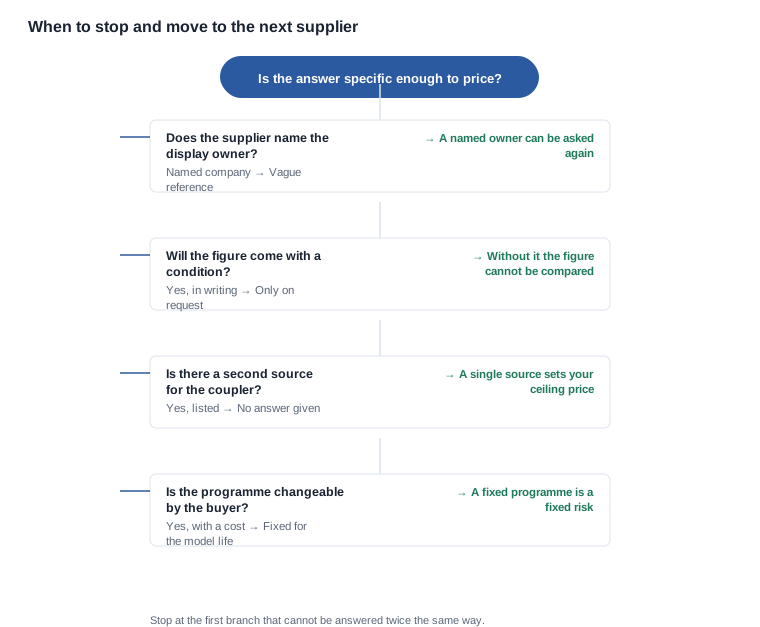
The decision tree above turns the hedging into a routing instruction. The first branch is the one that matters: if there is no named owner, there is nobody to escalate a figure to and no point collecting more answers from this supplier. Stopping there costs one call.

When a supplier's answer tells you to move on
There is a point in an evaluation where continuing is no longer information gathering. It happens when the supplier's answers stop varying, which usually means the evaluation has reached the limit of what that supplier is prepared to disclose rather than the limit of what is known.
Three answers are enough to justify moving on, and they are worth having written down as the exit criteria before the first call so that the decision is not made emotionally at the end of a long call:
- The owner of the display programme cannot be named. If no party is accountable for the figures being quoted, there is nobody to escalate a figure to when it is questioned.
- A headline figure refuses its measurement condition twice, by two different routes. One refusal is usually a communication problem. Two refusals, from two routes, is a policy inside the supplier.
- The figures and the conditions contradict each other. A brightness quoted at the eye, paired with a coupling efficiency that could not produce it, means the quotation was assembled from more than one document without anyone reconciling them.
Moving on is not the same as disqualifying. In a market with a small number of capable suppliers, a supplier who fails an exit criterion may still be the right answer for a different programme, and telling them which criterion they failed is more useful to them than silence. It also preserves the relationship, which matters in a category where the number of suppliers is small enough that everyone knows who has been evaluated and how.
The practical benefit of declaring exit criteria in advance is that it converts a judgement call into a process, which is what makes the result defensible when a supplier asks why they were not selected. It also stops a good supplier with an unusual structure from being dropped for being hard to read.
What the exit is worth commercially
A supplier evaluation is not free. It consumes supplier time, which shows up as a longer quotation cycle, and buyer time, which shows up as delay on every programme that waits for it. The commercial argument for a disciplined exit is therefore mostly about the programmes you have not started yet.
The figure that matters is the number of suppliers evaluated to reach a decision, and the number of questions each one required to answer. A supplier who answers the seven questions in one round has cost the buyer one round. A supplier who requires four rounds has cost four, and the cost is not linear, because the fourth round usually arrives after the buyer has already built internal expectations around their figures.
This is also where the comparison between quotations becomes fair. When two suppliers have been asked the same seven questions in the same order, a difference between their answers is a difference between their programmes. When they have been asked different questions because the evaluation wandered, the difference is mostly an artefact of the evaluation. That is the argument for a fixed question set, and it is an argument about the quality of the decision rather than about tidiness.
What we will and will not answer about AR glasses display technology
Our own position, and the limits of it
We publish the electrical rows for every model in our catalogue, and for the AR entry that means the cell configuration, the runtime, the charge time, the charging method and the radio version. We do not publish a display row, a coupler part number, a field of view figure, a brightness figure or a latency figure for it. We are not going to produce those numbers by inference from a marketing description or from a competitor's published specification, and the reason is not squeamishness: a figure without a measurement condition is not information, and publishing one would be worse than publishing nothing.
We will answer the question set in this article about our own programme, and we will answer it in the same format we would ask a supplier to use. Specifically: whether the product contains an image and which one; who owns the display programme inside the company; what the order includes; and which components of the optical path have a qualified second source. Where the answer is that a figure has to come from the display or coupler supplier, we will say so and name the document form we need, rather than substitute an estimate.
On the compliance side, the boundary is equally clear. The catalogue carries a company-level export certification page whose content is images rather than readable text, and the catalogue text contains no reference to CE, FCC or RoHS. There is no per-model certification row in it. So if a buyer asks us for a conformity document for a display-bearing product, the answer is that it has to be obtained in writing from the component and laboratory suppliers and confirmed for the configuration being built, and we will tell them what to ask for and by when.
What we cannot do, and will say so plainly, is answer questions about a display programme we have not built. The supplier verification steps are the version of this sequence written for a buyer running it on somebody else, and the consumer versus industrial comparison covers the adjacent question of what evidence a grade claim needs.
The commercial terms of a display programme, briefly
Three parts of a display quotation behave differently, and it is worth separating them before the negotiation rather than after. The component and assembly cost moves with volume and responds to a real forecast. The assessment and documentation work moves with the number of configurations and markets, and the part that is fixed is the assessment per product family and per market, which means the useful question is about scope rather than about price. The display module itself sits between the two, with a volume curve on one side and a minimum order it cannot cross on the other.
The clauses worth writing into the order are the same ones described earlier in this series, and they are short: the display figures with their conditions, the firmware version the latency and power figures belong to, the clause that a change of panel or coupler reopens the figure review, and a defined acceptance test on production units with the method agreed in advance. These cost nothing to request and everything to be missing.
What to send us before a supplier evaluation
Send the use case, the target market, the quantity and what the display has to do rather than what it has to show. We will tell you which optical families are realistic for that case, where the lead time sits, which parts of the specification become fixed once tooling starts, what a change of supplier would cost in schedule and money, and which of the seven questions above we can answer from our own documentation today. Where we cannot, we will say which document has to come from the display or coupler supplier and what form it has to be in.


