

A production schedule in smart glasses is a sequence of seven stages, and only two of them happen on the assembly line. A buyer who negotiates the schedule as though the factory's output were the only variable is negotiating about a third of the chain, because the parts have to arrive before the line starts, the paperwork has to be assembled around the configuration, and the consignment still has to be booked, moved and cleared after the last carton is closed.
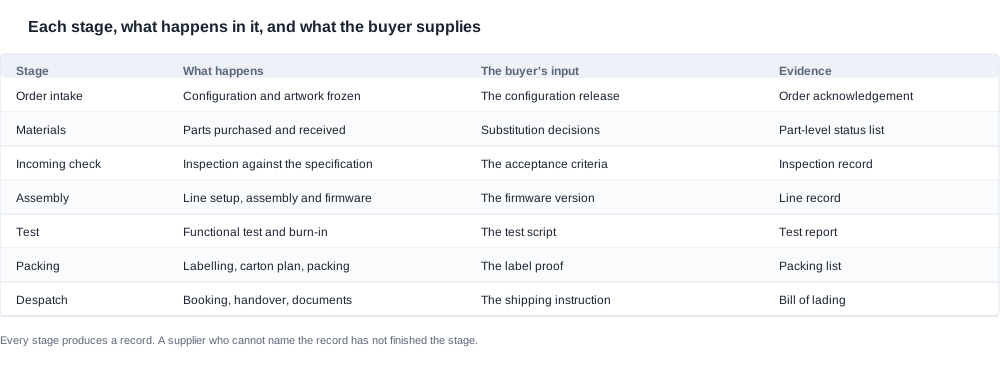
The second thing worth understanding is that every stage produces a record. The order acknowledgement, the part-level status list, the incoming inspection record, the line record, the test report, the packing list and the transport document are not administrative clutter — they are the evidence that a stage happened, and they are the only way a buyer can tell the difference between a schedule that is on track and one that has already slipped.
That gives a practical method. Ask for the schedule as a sequence of stages rather than as a duration, ask what record each stage produces, and check the records at the gates you care about. A programme with gates is manageable; a programme with only a delivery date is not, because the first signal of a problem arrives when it is too late to act on.

Smart glasses lead time: seven stages from order to consignment
Here is the chain as it actually runs, in order, with the part of it that sits outside the factory marked.
Stage one: intake and configuration
The order arrives with a deposit and with a configuration that is supposed to be frozen. This stage exists to establish that it is frozen: model code, colourway, feature set, packaging variant, firmware branch, destination market, importer identity. The catalogue for this range publishes twenty-eight models, each with its own rows, and a configuration that does not match one of them is a made-to-order configuration with a different commercial and scheduling treatment from a published one.
The record produced here is the order acknowledgement, and the record should carry the configuration as a versioned reference rather than as a description. A description can be interpreted; a version cannot.
Stage two: materials
Purchased parts are ordered against the configuration. This is the stage where the production window is really set, because the line cannot start until its material is on hand, and the material's date is a sub-supplier's date rather than the factory's. The record is a part-level status list showing what is on hand, what is on order and what each order's commitment is.
Stage three: incoming inspection
Parts arrive and are checked against the specification before they enter the line. This is the last point at which a mismatch can be caught without cost, and it is also the point at which a substitution is detected — if a part arrives that is not the part that was ordered, the programme has just acquired a specification change by accident.
Stage four: assembly and firmware
The line is set up for the configuration, the units are built and the firmware is loaded. The line record shows what was built and when, and it is the document that connects a unit in the channel to the component batch it came from.
Stage five: test, burn-in and first-article approval
Each unit is tested against a script, the batteries are exercised, and the first article is approved against the agreed criteria. The catalogue publishes a rated use figure for every model — from about twenty hours on the two children's models down to about six hours on two of the audio models — and a charge time for all twenty-eight, which gives a test script something specific to check against rather than a vague expectation.
Stage six: packing and labelling
The units are labelled, the accessories and the case are packed, and the cartons are counted and marked. In this category the label is a substantive document rather than a sticker, because it carries the importer's identity and the designations that the destination market requires.
Stage seven: despatch, booking and handover
The consignment is booked with the forwarder, the transport documents are assembled — including the battery test summary for a lithium product — and the goods are handed over. The transport chain and the destination clearance sit outside the factory gate entirely, and the buyer's own receiving is the final stage of all.

What each stage produces as evidence
The useful question about any stage is not "how long does it take" but "what proves it happened". A stage with a named record can be checked by a buyer who is not on site; a stage without one can only be confirmed by a statement.
The records that matter most
The part-level status list. It converts the vague statement "the materials are on order" into a dated commitment per part, and it is the record that lets a buyer know which component is constraining the programme. This is the record that most often identifies the real binding constraint.
The first-article record. It is the only document in the chain that connects the specification to the goods, and it is the defence against a compressed schedule. A first article approved against a written script is evidence; a first article approved by a visual check is not, because the two produce an identical-looking signature.
The test report. It should state the script it was run against, the quantity tested and the outcome. A report that lists the model's rated use without stating the method is a description of the product rather than a record of a test.
The packing list and the carton plan. It settles the carton count, the gross weight and the dimensions, which are the numbers the buyer's receiving, the forwarder and the destination authority all need. It is the record that makes a split delivery possible and a self-delivery by the buyer possible.
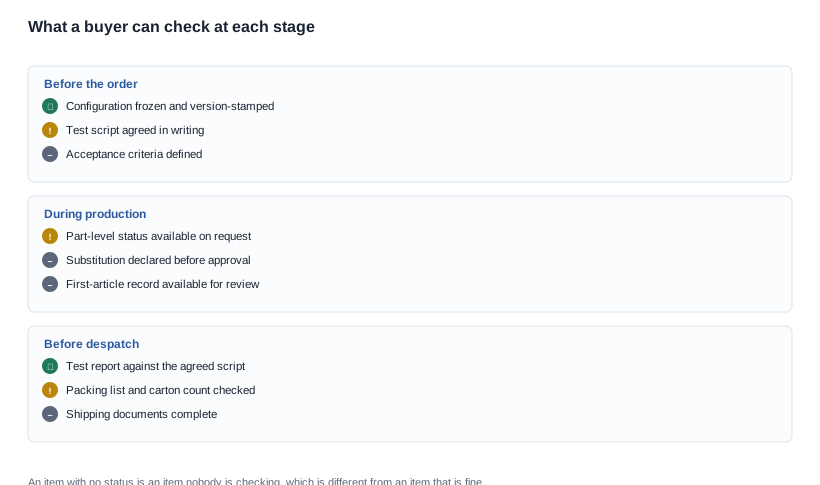
What to ask for when you cannot attend the gate
Most buyers will never be present at a factory gate, and the arrangements that make a programme visible from a distance are cheap to put in place. The questions to ask are the same for every stage, and they are worth asking before the order rather than at the first delay.
What record does this stage produce, and who holds it? A stage whose record sits with the buyer and has to be requested is a stage that will arrive late when it matters. A stage whose record is sent automatically is a stage that can be monitored.
What is the acceptance criterion for this stage? "Passed" is not a criterion. "Against the script dated on the order, on the quantity stated" is a criterion, and it is the difference between a gate and a conversation.
Who signs it, and what happens if it is not signed on the day? A named signatory plus a consequence is what converts a stage from an aspiration into a commitment, and it is the clause that makes a late slip visible while it can still be recovered.
How do I verify it independently once it exists? The order acknowledgement, the part-level list and the test report can each be checked against something else — against the versioned configuration, against the component order date, against the published rated use and charge time for the model. A record that cannot be checked against anything else is a status report.
The criteria for a good stage report are simple enough to state in one line and worth putting into the order: a record, a criterion, a name and a date. Anything less leaves the buyer watching a delivery date and hoping.
The stage gates worth asking for
A buyer cannot ask to be present at every stage, and should not try. The four gates worth a status request are the ones where a slip is both likely and expensive: material readiness at the start of the build, the first-article record before the run continues, the test report before packing, and the carton plan before the consignment is booked.
Each request should be a standing arrangement rather than a favour, and each should have a named recipient. A gate without an owner is a gate that will be reported late, and a gate reported late is a gate that has already become a surprise.
The stages that sit outside the factory gate
Of the seven stages, the factory controls one directly, contributes to three more, and does not control three at all. That distribution is the reason a quoted production duration is not a delivery date.
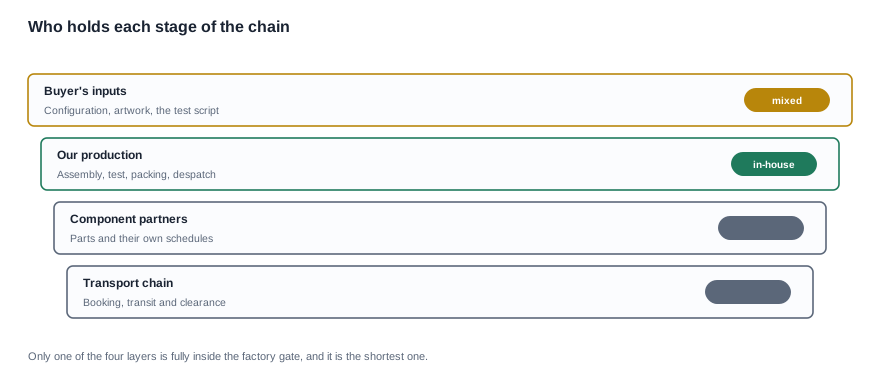
The buyer's inputs. The configuration release, the artwork, the test script and the shipping instruction all originate outside the factory, and each one gates a stage that follows it. A factory working to a schedule is, on these inputs, waiting rather than working.
The component partners. Parts and their own schedules sit outside the factory gate, and the factory's date is partly a function of theirs. This is why the part-level status list is the most valuable document in the chain for a buyer who is not on site.
The transport chain. Booking, transit and clearance are outside the factory's control and, in the case of consolidation, outside the factory's knowledge. A consignment that misses a sailing because the goods were finished late is a schedule failure that the factory could not have prevented.
The documentation route runs beside, not after
One stage is worth separating out, because it behaves differently from the rest. The conformity file for the destination market — the test evidence, the declaration of conformity, the technical file behind it, the battery transport summary — is assembled around a frozen configuration and can run in parallel with the build.
It usually does not. It is usually opened after the goods are finished, because the file is treated as an administrative task rather than as a stage. The interaction between that route and the schedule is set out separately at does certification add to lead time, and it is worth reading before the order rather than after, because the decision about when the file opens belongs to the buyer.

Why the last week is the one buyers misprice
The end of the chain is where the arithmetic goes wrong, and it goes wrong in a specific way: the last week is treated as a single period rather than as four separate activities that can fail independently.
Packing and labelling. A label proof approved late stops the packing of the entire batch, not of one carton. The label depends on an importer decision, which is the buyer's, which makes it the most common single point of failure in the last week.
Carton count and weight. An error here is discovered by the forwarder or by the carrier rather than by the factory, and it is discovered when the consignment cannot be accepted.
Booking. A booking cut-off can pass while the goods are finished and ready, and the consequence is not a delay of one week but of one sailing interval.
Clearance at the destination. The stage nobody on either side owns, and the one most likely to be discovered after the launch date has been announced.
Receiving and put-away. The buyer's own stage. A consignment that arrives when the warehouse is closed, or when nobody is scheduled to count cartons, has a schedule problem that the supplier cannot solve and that the buyer did not plan for.
The rule that comes out of it
A buyer should treat the last week as five separate gates with five separate records, and should ask for a status on each one rather than a single "ready to ship" confirmation. A confirmation that says the goods are ready to ship has collapsed five gates into one statement, and the statement is only as good as the latest of the five.
The red flags in the last week are worth naming, because they share a shape: each one is a step that looks administrative and is actually a dependency. A label proof approved by someone who did not read it. A carton plan issued after the packing has started. A booking made the day the goods were finished, which misses the cut-off. An inspection booked for a day the consignment has not arrived. A receiving slot that nobody owns. Before you order, these are the lines to write into the plan with a date and a name against each.

A stage-by-stage account of one order
The example below is an invented scenario used to reason through the stages. No customer, order or shipment is described; the model, the quantity, the durations and the destination are assumed so that the chain can be traced from end to end.
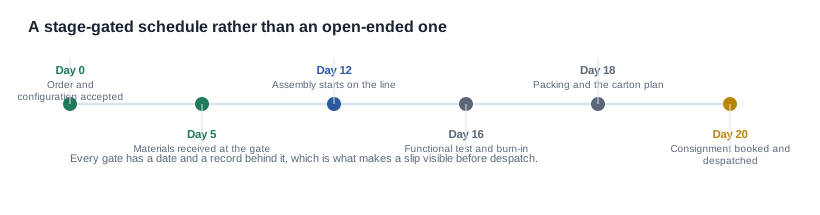
The scenario. An order for a camera model, one market, a single consignment, and a launch requirement eleven weeks after the order date.
Intake, days zero to two. The configuration is released and versioned. Two items are still open at intake: the packaging variant and the firmware branch. Both are recorded as open conditions, and the acknowledgement carries them as conditions rather than as assumptions. This is the moment where a buyer who does not do this creates the delay they will later attribute to the factory.
Materials, days two to five. The part-level status list arrives on day four and identifies one component on order with a commitment date that sits inside the production window. The critical path is now known, and it is a component rather than the line. The programme is monitored against that part rather than against a general expectation.
Incoming inspection, days five to seven. Every part is checked against the specification. One component arrives from a different batch than the one ordered. The specification is unchanged, so the programme continues, but the batch record is annotated and the first-article check is asked to cover that batch explicitly.
Assembly and firmware, days seven to twelve. The line is set up for the configuration and the firmware branch that was released at intake. The line record confirms which branch was loaded, which matters because a branch change after this point would restart part of the test.
Test and first article, days twelve to sixteen. The first article is approved against the written script rather than by inspection, and the test report records the script, the quantity tested and the outcome. The rated use figure published for the model and the charge time published for it both give the script something concrete to verify.
Packing, days sixteen to eighteen. The label proof is approved against the pre-production sample, and the carton plan confirms the count, the weight and the dimensions. The importer identity, which was open at intake, is on the label.
Despatch and transit, days eighteen to twenty-four. The consignment is booked, the transport documents are assembled including the battery summary, and the goods are handed over. The buyer confirms the receiving window and the inspection slot before the consignment is closed, which is the one part of the chain the buyer controls completely and most often forgets.
The outcome. A programme that ran without a single unplanned event, and a buyer who can explain every day of the schedule because every stage produced a record.
What we can show you, and what we cannot
Stated plainly: the stages and their records are the part of the schedule we can speak to in detail, and the durations attached to them belong to a conversation with a configuration, a quantity and a date range attached.
What we publish is the specification that each stage works to: the twenty-eight models and their rows — the battery capacity and the rated use for each, the charging time for every model, the charging method for the twenty-four where the catalogue states it, the Bluetooth version for the fourteen where it appears, the case capacity for the five models where it is published, and the ingress rating on the two models that carry one. The camera tier — eight models at 8 MP and three at 13 MP — is the input to the test script rather than to the schedule, but it determines what the script has to check.
What we do not publish: production lead times, production capacity, daily output, and the stage durations behind them. We will not quote a duration for a stage without knowing the configuration and the quantity, because a stage duration is a property of a particular order rather than of a factory.
What we will do is take a model, a quantity, a destination and a required date and tell you which stages apply, what each one produces as a record, which of them sit outside the factory gate, and where the last week of the chain usually breaks. We will also tell you plainly when a date cannot be met.
The benchmark question is at industry benchmarks, the buyer's own side of the chain is at practical advice for buyers, the compression question is at quality implications, the wider view is at the lead time section, and the factors behind the dates are at what affects it.
The action to take now. Ask any supplier for the seven stages, the record each one produces, and the gate at which they will report to you. A supplier who can name all seven is a supplier whose schedule you will be able to manage. A supplier who answers with a single duration has answered a different question.
Related reading
- Does certification add to lead time — the documentation route beside the build
- Industry benchmarks — comparing quotations
- Practical advice for buyers — the buyer's own part of the chain
- Quality implications — what a compressed schedule costs
- What affects the lead time — the factors behind each stage


