

A formal smart glasses shipping arrangement is worth building for the buyer who carries the risk between the factory gate and their own warehouse and who cannot prove what was inside the carton at the moment that risk passed. It is wasted effort for the buyer who buys on a delivered-duty-paid basis from a supplier who documents well, who runs a single destination and who can absorb a replacement unit without a conversation with a channel.
Volume is usually offered as the test for this, and volume is only a proxy. A forty-unit pilot sent to a customer you cannot afford to disappoint can carry more exposure than a five-thousand-unit run moving into a warehouse with a known tolerance for shortage. The real variable is where the risk sits and whether anybody in the chain can evidence it.
Smart glasses shipping: the document that transfers the risk between points
The four-question exposure test
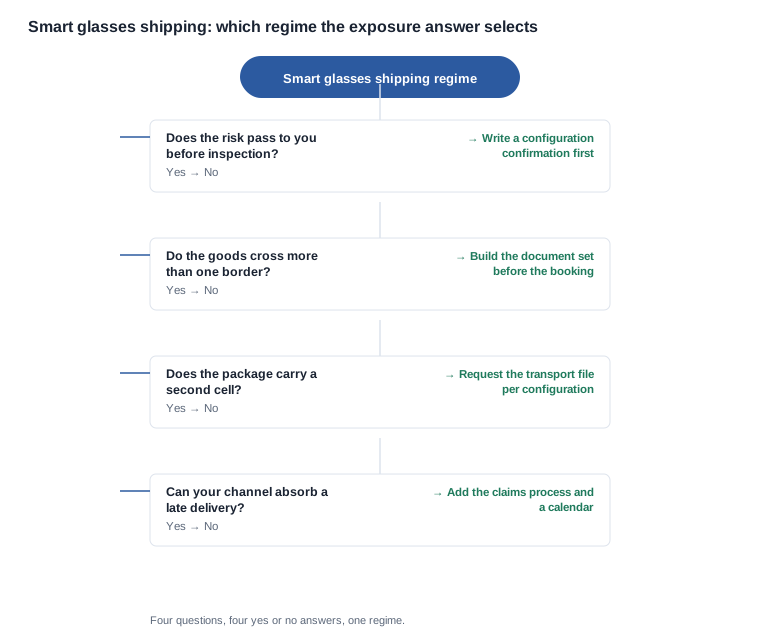
The shipping regime a buyer needs is set by four questions, and the answer to each is yes or no.
- Does the risk pass to you before you can inspect the goods? If the transfer point named in your supply terms is at the factory gate or at the origin port, you are the exposed party during the leg you did not arrange and cannot supervise. That leg is where a configuration error, a shortage, or a handling fault becomes your problem rather than the forwarder's.
- Does the goods cross more than one border on the way to your customer? A second border means a second document check and a second opportunity to stop, and a second market whose conformity requirements you may not have asked for.
- Does the configuration carry a lithium cell that adds a second cell to the package? A device with a cell plus a charging case with a cell is two cells in one carton, and that fact drives a battery transport file for the exact configuration being shipped rather than for the product family.
- Can your downstream absorb a late or short delivery without a commercial conversation? If the answer is no, then the shipping regime is not a logistics document set — it is the thing standing between a supply problem and a channel credit.
A buyer who answers no to all four is running a courier and a packing list, and that is the correct level of effort. A buyer who answers yes to three or four needs a written regime, and the writing is what turns exposure into something you can price, insure and claim.
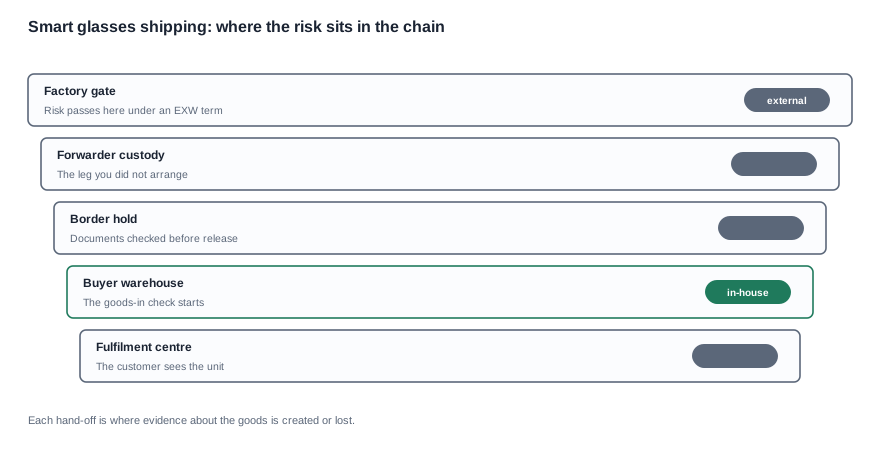
The chain above is the reason a shipping regime is more than a courier instruction. Each hand-off is a point where evidence about the goods is created or lost, and the buyer who cannot produce evidence at the hand-off they care about is carrying a risk they cannot transfer to anyone.
Why the answer is not simply "how much do I buy"
Order volume decides how painful a failure is in absolute money, but it does not decide who holds the risk during the transit. Three of the four questions above are about structure — where the transfer point sits, how many borders there are, what the package contains — and only the fourth is about scale.
This matters because it changes what a buyer should build first. A high-volume buyer with a clean supplier on a single border with one destination can start with a configuration confirmation and a goods-in check, and add the rest later. A low-volume buyer whose units cross two borders, carry a second cell, and land in front of a channel that will not forgive a late delivery needs the document set and the claims process before the first shipment, because the first shipment is exactly the one where there is no historical record to fall back on.

The freight problem this catalogue creates: one published weight for twenty-eight models
What a shipping regime needs, and what the catalogue publishes
A working shipping regime needs five inputs before a booking can be made: the weight of the unit, the weight and dimensions of the carton, the number of cartons, the number of units per carton, and the configuration in each carton. Here is where this catalogue stands.
| Shipping input | Published in the catalogue | Buyer action |
|---|---|---|
| Unit weight | One figure only: the MT6 eyewear body at 158 g | Request the packed weight per configuration |
| Carton dimensions and weight | Not published | Agree the carton specification at quotation |
| Units per carton and carton count | Not published | Confirm on the configuration sheet before release |
| Case option per configuration | Published for five camera models only | Fix the case option on the order line |
| Colour count per model | Published for the V03 Pro and the V06 | Use the SKU count to plan the carton split |
The MT6 figure is precise about its own scope, and that precision is worth keeping: 158 grams covers the eyewear body including the battery and the camera, and it excludes the folding charging case, whose 1200 milliamp-hour capacity is listed separately in the catalogue. No bare frame weight appears anywhere, and no other model in the twenty-eight publishes a weight of any kind.
The commercial consequence is direct. Freight and parcel pricing are weight-driven, insurance value is declared against a weight and a value, and a carton specification cannot be engineered against data that does not exist. A buyer who tries to estimate this from the catalogue will produce a number with no source behind it, and that number will end up inside a landed cost comparison between two suppliers — which is exactly the place where a fabricated figure does the most damage.
The case matrix makes the carton contents un enumerable from published rows
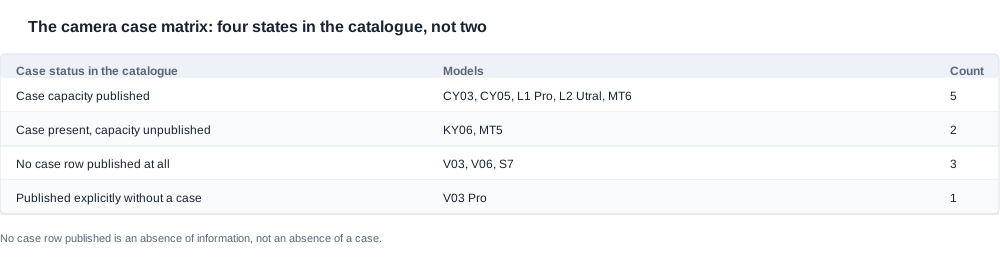
The camera range is where the packing problem concentrates, and the reason is that the case is not a uniform accessory. Five camera models publish a case capacity: 1400 milliamp-hours on the L1 Pro and the CY03, and the CY05, 900 or 1400 as a configuration choice on the L2 Utral, and 1200 on the MT6's folding case. Two more ship with a case whose capacity is not published, the KY06 and the MT5. Three publish no case row at all, the V03 and the V06, and the S7 — which is an absence of information, not an absence of a case. And one has no charging-case row, the V03 Pro.
A shipping regime therefore has to fix the case option per configuration on the order line, because the catalogue's published rows cannot be enumerated into a carton contents list. The L2 Utral is the sharpest case, since its two capacities are a configuration choice rather than a feature, and the carton weight, the freight class and the second lithium cell declaration all change with it.
Colour counts multiply the picking risk
Two models in the catalogue publish a colour count, and both of them are camera models: the V03 Pro publishes three — orange, cream white and black — and the V06 publishes four, adding white ice blue and dark ice blue to orange and black. Every colour is a stock-keeping unit, every stock-keeping unit is a potential picking error, and a picking error that survives the factory gate becomes a customer receiving the wrong colour in a branded box, which is a returns event and a marketplace review rather than a logistics event.
What is published about protection, and what is not
The IP54 marking appears on the V06 and the S7 and on no other model, and no test report is published behind it. A buyer moving units through a coastal route, a humid inland route or a seasonal monsoon route therefore has no published basis for a packaging specification aimed at splash and dust exposure. That is a question to put to the supplier in writing rather than an assumption to build into a carton design.
The document set that has to travel with the goods
Four documents, and the one that does the most work
A defensible shipping regime for this product category rests on four documents, and they are not equal.
- The configuration confirmation. One page, signed and dated by both sides, stating the model, the colour, the case option, the charging interface, the packaging, the quantity, the units per carton and the carton count. This is the document that the packing list is checked against, that the goods-in check is checked against, and that a claim is argued from. It is the cheapest and highest-value item in the whole set.
- The battery transport file for the exact configuration. A device with a cell plus a case with a cell is two lithium cells in one package, and the file has to cover the configuration actually being shipped rather than the model family. This is requested from the supplier and it is asked for at the border if it was not requested before the booking.
- The destination conformity documents. The catalogue carries one company-level export-certification page and no per-model certification row, and the words CE, FCC and RoHS do not appear anywhere in it. Per-destination documents are therefore a request, not a catalogue lookup, and the destination markets have to be fixed before the request can be made.
- The packing list format and the goods-in check. A format that both sides agree on turns a receiving operation into a comparison rather than an interpretation, and a comparison is the thing that produces an actionable discrepancy.
The verification sequence before a shipment is released
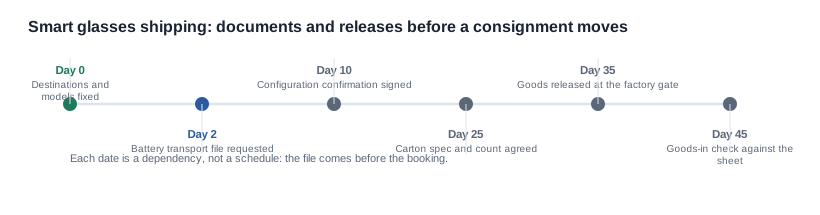
- Fix the destination markets and the fulfilment model in writing before anything else, because both the document list and the risk profile derive from them.
- Request the battery transport file for each configuration, including the case where the configuration has one, and record the date the file was issued.
- Request the conformity documents per destination market, and note that a request made after the booking produces a delay rather than a document.
- Agree the configuration confirmation template with the supplier and make it a release condition, not a courtesy.
- Agree the carton specification against the actual route, including the unit count per carton and the carton count, and record the agreed figures on the configuration confirmation.
- Agree the evidence standard for a claim — which photographs are taken, at what level, and by whom — before the first shipment rather than during the first claim.
- Agree the goods-in check with the receiving team, so that the comparison happens against the configuration confirmation and not against a general description.

What the risk transfer does to landed cost and to the insurance value
Landed cost is not the unit price plus freight. It is the unit price plus freight plus duty plus insurance plus the cost of the failures you have not insured against, and the last term is the one that varies most between two shipments of the same product. A shipment where you hold the risk through two borders and two hand-offs carries a different failure cost than a shipment sold delivered-duty-paid from a supplier with a documented process, even when the freight line is identical.
Insurance is where the missing weight becomes a commercial problem rather than an administrative one. A declared value needs a weight, and the catalogue publishes one weight for twenty-eight models, with a scope that excludes the case. A buyer who insures on an estimate is exposed on a difference between the estimate and the truth, and the truth is the part that is discovered after the loss.
Three terms are genuinely negotiable and one is not, and the distinction matters more than the list.
- Negotiable, and worth negotiating first: the shipment split — a first run delivered in two consignments against a staged payment, which converts a single large exposure into two smaller ones; the packaging specification and whether the supplier builds the carton to the route rather than to a workshop default; whether the configuration confirmation is a release condition; the evidence standard for claims; and the case configuration per order line, which is the input that decides the carton and the cell declaration at the same time.
- Not negotiable, and budgeted rather than argued: the cost and the lead time of a conformity document for a new destination; the testing cost and the lead time of a battery transport file for a new cell configuration; and tooling, which is amortised across the first order and quoted as a separate line rather than hidden in the unit price.
The shipping case example shows how one configuration confirmation is structured in practice, and the shipping practical advice covers the operational detail of the shipment itself.
How to compare two shipping regimes before you order
Two suppliers quoting the same unit price can produce two different landed costs, and the comparison has to be made on the regimes rather than on the freight line. The criteria that actually separate them are these.
- The total cost of the shipment, not the freight line. Build it as unit price plus freight plus duty plus insurance plus the reserves the regime implies. A regime with a higher freight line and a lower claims reserve can be the cheaper one across four shipments, and that calculation stays invisible unless somebody writes it down.
- Where the risk passes, named in the quotation. The transfer point determines who carries the disruption between the gate and your warehouse, and it determines which party is obliged to produce evidence when something goes wrong.
- The document lead time for the destinations you are actually shipping to. A supplier who already holds the conformity documents for your markets has removed a delay from your critical path; a supplier who has to request them has not.
- The configuration control standing at the packing station. Ask which document the pickers check each unit against, and what happens to a unit that does not match it.
- The evidence standard on a claim. Written down in advance it is a condition; discovered during a claim it is an argument you are probably going to lose.
The trade-off running through all five is speed against exposure. A faster regime with the transfer point early in the chain reduces your administration and increases your risk; a slower regime with the transfer point late reduces your risk and pushes work onto the supplier's schedule. There is no universally correct answer, and the correct answer is a function of the four-question test at the top of this article.

Shipping failures in this category, and where the carton breaks
A shortage discovered at the fulfilment centre rather than at the carton. The symptom is a picking line that cannot be completed and a customer order that goes unfulfilled. The root cause is that no carton count was confirmed at the factory gate, so the count arrives as an assertion rather than as a figure the receiving team can check. The prevention is the carton count on the configuration confirmation, verified before release.
The unit in the carton is not the configuration ordered. The symptom is a customer receiving a different case option or a different colour than the listing promised. The root cause is that the case option is treated as a product detail rather than as a packing variable, and that a colour count of three or four creates stock-keeping units that were never planned for. The prevention is to name the case option and the colour on the order line and to have the picking list checked against it.
A consignment held at the border on the battery documentation. The symptom is a delay measured in weeks rather than days, with no production impact visible to the customer. The root cause is that the request was made per model family instead of per configuration with a case, so the file on hand did not describe the package. The prevention is to request the transport file against the exact configuration, before the booking.
A claim refused because the evidence was a photograph of the parcel. The symptom is a write-off on a consignment that was genuinely damaged. The root cause is that the evidence chain stops at the carton, so nobody can show what was inside it. The prevention is to agree in advance which photographs are taken at which level, and to include the model designation and the case option in what is recorded.
Damage attributed to the supplier that was caused by the packaging specification. The symptom is a recurring damage pattern in one lane rather than across all lanes. The root cause is a carton designed for a bench and loaded onto a pallet for six weeks. The prevention is to specify the packaging against the route, and to review the damage pattern per lane rather than per shipment.
A wave of returns that has nothing to do with transit. The symptom is a cluster of returns arriving in one period. The root cause is usually a configuration change — an accessory, a firmware build, a packaging revision — that was not carried onto the configuration confirmation, so the receiving team cannot tell a good unit from a changed one. The prevention is to make the configuration confirmation the single place where every variable that affects the customer is written down.
The red flags worth naming before the first shipment. A supplier who answers the configuration confirmation question with "it will be the same as last time" is telling you there is no configuration control. A supplier who cannot name the transfer point in their own quotation does not have a shipping regime. A supplier who offers to skip the battery transport file "because the previous shipment went through" is offering to repeat an outcome that was never tested. These three answers carry more information than any reference they can supply.
Where our shipping position stops
Here, a shipping regime should be sized to the exposure a buyer actually carries, and the first step for any buyer moving past evaluation is a single-page configuration confirmation rather than a full inbound inspection programme. For this catalogue that means we publish the configurations, the charging interfaces, the case options where they are published, the colour counts, the structural features and the cell capacities, and we will confirm in writing which published rows apply to a specific configuration and destination.
What we do not publish and will not estimate: unit weights beyond the single 158 gram MT6 eyewear figure, carton dimensions, pallet configuration, shipping weights, freight rates, duty rates, insurance rates, and the minimum order quantity and lead time, which depend on the configuration and the destination and belong to the quotation. We will not state that any model in our range is certified for any market, because the catalogue contains no per-model certification line.
What we will do is take the destination markets, the volumes, the fulfilment model and the configurations, and tell you which documents have to exist before a booking is made, which of them we supply, and which your broker has to obtain. The shipping checklist is the level one version, the logistics pillar sets out the wider framework, the battery transport route covers the cell declaration, and the contract terms page is where a release condition on the configuration confirmation belongs in the agreement.
Before you order a second consignment, the questions to ask are the same six that produced this regime: which destinations, which configurations, which documents, which carton, which evidence, and which transfer point. A supplier who answers all six consistently has a process; a supplier who answers three of them has a habit. That is the whole distinction a buyer can draw from the quotation stage, and it is the distinction that matters most before a booking rather than after one.


