

A smart glasses factory audit works when it has a defined output, and the output is a decision rather than a feeling.
The most common version of the visit is a tour: a walk around the building, a walk past a line, a conversation in a meeting room, and a general impression that is difficult to write into a purchase order. That version has a real cost and a low return, because the four things a buyer needs to know — will they build my configuration, do they have the documents, will the date hold, and what will the returns be like — are all answerable with specific questions, and none of them needs a walk around the building.
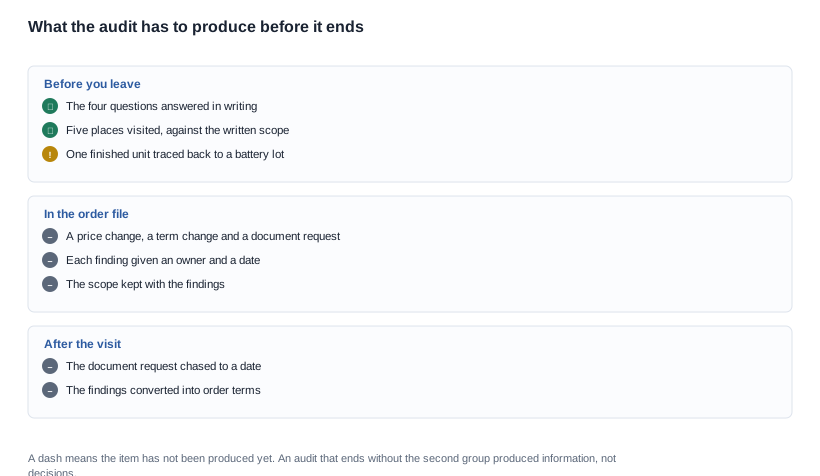
The output of a good audit is three written changes to the order: a price change, a term change, and a document request with a date. If a visit produces none of those, it was an expensive tour.

Smart glasses factory audit: what the visit produces when it works
The buyer deciding whether a day is worth spending
The person arranging a visit is usually one of three. A sourcing manager with a first order and a supplier they have never worked with. A channel buyer who has had one consignment arrive with a problem they cannot trace. Or a brand owner whose compliance team has asked what happens if a customer audits the supplier, and who now needs an answer rather than a policy.
All three have the same problem, which is that they do not know what a visit is for. The question they ask is "what should I look at", and it is the wrong question, because the answer to it produces a tour. The right question is "what do I need to know before I sign", and each answer maps onto a place on the site and a document to ask for.
That reordering is the whole content of this article. An audit is a procedure, not a venue, and the procedure is short enough to be written on one page.
The four questions, and what a good answer looks like
The four questions are simple enough to remember and difficult enough to answer well, which is why it is worth being precise about what each one requires.
| The question | A weak answer | An answer you can act on |
|---|---|---|
| Are you the party that will build the goods | We are a manufacturer with many customers | The licence, the contract and the payment account carry one registered name |
| Can you build this configuration | Yes, no problem | The line runs this configuration, and here is the date it ran |
| Do you hold the documents for this model | We have all the certificates | The report number, the issuing body, the model it names and the validity date |
| Will you tell me when something is not possible | Of course, no problem | A named condition, with the consequence spelled out |
The fourth row is the one that separates a supplier from a counterparty, and it is the row most often answered with enthusiasm and no content. "Of course, no problem" is what a supplier says before the first difficult conversation. A good answer names a condition: the artwork has to be final before the line starts, the case has to be confirmed before the packaging is printed, a variant change needs a re-issue. Conditions are useful to a buyer even when they are inconvenient, because a condition is something you can plan around.
The third row is the one that does the most work in a first relationship, and it is worth checking character by character. Model designations in this range are close together — A05, A06 and A07; MT5 and MT6; L1 Pro and L2 Utral — so a document that names a family rather than a model can be mistaken for coverage on a quick read, and the mistake only surfaces at a customs desk or in a warranty file.

The five steps, and the one that is usually skipped
Step one: set the scope from the order, not from the factory. The order decides what you need to see. A camera product with image quality at the centre of the proposition needs the imaging operation and the firmware loading. A children's programme needs the evidence and the traceability. A branded build needs the artwork, the packaging and the change control. A plain audio order needs much less. The audit buyer checklist is written as a scope-setting list for exactly this reason.
Step two: ask the four questions that cannot be faked. Are you the party that will build the goods? Can you build this configuration? Do you hold the documents for this model? Will you tell me when something is not possible? Each of them produces an answer that can be written down, and the fourth one is the only one that costs the factory anything, which is why the fourth one is the one worth asking directly.
Step three: verify the answers against the physical site. The production line, the cell store, the test bench, the packaging area, the document control. Five places, and each answers one of the four questions. The line answers the first two, the bench and the packaging area answer the quality questions, and document control answers the third.
Step four: write the findings while you are there. A buyer who leaves with a page of observations and three named people makes a better decision than one with a folder of photographs. Write it the same day, while the answers are fresh enough to check, and while the person who answered is still available to clarify what you wrote.
Step five: convert the findings into contract changes. This is the step most audits skip, and it is the only one that changes anything. A finding that does not become a price change, a term change or a document request has not been used.
Step one, scoped from the order rather than from the factory
The scope question has a useful test: for each item on the list, can you name the decision it informs? If you cannot, the item is a tour stop rather than an audit step, and it is costing you a day.
A camera programme usually produces a scope of four places — the imaging operation, the test bench, the packaging line and document control — because the four questions map onto them directly. A branded programme substitutes the artwork approval and the change-notice procedure for the imaging operation. An audio-only order can usually be scoped to two places and one document request, which is also usually the point where the buyer realises the visit was never necessary.
The scope should be written down before the visit and sent to the factory in advance. That is not politeness. It gives the supplier the chance to prepare, which is a risk, and it gives you the chance to notice a refusal, which is also a risk. Both are useful, and neither is as useful as the scope itself.
Steps three and four, the five places and the same-day write-up
The five places are a fixed set, and each one answers a different question. The production line answers whether the configuration is built. The cell store answers whether the components are controlled. The test bench answers whether the units are tested or only examined. The packaging area answers whether the configuration is carried on the label and the box. Document control answers whether the approvals are filed against the model.
The write-up is the part that gets skipped, and it is the part that decides whether the visit is worth anything. A finding written the same day is specific enough to be converted into a clause. A finding written a week later is a memory, and a memory is not a term.
One day on site, hour by hour
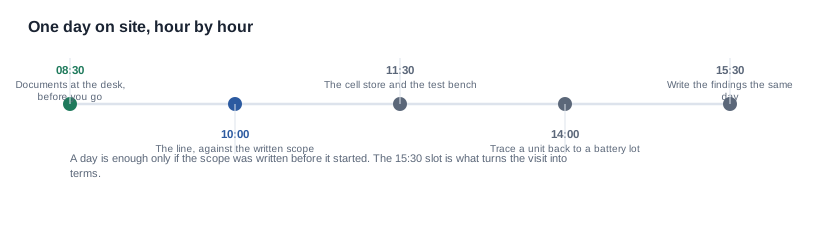
The shape of a useful day is remarkably fixed. The first half hour is documents at a desk, because the document set determines what is worth examining in person. The line walk comes next, against the written scope rather than against a tour route. The cell store and the test bench come third, in that order, because the store is upstream and the bench is where the configuration is proved.
The 14:00 slot is the single most informative half hour in the whole visit: tracing one finished unit back to a battery lot. Traceability either works in thirty seconds or it does not work at all, and no photograph substitutes for it. If the trace is manual and depends on one person's memory, that is the finding for the day, and it is worth more than everything else in the visit combined.
The last slot is the write-up, and it is deliberately inside the visit. A day that ends with an unstructured conversation and a photograph of a shelf has thrown away everything the morning produced.
Who answers which of the four questions
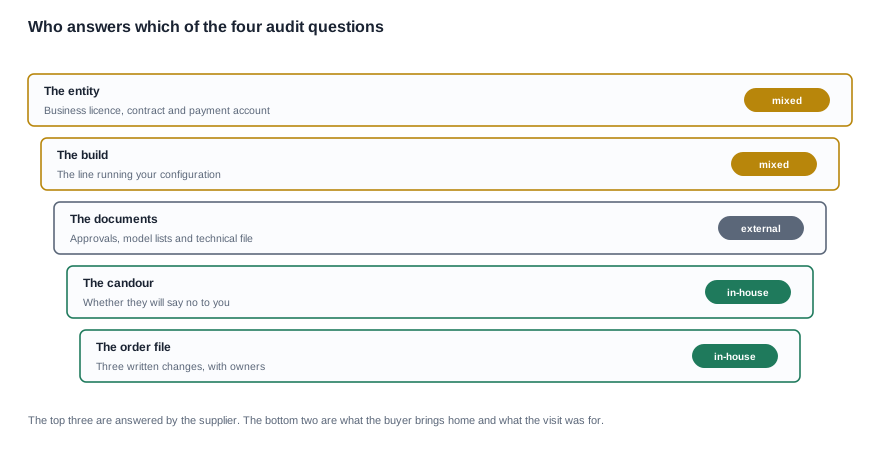
The layering is worth reading from the bottom, because the bottom two rows are what the buyer brings home and what the visit was for. The top three rows are answered by the supplier — the entity, the build and the documents. The fourth row, the candour, is answered by the supplier too, but it is the only one that costs them something to answer, which is why it should be asked in person and in front of the person who will have to live with the answer.
The bottom row is the order file: three written changes with owners and dates. If a visit does not produce that row, it has not finished.

When a video audit is the better version
A video walkthrough, done on a working day with the line running, answers most of the same questions as a visit in this category, because the risks are documentary and configuration risks rather than labour risks. It also removes the travel and the goodwill, which is a trade many buyers should take.
Three conditions make a video version work. The line must be running the configuration you are ordering rather than a showroom configuration. The call must be continuous rather than edited, so that the walk between stations is visible. And somebody on your side must have a written list to work through, because an unstructured call produces a tour in video form.
What a video cannot do is verify the claims you would make about the site. If your own compliance team or your customer's audit requirement asks you to have seen the production site, then a visit is not optional, and the video call checks are the preparatory step rather than a substitute.
What a video cannot do
A video cannot show you the cell store, because a store is not on the route between two cameras. It cannot show you what happens when the line stops, which is the only moment that reveals how the schedule actually works. It cannot show you the people, which matters more than it sounds: the confidence with which a supervisor answers an inconvenient question is itself evidence about whether the written process is the real one.
It also cannot be corrected. In a video call you cannot pick up a unit, read the label, check the barcode against the configuration sheet, and put it back. That single action closes more configuration questions than an hour of conversation, which is why the sample and the trace remain necessary even when the visit is replaced.
Two further points are worth having in mind before a visit is booked. The first is who goes. A single buyer who understands the configuration is worth more than a team of three where nobody has read the order, because the questions that matter are configuration questions and only one person can ask them. The second is the length. One day is enough for a scoped audit, and two days is usually a sign that the scope was not written, because an unscoped visit fills with anything the supplier is willing to show you.
A third point is about timing rather than duration, and it is the one buyers most often get wrong. A visit scheduled in the week of the order is an inspection. A visit scheduled in the week after the first production run is a conversation, and it is the more valuable of the two, because by then the first batch exists and the audit can look at real units rather than at a demonstration. If a supplier has a real production history, ask to audit the most recent batch rather than the next one.
What an audit cannot do, and what a sample can
No audit establishes that a product will be good, and in this category it is worth being blunt about the limits.
An audit cannot tell you the field of view, the video format, the frame rate or the low-light performance, because those are not published and they are not visible on a line. It cannot tell you the frame weight on a model where we do not publish one — the MT6 at 158 g for the glasses unit, excluding its foldable charging case, is the only published frame weight in the range. It cannot give you a certificate number, an issuing body or a validity date.
Those are sample questions, and a sample tested against a written list answers them faster and more reliably than a day of walking.
The sample questions that an audit cannot reach
| The question | Why an audit cannot answer it | What answers it |
|---|---|---|
| Does the unit record what the listing claims | The claim is a property of the finished unit | A sample tested against a written list |
| What does it weigh, on this model | Weight is a property of the built unit | A sample and a scale |
| Does the runtime hold in the shipped configuration | The runtime depends on the case and the charge cycle | A sample run in the delivery configuration |
| Is the firmware build the one that was ordered | The build is only visible on the unit itself | The version log, plus the unit |
The third row is the one buyers most often skip and the one that most often costs money. A published runtime of roughly seven hours for a 290 mAh model is a figure for a unit; what a channel actually experiences is the unit in its case, on a case charging cycle, over a working day. That is a different number, and the difference is a returns rate.
What we will answer without a visit
This is a worked case rather than a live order. It shows the sequence, not results.
Assume a brand owner opening a branded camera-model programme with a supplier in a new market, with a fixed launch date. The brand's compliance team needs a written answer on four points, and the commercial team wants to know whether the configuration sheet exists.
Before the visit. The brand sends the four questions in writing and asks for the configuration sheet. The supplier answers three of the four clearly. The fourth — whether they will build a specific branded configuration with a customer-supplied artwork deadline — comes back as a qualified yes, with a condition attached: the artwork has to be final before the line starts, and the line starts on a fixed date whether or not it is.
Step one. The scope is written from that answer rather than from a generic checklist: the imaging operation, the test bench, the packaging line, document control, and the artwork approval process. The brand sends the scope in advance, and the supplier's reply to that — the sequence they propose for the day — is itself informative, because a supplier who proposes a route that avoids the packaging line has told you something.
Steps two and three on the day. The line is running a comparable configuration, not the branded one, because the branded build has not started. The cell store is controlled and dated. The test bench exists and is in use. Document control holds the approvals, and the model list on them names the variant the brand is ordering rather than the neighbouring one. The trace works, and it works in under a minute.
Step four. The brand writes its findings the same afternoon: four answers, one condition, and two findings that need a clause. The condition becomes a term — the artwork date is in the schedule and the line does not start without it. The two findings become a price change and a document request with a date.
Step five, and the outcome. The brand's compliance team gets four written answers instead of a site visit. The commercial team gets a configuration sheet it did not have, and a launch date whose critical path runs through an artwork deadline that is now on the chart rather than in an inbox.
The visit was worth doing. It was also worth scoping, and the scope came from the order rather than from a list of factory amenities.
The position we take, and the requests we would make of you
Stated plainly: the audit is worth its cost when the camera, the children's, the customisation or the documentary risk is in the order, and the visit is the right instrument for exactly four questions. We publish the model data and we do not publish prices, minimum order quantities, capacity or lead times, and we will answer those four questions about our own operation directly and without a visit.
We will also say that a sample is not a substitute for an audit in a branded or a high-compliance programme, and that the two together answer different questions. The factory audit worked example shows what a real scope looks like, and the factory audit beginner guide covers the preparation.
Write the scope before you book the travel, and send it in advance. It saves a day and it produces information. If you are still deciding which method to use, the criteria for choosing one are set out in the audit method comparison.
Ask the four questions in writing first, and read the answers for consistency. The ones that arrive qualified are the ones worth travelling for. Those four questions are the core of the audit buyer checklist.
Tell us the model, the configuration and the market, and we will tell you which of the four questions we can close without a visit. The factory audit section holds the wider framework.
Related reading
- The factory audit buyer checklist
- Checks for a video call to tell a factory from a trading company
- A factory audit worked example
- The factory audit beginner guide
Send the model, the configuration and the market, and we will say which of the four questions we can close without a visit.


