
A buyer's first questions about waveguide types are always the same, and they are worth answering in one line each before the detail starts. This article does that and then does the part that the one-line answers cannot: it sets out which of the six questions actually decides the purchase, and what to do with a supplier whose answer to the second one is a recommendation rather than a specification.
The reader is a brand-side product or sourcing manager, a channel buyer or an e-commerce selection team. What they are managing is a component that is decided at the tooling stage and effectively fixed for the life of the product. The waveguide is the most expensive single decision in a display programme relative to its size on the bill of materials, and the one most often deferred until after the application has been assumed rather than established.
The six questions are these: what is a waveguide; which type should I buy; is one type visibly better; does the type change the weight; can I change the type later; and what should I ask a supplier. The fourth and the fifth are the ones that decide the commercial answer, and the sixth is the one that decides whether the first five produced usable information.
AR glasses waveguide types: the six questions and the order they matter
What is a waveguide? The optical element that takes light from a microdisplay and delivers it into the eye while letting the world through. It is the component that makes an AR display possible at all, and it is the reason the display-free architectures took the volume in this category.
Which type should I buy? There is no best type; there is a type that suits the application and a type that does not. A reflective structure and a diffractive structure trade efficiency, colour, thickness and manufacturing cost against each other, and the trade-off that matters depends entirely on what the user is doing. The waveguide types article sets out each one.
Is one type visibly better? Not without the conditions being stated. A comparison that quotes a field of view without saying how it was measured, or an efficiency without saying at what angle, is not a comparison. The AR glasses display technology article covers the measurement problem, and the AR display types discussion covers the architectures in general terms.
Does the type change the weight? Yes, and considerably. A reflective waveguide needs a longer folded path and therefore more glass; a diffractive one can be flat and thin; a photonic one adds manufacturing complexity that shows up in cost and potentially in mass. The what weight is acceptable article covers why weight and distribution decide whether a device is used at all, and this is one of the largest single contributors.
Can I change the type later? No, and this is the question that costs money if it is asked late. The waveguide is a hardware decision taken at the tooling stage. Changing it is not a variant but a new product, with new tooling, a new assessment and new documentation.
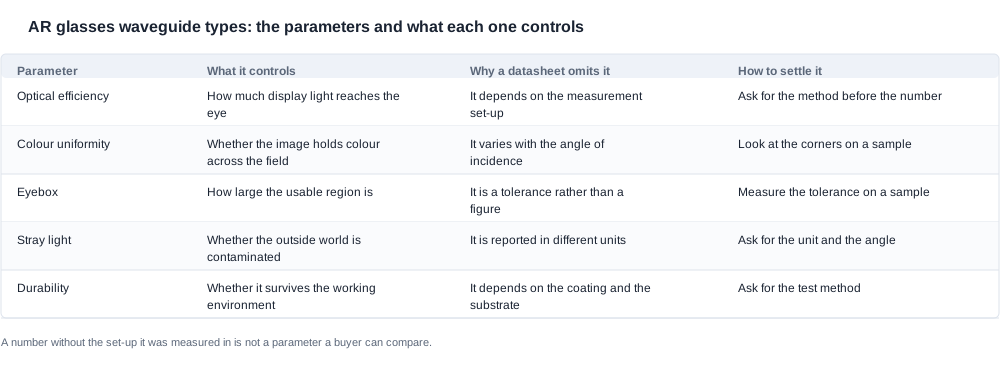
What should I ask a supplier? Five parameters that a spec sheet usually omits: optical efficiency, colour uniformity across the field, the eyebox, stray light, and durability. The waveguide types article covers each of them, and the how to test a waveguide before ordering article covers the sample procedure that settles them.
What a waveguide does, and why the type is a hardware decision
The mechanism is worth stating precisely, because the commercial consequence follows from it. A microdisplay produces an image. The waveguide carries that image into the eye while letting the outside world through, and it does so by redirecting light along a path inside a transparent substrate. Whether that path is achieved by a reflective facet geometry, by a diffractive grating structure, or by a photonic arrangement determines how much light reaches the eye, how the colour behaves across the field, how thick the substrate has to be, and how the part is manufactured.
Those four outcomes are not independent. A structure that delivers light efficiently over a wide field, in full colour, from a thin substrate, at a manufacturable cost does not exist in a single variant; what changes between suppliers is where the compromise has been taken. A buyer's job is to establish where the compromise sits for their application, and to do that before the tooling is committed.
The reason the type is a hardware decision rather than a configuration is the tooling. The substrate geometry, the coating process and the alignment tolerance are all established when the optical design is fixed. A change of type reopens the optical design, the tooling, the assembly fixtures and the tolerance analysis — and, downstream of all of it, the assessment that was written for a specific optical configuration.
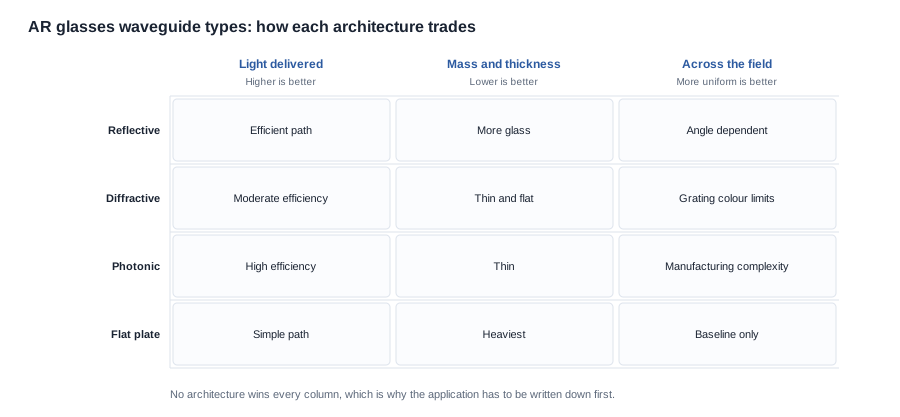
The matrix above is the honest version of the architecture comparison. No row wins every column, which is why the matrix is useless as a recommendation table and useful as a trade table. The buyer who asks a supplier "which waveguide should I use" without an application gets whichever row that supplier is best at, and that is a question about the supplier rather than about the product.
Which architecture the application implies
The application does the work, and it does it in a fairly predictable order. Four questions will usually settle the architecture before any supplier is asked.
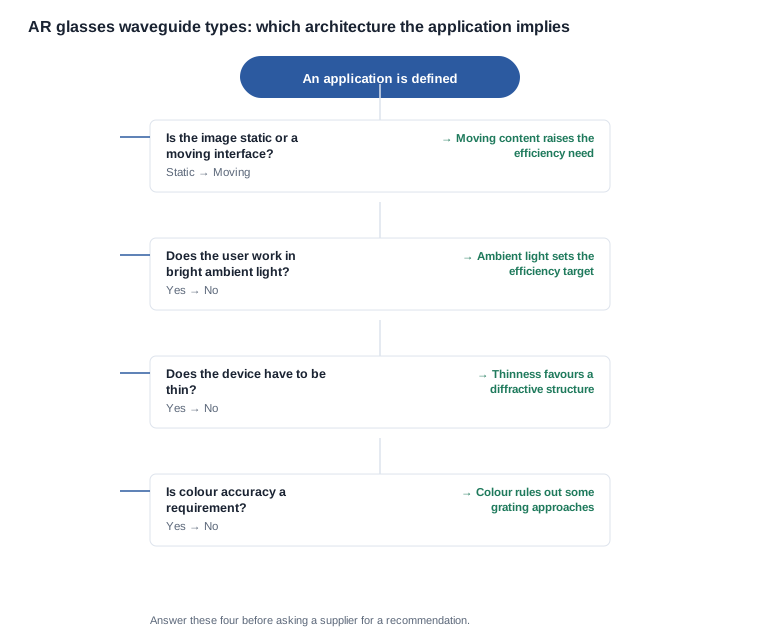
Is the image static content or a moving interface? Static content — a reference card, a checklist, a fixed overlay — tolerates a less efficient structure because the eye spends more time on it. A moving interface needs more delivered light to stay readable at a glance, which pushes towards the higher-efficiency architectures and, with them, towards a higher cost.
Does the user work in bright ambient light? Ambient light is the condition that decides the efficiency target, and it should be written into the specification as a condition rather than assumed. A device specified for indoor use and then deployed in a warehouse with high bay lighting is a device that will be returned.
Does the device have to be thin? Thinness favours the structures that can be flat, and it pushes against the ones that need a longer folded path and more glass. Where the channel is a fashion accessory, thinness is often the binding constraint; where the channel is a helmet-mounted or industrial system, it usually is not.
Is colour accuracy a requirement? Colour rules out some of the grating-based structures, because the diffraction behaviour that produces the efficiency also produces the colour shift. For an industrial overlay where a colour codes a state, that is a disqualifying constraint; for a navigation arrow in monochrome, it is not.
The order of these four matters less than the fact that they are answered before the supplier conversation. The decision tree above is a way of making the answers explicit, and its purpose is to turn "which type should I buy" into a question with a defensible answer attached.
The five parameters a waveguide datasheet leaves out
The parameters below are the ones that determine whether a waveguide works in a given application, and they are the ones least likely to appear on a datasheet.
Optical efficiency. How much of the display's light reaches the eye. It is a property of the assembly rather than of the part, so it should be asked as a figure for the configuration being quoted, with the measurement set-up stated. A datasheet efficiency measured on a bare part in a laboratory bench is a different number from the one in the assembled product.
Colour uniformity. Whether the image holds its colour across the field, and at what angle. This is the parameter that decides whether a product can carry colour-coded information, and it is usually reported as a range rather than as a figure — which is fine, and it is still a measurement rather than a claim.
The eyebox. The usable region: how far the eye can move and still see a usable image. It is a tolerance rather than a specification, and a tolerance that is wide enough for a comfortable fit at one head size may be insufficient at another. It is also the parameter most closely tied to the fit of the device on a specific population, and it should be requested as a range with the measurement method stated.
Stray light. How much of the outside world leaks into the user's view and how much of the image leaks out. It is reported in different units by different suppliers, so it is not comparable at all without the unit, the angle and the condition.
Durability. Whether it survives the working environment. It depends on the coating and on the substrate, so it cannot be inferred from the type of waveguide, and it has to be asked with the test method attached. A qualification claim without a method is a marketing statement.
The reason these five are omitted is not concealment. They are hard to measure consistently, they are measured differently by different suppliers, and they are only meaningful once the configuration and the application are fixed. That is precisely why they are the parameters that distinguish a supplier who has done this before from one who is relaying a catalogue entry.
What the omissions tell you about the supplier
An omitted parameter is a statement about the supplier, and it is a cheap one to read. A supplier who publishes an efficiency figure with its measurement set-up is publishing a number they expect to be checked against a competitor's, which means they expect the comparison to be made on that parameter. A supplier who publishes nothing at all is probably building an optical assembly rather than selling a waveguide, and the performance comes from their integration work rather than from a part they can specify.
That distinction matters commercially. A waveguide sold as a catalogue part with published parameters is substitutable, and the buyer can compare it against a second supplier on the same numbers. An optical assembly integrated by the supplier is not substitutable without redoing the mechanical and tolerance work, which means the buyer is comparing a component price with a solution price and usually does not notice the difference.
The same reading applies to the durability claim. A supplier who names a test method is telling you the part has survived something. A supplier who describes the part as durable is telling you the coating is good. The first is a specification and the second is a preference, and only one of them can be written into an acceptance test.
Settling a waveguide on samples before the tooling is paid for
The sample procedure is the only part of the waveguide decision that can be done before the tooling, and it is the part most often skipped because it appears to be an extra cost. It is cheaper than the alternative, which is tooling an optical design that a sample has already shown to be wrong.

The procedure has five steps, and each one has a completion test:
- Get the application and the ambient light condition in writing. Completion test: a sentence a supplier could quote back.
- Ask each candidate for the same five parameters, in the same units. Completion test: five figures per candidate, comparable side by side.
- Put the samples in the real lighting rather than on a bench. Completion test: the same lighting condition as the deployment, including the worst case.
- Check the corners of the image for colour and brightness shift. Completion test: a written observation per corner, including the worst one.
- Write down what a swap would cost in tooling and in assessment. Completion test: a number or a statement that the number is not available.
Step five is the one that changes behaviour, because it prices the sixth question. A waveguide swap is a new product, and the cost of that is the cost that the buyer has been avoiding by not asking.
What to ask a supplier about a waveguide quotation, and the questions that reveal whether the answers are real:
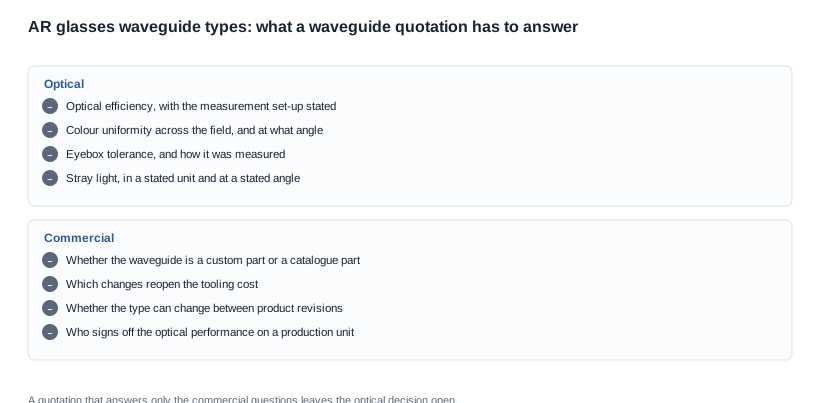
The commercial half of the list is where a buyer is most likely to be short of information, because the optical half is what gets quoted and the commercial half is what gets decided. Whether the waveguide is a custom part or a catalogue part. Which changes reopen the tooling cost. Whether the type can change between product revisions. And who signs off the optical performance on a production unit, because the sample and the production unit are not always the same thing and the party who accepts that difference should be named.

What our catalogue publishes, and what it does not
We publish an AR category and we publish no waveguide specification for it — no type, no efficiency, no field of view, no eyebox and no colour behaviour. The published rows are Bluetooth V5.4, a 100 mAh cell, charging at two hours or less, a runtime of about eight hours, magnetic charging, and an indicator light and button control. The AR glasses explained article sets out the five obstacles in the category.
We publish a weight for one model in the whole range, and it is the weight of the glasses body of a camera model — the MT6 at 158 g, which excludes the folding charging case, the weight of which is also not published. No frame weight is published for any model. That is worth stating plainly because a waveguide decision is a weight decision, and a buyer who is comparing architectures on mass needs a number for the assembly rather than for the substrate.
We do not publish display or waveguide performance figures, we do not publish a brightness or a field of view, and we will not print one. Our position is that we will describe what our catalogue holds, that we will not let a category listing stand in for a described product, and that a buyer who needs a waveguide specification should ask a supplier who can produce one with its measurement set-up attached.
The practical reason to prefer that position is the one that applies across this category: the failure mode is not a wrong figure, it is an unverifiable one. A figure without a measurement condition cannot be checked by anyone, including the buyer who received it, and a specification that nobody can check is a specification that will be discovered to be wrong by the customer rather than by the team that wrote it. Where a supplier will give the condition, the method and the configuration, the number becomes usable. Where it will not, the absence of the number is itself the finding, and it is better to have it before the tooling than after.
What a waveguide decision costs, and who carries it
The waveguide decision is the point in a display programme where the cost structure changes character, and buyers who have not seen that change before tend to negotiate on the wrong line item.
Up to that point, a display programme is a set of components, and the unit cost moves with volume in the ordinary way. The waveguide changes that. Its cost is dominated by three things that are not per-unit: the tooling for the substrate and the coating process, the tooling for the optical assembly, and the one-off engineering and assessment work that fixes the optical design. Once those are committed, the unit price of the waveguide itself becomes a smaller share of the total, and the decision that matters is no longer the price of the part.
The consequence for negotiation is direct. Argue hard about the unit price of a waveguide and the savings are small and one-off. Argue about the tooling scope, the number of variants you are paying for, the tolerance that determines the yield, and the terms under which the tooling is owned, and the savings are larger and permanent. A supplier who quotes one waveguide for one product is quoting a different commercial structure from one who quotes a waveguide for a family of products, and the difference is not visible in the unit price.
The trade-offs worth naming before you order are these. One waveguide type across the whole range is cheaper in tooling and restricts the application; two types double the tooling and double the documentation scope but allow the range to cover two environments. A custom part gives a better optical result and locks the design; a catalogue part gives a worse result and keeps the door open. A single supplier for the waveguide and the assembly makes the integration somebody else's problem and makes the specification somebody else's; two suppliers make the specification yours.
Which of those you take is a decision about the programme rather than about the component, and it is worth making explicitly rather than by default. The questions to ask a supplier are short: what the tooling covers and what it does not, whether the tooling is owned by the brand or by the supplier, what happens to it if the arrangement ends, and how many variants the quoted figures assume. Those four answers are usually more valuable than the unit price, because they describe the shape of the commitment rather than its size.
Related reading
- The mechanism — waveguide explained
- The types and their limits — waveguide types
- The parameters and their measurement — AR display types
- The sample procedure — how to test a waveguide
Tell me the application and the environment, and I will tell you which of these questions has a published answer and which have to be settled with a supplier directly.


