

The common mistakes in a smart glasses certification checklist are almost all about treating a mark as a document, and the correction is always the same: ask which model it covers and who signed it. Six mistakes account for most of the rework buyers cause themselves, and none of them is a failure of diligence. They are failures of vocabulary. A buyer who asks the wrong question gets a confident answer to the wrong question, and the confidence is what makes the mistake survive.
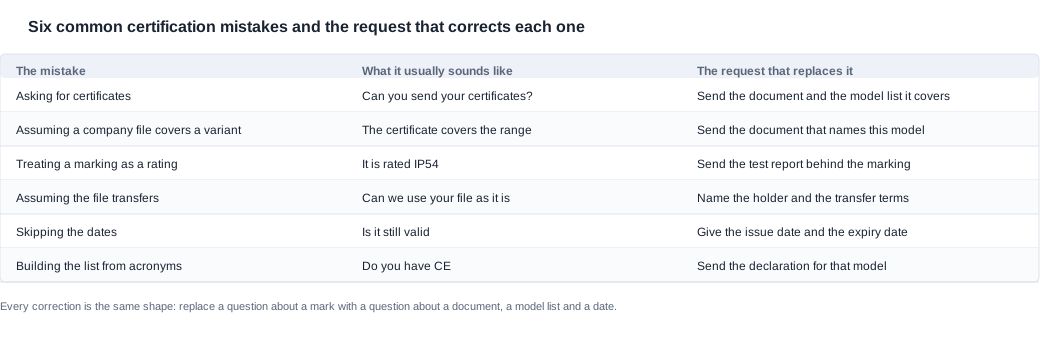
Six mistakes in a smart glasses certification checklist and the request that corrects each
The question that produces a folder instead of an answer
Most certification conversations start with a request that cannot be answered precisely, and then end with a document that cannot be used. The question "do you have CE" is the classic case. The honest answer to it is always yes, because a CE marking is a framework that any product in the European Economic Area can be declared under, and the answer carries no information about your model, your configuration or your market.
The second half of the problem is the difficulty in this category. Almost every mark a buyer will encounter is genuine, and the marks are still not usable on their own. CE is a declaration framework rather than a certificate a supplier can hand over. RoHS is a materials restriction. FCC operates through a grant that identifies an applicant and a device. A Bluetooth qualification listing identifies a product. An IP rating is a test result, and a test result belongs to a report rather than to a catalogue entry. Each of those has a different documentary shape, and a request for "your certificates" will receive a folder that does not fit the dossier it has to go into.
The six mistakes and the single request that fixes each
| The mistake | What it usually sounds like | The request that replaces it |
|---|---|---|
| Asking for certificates | "Can you send your certificates?" | "Send the document and the model list it covers" |
| Assuming a company file covers a variant | "The certificate covers the range" | "Send the document that names this model" |
| Treating a marking as a rating | "It is rated IP54" | "Send the test report behind the marking" |
| Assuming the file transfers | "Can we use your file as it is" | "Name the holder and the transfer terms" |
| Skipping the dates | "Is it still valid" | "Give the issue date and the expiry date" |
| Building the list from acronyms | "Do you have CE" | "Send the declaration for that model" |
The pattern across all six is identical. Each mistake replaces a question about a document with a question about a label, and each correction restores the document. That is why a single corrected request, repeated across a supplier evaluation, changes the quality of everything that follows.

Mistake one: asking for certificates instead of asking for documents
Why a certificate request is answered with whatever is easiest to send
When a buyer asks for certificates, the supplier responds with the items that are easiest to produce. Those are usually a certificate page, a brochure scan, a company profile and a declaration that is organised around the company rather than around a product. The supplier has behaved reasonably: it answered the question that was asked. The problem is entirely in the question.
The deeper issue is that "certificate" points at one object while the work requires several. A conformity assessment produces a declaration, which refers to a set of standards, which are evidenced by test reports, which were produced by a laboratory, which are held against a technical file, which covers a list of models. A buyer who asks for one object gets one object and has to assemble the rest by inference, which is exactly the work the request was supposed to save.
There is also a status problem. A certificate looks like a conclusion and a report looks like evidence, and the two carry very different weight in a dossier. A buyer who asks for "the certificate" when the dossier needs the report will receive whichever of the two the supplier happens to have, and will not necessarily notice the substitution.
The five answers that make a document usable
A request becomes precise when it asks for five things at once, because a document is only usable when all five are present.
- Which document it is, named as a type rather than described. A declaration, a grant, a test report, a test summary, a listing record.
- Which models it covers, as a list attached to the document rather than a description of a product family.
- Who issued it and who signed it, with the issuing party named separately from the signatory where they differ.
- When it was issued and when it expires, because validity periods differ between document types and between markets.
- Which production batch or configuration it was written against, which is the field that is hardest to supply and the one that decides whether a claim can be defended later.
A response that contains all five is a document a buyer can file. A response that contains one or two is a piece of literature, and it should be treated as such.
A corrected request, and the difference it makes
The practical test of the five answers is worth walking through, because the difference between a bad request and a good one is larger than it appears.
A weak request asks for the certification documents for a camera model going into the European Union. The likely response is a compliance statement that the range is certified, a company profile listing standards, and an offer to supply further documents on request. Nothing in that reply is wrong, and none of it can be used. The buyer now has to write a second email to find out whether the file covers the model, whether the case configuration is included, and whether the document is still inside its validity period, and the second email gets a more careful answer because the first one revealed what the supplier is prepared to say.
A stronger request asks for the declaration of conformity covering the specific model and configuration, with the model list attached, together with the issue and expiry dates, the issuing party, and the technical file index for that model, and it adds a second question about the transport summary for the cell in the carton and the case cell if a case ships in the box. The response to that request is short and mostly usable, and the two questions land in two different places inside the factory, which is how the buyer finds out whether the file is maintained per model or per company.
The difference in effort is a few extra words in the request. The difference in outcome is a file that can be filed, and a supplier whose documentation capability is visible after one exchange rather than after one shipment.
Mistakes two and three: a company file that covers a variant, and a marking treated as a rating
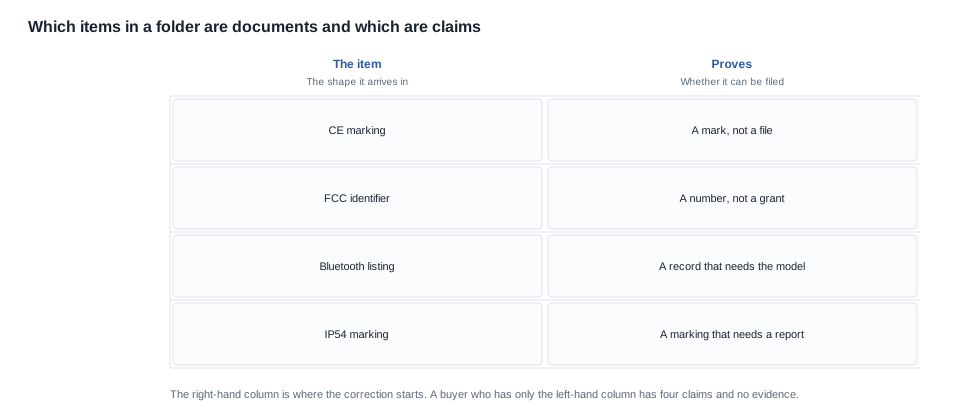
Mistake two, when the scope of the file is not the scope of the order
The assumption that a company level file covers a variant is the second most expensive mistake, because it is true often enough to feel safe. A supplier holds a file that covers a range. The buyer orders a specific model within that range, and reasonably concludes that the file reaches it.
A model designation that differs by a character breaks the link. Our own catalogue shows the pattern clearly enough. The L2 Utral appears in our product material as the L2 Utral and is also marked "Utral Pro Max", which is exactly the kind of naming inconsistency that produces a document that does not match the carton. The A05 and the A06 are published with identical parameters, 40 mAh cells, charging in two hours or less and about twenty hours of rated use, which makes them very easy to confuse in a file even though they are separate models. Neither of those is an error in the product, and both of them are a documentation hazard for anyone who assumes that similar products share a file.
The correction is narrow and cheap: ask for the document that names the model, not the folder that covers the range. The supplier's answer will either be a document with the model on it, or a clear statement that the file does not reach that model, and both of those are useful. What is not useful is the folder.
Mistake three, the ingress marking with no report behind it
The third mistake is treating an ingress protection marking as a certified rating. In our own catalogue the IP54 marking appears on the V06 and the S7, and no third-party report number is published behind it. If a retailer, a tender or your own customer asks for substantiation, a marking is not an answer.
The reason it matters commercially is that markings travel into listings. A marking becomes a word on a product page, and the word on the product page is what a distributor's compliance team, a marketplace reviewer or a tender assessor reads. If the answer to their request is "it is a catalogue marking", the listing has a problem that no amount of evidence in your file will solve later.
The IP rating discussion covers what the digits mean, and the certification red flags article covers the wider set of signals worth watching for in a documentation pack.

Mistakes four, five and six: transfer, dates, and a list made of acronyms
Mistake four, assuming the supplier's evidence becomes your evidence
For a product imported into a market where the importer carries the obligations, the question of who holds the evidence and in whose name is not a formality. The evidence may sit with a factory, with a sub-supplier, or with a laboratory, and each of those positions transfers differently. The your brand and our certificate question and the responsible person question both cover the substance of this, and the short version is that a file which cannot be transferred to your importer in your market is not yet a file.
The practical test is to ask the question in the way the authority will ask it: who is the party named as the holder, and in whose name would this document be produced if our importer were the one presenting it. If the supplier has to think about the answer, the arrangement has not been agreed, and it belongs in the purchase order rather than in an email thread.
Mistake five, the dates nobody checks
Validity periods differ between documents and between markets, and an expired document is a market access problem rather than a filing problem. The distinction matters because a filing problem is solved by a form and a market access problem is solved by a test, and the second one is on the critical path.
The certificate validity question sets out how to check, and the check itself is a date comparison against your launch date rather than a general question about whether things are current. A document that is valid today and expires before the goods reach a warehouse is a worse finding than one that expired last year, because the second is visible at the first check and the first is not.
Mistake six, a list made of acronyms
A checklist built on mark names cannot be completed, because the answer to "do you have CE" is always yes and the answer to "give me the declaration of conformity covering model X" is sometimes no. The list looks thorough and produces no information, and it is the easiest mistake to make because the list is the thing most people copy from each other.
A checklist that works is built from documents and from questions about them. The certification glossary defines the document types precisely enough to build one from, and the certification buyer checklist is the form version of the same thing.

The request list a smart glasses certification checklist should actually contain
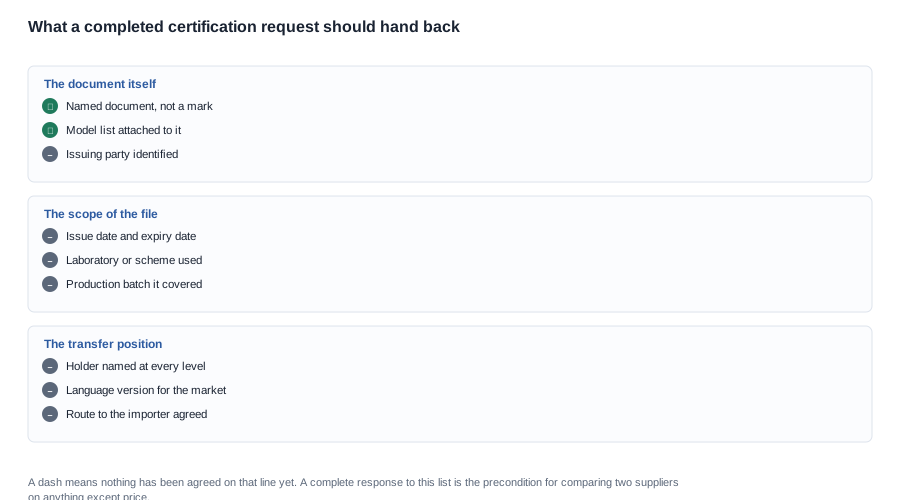
The seven lines, and why each one is there
| Line | What to request | Why it is the right ask |
|---|---|---|
| Model coverage | The document with the model list attached | A document without models cannot be filed |
| Holder and signatory | Who issued it and who signed it | A claim and an evidence carry different weight |
| Dates | Issue and expiry, and the market it is valid in | Validity differs between markets and documents |
| Test evidence | The report, the standard and the laboratory | A report evidences a test; a declaration asserts conformity |
| Batch scope | Which production batch the report covered | A report on a prototype is not a report on your goods |
| Transfer terms | How the evidence reaches an importer | Determines whether you can actually file it |
| Translation | The language version you will file | A translated copy is often what the authority needs |
The order of the lines is the order in which they should be asked, and the last two are the two that are skipped most often. A buyer who has the first five and no position on transfer and translation is a buyer with a file and no way to use it.
How to send it and how to read the reply
Send the list as a single request, addressed to the person who can answer all of it, and say what you are doing with the answers. A request that explains the destination market and the model list gets a scoped reply; a generic request gets a generic reply.
When the reply arrives, read it against the order of the list rather than against its length. A long reply that answers the first two lines and skips the rest is a partial answer, and partial answers are worth more than long ones because they show where the boundary is. The lines that come back empty are the ones that need a named owner and a date, and those belong in the purchase order.
What a partial answer tells you about the supplier's documentation
The empty lines in a reply are diagnostic rather than merely inconvenient, and they are worth reading properly before you draw a conclusion.
An empty line in the middle of the list usually means the document exists and is understood, but the holder of it is not the person who replied. An empty line at the end usually means the work has not been done, because the last two lines are the transfer terms and the translation, which are the two that are only worked out when somebody has actually put the file in front of an importer. An empty line in the first position, the model coverage, is a warning sign about the whole file, because a supplier that cannot state which models its documentation covers is telling you it does not maintain the documentation per model.
None of that is disqualifying on its own. What it does mean is that the verification load sits on your side of the table, and it should be priced into your decision rather than discovered during it. The honest comparison between two suppliers is not between their claims, which will sound similar, but between how much of the list each of them answered without being chased.
What we will and will not tell you about our own certification documents
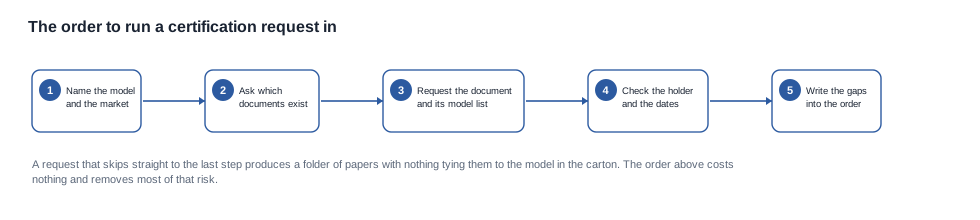
The first question we would rather you asked
The working rule we apply: the certification conversation in this category should be a document conversation, and the first question is never "do you have CE" but "which model does this document cover, and who signed it". We publish the certification position honestly, including the parts where it is not provided to us, and we would rather a buyer asked us for a report than assumed one existed.
We will also say that a supplier who claims a complete certification set for a whole range in one breath is telling you something that does not survive the first customs query. That is not an accusation against any particular supplier. It is an observation about what a complete certification set has to contain, and it is checkable in a single question.
The claim we make about our own range
In our own documentation, the export-certification page carries ten patent certificates — eight appearance-design patents and two utility-model patents — and its content is images rather than text; the catalogue names no CE, FCC or RoHS marking, no per-model certification row exists anywhere, and no model level coverage, certificate number, issuing body or validity date is published for any model, the applicable scope for a model and a market being written material to be requested and filed before the order. The published position on the ingress marking is that it appears on the V06 and the S7 with no third-party report number published behind it. The published position on charging is that the charging method is magnetic on seventeen of the twenty-eight models, Type C on seven, and not published for the CY05 and the MT6, and the L1 Pro and the CY03. The published position on the children's models A05, A06 and A07 is that no certification information has been provided at all.
Each of those is stated in the same form we would ask another supplier to state it, and the reason is that a buyer who is told where the gaps are can plan around them, while a buyer who is told only that the range is compliant cannot.
What a completed request looks like when it comes back to you
Send the models, the configurations and the destination market, and we will tell you which documents we hold for those models, which we do not, and what has to be obtained and by whom. If your programme involves the children's models or the bone conduction platform, tell us at the outset, because both of those raise questions that a document request will not answer.


