

A supplier will answer any question about AR glasses waveguide types. That is not the same as being able to answer the questions that matter, and the difference is where most purchasing effort is wasted. The question sets that circulate in this category are usually organised by subject, which means they are organised by the supplier's department rather than by the buyer's decision, and a buyer working through them ends up with a long transcript and no shortlist. What works is a shorter set organised the other way around: each question is asked because it settles one decision, and the decisions are ordered so that the cheap ones come first and the expensive ones come last. This article sets out that set, the answers that are usable, and the two questions that separate a supplier who owns an optical programme from one who is relaying somebody else's.
AR glasses waveguide types: sorting the questions by the decision they settle
The short answer on what to ask a supplier about waveguide types
The supplier questions divide into three groups and they have to be asked in that order. The specification questions are the ones that produce a number with a condition attached, and they are what convert a family name into something that can be compared against another supplier's family name. The process questions establish whether a document behind the answer actually exists, which is a different thing from whether the answer is true. The commercial questions price the architecture rather than the component, and they are the ones that decide what the product costs in year three rather than what the quotation says today.
The order matters because of what each group costs to be wrong about. A wrong specification answer can be corrected by asking again. A wrong process answer cannot be corrected at all, because the document either exists or it does not, and the buyer finds out at the sample stage or later. A wrong commercial answer is the expensive one, because the money is already committed by the time it surfaces.
One framing closes most of the gaps before they open. The buyer is not asking which waveguide is best. The buyer is asking which family the requirement points to, and the supplier's answer to that is a statement of suitability rather than a preference. The comparing waveguide types honestly page sets out the families themselves; the Waveguide limitations and drawbacks material covers the reasons a family is chosen over another.
Who this is for and what the buyer has to leave with
The reader is a procurement manager or a product lead who has to select a display architecture for a product they are about to commit tooling money to. The decision has four parts and they are not equally easy: which family, which figures, what evidence stands behind the figures, and what it costs to change any of it later. A buyer who leaves the conversation with answers to the first two has a specification. A buyer who leaves with all four has a programme they can put into an order and hold a supplier to.
What is being managed is the cost of a later change. In this category a late change of coupler is not a component substitution; it moves the field of view, the eye box, the housing geometry, the calibration process and the marketing claims, all at once. The questions below are structured to find out how expensive a change would be while the change is still hypothetical and the quotation is still open.
The second thing being managed is the supplier's credibility as a source. There is a meaningful difference between a supplier who owns an optical programme and one who integrates somebody else's coupler and relays the figures. The former can answer the process questions. The latter cannot, and it is better to know that in week one than to discover it while a sample is being built.
Why the question order is not the natural one
The natural order for a buyer is to ask the questions they find most interesting, which in this category is usually the technical family question. That order is backwards. The technical question is the most expensive to get wrong, because it determines the architecture, and it is the question whose answer changes least between suppliers, because most of them quote the same two or three families with the same trade-off.
The cheap questions come first, and they are cheap because they are about the programme rather than the technology. Can this supplier name the coupler part number and its revision? Will they put the service life of the coupler in hours in the quotation? Is there a second qualified plant for the part? Each of these can be answered in a single email, and each one either opens the conversation or closes it.
There is a second reason to lead with them. A supplier who will not answer the cheap questions is telling the buyer something about how the programme is run, and that information is more valuable than the family answer would have been. A supplier who answers all of them accurately is demonstrating a documentation discipline that the buyer can then rely on when it comes to the figures.

The specification questions that have to produce a number
Four specification questions do the work in this group, and each one has to be answered with a figure and a condition. The condition is not pedantry: without it the number cannot be compared with another supplier's number, and a comparison the buyer believes they have made is worse than no comparison because it produces a decision.
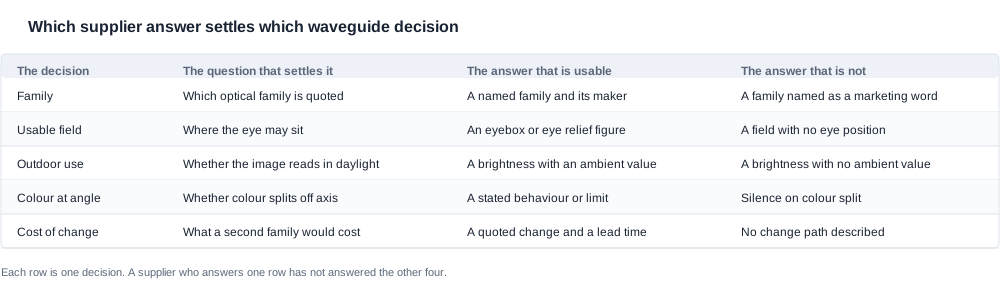
The table above is organised by decision rather than by subject, and the right-hand column is what a buyer gets instead of an answer. Read the fourth column as the reason each question is phrased the way it is. A family name asked for as a marketing word returns a marketing word; a family asked for as a part number returns something a buyer can put in an order.
Which optical family is quoted, and by whom? The useful answer names the family and the manufacturer of the coupler, because a family offered without a manufacturer has not been selected, only named. The follow-up question is whether the coupler is the supplier's own or a purchased part, because that determines who can answer the process questions in the next group.
Where may the eye sit? This is the eye box question, and it is the single most useful question in the set, because it decides whether the product can be used by a range of people at all or only by people with one head shape and one posture. A usable answer gives a dimension. An answer that describes a wide field of view without a dimension has described the diagonal of a rectangle rather than the region a person can actually use.
Does the image read in daylight? The answer has to be a brightness figure with an ambient value and an angle, not a brightness figure. Ask what the figure would be under a stated condition, and ask whether the supplier will warrant it. A supplier who declines to warrant a brightness figure has told the buyer that the figure is a measurement rather than a specification, which is entirely legitimate and entirely useful to know.
What happens to colour away from the centre? This question exists because colour separation at the edge of the field is the characteristic behaviour of one family and it is rarely described on a sheet. A supplier who answers it precisely, with a limit and a direction, is describing a characterised part. A supplier who answers it with silence is telling the buyer that nobody has examined it.
There is a fifth specification question that belongs in this group even though it does not produce a number, and it is the one that saves the buyer from a category error. Ask whether the quoted architecture is a coupler at all, or a folded display with a lens on an arm. The two are quoted side by side because they achieve the same result by different means, and they carry entirely different consequences for volume, weight, servicing and unit cost. A buyer who has accepted a coupler specification and then discovers that the quotation is for a folded display has lost the argument about the housing, the service procedure and the price, and it should have been caught by one sentence in the first round. The question is worth asking explicitly because the answer is often delivered as a correction to the buyer's own terminology rather than as a change to the product.
A sixth question is worth adding whenever the programme has a channel. Ask whether the eye box has been checked against the shapes of the people who will use it, or whether it has been checked against a nominal user. The first produces a product with a stated user population. The second produces a product that will be returned by anyone who does not match the nominal user, and the returns will be classified as preference rather than as a fault, because the specification was never written against a population.
The process questions that reveal whether the file exists
These are the questions that cannot be answered well by a supplier who is relaying figures, and they are the cheapest to ask. They also carry the highest consequence, because a document that does not exist cannot be produced later at a cost that anyone is willing to pay.
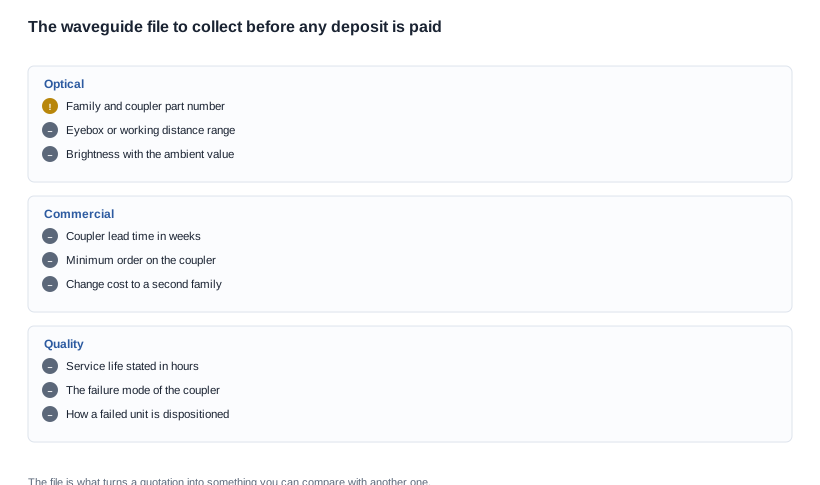
The checklist above is the file to collect before a deposit, and it is organised by who has to produce each part. The optical group is what the buyer needs to compare two suppliers. The commercial group is what the buyer needs to negotiate with. The quality group is what the buyer's own service organisation needs before the product is in a channel, because a coupler failure is a replacement rather than a repair, and the returns cost of that is a product planning figure rather than a service figure.
Three process questions are worth asking in exactly these words, because the wording is what makes the answer checkable:
- What is the coupler part number and its current revision? A part number without a revision is a series, and a series means the part can change without anybody telling the buyer.
- What is the rated service life of the coupler in hours? This is a specification a supplier will have if the part has been characterised, and a supplier who does not have it is telling the buyer that nobody has asked how long the optical element survives.
- How many qualified plants exist for this coupler? One qualified plant is a pricing ceiling that neither side controls. Two or more is the difference between a component and a dependency.
A fourth question, which is really a commercial one carrying a process disguise, is whether a change of coupler reopens the review of the quoted figures. The answer is almost always yes in principle and is usually unstated in practice, which is why it belongs in the order rather than in the email.

The commercial questions that price the architecture rather than the part
The commercial conversation in this category has two halves that buyers routinely run together, and separating them is worth more than any unit-price argument.
The first half is the coupler. It has a volume curve, it has a minimum order that the supplier cannot cross without changing terms, and it may carry a qualification charge for a second source. It is a component and it is priced like one.
The second half is the architecture. The family determines the field of view the product can offer, the light output it can deliver, the volume the housing needs and the eye box the operator has to work with. Those are product decisions with unit-price consequences that run for the life of the product, and they are usually settled as if they were a component choice because they arrive in the same quotation.

The sequence above is the order in which a requirement becomes something a factory can quote against. It starts with the use case rather than with the family, and that is deliberate: a supplier who is given a one-sentence use case will name the family that fits it, and a supplier who is given a family will explain why the family fits.
The commercial questions worth asking are therefore these. What does a change of coupler cost in money and in weeks, and what has to be re-qualified when it changes. What is the minimum order on the part, and what happens to the price at the volume the programme will actually run at. Is the coupler part of the product's bill of materials or supplied separately, because that changes who owns the incoming inspection. And whether the programme has a second source today or could have one in a defined period.
The question that surfaces the most useful information is the one about what happens if the requirement moves by one step. A supplier who can quote the incremental cost of a wider field, more light or a larger eye box has a costed architecture. A supplier who cannot usually has a single design and no idea what changing it involves, and that is a programme with a long and expensive change path.
The second most useful commercial question is about who owns the incoming inspection. A coupler supplied as part of the finished unit arrives as somebody else's part inside somebody else's product, and the buyer inherits a question about what to do with a unit that arrives with a defect in it. A coupler supplied as a separate line on the purchase order arrives as the buyer's part, and the incoming inspection procedure belongs to the buyer, along with the decision about what to do with a rejected unit. The difference in cost per unit is small and the difference in the returns process is not, and this is a question that costs nothing to ask and is almost never asked.

The two questions that separate a supplier from a relay
Most questions in this category can be answered by a supplier who is integrating somebody else's coupler, because the figures are published and the family is a catalogue entry. Two questions cannot, and they are worth asking early precisely because they are the ones that will fail.
Which party signs the quoted figures? The question is not about the coupon being right in a legal sense; it is about whether there is a named party inside the organisation that is accountable for the numbers and can be asked again when one of them turns out to need qualifying. A supplier who answers with a partner company has told the buyer that the numbers are not theirs to stand behind, and that any future question about them will have to be routed through a relationship the buyer does not have.
Who produces the evidence when a figure is questioned? This asks about the mechanism rather than the answer. A supplier who owns an optical programme has a place where the measurement data lives, whether that is a test cell, an external laboratory or a partner's file with a name attached. A supplier who does not own it will answer that the evidence is available through the coupler supplier, which is not an answer so much as a routing instruction, and it tells the buyer that the evidence chain has one more link in it than the programme chart suggests.
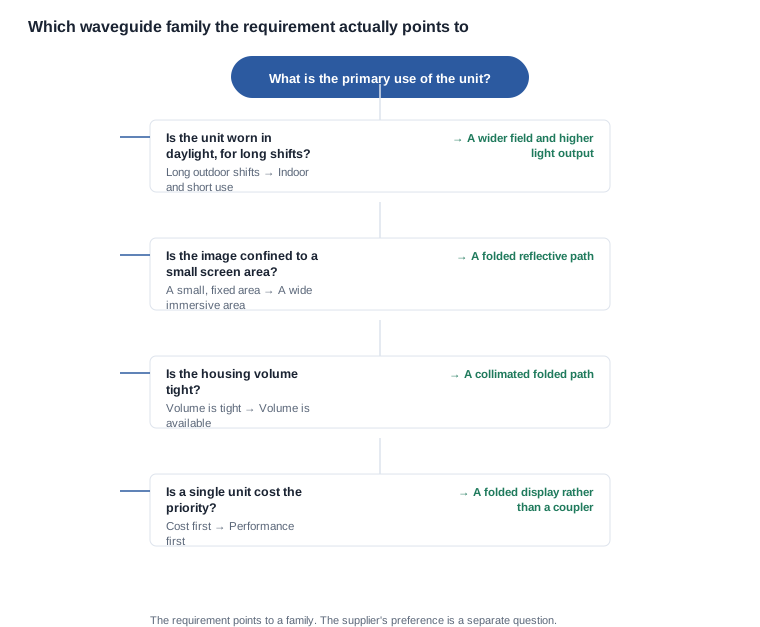
The decision tree above is the simplest version of the same idea. It starts from the use case rather than from the technology, because the use case is what the supplier has to answer to, and each branch removes one family from consideration for reasons the buyer can state in a sentence. It is worth using with every supplier, because a supplier that disagrees with the routing has to say why, and that disagreement is itself informative.
Handling an answer that contradicts another
Two suppliers, or one supplier on two questions, can produce answers that cannot both be right. The most common contradiction in this category is between the family named in the quotation and the behaviour described in the answers: a diffractive coupler quoted for a wide field, and a supplier who describes the usable eye region as narrow, is describing either a different part or a different constraint than the one the buyer has assumed.
There are four ways to handle it, and the choice depends on what is at stake. If the contradiction is about a figure, ask again with both answers quoted back, in the same email, and give the supplier a specific date. If the contradiction is between a figure and the commercial terms, treat it as a configuration error and ask which configuration the price refers to. If it is between two suppliers, keep both answers and put the contradiction in the comparison sheet as an open item with a name against it, because it is usually the item that decides the evaluation. And if the contradiction is between what the supplier says and what the datasheet says, stop and check whether they are quoting the same part revision.
What must not happen is a silent reconciliation. The temptation is to pick the more plausible answer, fill the cell and move on. That is how a buyer ends up with a specification that no supplier agrees to, discovered at the point where the tooling has already been paid for. An unresolved contradiction is a legitimate outcome of an evaluation, and it is a legitimate reason to ask a different supplier the same question.
Where we sit on waveguide questions
Our catalogue publishes electrical rows for every model, and for the AR entry it publishes the cell configuration, the runtime, the charge time, the charging method and the radio version. It does not publish a waveguide row, a coupler part number, a field of view figure, a brightness figure or an eye box dimension. We do not produce those by inference, and we do not describe a product as having a waveguide family when the catalogue does not say so.
What we can do is answer the questions that are about the programme rather than the optics. Which families are realistic for a stated use case. Where the coupler lead time sits in the schedule. What a change of coupler would cost in weeks and in money. Which parts of the specification become fixed once tooling starts, and which are still open. What a second source would involve. And what the buyer should have in a file before a deposit is paid, which is the checklist above.
On the two questions that separate a supplier from a relay, we would rather say plainly that the optical programme sits with the display and coupler suppliers and that our answer comes from them in writing, confirmed for the configuration being built. The catalogue also carries a company-level export certification page whose content is images rather than readable text, and the catalogue text contains no reference to CE, FCC or RoHS, so we do not present those marks as evidence of anything. Any conformity document a buyer needs has to come as a document with a number on it.
What to send us for a coupler quotation
Send the use case, the environment, the duration of use and the quantity, and describe what the image has to support rather than what it has to show. We will tell you which optical families are realistic for that case, what the coupler lead time does to the schedule, what a change of supplier would cost, which parts of the specification become fixed the moment tooling starts, and what has to be collected in a file before any deposit is paid.


