

No — and in this specific category the reason is not a gap in the documentation. It is a property of the design. An open-ear audio product has openings in it by definition: the acoustic port that lets the sound out, and the microphone port that lets the voice in. Those are holes in the enclosure, and they are what make the product work. Any claim that such a product is waterproof is a claim about a product that could not exist.
That said, "are they waterproof" is a question with more than one honest answer, and buyers who treat it as a single yes-or-no are the ones who end up with a returns problem. The audio family in our range publishes no ingress rating at all. Two models in the wider range — the V06 and the S7 — publish an IP54 marking, and they are camera models rather than audio models. So the answer depends on which product is on the page, what the rating actually permits, and how the product will be described once it reaches a marketplace.
Are they waterproof: what an ingress rating actually permits
An ingress rating is a precise statement about a specific test, applied to a specific product in a specific configuration. It is not a word that can be applied loosely, and the discipline of reading it properly starts with understanding what the two digits mean.
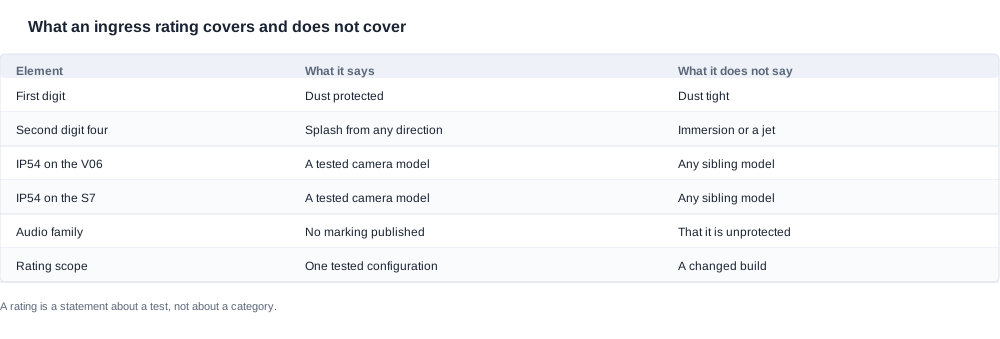
The first digit concerns solids. A first digit of 5 means the product is dust protected — protected against ingress of dust under the defined test conditions, with the caveat that it is not dust tight. This is why an IP54 product can still have a problem with a dusty environment: the rating permits some particulate to reach the product while resisting enough of it to avoid damage.
The second digit concerns water. A second digit of 4 means the product is protected against splashing water from any direction, under the defined test conditions. This is a limited protection, not a waterproof rating. It covers the ordinary accident — a splash, a few drops, rain blown across the frame on a bicycle — and it does not cover immersion, a jet of water, a shower, a washing machine or a submerged unit.
The IP ratings explained reference covers the code system in full, and it is worth reading before you write anything about protection on a product page, because the temptation to round up is strong and the consequences are not.
Three things follow from that, and they are the ones that matter commercially. First, an ingress rating is a property of a tested configuration — adding a case, changing a lens, altering the seal or switching the charging method can take you outside what was tested. Second, a rating applies to the model it was measured on, not to the family and not to the sibling. Third, the rating is a statement about water entry, not about what happens after water has entered: a product can pass an ingress test and still be damaged by moisture that reaches the internals.
Why the answer to are they waterproof differs by family
In our own published range, the position is specific and it is worth stating precisely rather than generally.
The Bluetooth audio family publishes no ingress rating. All eight audio models — YK12 and D11, LC-105-1 and D12, G07 and K02, and K01 and LC-105-2 — carry no IP marking, no water-resistance wording and no ingress test reference. The reason is structural rather than accidental. The open acoustic design is the hardest thing on the product to seal, and the family with no rating is the family whose whole function depends on the openings staying open.
Two models in the wider range publish IP54, and both are camera models. The V06 and the S7 are named for sport and both belong to the eleven-model camera tier. A camera product is a closed box with a lens opening; an open-ear audio product is a box with two functional openings that have to breathe. The difference in what can be sealed is the difference in what can be rated.
A protection claim cannot be inherited across the range. The V06 publishes four colours and the S7 is in the same tier, but the fact that one camera model carries a marking says nothing about the audio models, about the camera models without a marking, or about the children's models, the photochromic entry or the bone conduction entry. Only the V06 and the S7 carry an IP54 marking in the published catalogue, and nothing else in the range carries any IP marking at all.
This is also where a common confusion creeps in. The sport family contains three models — YKC02, D17 and ZH12 — and two of those are the only models in the entire catalogue that publish a fast charge time of about one hour, while twenty-six publish two hours or less. The D17 and ZH12 are sport models and they carry no ingress marking. "Sport" in a model name describes the use case, not the sealing. The V06 and the S7 are sport-named and they carry the marking because they are camera products with a closed enclosure.
So the honest answer to "are they waterproof", for a buyer working across this range, is a table with one row per model and a column for what is actually published. It is not a sentence that applies to the category.
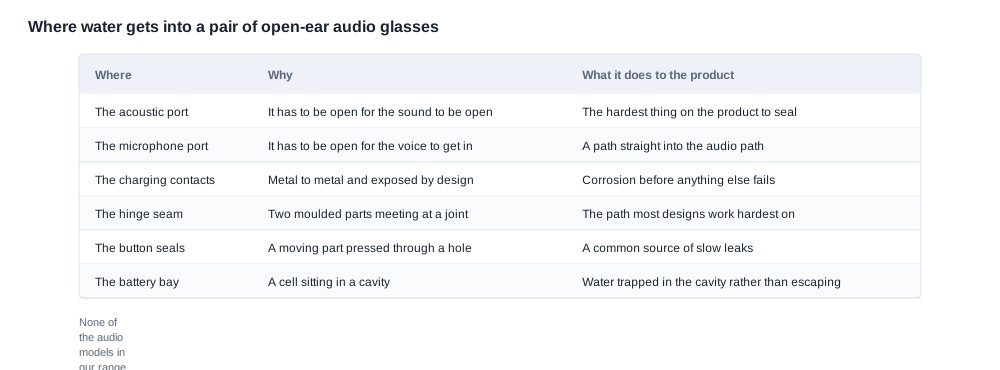
Where water enters an open ear audio product
This is worth understanding, because the failure modes are what a returns policy has to anticipate.
The acoustic port. The opening in the temple that the sound radiates through, and the largest opening on the product. A design that seals it has to use a mesh or a membrane, and a membrane that passes sound at speaker frequencies is doing something quite subtle — which is why sealed versions tend to sound different and why open versions are easier to make well.
The microphone port. Smaller, but a direct path into the audio path, and a microphone that has taken in water produces noise, crackle or silence. This is often the first symptom a customer notices, and it appears days later, because water inside a microphone housing does not dry quickly.
The charging contacts. Metal to metal and exposed by design, because that is how a magnetic charging cradle works. Corrosion appears here before anywhere else, and it presents as intermittent charging rather than as a dead product — a much harder failure to diagnose and a much more common source of returns. The same applies to a Type-C port: the port itself is a cavity, and a Type-C connector in a wet pocket carries contamination into the charging path.
The hinge seam. Two moulded parts meeting at a joint. This is the path most designs work hardest on, and the one where the quality of assembly matters most.
The button seals. A moving part passing through a hole in a sealed surface. A common source of slow leaks, and a slow leak is worse than a fast one because it is intermittent and easy to dismiss.
The battery bay. A cell sitting in a cavity. Water that gets in here is trapped rather than escaping, and it sits against the cell, which is the worst place for it to be.
The ordering matters for the returns policy. The microphone and the charging contacts fail first and fail visibly. The battery bay fails last and fails expensively. A support policy that assumes every water incident is a microphone issue will mis-triage the expensive ones.


The listing and support cost of a wrong are they waterproof answer
A customer who takes a pair of open-ear glasses into the rain and then finds one ear silent has a complaint. If the listing said waterproof, the complaint is justified and it is expensive. If the listing said nothing about water, the customer has no expectation, and the support conversation is a short one.
The problem is that the word waterproof is so widely used in this category that its absence reads as a claim of the opposite. Which is why the listing has to say something, and what it should say is what the product actually is.
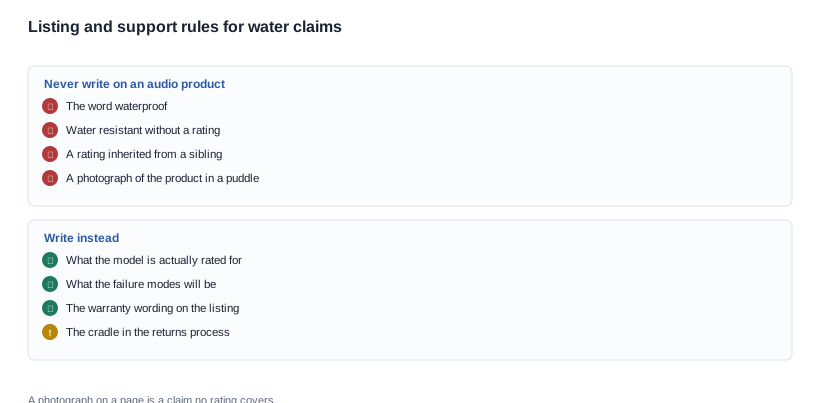
The rules that follow from this are straightforward. Do not print the word waterproof on an audio product, and do not print water resistant unless there is a rating with the test behind it. Do not extend an IP54 marking from one model to a sibling in the same family. Do not put a photograph of a product in a puddle on the product page, because a photograph is the most powerful claim on a page and no rating covers it. And do not let the category language leak in through the photography brief — a lifestyle shoot in the rain is a claim even when no sentence on the page makes it.
The cost of getting this wrong falls on two sides. The direct cost is returns: a claim that the buyer's own listing justified cannot be refused without causing more damage than accepting it. The indirect cost is the support burden, because every ambiguous listing produces a category of question that has to be answered individually, and the answers are inconsistent unless the policy was written first.
The indirect cost is the one that is easier to forget. Channel partners and marketplace listings repeat the claims from your product page, and they repeat them more loosely than you wrote them. A claim you did not make becomes a claim you are responsible for, made by somebody else, in a channel you do not control. The only reliable defence is to make the correct claim first, in a form that survives being copied.
For a distributor or an e-commerce seller, this has a specific consequence in the due diligence pack. A channel partner will ask what the product is protected against, and a seller who cannot answer from the published rows will either guess or forward the question upward, and the guess is what reaches the listing. The answer takes one sentence per model — the marking, the scope, and the exclusion — and it is the same sentence that should appear in the listing, in the training material for the channel, and in the warranty.
The same principle applies to the photography and the packaging. A carton that carries a water symbol, an umbrella icon, or a "rainproof" badge creates the claim that no sentence on the product page contradicts. Where a model carries no marking, the packaging artwork is where the claim usually sneaks in, and the artwork is commissioned early — often before the listing is written, and often by somebody who has not seen the specification.

The questions to ask before are they waterproof reaches a product page
Six questions, and the first is the one that decides everything else.
- Is there an ingress rating for this specific model? Not for the family, not for a sibling, not for a model with the same enclosure in a different colour. In our range the answer is IP54 on the V06 and the S7, and nothing published on the audio models.
- If there is a rating, what standard, what tested configuration, and what report reference? A rating without a test behind it cannot be reproduced by your own quality team or defended to a market-access question.
- What happens if the unit gets wet? Is it repairable, is it diagnosable, is it written off? This is a support question and it should be answered before the product ships, because the answer determines the handling instruction you put in the box.
- What are the failure modes after water ingress? For a buyer assembling a returns policy, the microphone and the charging contacts are the likely ones, and the battery bay is the expensive one. The triage order is part of the policy.
- Is the charging cradle affected as well? The cradle is a separate product with its own contacts and its own failure modes, and it is the part most likely to be left in a car or a bag where the glasses are not.
- What does the warranty say about liquid ingress, and is that wording visible at the point of sale? A warranty exclusion that is buried on a policy page rather than stated on the listing is a dispute waiting for a customer, not a protection.
Are they waterproof and the warranty: where the claim and the policy meet
Water is the failure mode that intersects the listing, the warranty and the returns process, and a mismatch in any one of the three shows up as a dispute in the other two. The commercial mechanics of that intersection are worth working through before the product ships, because they are much cheaper to design than to fix.
The listing sets the expectation and the warranty responds to it. If the product page says nothing about water, the warranty can exclude liquid ingress without much argument. If the page says "IP54", the warranty has to align with what IP54 permits — which means excluding immersion while covering splash, and saying so in words a customer can read. A warranty exclusion written as "damage from liquid ingress" against a listing that says "water resistant" is a contradiction on the same product, and the contradiction is resolved in front of the customer.
The returns process needs a diagnostic step, not a decision step. "Water damaged, no replacement" is a policy; "unit returned with visible corrosion at the charging contacts and no microphone symptom — water exposure confirmed, model not rated for water, claim declined" is a process. The second version is defensible and the first is a dispute waiting to happen, because the first asks a support agent to judge a technical question. Ask the supplier for the diagnostic indicators they can confirm — corrosion, residue, a microphone symptom — and write them into the inspection instruction your own team uses when a unit comes back.
The unit that proves the claim is the sample. A buyer who wants to know how a wet unit fails should wet a unit, and the cheapest version of that is a sample in the quantity and configuration you are shipping, tested under the conditions you will describe. This is the same golden sample logic that applies to colour and finish, applied to a stress case: one unit, a written procedure, a recorded result, and a reference the inspection team can point at.
The tolerance question belongs in the same document. If you are going to write a handling instruction, it needs a tolerance attached — how much water, how long, before the unit is considered out of specification. Without one, the handling instruction becomes an admission that any amount of water is a defect.
Certification and the warranty are the same conversation in this category. Because no certification row is broken down by model in our published catalogue, and the export-certification page shows ten patent certificates with no per-model table behind it, the documentation that would support a market-access position does not exist in a form you can forward. So the water position in your listing has to be defensible on the strength of the marking and its published scope alone — which means it has to be narrow, precise and consistent with the warranty wording.
The commercial trade-off is straightforward. A narrow, accurate protection claim costs you some marketing ambition and buys you a returns rate you can forecast and a support team that can answer consistently. A broad claim costs you the difference between those two, and you pay it per unit, per claim, per channel partner who repeats it more loosely than you wrote it.
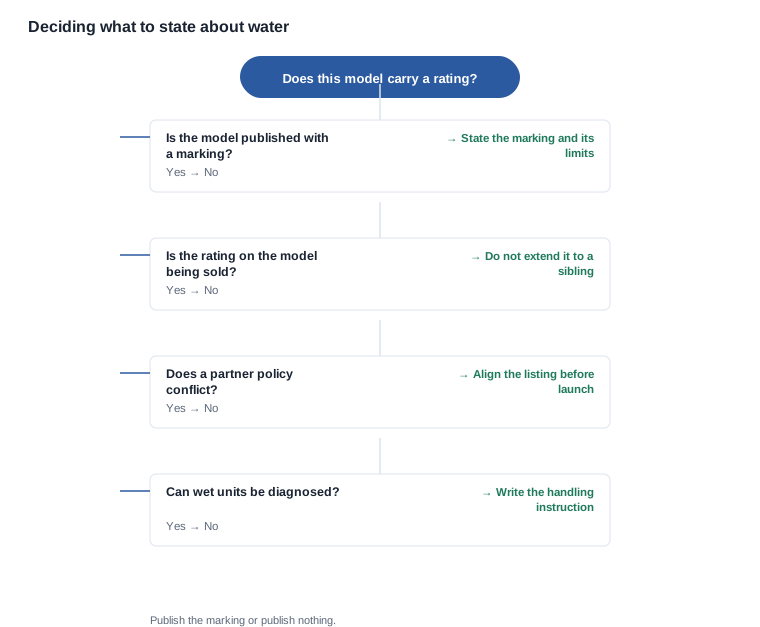
There is one further question that is not about the product at all and is worth more than any of the six: what does your channel partner's customer service policy say? If the partner's returns process treats a liquid-damage claim as a manufacturing defect, then your listing, your warranty wording and their process are three documents making three different promises. Aligning them before launch is a day of work; aligning them after the first hundred claims is a negotiation with a partner who now has an opinion.
It is worth adding two commercial questions to that list, because they are the ones a buyer forgets and a supplier will answer without being asked. What is the lead time on a replacement unit? A returns policy that promises a replacement from stock is a promise about a lead time that is not published, and it is a promise somebody has to keep. And what does the sample cost, and is it credited against the order? A water-handling instruction is only as good as the unit you validated it on, and the cost of that unit should be part of the same commercial conversation as the order rather than a separate small transaction.
The due diligence checklist for a water claim, in short: the marking for the exact model, the test behind it, the exclusion in the warranty, the diagnostic indicators in the returns process, the handling instruction with its tolerance, the sample that validated it, and the packaging artwork that has been checked for a stray symbol. Seven items, and every one of them is cheaper to establish before the launch than after it.
We will publish an ingress marking exactly as the catalogue states it, and will not describe an open-ear audio product as waterproof, splash-proof or water resistant. We publish the IP54 marking on the V06 and the S7 because that is what the catalogue states, we publish no ingress rating for the audio family because none is stated, and we will not convert an absence into a claim in either direction. The sport smart glasses range is where the two rated models sit, and the Bluetooth audio glasses range is where the eight unrated ones do.
We will also tell you what we cannot show you, because it is part of the answer. Our published catalogue contains no certification row for any single model, and the export-certification page carries a single picture of ten patent certificates — eight design patents and two utility models — so there is no ingress test report to forward for a given model. We publish the marking or we publish nothing, and where the marking is absent, the absence is the fact.
Tell us the model and the environment your customers will use it in, and we will say what the published rows support, what the failure modes will be, and what the after-sales support policy has to cover.
Related reading
- The codes and what each one permits — IP ratings explained
- The models that carry a marking — sport smart glasses range
- The audio family and its published rows — Bluetooth audio glasses range
- The support policy that has to exist — after-sales support
Tell us the model and the environment your customers will use it in, and we will say what the published rows support and what the failure modes will be.


