

Bone conduction glasses technology: five components, one date
Why a single lead-time number misleads
Lead time in this category is usually quoted as a single number, and the number is usually about the wrong thing. It describes how long production takes, which is one of five components of the total, and it is frequently the smallest.
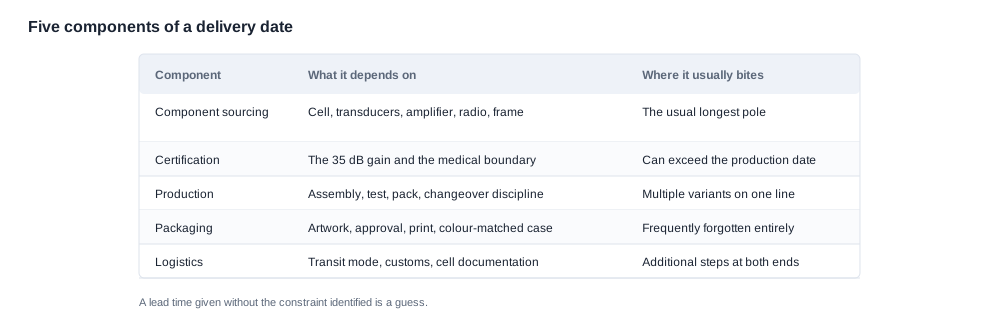
The five components are component sourcing, certification, production, packaging and logistics. A programme where every one of them runs in parallel takes as long as the slowest. A programme where they run in sequence takes the sum. Which of those two situations you are in determines whether the quoted production lead time matters at all, and it is very rarely discussed.
The only lead time worth planning against is a breakdown with the constraint named: which component is holding the programme, what it is waiting on, and what has to be frozen for the date to hold. Our published position is that production lead times are Not published on this site and are confirmed per enquiry, because a lead time depends on the configuration, the quantity, the certification position and the current schedule. So bone conduction glasses technology smart glasses lead time factors is best understood as the set of variables that actually determine the date.
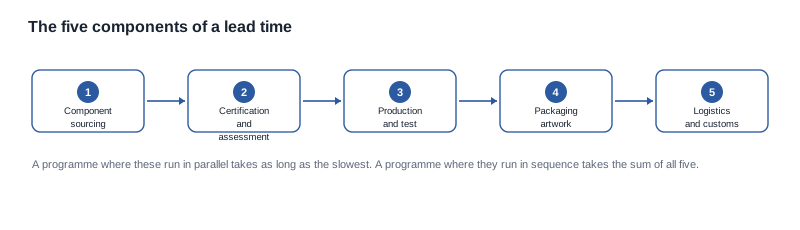
The buying task behind the date
A buyer asking about lead time in this category is usually in one of four situations, and each has a different date that actually matters.
A buyer with a fixed launch date is working backwards from a marketing commitment. Their risk is a schedule that looks fine and is not, and the useful thing they need is to know which component is the constraint, because only the constraint can be attacked.
A buyer with a fixed order quantity is working forwards from a budget. Their risk is a date that moves when the quantity changes, and the useful thing they need is the breakpoint — the quantity above which the lead time changes — because that is the number a negotiation with the factory turns on.
A buyer comparing two suppliers is trying to find out whether the difference between two dates is real. Their risk is comparing a date that assumes parallel work against a date that assumes sequential work, which is a comparison of two different schedules rather than of two factories.
A buyer who has already been burned is trying to establish what the supplier's schedule actually looks like. Their risk is a date that depends on a decision nobody has made, which is the failure mode this article spends the most time on.

Where the schedule is actually set
The five components, and what makes each one late
Component sourcing. The usual longest pole. For this category it includes the cell, the bone conduction transducers, the amplifier electronics, the radio module and the frame components. A 200 mAh cell with a 35 dB amplification gain is a different bill of materials from a 100 mAh Bluetooth audio model, and the amplifier is a component with its own sourcing cycle. The frame is the slowest part of this one, because a frame that has to hold a consistent contact pressure is a longer part to tool and to qualify than a housing.
Certification. In this category the specific factor is the medical boundary. Our catalogue entry for the bone conduction model publishes a 35 dB amplification gain, a 200 mAh battery, a charge time of two hours or less, roughly seven hours of runtime and Type-C charging. The certification status is not published to us. A 35 dB gain is at the level where the regulatory question becomes real, and the guidance that bone conduction products cannot be sold as over-the-counter hearing aids in the United States because the FDA definition in 21 CFR 800.30 covers air conduction devices is the kind of boundary that changes what you can write on a product page — and a boundary that is not settled cannot be scheduled around.
Production. The actual assembly, test and pack. In a range with cell configurations from 40 mAh up to 290 mAh and camera tiers at 8 MP and 13 MP, a line running several variants needs a changeover discipline, and changeover time is part of the lead time. For a single-platform bone conduction programme the changeover cost is low, which is one of the quieter advantages of a narrow range.
Packaging. Usually forgotten, occasionally the longest part of the whole schedule if the artwork has to be produced, approved and printed, and if a colour-matched case is involved. In this category the artwork also carries the compliance content, which adds a review cycle that a decorative artwork does not have.
Logistics. Transit time by mode, plus the customs and documentation steps at each end. A product with a lithium cell has additional documentation on both sides of the journey, and the transport file covers a specific cell, so a late cell substitution is also a late shipment.
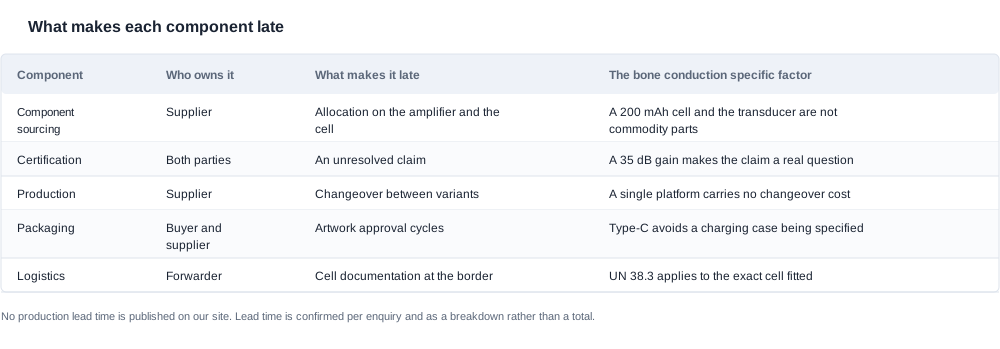
What the bone conduction tier adds to the schedule
Four factors in this category are specific to it, and each one is worth raising separately with a supplier because each one is a common place where a quoted date is optimistic.
The 35 dB figure is the schedule risk, not the specification. It is the most aggressive published parameter in our entire catalogue, and it comes with the highest compliance exposure in the same row. A buyer who treats 35 dB as a marketing differentiator without a regulatory position is creating a problem that will surface at listing review, and the fix costs schedule rather than money.
No model designation is published for this entry. That is a documentation problem with a schedule consequence: a product without a formal SKU is harder to put in a conformity file, harder to reference in a contract, and harder to trace in the field. The first thing to establish is the designation, and until it exists the certification component has no subject.
Type-C charging and a 200 mAh cell. Different from the magnetic-charged, dual-cell products elsewhere in the range, and it means the battery logistics and the transport documentation are specific to this configuration rather than generic.
The customisation capability is undisclosed. A private-label programme that needs a logo, a lens tint, a colourway and a retail package has to know whether those exist, because each one that has to be created is a new tool, a new artwork and a new qualification step, and none of them is in the quoted lead time.
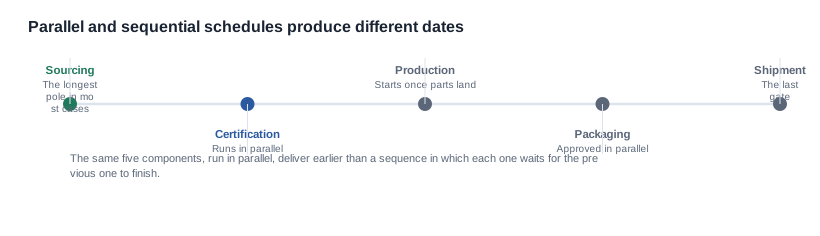
The tests that identify the constraint
Five questions that turn a lead time into a plan
Which of the five components is the constraint on this programme, and has it started? A lead time given without the constraint identified is a guess. This is the single most important question, and it is the one that is almost never asked, because it asks the supplier to describe their own schedule in a way that invites a considered answer rather than a number.
What is the date for the sample, the date for the first production run, and the date the goods can be listed and shipped? In many programmes the sample is faster because it is not waiting for the same documentation. The gap between the production date and the shippable date is the compliance work, and it is the number a buyer should be working backwards from.
What happens to the date if the quantity changes? The relationship between quantity and lead time is not linear, and the breakpoint is worth knowing precisely, because it is the number a negotiation turns on and the number a factory's own capacity planning turns on.
What has to be frozen, and by when, for the date to hold? A date that depends on an unfrozen decision is not a date. The decisions in this category are typically the claim, the destination markets, the model designation, the configuration, the packaging and the artwork approval, and each of them has a different owner.
Which decisions are still open on the day the quotation is issued? The honest answer is the most useful one a supplier can give, because it tells you which parts of the date are real.
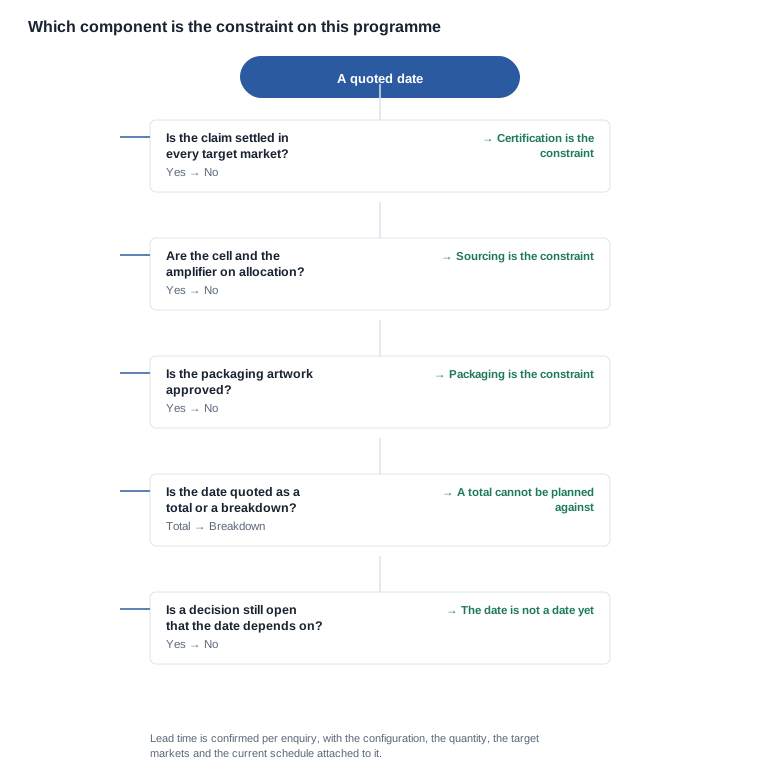
The thresholds that make a date usable
Four thresholds separate a usable date from a number on a quotation.
A named constraint with a current state. The constraint has to be identified and its current position stated — allocated, in production, in testing, in assessment. A date that does not include this is a forecast.
A frozen-decision list with dates. The date holds only against a set of decisions that are closed, and the list of decisions plus their dates is what makes the commitment meaningful. Without it, any change to the plan can be absorbed into the schedule, and the supplier is not wrong to do it.
A separate shippable date. The date on which the goods can lawfully be listed and shipped, as distinct from the date on which the units are packed. A buyer who plans a launch from the packed date has a gap in the plan, and in this category the gap is the compliance work.
A quantity breakpoint. The quantity above which the date changes, and the new date. It is a planning input rather than a commercial one, and it is usually the most useful thing a buyer can obtain from a factory in this category, because it is a fact about their capacity rather than an opinion about their intent.

Confirming a date, and where a date breaks
How to check a quoted date
The verification sequence for a lead time is short, and its purpose is to convert a total into a plan.
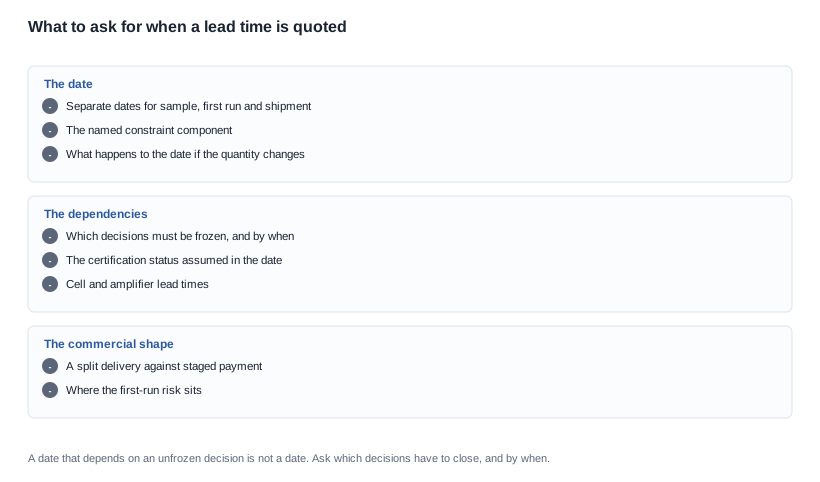
Ask for the breakdown, not the total. Five components, with the constraint named and the current state of that constraint stated. A supplier who answers with a total has told you the least useful version of the answer, and a supplier who answers with a breakdown has told you the useful one.
Ask for three dates rather than one. The sample date, the first production run date, and the shippable date. The differences between them are the programme, and they are the part a buyer has to plan around.
Ask what has to be frozen. The decisions, their owners and the dates by which they must close. The completion standard here is specific: a list, not a general assurance that things will be decided in time.
Ask about the quantity breakpoint. The quantity above which the date moves, and the new date. The completion standard is a number, and a number is either right or it is not.
Ask what the date assumes about the compliance position. Specifically, whether the date assumes a regulatory position that has been established, or one that is still being worked on. This is the question that separates a shippable date from a packed date.
Ask what happens if a component is late. The recovery plan, not the apology. In this category the most likely late component is the cell, and the recovery for it is not a faster courier; it is the fact that a cell change invalidates the transport documentation.
Where a date breaks
A date built on a decision that was never made. This is the most common break and the most expensive, because it does not fail loudly. The schedule absorbs the change, the date moves, and the launch date moves with it, and nobody can say why.
A date built on the packed date rather than the shippable date. The goods are finished and cannot be listed. The gap is the compliance work, and in this category it is also the artwork approval, which is a review cycle with a queue.
A date that assumes parallel work in a factory that runs sequentially. Two suppliers can quote honestly and still be describing different schedules, because one runs certification while the line is producing and the other waits for one to finish. The question to ask is which, and it is more useful to ask it in the form of "what is running in parallel at the time of our first run".
A date that includes a cell that may change. A cell substitution is usually a commercial decision taken late, and it invalidates the transport summary, which means it invalidates the shipment rather than merely delaying it.
A date for a configuration that does not exist yet. A private-label programme with a logo, a tint and a colourway that have not been confirmed as available inherits three additional lead times that nobody quoted, because nobody knew. This is the practical cost of the undisclosed customisation capability.
A date given as a range with no constraint. A range is a way of saying that the supplier does not yet know which component is the constraint. It is honest, and it is not a plan.

Terms, and a worked schedule negotiation
What the schedule does to the commercial terms
The schedule shape and the commercial terms are the same negotiation, and a buyer who treats them separately ends up paying for the schedule twice.
Fixed and not a negotiation target: the assessment cost and its lead time, the regulatory classification work, the acoustic hardware, tooling cost, which is usually amortised across a first order and should be asked about as a separate line rather than folded into the unit price, and the cost of a second qualification run of the same model.
Negotiable, and the leverage comes from the schedule rather than from the price: the staging of the first run into two deliveries against a staged payment, because that keeps the option open on the decisions that have not closed; the number of units taken at the pilot tier rather than the run tier, which is where the factory's exposure concentrates; the configuration itself, since a configuration that already exists is faster than one that has to be created; the packaging scope, because a simplified artwork is a shorter artwork cycle; and the scope of the conformity assessment.
Documents to request before a deposit: the lead time as a breakdown with the constraint named and its current state; the three dates; the frozen-decision list with owners and dates; the quantity breakpoint; the model designation table; the certificate register with numbers and validity dates; the battery transport documentation for the fitted cell; the packaging artwork proof; the agreed acceptance criteria for incoming inspection; and written confirmation that no claim in the listing copy characterises the product as a hearing aid or makes any claim about treating, preventing or improving hearing. Clause language is published at contract terms, and the commercial structure of a first order is published at pricing.
A worked schedule negotiation
Assume a brand owner has a launch date eight months out, a first order quantity set, and a supplier who has quoted a single lead time without a breakdown.
The first move is to ask for the breakdown, because a single number cannot be negotiated against and cannot be planned around. The answer comes back with the constraint identified as the assessment component, not the line, which reverses the buyer's assumption and saves a week of chasing a production date that was never the issue. The reason the assessment is the constraint is the same reason it is the risk: the 35 dB gain puts the regulatory question at the level where it has to be answered before the file can be assembled, and the model designation does not exist yet for the file to name.
The second move is to ask for the three dates. The gap between the production date and the shippable date is larger than the buyer expected, and it is made up of the assessment and the artwork approval. The artwork approval is the part the buyer controls, and moving it earlier — by freezing the claim and the markets at the start of the programme rather than after the design — buys several weeks. That is the highest-value action in the whole schedule, and it costs nothing.
The third move is to establish the frozen-decision list. Six decisions come out of it: the claim, the destination markets, the model designation, the configuration, the packaging and the artwork approval. Each gets an owner and a date. The list goes into the purchase order as a schedule annex, because a decision list that is not in the contract is a decision list that will be renegotiated under pressure, usually at the buyer's cost.
The fourth move is the quantity breakpoint, and the answer is that the date holds to a specific quantity and moves beyond it. That number is the one that a negotiation over the first-run size turns on, and it also tells the buyer where the factory's own capacity limit sits, which is a fact worth having even when the buyer is not near it.
The fifth move is the commercial structure, and it follows the schedule rather than preceding it. The order is staged: a first delivery against the pilot quantity and a staged payment, with the second delivery conditional on the gates closing, which is the only structure that matches a schedule with open decisions in it. The negotiation is therefore about risk allocation rather than about price, and the trade-off the buyer is making is a slightly higher unit cost in exchange for the ability to stop after the first delivery.
The sixth move is the paperwork, and the decisive item is the model designation. It gates the file, the label, the contract and the certificate, and the buyer should treat it as a condition of the schedule rather than as a task in it. A supplier who cannot produce one cannot produce a shippable date, and a supplier who can produce one has already done the hardest part of the identity work.
What we will and will not quote
Why no lead time is published on this site
We will not publish a lead time on this site, because a lead time quoted without the configuration, the quantity, the certification position and the current schedule is a number you cannot plan against. Lead time is confirmed per enquiry, and it is confirmed as a breakdown rather than a total.
We will also be direct about the medical boundary in this category, because it is the part most likely to cost a programme its launch date: a 35 dB amplification gain sits at the level where the regulatory position has to be settled before the listing copy is written, not after.
And we will be direct about the identity gap, because it is the part most likely to cost a programme its paperwork: no model designation is published for this entry, and a product without one cannot be named in a conformity file, referenced in a contract, or traced in the field.
Configuration, quantity and the launch date
If you tell us the configuration, the quantity, the target markets and the launch date you are working back from, we will tell you which component is the constraint and where the risk sits, which decisions have to be frozen and by when, and which published rows cover your configuration. The category is described under bone conduction audio, the delivery framework is set out at lead time and delivery, the compliance boundary is at medical device boundary, and the range is at bone conduction glasses.
Related reading
- Bone conduction audio technology
- Lead time and delivery
- Medical boundary compliance
- Bone conduction glasses range
Send the configuration, the quantity, the markets and the date you are working back from, and we will tell you which component is the constraint.


