

Bone conduction glasses technology: rows it leaves empty
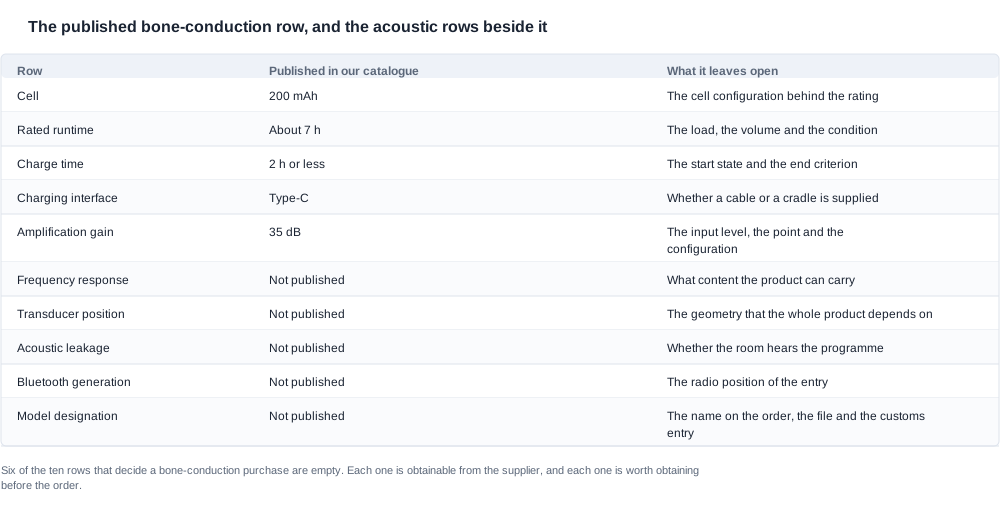
A bone-conduction spec sheet is unusually complete in the rows that do not matter and unusually empty in the rows that do. Ours is a good example of the pattern. The catalogue publishes a 200 mAh cell, a rated runtime of about seven hours, a charge time of two hours or less, Type-C charging, and an amplification gain of 35 dB. It does not publish the frequency response, the transducer position, the coupling method, the acoustic leakage into the room, the behaviour with the ear canal blocked, or the effect of hair, a helmet or a hood on the transmission path. Six rows that would let a buyer compare two bone-conduction products, and none of them is in the file.
That pattern is not an oversight in the catalogue; it is the shape of the category seen from outside. Bone conduction is sold on a mechanism — the transducer, the contact, the bone path — and the mechanism is what the seller understands. The buyer is asked to approve a product on the strength of a gain figure and a runtime, and the rows that decide whether the product works in the customer's environment are the rows nobody publishes.
The reason the omissions matter more here than in an open-ear product is that bone conduction has a specific set of dependencies, and each of them corresponds to a blank row. The transmission depends on a transducer sitting in the right place against the skull. The output depends on the coupling between the transducer and the head, which depends on the frame geometry and on whatever is between the transducer and the skin. The perceived output depends on whether the ear canal is open or blocked, because the ear canal changes the response in ways that are not intuitive. The room hears part of it too, because the structure radiates sound as well as transmitting it. And the same path that carries the programme to the listener also carries the listener's own voice back into the microphone, which is a problem for any product with a voice feature.
- Frequency response — what content the product can carry at all, and therefore what it may be sold as.
- Transducer position and coupling method — the geometry the whole design depends on, and the row that cannot be fixed late.
- Acoustic leakage into the room — whether the product is usable in a shared space or an open-plan floor.
- Behaviour with the ear canal blocked — the condition the customer will actually produce in a helmet or a hearing protector.
- The occlusion effect on the microphone — whether a voice feature works at all, or captures the operator's own voice.
- The model designation — the name on the order, on the file and at the customs entry.
None of this is exotic. It is a short list of dependencies, and each one has a corresponding measurement. The point of this article is that a buyer can specify the missing rows without a laboratory, can hold a supplier to them, and can tell in advance which of them will disqualify a product for a given application. The mechanism behind the technology is on the bone conduction audio page.
Where bone conduction wins, and where it does not
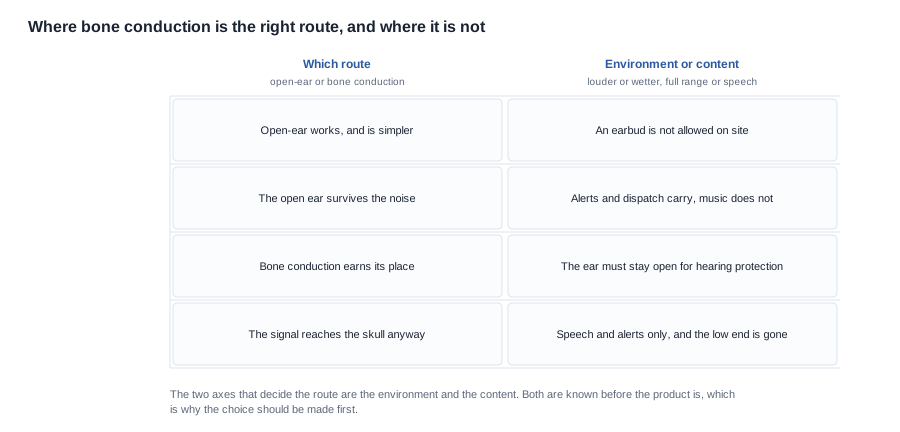
Bone conduction is a good answer to a narrow set of problems, and a poor answer to a wider set that it is frequently asked to solve. The case for it is that the listener hears the audio while the ear canal stays open, so the product can be used in an environment where an earbud or a headphone either cannot be worn or cannot be worn for long. It also works in a loud environment, because the environment does not have to be quiet for the signal to reach the skull. And the product can carry a microphone for voice capture without the same occlusion problem that an earbud creates.
The case against it is that the transmission path is short and lossy. The low-frequency end of the response is heavily attenuated, so the product cannot deliver a full-range music signal, and a buyer who is planning a product around "audio" rather than around voice or alerts is planning the wrong thing. The output level is also low by design, and the listener's own perception of it depends on a contact that depends on the head and on what is between the transducer and the skin.
The commercial consequence of all this is that a bone-conduction product is a narrower product than an open-ear product, even though the two are sold in the same channels with the same language. The two decisions that determine whether it is the right choice are the environment and the audio content. If the environment is loud, wet or unsuitable for an earbud, bone conduction is usually right. If the content is music rather than speech or alerts, it is usually wrong, and no amount of specification will change that.
How to read a bone-conduction claim without a laboratory
Every claim in this category needs to be converted into a condition, and the conversion is mechanical. The claim "35 dB amplification gain" converts into a gain figure with a stated input level, a stated measurement point, and a stated transducer configuration. A claim about how the product sits converts into a contact area and a contact pressure, with the effect of hair and a head covering stated. The claim "clear sound" converts into a frequency range and an intelligibility measure at a stated position.
The row that the gain figure actually leaves open is the measurement point, and it is the one that decides whether a comparison is possible. A gain measured at the transducer, a gain measured at a reference point on the head, and a gain measured as an acoustic output into a coupler are three different quantities that a supplier may each call a gain. A buyer comparing two products on a gain figure without establishing the measurement point is comparing two numbers that were produced by two different procedures, and the difference between them can be large enough to reverse the ranking.
The other structural gap is the absence of a model designation in our catalogue for this entry. That fact is not a curiosity; it decides the schedule, the artwork, the customs description and the conformity file, and it is the reason a buyer cannot write the exact product into a purchase order until the supplier issues one. The same applies to the Bluetooth generation, which our catalogue does not publish for this entry, and to any radio question at all.
The frequency response is the third gap and the one that most often decides the application, because it tells the buyer what the product can be sold as. A response that carries speech and alerts and rolls off below a certain frequency describes a voice and notification product. A response that extends into the low range describes an audio product, and that is a different product in a different channel with a different claim.
The frequency response gap
The frequency response of a bone-conduction transducer is shaped by the transducer itself, by the coupling to the head, by the geometry of the frame around the temple, and by whatever the head is in contact with. That last factor is the one that surprises buyers: the response is not a property of the product alone. A operator with a hood, a helmet, a winter hat, a collar, or a significant amount of hair in the transmission path will get a different response from the same unit. The product is therefore specified in a configuration, and the configuration has to be in the order.
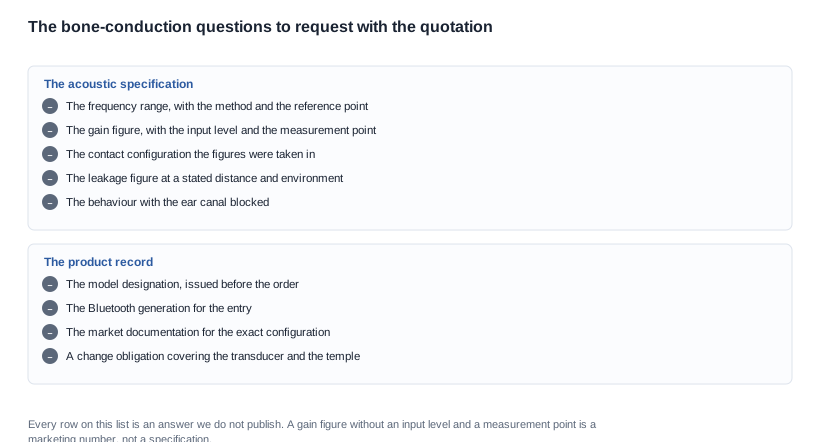
A buyer who asks for a frequency response should ask for four things with it: the range, the method, the reference point, and the contact configuration in which it was taken. A range without the method is a marketing figure. A range without the reference point cannot be compared with another supplier's. A range without the contact configuration describes a product that does not exist in the customer's environment.
The commercial value of getting this row right is large, because it decides what the product may be marketed as. A buyer who has specified the range can write a claim that matches the evidence, and the channel can sell it on the basis of what it actually does — voice, alerts, guidance — rather than on a generic audio promise that the product will not meet. A buyer who has not specified it will write the claim from the retail word, and the returns will follow.
The gain figure and the medical line
The catalogue publishes an amplification gain of 35 dB for the bone-conduction entry. It is a catalogue parameter and it belongs in a technical conversation, but a buyer needs to understand the line it sits near before it reaches a listing.
Devices positioned around a hearing-related benefit sit close to the boundary at which a product is treated as a medical device rather than as an audio product, and the consequences of crossing that boundary are substantial: the conformity assessment route changes, the marketing surveillance rules change, and the claims that may lawfully be made change with them. This is not a matter of wording. A listing that describes a hearing benefit rather than an audio function can be the thing that moves a product across that line, and the cost of moving it afterwards is a documentation and schedule problem rather than a copy problem.
We make no hearing, medical or health claim for any product in our range, and this article is not a route to one. The correct procedural advice to a buyer is simple: establish where the product sits before the artwork and the copy are written, not after a listing review rejects the claim. Asking the supplier for the conformity position of the exact model, and for the market routes it supports, is a normal part of a sourcing enquiry and it is a question a serious supplier will have an answer for.
There is a second, quieter version of the same issue. A 35 dB gain figure is meaningless without the input level it applies to, and a gain quoted without one invites a claim that the product cannot support. Ask for the input, the measurement point and the configuration, and the figure becomes a usable engineering parameter rather than a marketing number.

The measurement steps a buyer can demand
Bone conduction can be evaluated on a desk, with a written protocol and a repeatable procedure, and the buyer does not need an acoustic laboratory to do it. What the buyer cannot do is evaluate it without a protocol, because the perceived result varies with the head, the contact and the environment in ways that make an unstructured impression worthless.
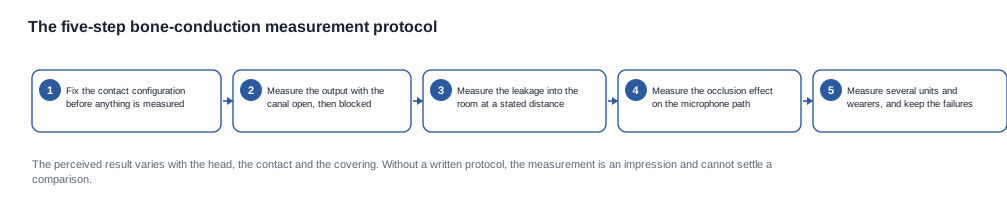
Step one: fix the contact configuration before anything is measured. The head covering, the temple position, the seating of the frame, and whether the ear canal is open or blocked are all part of the condition, and they are all recorded. Two measurements of the same unit in two configurations are two different products as far as the data is concerned.
Step two: measure the output at the ear with the canal open, and again with it blocked. The difference is large and it is the difference between a product that works in a noisy environment and one that does not. A buyer whose application involves an earplug, a helmet or a hearing protection has to know the blocked figure, and the blocked figure is not a correction to the open figure — it is a separate measurement.
Step three: measure the leakage into the room. The structure radiates, and the room hears part of the programme. The measurement is the same one an open-ear product needs, at a stated distance in a stated environment, and it decides whether the product is suitable for an open-plan space or a shared retail floor.
Step four: measure the occlusion effect on the microphone. With the canal blocked, the operator's own voice is carried to the microphone through the bone path, and it arrives louder than it otherwise would. This is the mechanism behind a specific and common failure: a voice feature that transcribes the user's own voice back to them, or that captures their own speech as noise on the call. A buyer with a voice feature should test it with the canal in the state the application will actually produce.
Step five: measure several units and several operators, and keep the failures. Contact quality varies with head geometry and with the tolerance of the assembly, and the units that sit badly are the units that come back. A measurement on one unit with one operator proves that the product can work; a spread across units and operators is what a warranty is priced on.
The bone-conduction failures that appear after launch
Four failures recur in this category, and each of them is an information failure rather than a transducer fault.
The claim promises a listening experience the product cannot deliver in the application. The symptom is a return cluster with a description that mentions sound quality or lack of bass. The root cause is that the claim was written from the retail word rather than from the measured range, and nobody established the application — a noisy site, a vehicle, a poolside, a call centre — against which the claim had to hold. The prevention is to fix the claim to the range and the environment, and to refuse a listing that promises more than the measurement supports.
The product works in the demonstration and fails with a hat, a hood or a helmet on. The symptom is returns that correlate with the season or with the shift pattern rather than with the product. The root cause is that the contact configuration was never part of the specification, so the product was only ever characterised in one. The prevention is to specify the configurations the product will actually be used in and to require the response for each.
The voice feature captures the operator's own voice. The symptom is a call in which the other party reports echo, or a transcription that repeats the user's own words. The root cause is the occlusion effect, which nobody tested because the test was run with the canal open. The prevention is to test the voice path in the blocked configuration and to write the behaviour into the acceptance criterion.
The documentation names a different product. How it shows up is a customs query, a platform rejection, or a warranty claim with nothing to point at. The root cause is that the entry has no model designation and the family-level documents were treated as coverage for a configured product. The prevention is to make the designation a condition of the purchase order and to check the string on the units on receipt.
A bone-conduction evaluation, from brief to order
The sequence below is a hypothetical case, included to show the order of the decisions rather than a result from a client engagement. Assume a brand buyer opening a bone-conduction line for an industrial safety supplier, where the product is issued to site staff who work outdoors, often in protective equipment, and where the audio use is alerts and radio dispatch rather than music.
Step one: the use is written down before any supplier is approached. The environment is a yard and a plant floor, the audio content is alerts and dispatch, the user is in a hard hat and hearing protection for part of the shift, and the voice feature is used for hands-free reporting. That description immediately makes the blocked-canal measurement essential and the low-frequency response irrelevant, which saves a round of questions.
Step two: the shortlist is cut on what the catalogue publishes. The buyer eliminates on the cell configuration against the shift, on the charging interface against the depot, and on the entries that carry an ingress marking, since the yard is the application. The bone-conduction entry survives on the published rows, and it survives with a question attached: the catalogue publishes no Bluetooth generation and no model designation for it, so both have to be requested before the programme can be scheduled.
Step three: the protocol is written before the sample. The contact configurations, the open and blocked measurements, the leakage measurement, the occlusion measurement on the voice path, and the number of units and operators. The buyer also states the pass rules, because a protocol without pass rules produces data rather than a decision.
Step four: the samples are measured in the configurations that matter. Open canal in the quiet room, blocked canal with a helmet, and the voice path with the canal blocked, because that is where the occlusion effect appears. The units that perform worst on the occlusion test are the ones that decide the voice feature's inclusion, and the buyer finds out before the copy is written rather than after the first complaint.
Step five: the order carries the conditions. The measurement configuration for every published acoustic figure, the pass rule for the voice path, the exact model designation, the market documentation for the exact configuration, and a change-control obligation covering the transducer and the temple geometry, since either of those invalidates the acoustic data.
The walk-through produced no recommendation between products. It produced a set of conditions, a shortlist cut on published rows, and an order that can be assessed rather than argued.
The commercial terms that suit a bone-conduction programme
The commercial structure of a bone-conduction programme differs from an open-ear one in three ways that a buyer should price separately. The variable layer is the unit price, and the transducer and its drive electronics sit at a higher share of the bill of materials than a small speaker does, so the gap between a bone-conduction quote and an open-ear quote is wider at low volume than the product descriptions suggest. The setup layer is where the acoustic development and the tooling sit, and the acoustic work is the expensive part of it: a transducer, a drive circuit, a coupling geometry and the development to make the coupling consistent across production units. The recurring layer is where a bone-conduction product has an accessory line that an open-ear product does not, because the contact depends on the seating and on the temple geometry, and the replaceable contact parts, together with the accessory kit that carries them, become part of the product.
A buyer comparing two bone-conduction proposals should work through a short checklist before comparing any prices: which acoustic rows are published with a method, which are published as a bare figure, which contact configuration the figures apply to, what the blocked-canal behaviour is, and whether the model designation has been issued. How to compare two quotations in this category is therefore a matter of reading the configurations and the methods side by side rather than the gain figures, and a shortlist built against those criteria is comparable between suppliers; a shortlist built on a gain figure is not. The trade-offs the buyer is actually making are explicit at that point — a wider response against a stronger contact, a lower gain against a safer claim, a developed transducer against a higher unit price at low volume. And the red flags are short: a gain figure with no input level, a response quoted without a configuration, and a conformity position nobody has confirmed.
Before you order, a bone-conduction due-diligence pass is short enough to do in an afternoon: read the acoustic rows line by line, mark the ones where the supplier answered with a description rather than a measurement, and treat each of them as an open item in the order rather than as a gap to be closed later. The total cost of the programme then includes the acoustic development and the revalidation for those rows, and a buyer who has counted that work holds a comparable total cost rather than a comparable unit price.
Four terms are worth asking for explicitly. The first is a written acoustic specification attached to the order, with the configuration and the method, so that a lot that fails it is a lot the buyer can refuse. The second is the model designation, and the market documentation that follows from it, as a condition of the order rather than as an administrative item. The third is a change-control obligation naming the transducer, the drive electronics and the temple geometry, because a change to any of them invalidates the acoustic data and the claim. The fourth is a statement of the contact configuration the published figures apply to, so that the technical file and the customer's experience describe the same product.
One cost is fixed in a way that is worth naming early. The conformity work for a product with a radio runs through the Radio Equipment Directive (EU) 2014/53/EU — the radio equipment directive, not the EMC directive, which is a separate instrument with a different scope — and the battery transport documentation under UN 38.3 is a per-cell and per-product task with a laboratory queue attached to it. Neither shortens because the order is large, and the useful question is whether the documents cover the exact model, the exact configuration and the exact markets the buyer is shipping into. For a product whose entry has no model designation at all, that question is the first one to ask, because the answer determines the schedule before anything else does.
The electrical row, and the frequency response we omit
We publish the electrical row for the bone-conduction entry: a 200 mAh cell, a rated runtime of about seven hours, Type-C charging, a charge time of two hours or less, and the 35 dB amplification gain figure. We do not publish the frequency response, the transducer type or position, the coupling method, the contact pressure, the leakage into the room, the blocked-canal behaviour, the occlusion effect on the microphone, the Bluetooth generation, a model designation, or a frame weight. We do not hold verified figures for those rows and we would rather leave them empty than publish a number a buyer's own measurement would contradict.
We also do not publish a weight for this entry, and we will not borrow the weight from another model in the range. The single weight our catalogue states belongs to a different product in a different family, and reusing it would be a factual error rather than a helpful approximation.
What we will do is walk a buyer through the published rows, confirm which configurations exist, and state plainly where a requirement in the brief is one we cannot answer from the catalogue. If the requirement is acoustic, the productive next step is to write it as a configuration, a method and a pass rule, and to put it to a supplier who is willing to be measured against it. That is the only version of a bone-conduction specification that survives contact with a customer's environment, and the bone conduction audio page is where the mechanism behind these questions is set out in more detail.


