

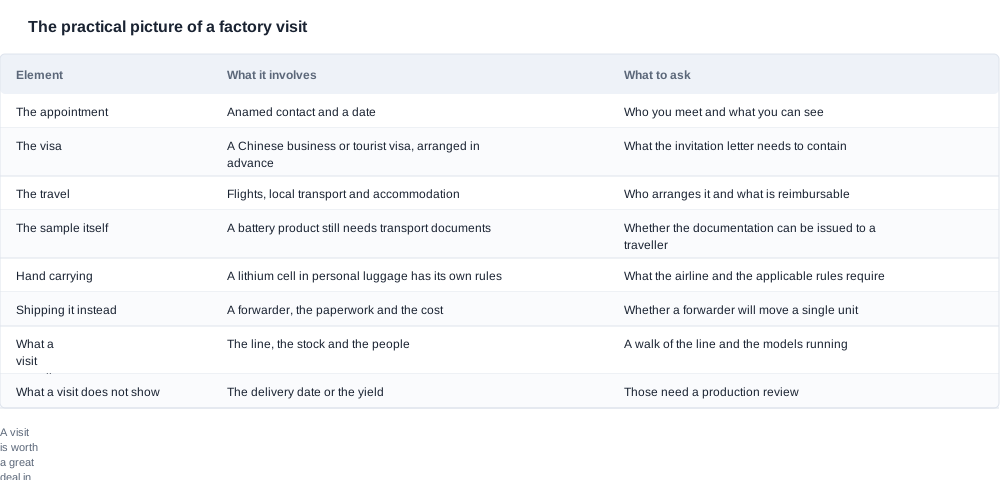
Yes to the visit, and it is worth more in this category than it is in most, because the thing a buyer is really trying to establish is whether the supplier is a factory rather than a trading company, and that is much easier to see in thirty minutes on a floor than to establish from a document. The sample is the part where the practicality is more complicated, because a smart glasses sample is a battery consignment and hand-carrying one across a border is not simpler than shipping it. This article sets out what each half involves and why they are usually worth separating.
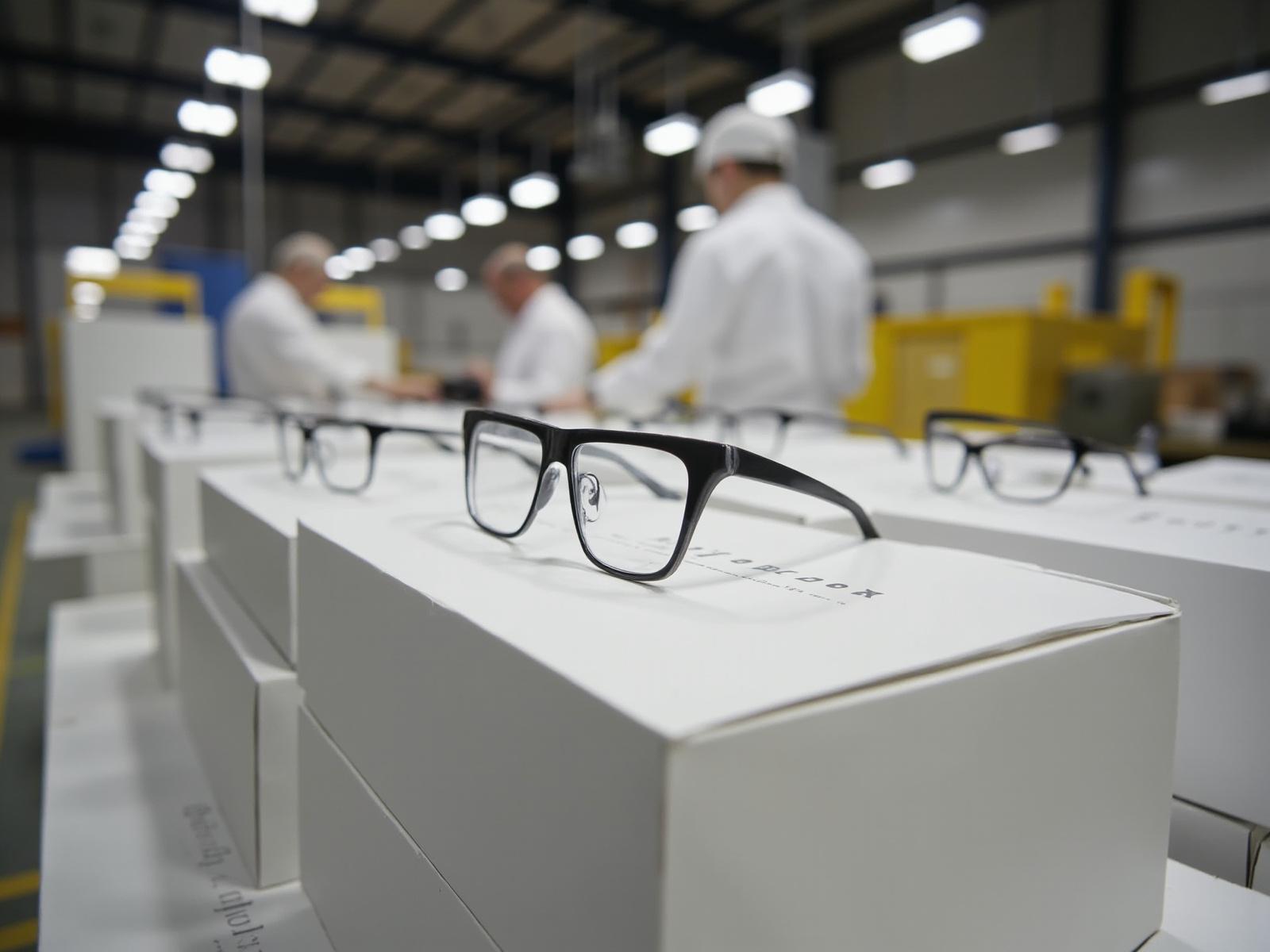
There is one more reason to pick samples up in person rather than having them couriered, and it is the reason experienced buyers do it. A couriered sample arrives on its own, one model at a time, from a production window you know nothing about. A sample you collect in Shenzhen can be two or three models pulled from the shelf on the same morning, weighed on the spot against your own scales, compared side by side against each other, and — this is the part that matters — used to build a golden sample for incoming inspection that you know was produced from the same batch. That advantage does not survive the flight home in your hand luggage.
Can I visit the factory and pick up the sample myself: two different problems
The question bundles two decisions that have different answers, different costs and different failure modes, and separating them is the first thing worth doing.
The visit is a question about information. Can you get to the factory, can you see the production floor, and can you get useful answers to questions that documents cannot answer? The answer to that is generally yes, subject to a visa and to scheduling, and the value is high when the purchase is large or the supplier is unfamiliar.
The pickup is a question about transport. Can you physically take a battery-powered sample home in your luggage? The answer is that you can try, but it adds a regulatory risk that the freight forwarder would otherwise absorb, and the risk lands on you at the airport rather than on a professional who does it every week.
The two decisions also have different economics. The visit has a cost that is largely fixed — the flights, the visa, the time — and it does not scale with the number of models you want to evaluate. The sample transport has a cost per consignment. So if you are visiting anyway, collecting several samples in person is the cheaper way to get them, and if you are not visiting, shipping a couple of samples is usually cheaper than flying. The pairing that makes sense is almost always: visit once, evaluate several models in person, ship the samples you keep afterwards so they reach you with the paperwork already handled.
There is a third question hiding inside the one you asked, and it is worth separating out before you write to a supplier. Are you visiting to look at the business, or are you visiting to collect evidence for a specific decision? A buyer who is still comparing suppliers is better served by a video walk-through and a sample programme, because the trip only pays for itself when there is a live order to place. A buyer with a shortlist of one or two models, a real volume and a real budget gets much more out of two days on site, and those are the two days that can close a lot of rows at once.

What the visit settles, and can I rely on it for the schedule
A factory visit answers the questions that a specification sheet cannot, and it is worth being precise about which questions those are.
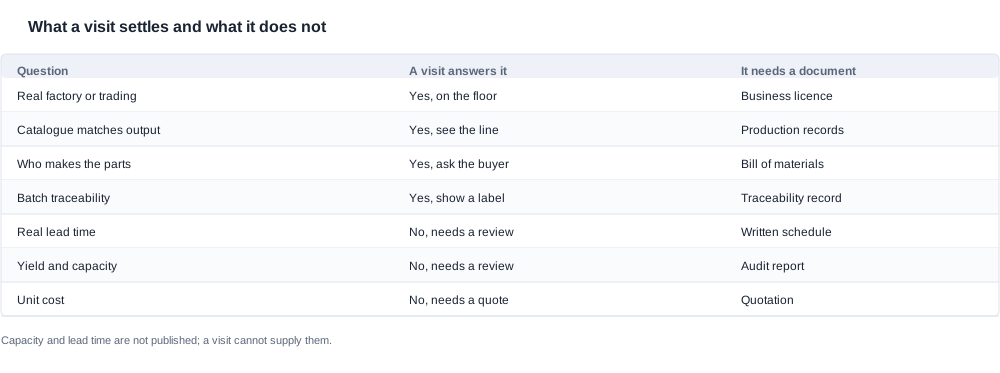
Whether there is a line running. Whether the models in the catalogue are the models on the floor. Whether the people you are dealing with can answer a question about a component without going to find somebody. Whether the stock in the room matches the stock in the system. Whether the sample you were sent came from a real production run.
The last of those is the one people are usually looking for, and it is worth dwelling on. A factory that assembles from parts it buys in and does not build them is a perfectly legitimate business, and it is also a different proposition from one that builds them. The difference shows up in three places: the price, because a bought-in component carries someone else's margin and someone else's lead time; the lead time, because an assembly factory is at the mercy of two upstream schedules rather than one; and the amount of your design that the supplier can change, because a factory that makes the part can change it.
The second thing a visit settles is the bill of materials question, in a way that a document cannot. The catalogue publishes a lot of the answer already and not all of it: charging is magnetic on seventeen models and Type-C on seven, and the method is not published for the MT6 and the L1 Pro, and the CY03 and the CY05; twenty-six models publish a charge time of two hours or less while the D17 and the ZH12 publish about one hour; the camera models run on cells in the region of 220 to 290 mAh with a rated runtime of roughly five to eight hours and no test condition published. On site you can hold the actual unit and see how the charging dock is presented, how the case is packed, and how a service engineer would actually reach the port. That is worth more than the parameter.
The third thing a visit settles is traceability, and traceability is the thing a compliance file is built on. The question to ask is simple — how do you identify which batch a unit came from — and the answer is usually immediate when you are standing next to someone who does it daily, and usually vague when you are reading a policy document. A factory with a batch label, a work order reference and a date code on the carton can give you a traceability story. A factory without one cannot, and a branded programme that depends on traceability is going to hit that wall at some point.
What a visit does not settle is equally important. It does not give you a delivery date, a yield figure or a production capacity, because all three come from a production review rather than a walk. A buyer who leaves a visit believing they now know the schedule is going to be disappointed, and a buyer who uses a visit as the substitute for a written production plan is going to discover the difference at the worst possible moment. Capacity is not published in our catalogue, lead time is not published, and a factory that quotes a schedule from a visit rather than from a review is quoting a guess.
The sample, and can I carry it in my bag instead of shipping it
This is where the battery complicates things, and the complication is worth understanding rather than working around.
A sample is still a consignment. Every model in this range is a rechargeable, battery-powered product, and the transport rules for batteries apply to a single sample exactly as they apply to a thousand units. That means the shipping paperwork, the classification and the carrier's requirements are in play for one unit, and the forwarder handles them as part of the job.
Carrying a cell in personal luggage has its own rules, and they are airline rules as well as national ones. A cell carried in hand luggage is treated differently from the same cell in checked baggage, and a spare battery is treated differently again. Anyone planning to carry a sample should ask the airline in writing rather than assume, and should know that a battery that does not satisfy the carrier's conditions can be refused at the gate, with the trip and the evaluation both lost.
Shipping a single unit is usually simpler and always more predictable. A forwarder will move one sample; the documentation is the same documentation the commercial order will need, which means shipping the sample is also a dry run for the paperwork of the order; and the risk of a refusal sits with a professional rather than with you at a gate.
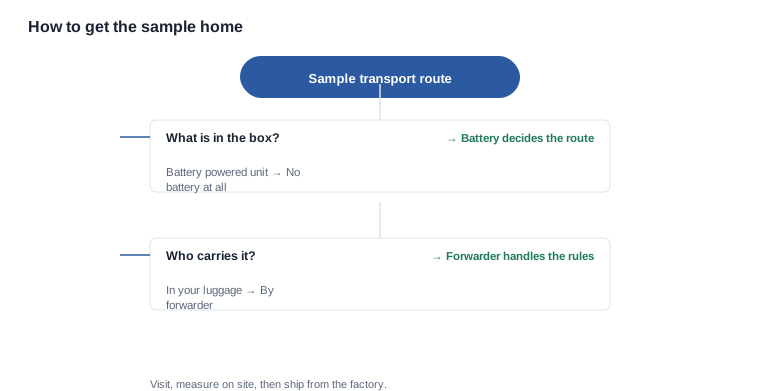
The practical recommendation is to visit and then ship. If you are already on site, take the sample with you as a personal item for the duration of the visit, use it for the measurements you came to make, and then ship it from the factory. That gets you the in-person comparison advantage without the airport risk, and it puts the transport paperwork in the hands of the people who do it every week.
There is one more consideration specific to the way this category is bought, and it is about what you pick up rather than how you transport it. A sample that you collect in person can be held alongside other samples from the same factory on the same morning. That is the point at which the catalogue's gaps become obvious: whether the frame weight of the model in your hand matches the weight you expected, whether the charging method is the one you assumed, whether the colourway is the one in the listing, whether the case is present when the catalogue says it should be. Our catalogue publishes a frame weight for exactly one model, the MT6 at 158 g for the glasses alone excluding its foldable 1200 mAh case, and it publishes the resolution tier, the colour list and the photochromic option per model — so the numbers you can check against the physical unit are limited, but the physical characteristics you can check against your own expectations are not.
A buyer who collects samples in person can therefore generate their own specification for the models nobody publishes numbers for, and can do it with a scale and a tape measure in a hotel room. That document is not a substitute for the supplier's own figures, but it is a defensible observation, and it is exactly the kind of evidence a listing can carry when the catalogue is silent.
There is a further advantage to collecting in person that only applies to the models nobody publishes numbers for, and it is about the physical samples rather than the specification. A unit that you have taken off a shelf yourself, that you have weighed, that you have compared against another unit from a different model, and that you have watched being packed, is a unit you can use as a reference for the rest of the programme. When the production order arrives and the units are not quite the same, you will know within a minute whether the difference is a production variation or a different configuration altogether. That judgement is only available to a buyer who has handled a reference unit, and it is the difference between a dispute and a conversation.
The same reference unit also disciplines the endurance testing. A camera model's rated runtime is published at roughly five to eight hours with no test condition attached, so the only way to know what a shooting day feels like is to run one. Start that run with a unit whose build you know, keep it as the reference for every later unit, and the numbers you publish are comparable across the programme rather than being a series of unrelated observations.
The preparation, and can I get real value out of two days on site
Two days on site is enough to settle most of what matters, but only if the time is planned. A visit without preparation produces a tour and a set of impressions, and impressions are worth much less than a signed specification.
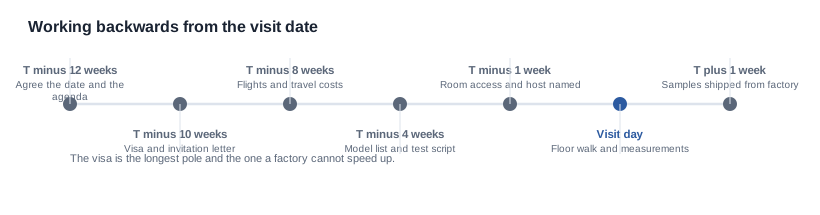
The planning sequence runs backwards from the date, and the visa is the longest pole in it because it is the one item a factory cannot accelerate.
- Eight to twelve weeks out: agree the date, the agenda and the models to be evaluated. Ask for the agenda in writing before you travel, and check that it includes the production floor rather than a meeting room. Ask who your host will be and who else will be in the room, because a visit with a sales manager and no engineering presence is a different visit.
- Eight to ten weeks out: the visa and the invitation material. This is the longest item in the sequence and it is the one that decides whether the date is achievable.
- Six weeks out: flights, accommodation and the travel cost question. Which costs the supplier picks up should be settled plainly before anybody travels, and it is entirely reasonable for a supplier to cover the cost of a serious evaluation visit and entirely unreasonable to expect it to cover a holiday. Saying so at the start is what keeps the end of the visit civil.
- Two to four weeks out: the model list, the test script and the question list. Decide which models you will collect on the day, and be explicit that you want more than one so that you can compare them side by side.
- On the day: the floor, the questions, the measurements, the photographs of the work orders, and the samples.
- Within a week of the visit: the samples shipped from the factory, the specification document written up, and the open rows turned into a written request to the supplier.
The preparation that most improves the visit is the test script. Bring the acceptance criteria you intend to apply, because watching the thing being built while you have those criteria in your head is where the value is. A buyer with a script can watch an assembly operation and see immediately whether the operation matches the drawing. A buyer without one watches a tour.
Two practical details about the script are worth sorting before you travel. The first is that the acceptance criteria should be written as measurements wherever possible, because a measurement is reusable and an impression is not. Weight in grams, temple length in millimetres, charge time in minutes, runtime in hours, and the observed behaviour of the pairing, the buttons and the audio are the criteria that survive a second visit and a second production run. The second is that the script should be shared in advance, not sprung on the day. A factory that has seen the criteria can prepare for them and can tell you in advance which ones it will fail, and that conversation is worth more than the result of the test.
One item deserves its own line in the preparation because it is easy to forget and impossible to do on site: decide before you travel what you are going to do with the samples once they arrive. Whether they will be endurance-tested, weighed against the golden unit, compared against the alternative supplier's sample on the same afternoon, or held for a later regression test after the first production order arrives. A sample that arrives and sits in a box for four weeks generates no information and costs shelf space in the buyer's office.
Six questions to carry on the floor, in the order that produces the most information:
- Which models are in production right now, and on which line?
- Which components do you buy in, and which do you make?
- How do you identify which batch a unit came from?
- What is the smallest order you have run on each model?
- When a cell arrives late, what happens to the schedule?
- What happens to a customer who wants a change after the design is frozen?
That last one is worth asking carefully. The answer describes how much of your programme the supplier is willing to absorb after the design freeze, and it is one of the clearest indicators of whether you are dealing with a partner or a vendor.
The commercial side, and can I negotiate the visit and the sample together
None of this is published — not the sample fee, not whether it is credited against an order, not the visit cost policy, not the reimbursement rules, not the shipping cost of a sample, not the price, not the minimum order quantity, not the lead time, not the warranty. These are terms agreed per enquiry, and the right way to get them is to ask in one message with all the details attached rather than in a sequence of emails that each ask a smaller question.
What is worth putting on the table for that conversation, in rough order of how much it matters:
- The sample fee and its treatment. Whether it is refundable or creditable against a first order, and at what volume. A written statement that it is credited removes the main reason a cautious buyer hesitates over a sample programme, and it costs the supplier very little because a sample that is not evaluated is not a sale.
- Whether the visit costs are shared, and how. Flights and accommodation for one or two people, against a stated order value. Suppliers vary widely on this and it is easier to agree before travel than after.
- Sample shipping. Whether the factory ships to you or uses your forwarder, who pays the freight, and whether the cost is credited if the order follows.
- The models to be evaluated. Getting more than one model into the sample programme is cheap for the supplier and it is what makes the comparison useful, so it is worth asking for two or three rather than one.
- Delivery terms and the shipping split. Ask for both a delivered-duty-paid and a freight-on-board quotation, and ask what the landed cost per unit is if the order arrives in two deliveries, because a split delivery in this category is a realistic scenario rather than an edge case.
- Payment nodes against inspection. Inspecting against the sample you collected before the balance falls due is a commercial term and not an operational favour, and in this category it is the only inspection that would catch a mismatch between the units on the floor and the units in the carton.
- A written schedule with a lead time, because a visit cannot substitute for one and the buyer will need it either way.
Two costs are not the negotiator's to move. Certification cost and its lead time follow the process and the testing body. Tooling is usually amortised across the first order while certification cost sits per product family, and the two are frequently bundled into a single figure that hides which is which — ask which one a quoted line represents. In a visit, this is the moment to ask, because you can ask it face to face and get an answer with a diagram.
The certification checklist is the document set to work from during the visit, and it is worth bringing as printed pages rather than as a link on a phone, because the conversation about what documentation exists is much more productive when the list is in front of both parties. On our side the honest position is that there is no per-model certification row to show you, and the export-certification page carries ten patent certificate images — eight design patents and two utility models — which are rights over design and construction rather than conformity evidence. Both of those things are better said in a meeting room than discovered in an audit.
The sample request itself, and the commercial terms that go with it, are handled through the sample request page and the quotation request page. Send the models, the questions and the date you are considering in one message, and we will agree the agenda, provide the invitation material our side needs to provide, and make sure the visit is a working session rather than a tour. We do not publish a visit policy or a reimbursement policy, because those are terms agreed per enquiry and a published figure would apply to only some cases.
Related reading
- The sample request and what to include — one model or a mix
- The shipping side of a sample — shipping for samples
- The payment and the commercial terms — paying the sample fee
- The document set a buyer should ask to see — certification checklist
Send the models, the questions and the date you are considering, and we will agree the agenda and provide the invitation material.


